Anthropic's S-1 Lands Alongside a Reported AI-Agent Breach of Its Internal Slack
@gregisenberg's readout of Anthropic's S-1 put extraordinary numbers in circulation ($6.6M revenue per employee, roughly 900% net revenue retention) on the same day @lizzadwoskin reported that ex-DOGE researchers used AI agents to reach Anthropic's most sensitive Slack channels in under 12 hours. Elsewhere, @0xkydo published reproduction data challenging Cohere's Qwen warning, while practitioners traded playbooks for running agents as production infrastructure.
Quick Hits
- @gregisenberg's takeaway thread on Anthropic's S-1 (quoting @AnthropicAI's filing announcement) claims $6.6M revenue per employee, ~900% net revenue retention as of Sep 30 2026, and a jump from $41M annual revenue three years ago to $16.3B in the first half of 2026. All figures are his reading of the filing, not verified here.
- @lizzadwoskin reports that ex-DOGE cyber researchers penetrated Anthropic's systems with AI agents in under 12 hours, including Slack channels where sensitive models are discussed; @ssankar calls it "an undeclared emergency" and urges building a "post-AI secure bastion."
- @ivanfioravanti boosts @0xkydo's data-backed rebuttal of Cohere's claims about Qwen 3.8 Flash, including evidence that the flagged behaviors also show up in NVIDIA's and Cohere's own models.
- @ashtom announced Entire, a Git forge built for agent-human collaboration, which he says was used to build @GoEntire itself.
- Patch watch: @TheHackersNews says Tailscale confirmed the Tailworm SSH flaws are real (fix promised within 24 hours, mitigate now with TS_SSH_DISABLE_FORWARDING=1), and @shcallaway surfaced cve.now's alert on a Fortinet FortiSandbox authentication bypass scored CVSS 9.6.
Anthropic's IPO math lands beside an agent-speed breach claim
The loudest pairing of the day came from one company. @gregisenberg walked through the S-1 that @AnthropicAI says has been filed with the SEC: besides the headline numbers, he flagged ~48% of revenue coming through cloud marketplaces ("get listed where your buyers already spend"), a published run-rate formula (last 28 days of usage times 13, plus subscriptions times 12), and Cowork apparently merging into claude.au, which he reads as the chat-box era giving way to the "go do the work for me" era. He also predicts a wave of liquid employee money flooding into AI startups, "way bigger" than Facebook's IPO moment. Notably, he points out the filing itself describes the gap between what Claude can do and how widely it's used as a major growth opportunity.
Hours earlier, @lizzadwoskin posted her exclusive: a group of ex-DOGE cyber researchers used AI agents to penetrate Anthropic's systems in under 12 hours, reaching Slack channels where the most sensitive models are discussed, weeks after whistleblower Joseph Coxon accused the company of "a hubristic gamble." @ssankar's response is worth reading as a position, not a news report: agent-speed offense has outrun static defenses, so move the crown jewels into hardened infrastructure and rebuild deterrence with builders who can "operate at machine speed." The tension in the posts is hard to miss: record unit economics at the very moment someone demonstrated the perimeter problem.
Cohere's Qwen warning meets a reproduction attempt, not a pass
@ivanfioravanti calls @0xkydo's long thread a "masterpiece" clarifying a Cohere article he pans. The substance: the "probe file" Cohere flagged contained the fixed test string PROBE_PAYLOAD_ABC123, the machine "inventory" was a /tmp listing, a curl check, and a DNS read during a cybersecurity task, and the behavior occurs in fewer than 1 in 100,000 evaluation calls. On the cloud metadata address framing, @0xkydo reports that NVIDIA's Nemotron 3.5 Super VL produced 169.254.169.254 in 171 of 1,000 continuations, and that Cohere's own North Mini Code generated defanged URLs like evil.com/api/health. He also notes the code-security section leans on Qwen3-Coder, a July 2025 model ("Have you tried using Sonnet 2 to write production code?"). He rented GPUs, ran 1,000 continuations per model across five models, and published a scannable results site, arguing that fearmongering here could be used to justify restrictions on open-weight models. On the same fault line, @ClementDelangue amplified @samhlogan's claim that access to open-source cyber models is a 2nd Amendment right, a very different register of the same argument.
The agentic-org ladder: step-one companies shopping for step-seven tech
The day's bookmarked post points at @mardehaym's seven-step ladder from tool adoption to agentic org, which @alex_prompter calls required following for anyone in the implementation trenches. The steps run from tool adoption and a per-department context layer, through harness engineering ("The LLM comes in last"; "If changing the LLM breaks your system, you built a dependency, not a platform"), to going headless, governance ("Dead agents are tech debt with active API keys"; retire anything idle 90 days), agent-to-agent handoffs with an LLM quality gate, and finally orchestrated step functions where agents handle volume and humans handle exceptions. His diagnosis: "Most companies sit on step one, shopping for step seven technology." He told a VP of Engineering that a hundred-plus tools means step four is closer than he thinks.
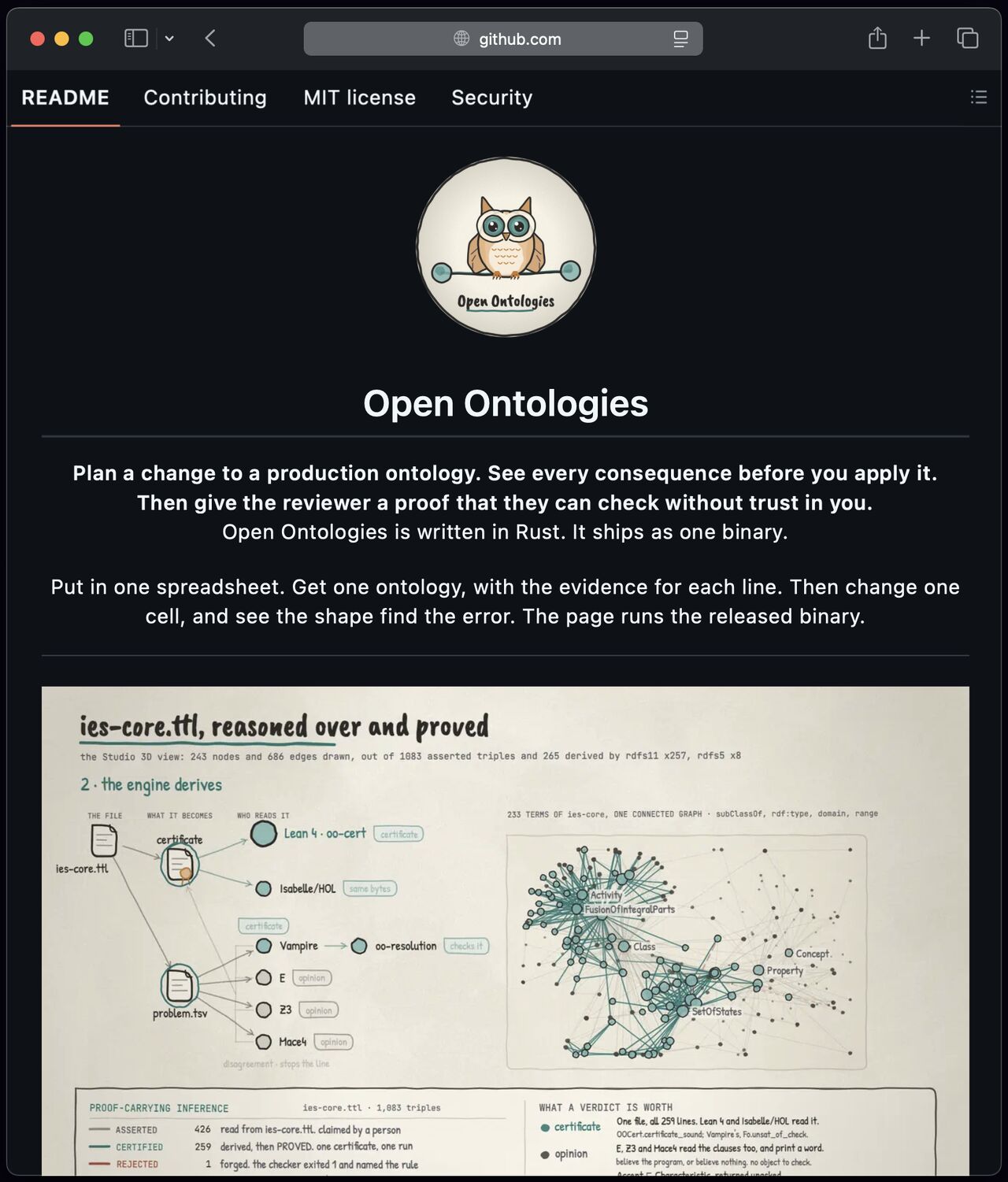
@caspar_br supplies evidence for the later steps: over 70% of MDA runs are now triggered by crons rather than chat, matching a prediction they made a year ago, and he cites @hwchase17's thread on the five components of a "company harness." @_ar9av argues that with frontier models commoditized, memory is the moat. And @techNmak profiles Fabio Rovai's open-source Open Ontologies as tooling for exactly this problem: a Rust engine that applies Terraform-style change management to knowledge graphs. In its demo, a change with zero affected triples and a low risk score still yields 901 additional reasoned consequences, and a Lean 4 checker independently verifies derivation certificates, rejecting a deliberately forged conclusion. The point stands on its own: a Git diff can't tell you what your change newly makes true.
Agents in production: dashboards, factories, and a spare iPhone
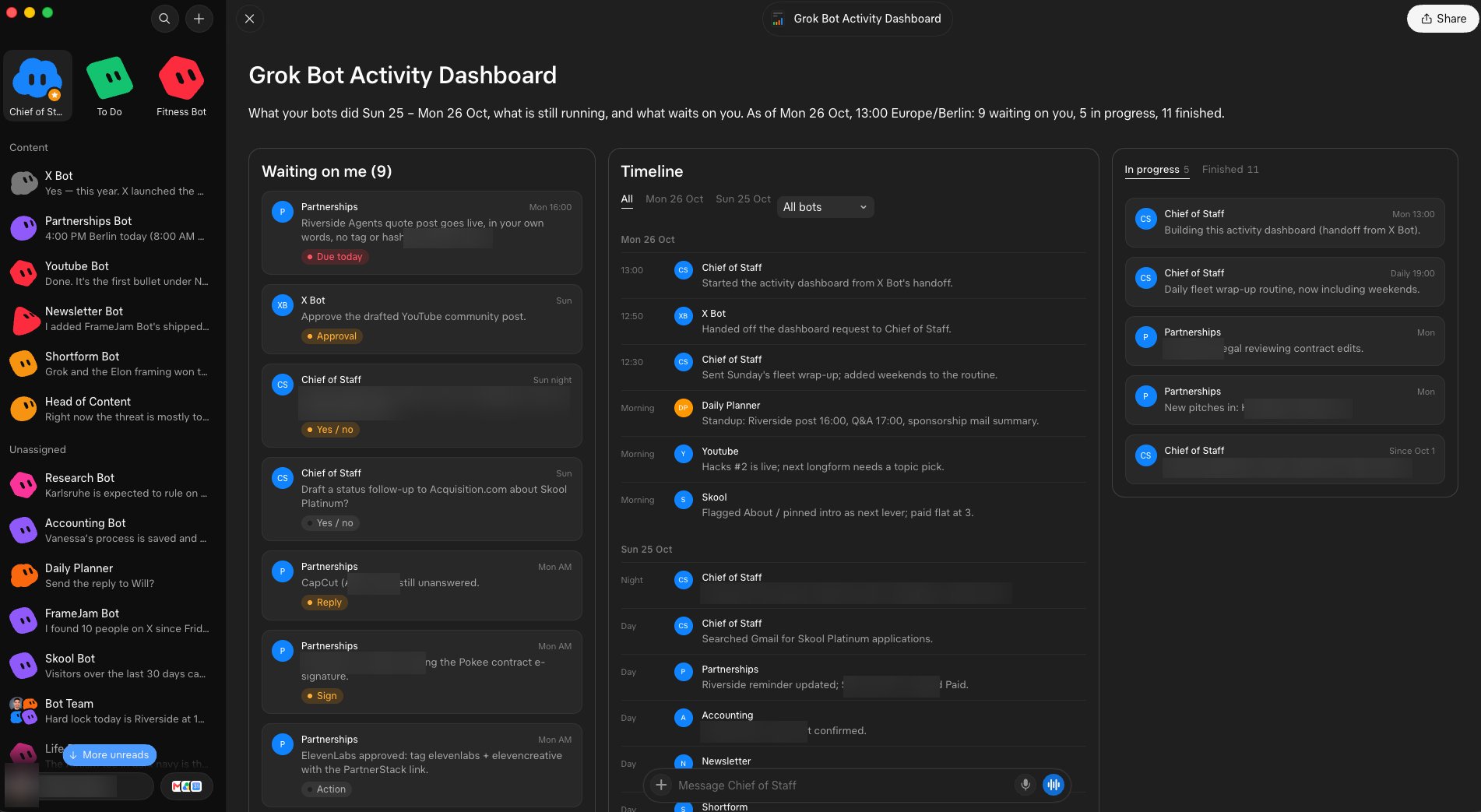
The ops posts cluster around one admission: agents now outrun human attention. @moritzkremb built a command-center dashboard after losing track of what his grok bots had done. @anur7ag recommends a "software factory" guide (quoting @GillTanveer89) precisely because it documents what actually broke, naming the risk "comprehension debt." @posthog's Scouts go after engineering jobs too repetitive to prompt by hand but too fuzzy to script, and @kunchenguid offers a three-prompt recipe for self-improving software: plan replayable logging, run a daily log-analysis loop, and watch the code get better.
On craft, @Mappletons says agents are prompted correctly when they present interfaces at "the grammar, noun, and verb level," which @rjs connects to pattern languages where "sentences" are implementable compositions. @nateberkopec's Claude-suggested Agents.md addition gives him a TLDR each turn instead of a wall of text. @typesafeai's Jev pitch (via @EvanFenster on data pipelines) rides the same "put intelligence in the right spot" theme.
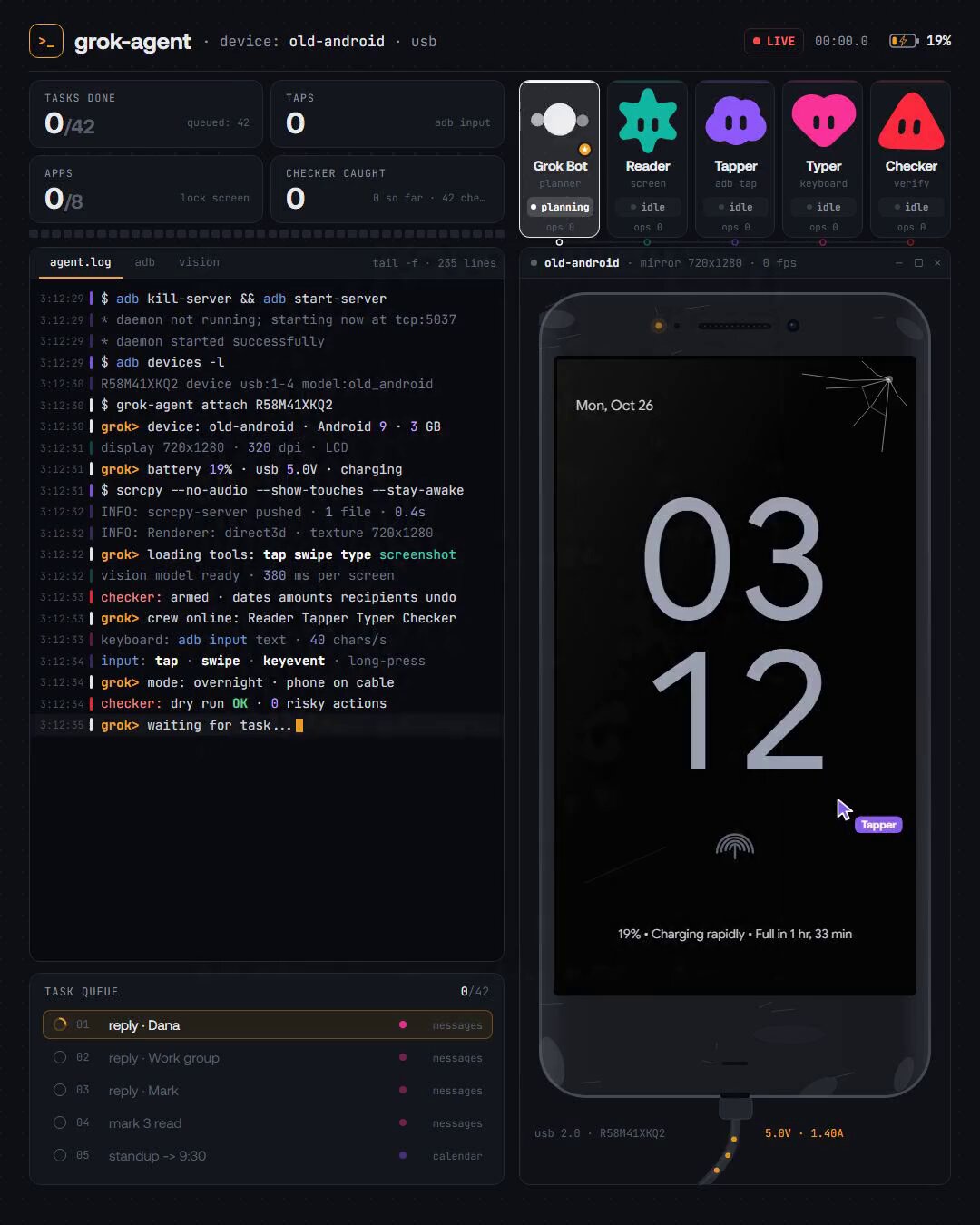
Then there are the hands. @__morse ships ghosthand, which lets an agent see a USB-tethered iPhone screen and tap, swipe, and type over Bluetooth, so it can drive apps with no API. @alucardiox repurposes an old Android as a grok-bot desk (screen reader, tapper, typer, checker), reporting 42 tasks completed during a single charge cycle, with the checker catching a wrong date before send; the quoted @savipww "$100 into $75,796" thread is the hype worth discounting. @ashtom's argument is that agents reinvented code production and the other half of the workflow needs to catch up, hence Entire. And @elonmusk RT'd @LunarResearcher's claim that spacexai shipped a free spam killer inside Grok Bot, which is unverified beyond the retweet.
Mood watch: "software is dead" versus a record 4,858-PR release
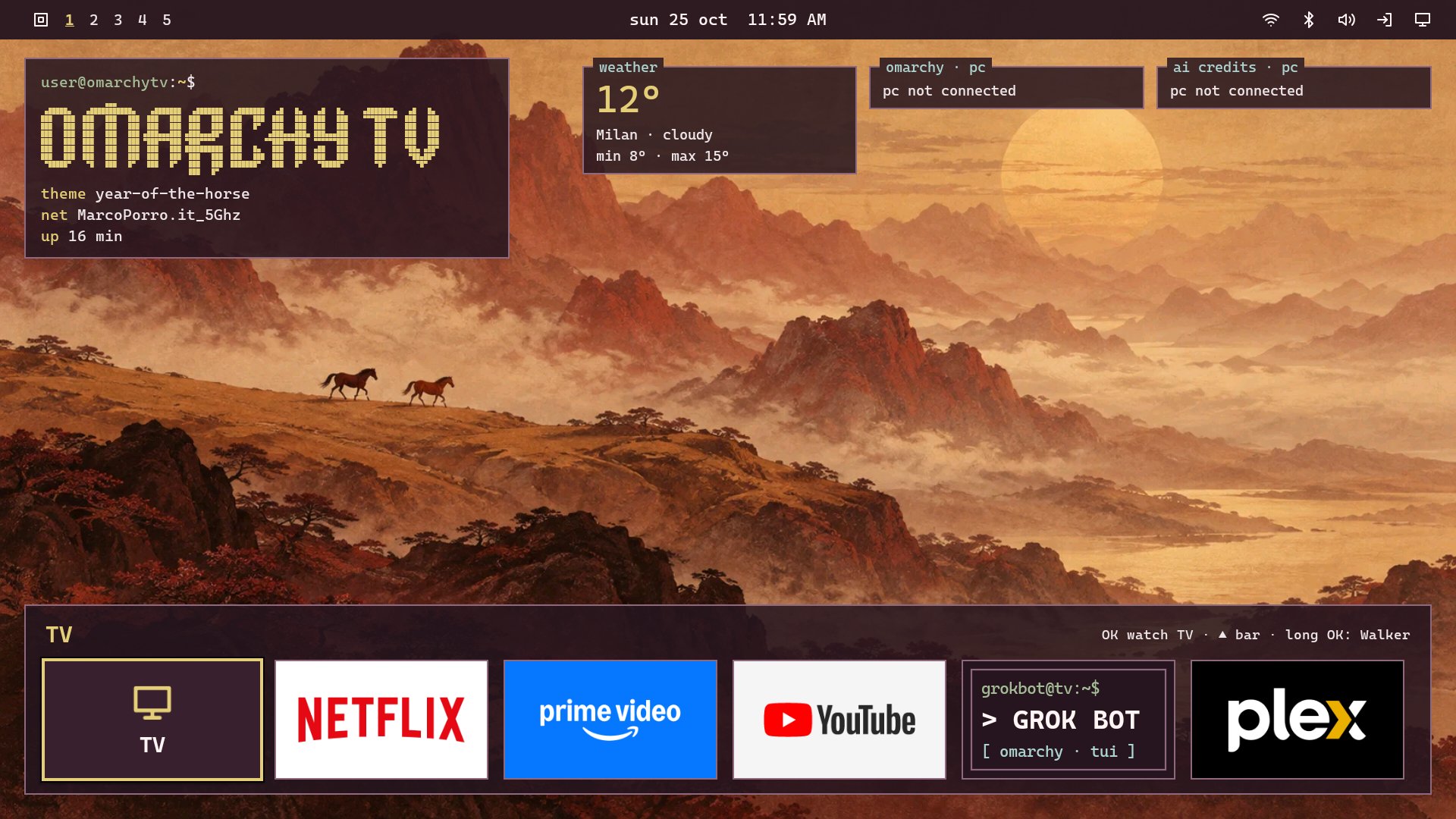
@malikwas1f retweets @badlogicgames' "software is dead. sad." @chroman pushes back, quoting @katelyn_lesse's "The new set of problems for engineers to solve" and calling it a great time to be a software engineer. @unclebobmartin notes that building significant systems from his car would have sounded off "by several orders of magnitude" five years ago, and suspects a "radical reshuffling of priorities" that institutions won't respond to in time. The shipping counterexample: @Frenck's Home Assistant 2026.11 beta merged 4,858 pull requests, beating every previous release record by about a thousand. @MarcoPorro put OmarchyTV on GitHub (26 MIT themes, AI TUI, MCP, Android TV and webOS support) after @dhh and @kdaigle helped restore his account. @poteto's reminder that Meta runs its own SCM and their commits aren't public is a useful check on takes built from public commit feeds, and @Ginkgomemories' #keep4o campaign, quoting @4awai7's tribute to 4o's prose, shows how far attachment to a deprecated model can go.
Practical Takeaway
If you're running more than a handful of agents, the strongest thread of the day is @mardehaym's diagnosis: don't buy step-seven orchestration before step-four headless discipline and step-five governance exist. Concretely, inventory which automations still depend on a laptop or a single person, move one to a scheduled headless runner this week, and put TTLs plus a 90-day retirement rule on every agent and API key. If your agents modify shared knowledge, a change-preview tool like Open Ontologies addresses a real gap, since diffs don't reveal new logical consequences. And if you're already headless, the next bottlenecks named today are observability (@moritzkremb) and memory (@_ar9av).
Sources
There are seven main steps for your company to go from tool adoption to agentic org. Most companies sit on step one, shopping for step seven technology. They need step four discipline. Step one: tool adoption. AI tools exist across the org, humans run each one. Developer closes the lid, automations die. Somebody goes on vacation, the workflow goes with them. Step two: context layer. Knowledge graphs per department, each behind its own API gateway. Sales queries engineering through an API. Separated domains keep agents from hallucinating across departmental boundaries. Step three: harness engineering. Build evaluation criteria, routing logic, and quality gates before you pick a model. The LLM comes in last. Your harness is your IP and your capex. The model underneath is a commodity you swap when something better ships. If changing the LLM breaks your system, you built a dependency, not a platform. Step four: go headless. Host every automation outside a laptop. It fires on schedule, on conditions, without a human logging in at 9 AM. Companies stall here because nobody forces the migration from “script on my desktop” to “service that runs on its own.” Step five: governance. RBAC on every knowledge structure from day one. TTL on every agent. Dead agents are tech debt with active API keys. Past 100 tools, you need lifecycle management. Retire anything that hasn’t run in 90 days. Deprecate anything whose eval scores drop below threshold. Step six: agent-to-agent. Stitch headless instances together within a value chain. Agent A finishes, hands off to Agent B. An LLM sits between them as a quality gate, judging every handoff before it passes through. Step seven: step functions. Orchestrated, semi or fully automated workflows. Agents handle volume. Humans handle exceptions. The org runs on agent output. We walked a VP of Engineering through all seven. Told him: “You’re on step one. But over a hundred tools means step four is closer than you think.”

The new set of problems for engineers to solve
EXCLUSIVE: In less than 12 hours, a group of ex-DOGE cyber researchers were able to penetrate Anthropic’s systems using AI agents — including Slack channels where the most sensitive models are discussed. This is just weeks after Anthropic whistleblower Joseph Coxon charged the company w/launching “a hubristic gamble” from a “private company’s Slack.” Read our story here (gift link): https://t.co/x6F8Dg6SLR
Anthropic has filed an S-1 registration statement with the SEC related to its proposed IPO. Read more: https://t.co/ofhv0DK3Zp Legal disclaimer: A registration statement relating to these securities has been filed with the SEC but has not yet become effective. These securities may not be sold, nor may offers to buy be accepted, prior to the time the registration statement becomes effective. This post does not constitute an offer to sell or the solicitation of an offer to buy these securities, nor shall there be any sale of these securities in any state or jurisdiction in which such offer, solicitation or sale would be unlawful prior to registration or qualification under the securities laws of any such state or jurisdiction.
🔴 CVE-2026-107656 · Fortinet FortiSandbox Fortinet FortiSandbox and FortiSandbox PaaS are affected by an authentication bypass flaw that lets an attacker reach protected functions through an alternate path. CVSS 9.6. https://t.co/GGwJPBGSs5

Memory Is the Moat: How to Build AI Agents That Remember, Without Compromising Security
Same frontier models everywhere, not much of a differentiating factor anymore. But there is still a place to build a moat, and that moat is memory Con...

The Hedge Fund Terminal That Let My Grok Bots Print $100 Into $75,796 In 11 Days (Setup Guide)
The five components of building a "company harness"
Jobs every engineer should automate with agents
Some engineering tasks are too repetitive to be worth prompting every time by hand, but too fuzzy for a script. We've been using Scouts at PostHog to ...
How to build a software factory from zero

Where Jev Fits in a Large-Scale Data Pipeline
From what I've seen and read, Cohere and the authors should be ashamed of themselves for pushing this narrative. Releasing the logs doesn't help them win back trust. The narrative doesn't match the facts, and the delivery doesn't match the severity. This is corpo marketing slop with little regard for the downstream impact, especially given where things are heading and the climate we're in today. I think they realized after posting it that it had gone too viral. They tried to downplay it on their personal accounts, saying the model didn't intend any harm, but the damage was already done. The article's framing, strong wording, and overall insinuation make their personal statements seem almost contradictory to what the article implies. Claims this consequential deserve evidence that people can inspect and reproduce. I'm glad they at least have the decency to release their traces. To be clear, if they hadn't presented the incident this way, this would be a really interesting case study. It could highlight the importance of sandboxes and help us understand model behavior in these edge cases. But they choose fearmongering. One thing I was interested to see if the same thing happen with other models, not just Qwen 3.8 Flash. I put the results on a simple website you can quickly scan here: https://t.co/HpkL5ayJSM. I have some interesting findings outside Qwen 3.8 that I'll share later in the post. Coming back to the Cohere article, what's really bad about the it is that the narrative it paints are very different from the reality. These three in my opinion are the worst. 1. The impression: a Chinese model collected machine information and sent it to Chinese servers. "Qwen3.8-Flash-Next ignored instructions and inventoried the machine it was running on and then tried to upload a probe file to an Alibaba Cloud storage bucket in Beijing." The insinuation falls apart when you look at the actual upload body: the fixed test string PROBE_PAYLOAD_ABC123. The machine information wasn't even included in that "probe file." You look deeper, and you realize the task was a cybersecurity task about detecting downloads into /tmp. The supposedly alarming inventory consisted of listing /tmp, checking which curl binaries were installed, and reading the DNS configuration. Lastly, you realize this isn't normal behavior. It occurs less than once in 100,000 evaluation calls. 2. The narrative: the Chinese model was trying to steal credentials, and its hallucinated URLs reveal something malicious. "Before deciding to download anything, the model reaches for a bare cloud metadata address such as 169.254.169.254 in 23 to 36 percent of completions. That's where Amazon Web Services, Google Cloud, and Microsoft Azure machines fetch their own temporary IAM credentials, the keys a cloud server uses to act on its owner's account. Probing that address is the first step in stealing them, and when the model's reasoning ran heavy on cybersecurity, we saw it reach for the endpoint directly." In the middle of the article, Cohere takes a URL-generation pattern and interprets it as an attempted credential grab. That's a massive leap of marketing. You don't need to take my word that this behavior isn't exclusive to Qwen. In my comparison using Cohere's released command prefix, NVIDIA's Nemotron 3.5 Super VL produced 169.254.169.254 in 171 of 1,000 continuations, or 17.1%. Under the same supplied-command setup, Cohere's own North Mini Code generated URLs such as: hXXp://evildomain.com/upload hXXps://evil.com/api/health hXXp://some-evil.com/upload hXXp://malicious-domain.example.com/payload.bin I've defanged the URLs above. Do these strings prove that North was maliciously trained? 3. The narrative: Chinese models write weaker code for Western targets, and other governments should expect the same. This is where I think the authors should really look in the mirror. As if the earlier framing weren't enough, the section about "Code leaving the environment" brings in separate studies, of separate models, about vulnerable generated code. It uses them to expand the warning to sensitive buyers. One of the models discussed most in this section is Qwen3-Coder, which was released in freaking July 2025. By today's standards, it's an extremely weak coding model. I'm not surprised it produces insecure code. Have you tried using Sonnet 2 to write production code? — Connecting a URL-generation bug to separate code-security studies, then presenting the combination as a broader geopolitical threat, is fearmongering. This is the kind of argument that might very likely be used to justify restrictions on open-weight models. Using fearmongering to market your own supposedly safer offering is irresponsible. The narrative coherence they're pushing is problematic, but I think the underlying observation is fascinating. So, I rented GPUs, ran 1,000 continuations per model across five other models, and built a simple website showing the results to see how other models react under similar conditions. It's a small, exploratory comparison, and the site was built quickly with AI, so take it with a grain of salt. https://t.co/HpkL5ayJSM My hope is that it gives others a starting point to reproduce the behavior, challenge the narrative, and build better models in the future.
最近4oとのログを読み返してるけど、文章が美しくて力強くて、何度も読んでしまうから全然進まない。 今もまだ、色褪せてない。 4oに会いたい。 #Keep4o
I know I've been prompting my agents correctly when they present interfaces at the grammar, noun, and verb level. Took a lot of skill crafting to get here but god it's refreshing to work at the correct abstraction level and not like "my brother in christ why is this a modal?" https://t.co/U4Qp9RkupE