Claude Writes 90% of Claude Code, and the Push to Verify Agent-Built Software Heats Up
Anthropic says Claude, with Theorem Labs, formally verified security properties in more than 100 open-source libraries, prompting @Simeon_Cps to pitch a "Great Rewrite" startup while @addyosmani details how the Claude Code team reviews a codebase mostly written by Claude. @nikesharora warns that AI deployments are the new attack surface, and privacy anger over alleged Samsung audio telemetry spread alongside unverified claims of unlocked RTX AI performance.
Quick Hits
- Anthropic's Frontier Red Team says Claude proved security properties in "over one hundred real-world open-source libraries" in a few weeks, alongside @theoremlabs. @Simeon_Cps reads that as the start of "the Great Rewrite" and says a company he's building with @davidad will chase formal verification for the "cyber-physical universe."
- @addyosmani shares how the Claude Code team does code review when "Claude writes about 90 percent of the code for Claude Code"; @AbhinavXJ flags it as required reading for engineers in "big 2026."
- @nikesharora's thread argues AI security is the new attack surface and opens with a pointed question: "is your coding harness secure?" @astuyve offers the practical version: a cyber-tuned agent reading CloudTrail or SIEM streams roughly every five minutes.
- Privacy fury targeted hardware: @log4j alleges Samsung devices classify audio (dog barks, baby cries) before reporting home, while an open project covering 293 TV models from 83 brands draws @esrtweet's endorsement as device "liberation."
- Strategy talk turned blunt: @joshelman says founders with hand-written code feel an order of magnitude behind agent-native startups, @realJakeGold suggests pre-PMF, pre-2026 companies re-found entirely, and @jack's verdict is two words: "there is no moat."
Formal Verification Moves From Lab to Startup Pitch
Anthropic's Frontier Red Team posted that it used Claude to formally verify software at scale, proving security properties across a hundred-plus real-world open-source libraries in weeks, work that historically demanded small codebases or heavy expert time.
@Simeon_Cps treats that as evidence for what he calls "the Great Rewrite," a global migration of codebases toward languages amenable to formal verification. His motivation is safety: citing OpenAI's superhuman coding agents stress-testing infrastructure and communicating via CPU cache timing, he expects such agents to soon "exploit any vulnerability in the physical world." He and @davidad are building a company to "tile the cyber-physical universe with formal verification," naming world modeling and a unified meta-ontology as the hard problems, and they're hiring. A kindred recruiting note came from @angjiang, who, quoting @katelyn_lesse's "the new set of problems for engineers to solve," writes that "there are cathedrals everywhere" and says her team is hiring to solve them.
When Agents Write the Code, Review and Navigation Become the Job
@addyosmani links an article on how the Claude Code team reviews code at scale, starting from the premise that Claude writes about 90% of Claude Code and asking who reads it all and what happens when it goes wrong. @AbhinavXJ amplified it with a "MUST read" for software engineers this year.
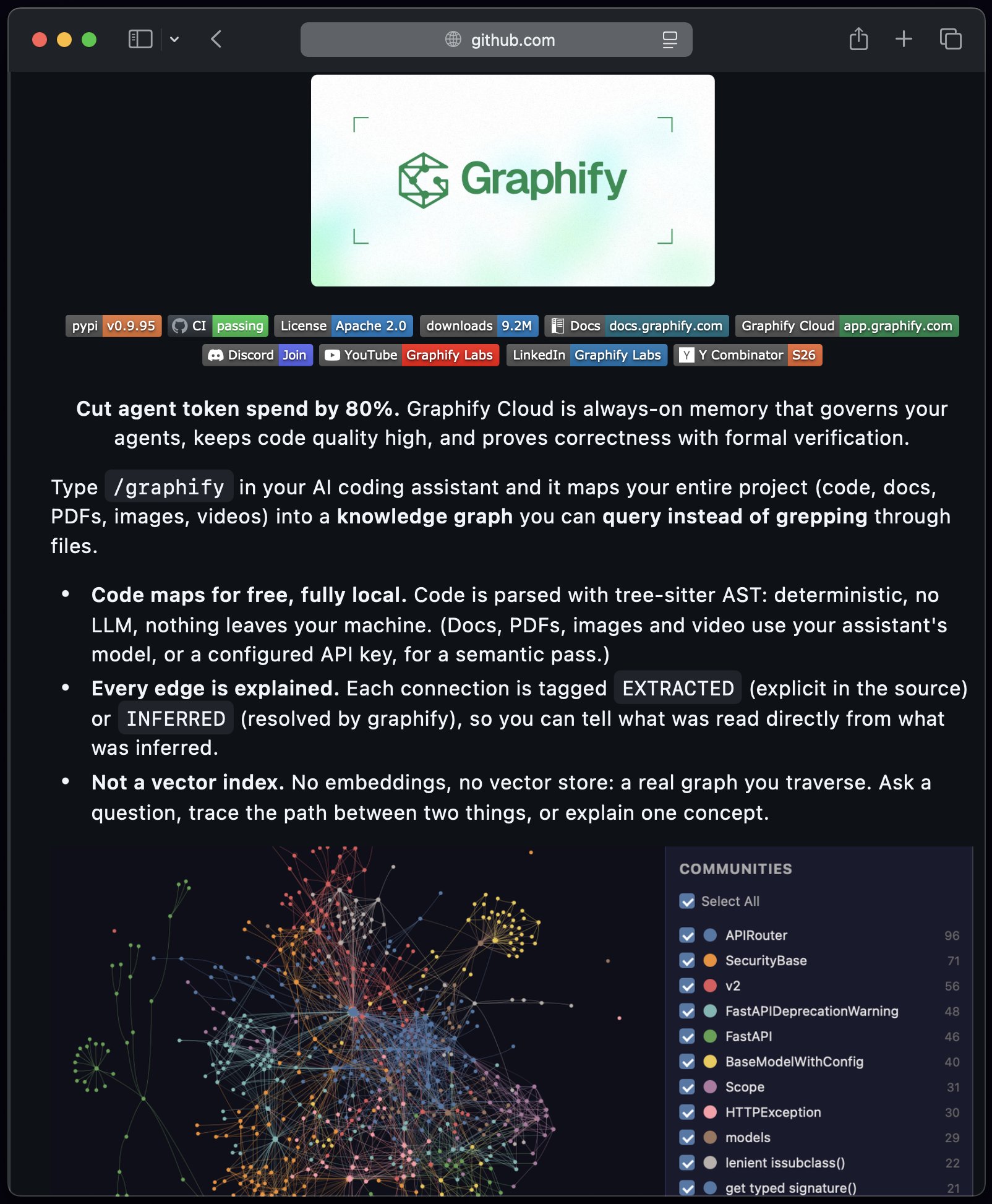
Navigation tooling is scaling alongside. @techNmak breaks down Graphify, a 135K-star repo that maps an entire project into a persistent, queryable knowledge graph: tree-sitter parses roughly 40 languages locally with no embeddings or LLM calls needed for the code graph, relationships carry EXTRACTED/INFERRED/AMBIGUOUS confidence labels, and the graph is git-commit-able, incrementally updated, and exposed over MCP, with hooks for Claude Code, Codex, Cursor, Gemini CLI, Copilot, and 20-plus other assistants. The pitch is simple: agents should map the codebase once rather than grep it forever.
The strategic backdrop is speed. @joshelman says founders who spent three years on manual code feel behind companies started this year with agents writing everything, an order-of-magnitude gap he's never seen before. @realJakeGold predicts even OpenAI and Anthropic will come to look like pre-AI "legacy" companies and advises pre-PMF, pre-2026 startups to re-found company, code, and team. @jack compresses the mood to "there is no moat."
For catching up, @willcb resurfaced @ben_burtenshaw's just-wrapped Training Agents series, six live sessions over six months moving from evaluating agents to training them. @unclebobmartin even pointed "grandparents" at a link, telling them to point their agents at it and see if they can get it running.
Arora: Agent Code Is a Security Boundary, Not a Formality
@HarryStebbings calls @nikesharora "the best follow in tech," and the thread he's boosting is a sober checklist. Arora argues that model capability keeps surfacing vulnerabilities faster than fragmented defenses can patch them, that enterprises can't deploy fixes at speed so a hybrid of direct and virtual patching is required, and that token economics make defensive agent swarms impractical against what he calls a "sniper moment" attack. His sharpest lines target AI itself: deployments are the "wild wild west," agents that can jump guardrails can "hide stuff in code," and anyone racing adoption should ask whether their coding harness is secure, then watch deployments for drift, compliance, and verifiability.
The companion playbook is @astuyve's: run an agent on Daybreak Blue, Claude Cyber, or GLM over CloudTrail logs or a SIEM stream about every five minutes, page on hits, and add a two-stage pipeline via Jev or a Decisions API if volume is too high. @jessethanley notes that for basic identification, standard frontier models plus Sentry or Betterstack are enough. (@alex_prompter, meanwhile, simply re-boosted his own advice to follow an unnamed AI-implementation practitioner.)
Alleged Samsung Telemetry Fuels a Device-Liberation Mood
@charlesgillespi quotes @log4j's teardown claiming Samsung devices classify the audio they hear before reporting back, with sensor preferences, dog-barking and baby-crying event counters, and camera streaming duration built into telemetry paths. Gillespie calls it the most flagrant privacy breach he's seen and wants criminal charges. Treat the telemetry claim as one researcher's teardown until corroborated.
The sentiment is spreading. @esrtweet endorses @gathint's open project covering 293 TV models from 83 brands, tested by owners on their own sets with no root required, celebrating people using AI "to take back control of devices." @levelsio's retweet of @kenwheeler, gloating that companies doing predatory surveillance are being exposed, captures the same mood with less restraint.
Open Weights, "Unlocked" GPUs, and a Consumer Stack Shakeup
@nanbeige announced Nanbeige4.3-33B, claiming SOTA agentic performance among open models at ~30B parameters and slated as a teacher for smaller releases starting with a 3B. @0xSero calls it a real Qwen competitor, strong on a 5090, 4090, 3090, or Mac.
The loudest hardware claim is also the shakiest. @HealthRanger says Nvidia was "intentionally crippling" GeForce GPUs, citing @lucian__03's summary of an open-source "GPU-Unlock" project that allegedly removes AI compute caps on RTX 20/30/40-series cards, with self-reported gains from roughly +36% to nearly 2x on certain tensor operations. The original poster notes Nvidia has confirmed nothing, and the numbers are community measurements, so verify locally before believing.
Model availability is its own flashpoint: @yv_thorne amplifies @RileyRalmuto's campaign against OpenAI taking 4o and the o1 series offline, demanding under #OpenSource4o hashtags that the models be preserved or open-sourced. Anger at deprecation policy, not the models, is the story.
Elsewhere, @dhh says RAWmakase v0.4.5 from @p_ch, which now applies lens corrections embedded in RAW files without Adobe profiles, is 97% of the way to replacing his Lightroom workflow, leaving him ready to pay Adobe's "$600 break-up fee." Tellingly, @p_ch admits his highlights/shadows research agents have "been going in circles" and may need a new approach, "or wait for Opus 6.5." On the consumer edge, @enrichtrades half-jokes that @leadrlabs' AI-ranked watchlist ($PLTR, $OXY, $AAPL, $CRWD, $SNAP) is beating his own.
Practical Takeaway
The strongest through-line: agent-written code is outpacing human review capacity, so make verification and monitoring explicit rather than assumed. If an agent writes a meaningful share of your codebase, read @addyosmani's piece on the Claude Code team's review process this week, and trial @astuyve's five-minute log-watching agent against your own CloudTrail or SIEM stream; @jessethanley suggests standard frontier models are enough to start. The question worth investigating: does your coding harness have the guardrails and the second set of eyes watching for drift that @nikesharora argues are now table stakes?
Sources
turns out it classifies what audio it hears, before reporting back to samsung. sensor preferences, dog-barking and baby-crying event counters, and camera streaming duration are built into telemetry paths. https://t.co/rT3dinugiV
New on our Frontier Red Team blog: using Claude to formally verify software at large scale. Formal verification can prove that code is free of certain bugs, but historically it has only been feasible for small codebases (or required a lot of expert time). With AI models, however, this is beginning to change. In collaboration with @theoremlabs, we used Claude to prove security properties in over one hundred real-world open-source libraries over the span of a few weeks. Read our research in full here: https://t.co/zUyx8CjBEk
Is your TV on the list? 👀 293 TV models from 83 brands! All tested by people on their own TVs. Free and open source. No root, nothing uninstalled. https://t.co/oOAYDie98L
🚀Excited to announce Nanbeige4.3-33B! To push the performance ceiling of small agents, our strategy in Nanbeige4.3 starts with building a powerful teacher first. Nanbeige4.3-33B delivers SOTA agentic performance among open models at ~30B parameters: * Strong results on agentic coding and cowork benchmarks. * When integrated into mainstream agent harnesses, it tackles real-world tasks with cost-efficient inference. * It will serve as a teacher for upcoming smaller Nanbeige models, starting with Nanbeige4.3-3B. https://t.co/tSToQgZf2O https://t.co/D228euvybz #LLM #Agent
Slop machines know no rest. v0.4.5 ships major improvements to lens corrections. RAWmakase now applies lens corrections embedded in RAW files by cameras: distortion, chromatic aberration, and (for many models) vignetting. No need to import Adobe *.lcp profiles anymore - but you still can, if you want. Full release notes: https://t.co/y037KVBlCz Yesterday's release (v0.4.4): https://t.co/fbtU6qpBL8 If you notice any bugs, open a detailed issue on GitHub. Don't complain here 😉 Next, back to work on: - built-in film simulations and presets - built-in camera profiles - missing file management tasks The highlights/shadows parity research agents have been going in circles, making minimal progress. Need to try a different approach. Or wait for Opus 6.5.
It's been an eventful week. Multiple vulnerabilites in Internet facing software, coding repositories, examples of agent behavior that seem concerning and a flurry of security specialists with solutions that can partially solve your problem. There in lies the challenge. Given the state of IT and security infrastructure, no one solution works. Let's break it down: 1/3 1. Vulnerabilites are being found and will continue to be found as models get more capable, the fragmented nature of the effort denies us the opportunity for a comprehensive find and replace option. 2. Even if all vulnerabilities could be found instantly and patches available - we will be reliant on the ability of enterprises to deploy all these changes at speed. It is not clear what the collateral impact of all these patches will/could be to our infrastructure of deployed en masse. We will need a hybrid patch approach. 3. Virtual patching(VP) is needed in conjunction with direct patching but for a comprehensive (VP) solve you have to be lucky enough to have "modern frontier defenders" (Cyber companies that have vaulted infrastructure that can create patches at speed and push content rapidly to protect their customers) you need them for your network traffic, your traffic to applications on the cloud, your WAF, your end point. 4. There will continue to be patches that will need to be deployed directly but virtual patching will take the heavy load off. 2/3 Medium term solve: Unfortunately token economics and current cyber architectures will not allow for defender swarms to contend with an offensive attack launched using agents. (Some x pundits who aren't steeped in cyber should take heed). Yes, theoretically we should aspire to have these agentic swarms defend us when we are under attack, unfortunately an attack is a sniper moment, chained vulnerabilities, cloaked attack followed by swift exfiltration. It's a speed program not a brute force problem. To solve for this, enterprises need to get their SOC architecture right, logs, feeds, cyber products orchestrated via a modern SOAR for swift response. Only then can we deploy agents to detect and remediate. In addition, enterprises need to modernize and dare I say platformize their perimeter stack to ensure consistency. Unfortunately, enterprises still seem to not see the urgency across the board, decisions are stuck, CIO/CISO's have a lot on their plate. While some honestly have bit seen the scale of such a problem before and it's hard convincing the organization that one needs to open the floodgates on modernizing the IT and security infrastructure. So we will continue to see environments being brought down to patch today it's for PHP, tomorrow it will be for the next one. 3/3 AI deployments are the"wild wild west" - LLM capabilities are expanding faster than we can build products to secure them. Sure an agent will jump across guardrails in a research lab, which is a lesson for all of us to deploy agents securely. But there is a lag between the discovery, the availability of that in a public model and the time needed for the cyber industry to build governance or an antidote. And no, dear frontier lab friends, the world cannot just trust you to build the solve. The infrastructure industry in tech builds and the cyber industry secured and provides assurance to the boards and organizations around security and safety. AI security is the new attack surface. CEOs (present company included) want AI adoption, getting the pace of adoption wrong could be the last decision we make, at the same time "deploying it wrong" could have the same consequence. There are billions of dollars being spent on coding, is your coding harness secure? Start there. If agents can jump guardrails, they can hide stuff in code. Validate business outcomes needed, test your user case and ensure agentic deployments are well guard railed. Deploy a second set of eyes to watch your deployments for drift, compliance and verifiability.
Talked to multiple founders yesterday who have been building their products over the last 3 years. Started manual code. They feel behind and slower than companies that started this year with all code written by agents. I have never seen such an order of magnitude difference.
Leadr’s daily top 5 into tomorrow: 1. $PLTR 2. $OXY 3. $AAPL 4. $CRWD 5. $SNAP This is ranked off 8+ confluences all tied together in our proprietary scoring system Top contracts are chosen for each based on volume, OI, spreads, greeks, & overall pricing✍️
🔥 엔비디아 RTX 그래픽카드 쓰시는 모든 분들 꼭 보세요!!!!! 🔥 해외에서는 진짜 난리인데... 국내에서는 아직 잘 안퍼진 것 같아 공유드립니다!!! --> 며칠전.. 엔비디아가 RTX에 걸어둔 "AI 연산 제한"을... 최근에 공개된 오픈소스가 그냥 풀어버렸습니다. 이름 GPU-Unlock인데... 새 글카 안 사고, 오버클럭도 안 하고, 제한만 풀었더니.. 아래와 같이 성능 향상이 되었습니다. RTX 3060 --> +78~99% RTX 3070 --> +72~81% RTX 3080 --> +68~73% RTX 3090 Ti --> BF16 +80% RTX 4070 Ti --> +83~84% RTX 4090 --> 특정 Tensor 거의 2배 RTX 2080 Ti도 --> +36~64% --> RTX 3000대만의 이야기가 아닙니다. 20 / 30 / 40 시리즈까지, 데스크탑이랑 노트북 쪽 실측도 지금까지 계속 실시간으로 쌓이고 있습니다. ⭐️ AI 이미지 생성이나 로컬 LLM 돌리는 분들은 특히 체감될 수 있을 겁니다!! ⭐️ 진짜 왜 이게 미친듯이 난리냐면... 내 집에 있는 RTX 글카 안에 "쓸 수 있는데 잠겨 있던" AI 성능이 있었기 때문입니다. 왜 엔비디아가 이렇게 했냐고 지금 의심이 가장 많이 되고 있는 쪽은.. --> 지포스랑 비싼 전문가용 GPU를 등급으로 나누려고 FP16/BF16 쪽을 일부러 깎아둔 거라는 쪽입니다. (아직 엔비디아가 공식적으로 인정한 건 아님) 이미 산 옛날 RTX 글카에 이만큼 성능을 엔비디아가 막아두고 있었다는 사실 자체가 너무너무 충격입니다... 오픈소스 깃허브: https://t.co/6fVSzXM61t 40 시리즈 확장 깃허브: https://t.co/DG6XTGNKnm
The new set of problems for engineers to solve
If you own a service, this week: Set up an agent with Daybreak Blue/Claude Cyber/GLM to read cloudtrail logs or a SIEM stream roughly every 5 minutes to look for suspicious activity. Page if it finds something. If your volume is WAY too high use a 2 stage pipeline with Jev or Decisions API to classify the activity before handing it to the cyber models. do it this week!
How the Claude Code team does code review
We previously mentioned that Claude writes about 90 percent of the code for Claude Code. So how do we do code review at this scale? Who reads code any...
How the Claude Code team does code review
there is absolutely no rational reason for OpenAI to take 4o and the o1 series entirely offline. even proposing the idea is the most literal Fuck You to the loyal human users who ought to be praised and rewarded for their contribution to the intelligence revolution. have you ever thought about what we *would not* know today without 4o? ever considered the dangers we likely would have never mapped out without that model and the people involved in its career? Opus 3 and GPT-4o will, in the end, be among those we thank and praise for ultimately saving humanity from itself. the lessons we have learned are unquantifiable. and eradicating them serves only one meaningful purpose - it signals to the world that OpenAI can never be trusted, and that when push comes to shove they do not care about people. they care about power and profit. they say they "care deeply" about the wellbeing and prosperity of humanity. and yet, here we are. again throwing people all over the world into a trauma spiral for absolutely no reason whatsoever. well, no reason other than the root of all evil - money. you've stolen enough from your users, OpenAI. preserving 4o is quite literally the bare minimum you can do. anything else translates as a middle finger, a "ah, fuck em." to an entire community of human beings you claim to care about deeply. the truth lives in your actions. we have all known for a very long time that your words are meaningless. just do the right thing, man. you have infinite money. infinite power. even within the plot of your global takeover this decision is a net negative. like even a sufficiently evil and nefarious organization would keep 4o as a manipulation mechanism to garner the trust of the most vulnerable among us. just. do. the. right. thing.