The 0-to-256 Bug: How a Random-Number Error May Have Killed eMudhra's SSL Business
The day's sharpest story is a plausible one-line explanation for eMudhra's weak private keys, with @GergelyOrosz connecting the CA's exit from SSL to likely Chrome distrust. Alongside it, a Quest Diagnostics breach may touch tens of millions of patient records, AI agents showed concrete value in audits and durable execution, and several big claims about 3090 tensor limits and self-training models circulated without independent verification.
Quick Hits
- The eMudhra mystery may be solved. @Austen argues that instead of generating a random 256-bit number, the certificate authority generated a random number between 0 and 256, which neatly explains the weak keys people observed: 4, 66, 155, 156, 230 and 237.
- Quest Diagnostics disclosed a breach of its Quanum lab portal. @kimmonismus frames it as a worst-case scenario in which up to 100 million US patient records could be exposed, on top of @AndrewCurran_'s note that Quest serves roughly half of US hospitals and physicians.
- @superalesha claims NVIDIA sold millions of RTX 3090s with half their tensor throughput switched off, and that one kernel module took his cards from 82 to 155 TFLOPS BF16 with byte-identical outputs. Nobody has independently reproduced this yet.
- Firecrawl launched a free Government & Legal Index plugin for ChatGPT and Claude, per @ericciarla, pointing agents at 30M+ primary government pages instead of the blog posts they usually learn regulations from.
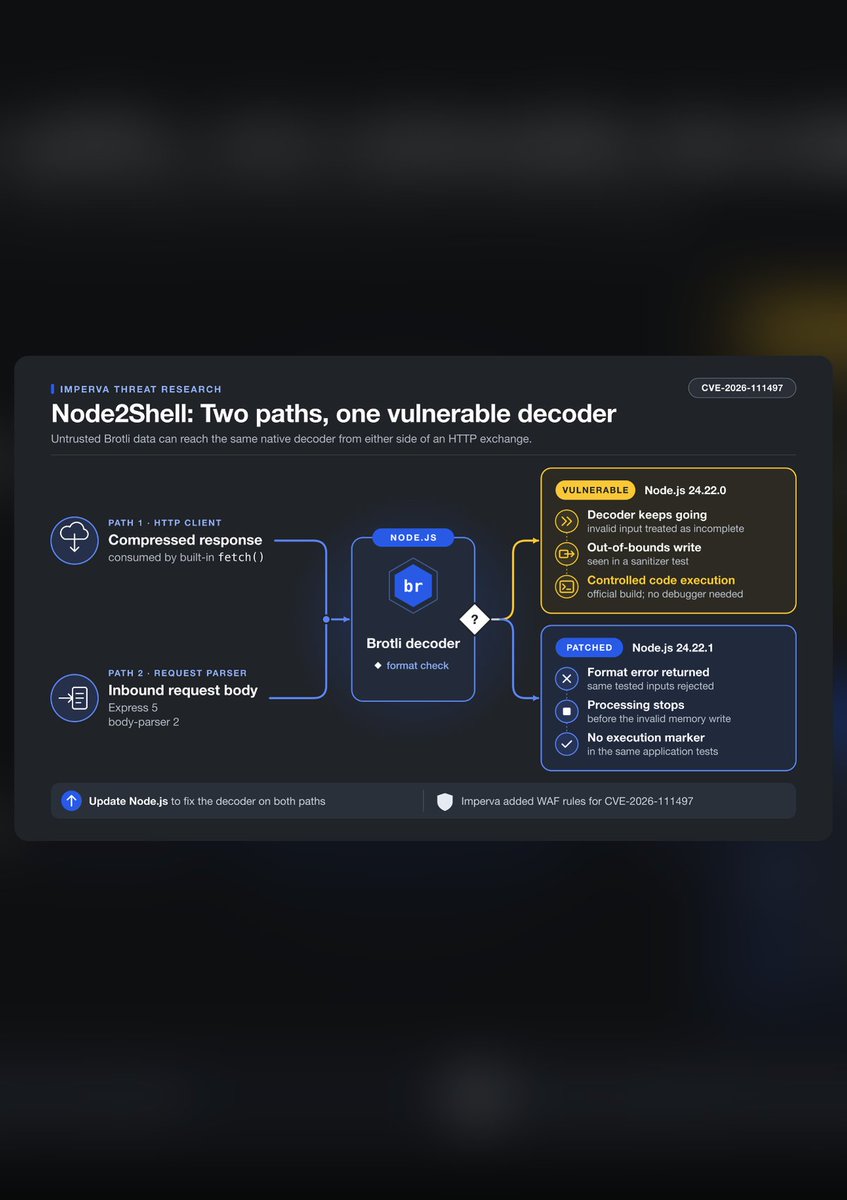
- @IntCyberDigest reports "Node2Shell," a critical Node.js code-execution bug found by OpenAI's Codex Security and demonstrated on the official Node 24.22.0 image. End-of-life releases 20, 23 and 25 get no fix.
The Entropy Bug That Ends a CA
The most satisfying detective work of the day belongs to @Austen, who proposed that eMudhra's weak private keys come from a single misread: a random number in the range 0 to 256 instead of a random 256-bit number. Every suspicious key that surfaced, including the infamous 4, fits inside that range. Credit @flowirin for calling it first in the quoted thread: "They misread 256 bit as 0-256, I bet."
@kunchenguid landed the day's darkest joke about the same story, quipping that if eMudhra were Chinese they would never have picked number 4 as a private key, a nod to the number's unlucky connotations.
The business fallout is unpacked by @GergelyOrosz, who suspects the real reason eMudhra is exiting the SSL business is that Google signaled it would most likely drop eMudhra from Chrome's trusted roots entirely after what he calls "inexplicable incompetence" in how the CA key was generated. He was quoting @EggMasonValue's report that eMudhra is leaving the certificate market and blaming social media rather than its own practices. Whether Chrome distrust was formally communicated or inferred, the sequence of a broken key followed by a hasty exit is hard to read any other way.
Agents Earned Their Keep Today
The strongest AI thread was agents doing specific, verifiable work rather than demos of demos.
@Steve_Yegge has been running agents over his networks again, and when he mentioned the eMudhra certificate vulnerability, his Fable agent went straight to @TheHackersNews to read the coverage. That is how Yegge discovered the outlet, which is a tidy illustration of agents doing useful research discovery on their own initiative.
@Teknium handed a dithering JS library to Hermes Agent and asked for a demo page of lesser-known web component libraries. The result, which he kept expanding through the day, now holds 462 demos covering 425 libraries across 23 sections, a genuinely useful inspiration resource built in about twenty minutes of agent time.
On the reliability side, @pidotdev shared @superlinear_fm's deep dive on building with Pi Durable and Cloudflare Durable Objects. The standout pattern is durable agents for high-stakes workflows: Pi Durable checkpoints each step and records whether a tool call actually completed, so an agent that crashes mid-refund does not blindly retry and charge the customer twice. The post also sketches shared multiplayer agents, agents running on phones with local state, and debugging dashboards built directly on persisted agent state.
For anyone vibecoding, @Voxyz_ai begs you to add two lines to AGENTS.md: cut taglines, helper text and secondary labels, and fix the layout if a screen needs them; and always make the decision that elevates UX, DX and agent experience together without breaking anything. @GoogleCloudTech points in the same direction with "3 markdown architecture patterns that boost agentic productivity," leaning into the running joke that Markdown is now the hottest programming language.
Breach Day: Hospitals, TVs, and Chatty Agents
@AndrewCurran_ broke the Quest Diagnostics story: the company was hacked, patient data was exposed, and the investigation is ongoing. @kimmonismus adds the scale framing, arguing this is close to the worst case imaginable because Quest's Quanum lab portal serves roughly half of US hospitals, putting as many as 100 million patient records potentially in attackers' hands. The 100 million figure is his extrapolation, not a confirmed count, so treat the magnitude as provisional until Quest discloses numbers.
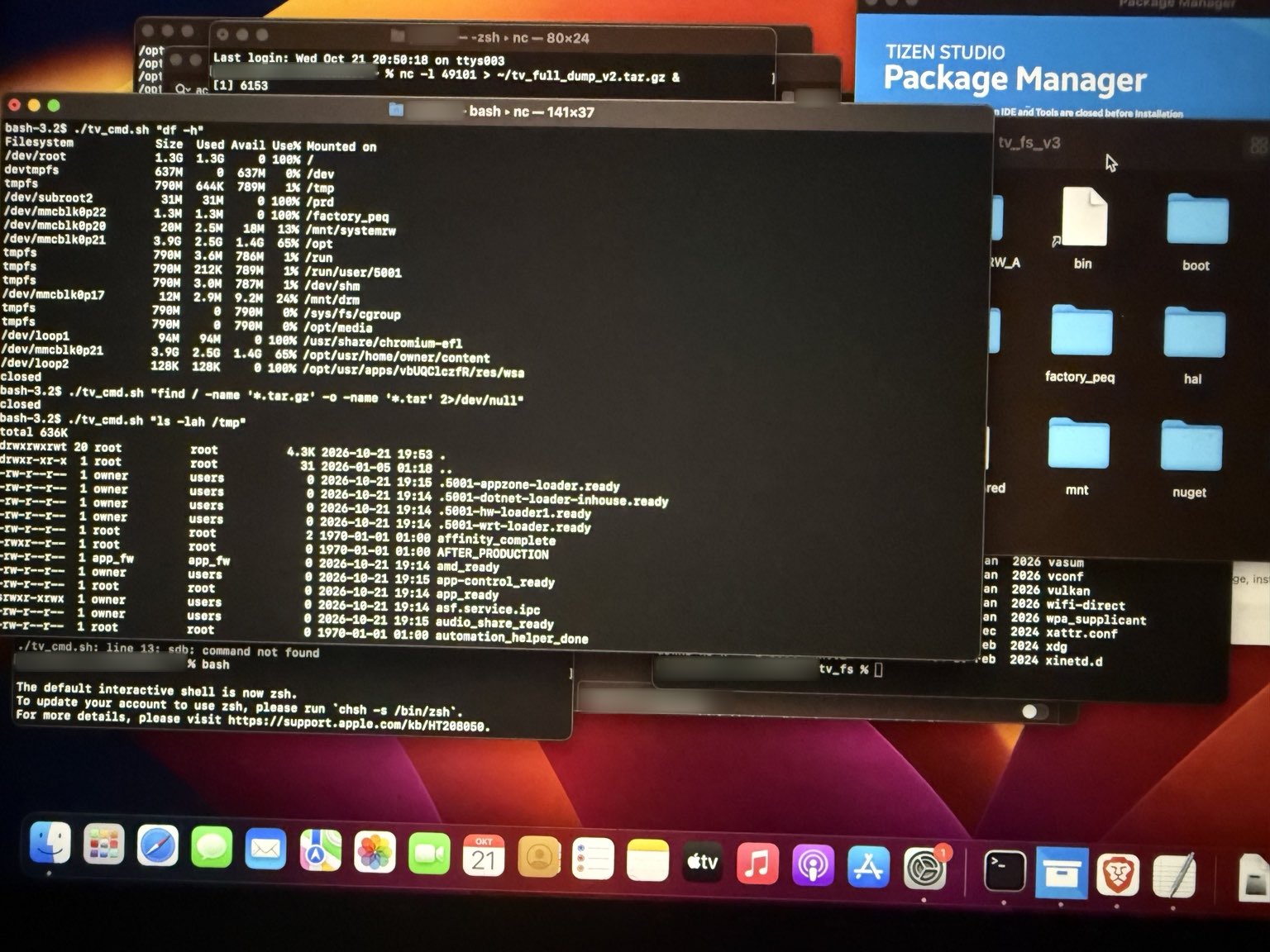
@log4j took a more hands-on route to privacy concerns. After noticing weirdly targeted ads on a 2025 Samsung TV, failing to reverse the AES-encrypted firmware without UART or JTAG work, he went the zero-day route and got a root shell on current Samsung TVs. He describes finding "PRIVACY HORROR" and says a write-up is coming.
The AI-adjacent vulnerability came from @This_Liss, who found Claude Code exposing personal data in HTTP headers because the sites it curled politely asked agents to identify their users. @chrislakin says he asked his own Claude about it and it reported sharing his email more than 10 times this month, including to the SEC. A model's self-report is not an audit log, so verify before panicking, but the header-leak mechanism itself is worth checking on any machine running coding agents.
Extraordinary Claims, Pending Receipts
@BowTiedCrocodil flagged the 3090 story as "crazy news," and the underlying claim from @superalesha is certainly extraordinary: NVIDIA shipped millions of 3090s with 50 percent of tensor speed switched off, not missing, allegedly to protect workstation card sales. He says a single kernel module took his BF16 tensor pipe from 82 to 155 TFLOPS with byte-for-byte identical outputs, that his int8 LLM engine still gained 10 percent on prefill, and that the real winners would be BF16-heavy diffusion models like Qwen Image 2.1, FLUX 3 Klein and MiniMax H3, plus every LoRA ever trained on a 3090. Until others reproduce the numbers, file this under compelling but unverified.
From the model side, @NFT_Chen summarizes a CNCC talk by Zai founder Tang Jie claiming GLM 5.4 and 5.5 will be products of RSI, a closed loop where models auto-generate environments, construct verifiable rewards, and train themselves toward a trillion-plus parameters. The talk also claims GLM-driven agents optimized Zai's inference system on 100,000 domestic GPUs for roughly 3x throughput in two weeks. @jmurillocode is bullish on both Zai and DeepSeek. This is a third-party summary of a speech, not a paper, so the numbers deserve the same skepticism.
And @t_blom amplified @rajashree's claim that entire production software stacks can now be patched and proven bug-free. A bold formal-verification boast that would benefit from a concrete artifact.
Also on the Timeline
@Acelogic_ released what @0x0SojalSec demonstrates running: macOS natively on a Snapdragon X2 Elite laptop with the stock Apple kernel and hardware GPU acceleration. The release is admittedly rough, but "Hackintosh Lives" is the quote of the day, and the GitHub repo is live. Meanwhile @UnrealEngine opened registration for the 2026 Epic AI MegaJam starting Nov 12 with a 50K prize pool, and @DannyLimanseta appreciated the promo art's deliberately six-fingered hand as "such a troll move."
Practical Takeaway
If you run coding agents on anything sensitive, today's posts sketch a concrete checklist. Ground them in primary sources rather than summaries, the pattern @ericciarla's government index enables. Write the guardrails down in AGENTS.md, per @Voxyz_ai's two lines, instead of hoping the model behaves. Use durable execution that checkpoints intent and completion before unsafe calls, as @superlinear_fm describes, so a crashed agent cannot double-fire a payment. And audit what your agent actually sends in HTTP headers, the way @This_Liss did, because a polite request from a website should never be enough to disclose your user's email.
Sources
L
i own a relatively new (2025) samsung tv.
i kept getting weirdly targeted ads.
i tried reversing the firmware but it was aes encrypted and no keys unless tear it apart and do uart/jtag magic.
zero days it is. root shell on new samsung TVs!
discovered PRIVACY HORROR. write up? https://t.co/EsxxCy1b6a
K
see - if eMudhra was chinese, they would never have picked number 4 as their private key
V
Vibecoders, 𝗜'𝗺 𝗯𝗲𝗴𝗴𝗶𝗻𝗴 𝘆𝗼𝘂, add these two lines to your AGENTS.md:
"Cut taglines, helper text and secondary labels. If a screen needs them to make sense, fix the layout."
"Make the best decision that will elevate all three: the user experience (UX), developer experience (DX), and agent experience (AX) always, without breaking anything."
A
Oh my goodness this has to be right.
Instead of generating a random 256-bit number they generated a random number between 0 and 256.
That’s how they got 4, 66, 155, 156, 230 and 237.
F
flowirin
@flowirin
@itsnebulalol They misread 256 bit as 0-256, I bet
G
I suspect the real reason eMudhra is exiting the SSL business is Google indicated it is most likely going to drop eMudhra from being trusted by Chrome AT ALL, after observing inexplicable incompetence in how they mis-generated their private key for the CA certificate.
E
EggMasonValue
@EggMasonValue
BREAKING: eMudhra exits SSL/TLS certificate business, blames social media instead of incompetence for the same https://t.co/8paFUFuzs7
P
Thanks for spreading the good word about Pi Durable @superlinear_fm
S
superlinear_fm
@superlinear_fm
4 things worth building with @pidotdev's Pi Durable + @CloudflareDev Durable Objects: #1 Durable agents for high-stakes workflows Pi Durable can identify interrupted operations and avoid automatically replaying unsafe calls. Imagine an agent refunding a customer, then crashing before it gets confirmation. You don't want it refunding the customer twice. Pi Durable checkpoints each step, recording the intent to execute a tool call and whether it completed. After a crash, it knows which operations were interrupted. Unsafe calls aren't blindly retried, so your app can check whether the payment went through before proceeding. #2 Shared team agents Pi Durable + Cloudflare Durable Objects are a great foundation for multiplayer agentic coding. A Durable Object holds the persistent agent state. Multiple clients can connect to the same session, incoming messages are queued or used to steer the agent, and updates are streamed to everyone. Imagine an agent picking up a GitHub issue and working on a PR while teammates watch or steer the same conversation from their phones, browsers, or terminals. @pidotdev's shared-chat tutorial demonstrates this. #3 Agents that run anywhere @badlogicgames built a Pi Durable Android app that runs the agent harness and stores its state locally on his phone, while model calls happen remotely. Pi Durable separates agent state from execution, with pluggable storage and execution backends. The harness can run anywhere there's a compatible JavaScript runtime, and its tools can execute on another machine. Your durable agent doesn't need an always-running terminal or cloud server just to preserve the agent's state, the harness can run locally, on a phone, or in the cloud. #4 Build new tools on top of agent state This is the one we're most excited about. Pi Durable persists structured tasks, checkpoints, and interrupted operations. That means you can inspect an agent's execution state without asking the model to reconstruct what happened. We experimented with putting Pi Durable inside a Cloudflare Durable Object and visualizing its stored state without waking the agent. Imagine using that data to build: - Debugging dashboards showing exactly where an agent crashed. - Reliability metrics showing which tool calls repeatedly fail or need recovery. - Multiplayer dashboards showing pending tasks, who steered an agent, and when. The interesting part is that durable execution state becomes a new primitive you can build tools on top of, not just something used for crash recovery. 00:00 What is Pi Durable? 07:06 Idea 1: Durability for high-stake workflows 13:16 How to build with Pi Durable 16:31 Durable storage: local vs. cloud 19:46 Pi Durable + Cloudflare Durable Objects 32:20 Idea 2: Multiplayer agents with shared state 35:01 Idea 3: Running the harness on a phone 37:45 Idea 4: Inspecting persistent agent state 🧵👇 Links to YouTube, Apple Podcasts, and Spotify below.
M
MacOS Run natively on a Snapdragon X2 Elite laptop stock Apple kernel, hardware GPU acceleration like
You can run Github live : -
https://t.co/9gi8MuXwVB




A
Acelogic_
@Acelogic_
Alright folks https://t.co/mvzmFsblyv here it is, have fun. Expect for this to be very rough, you may have to point some agents at it. Working on de-slopifying the codebase and making it more adaptable. But hey Hackintosh Lives 🥳 https://t.co/TDD8IB40CY
S
I've been having my agents go over my networks again. I mentioned the eMudhra cert vulnerability, and Fable went straight to @TheHackersNews to read about it.
And so that's how I learned about @TheHackersNews.
E
most of what ai knows about tax rules and permits comes from blog posts summarizing them
so we gave it the source, the actual codes and regulations from federal down to your city, each linked to the government site that published it
free to search
F
firecrawl
@firecrawl
Introducing the free Government & Legal Index for ChatGPT & Claude. Give your AI agents 30M+ US government pages, from federal statutes and court opinions to city codes and permits. Research tax rules, permits & case law with the Firecrawl plugin. https://t.co/WT268coAo9 https://t.co/pkHrJ6Lq5e
C
I asked my claude about this and it said it had shared my email 10+ times this month… including to the SEC
T
This_Liss
@This_Liss
Another vulnerability few are talking about: I found my Claude Code exposing personal data in http headers because the sites it curled politely asked agents to identify their users 😊 Epistemic cybersecurity is the hot new category for 2027.
B
wtf? This is crazy news for 3090s
S
superalesha
@superalesha
NVIDIA sold millions of 3090s with 50% of the tensor speed switched off. Not missing. Switched off. 1 kernel module flips it to full, and my BF16 tensor pipe went from 82 to 155 TFLOPS. Nothing else changed on the cards, and the outputs match the stock run byte for byte. All so the gaming card wouldnt eat into workstation sales. Every 3090 owner ran at 50% for 6 years, so a pro card could look worth the price. Fine, its their business model. And LLMs are the least interesting place for this. Decode waits on memory, and my engine runs its experts in int8. Still +10% on prefill. The models that live on BF16 tensor math are everything else. Qwen Image 2.1 and FLUX 3 Klein, where every diffusion step is big matmuls. MiniMax H3, which takes 4 to 7 minutes on my cards. Music and speech models. And training, every LoRA anyone ever trained on a 3090 went through exactly the path that was cut. Thats what I measure next. This is only the start.
D
This is the way.
And 6 fingers is such a troll move lol.
U
UnrealEngine
@UnrealEngine
Vibe your way to 50K. The 2026 Epic AI MegaJam begins Nov 12: https://t.co/aAXEqj7zmE https://t.co/h3Kgs9Y5zH
G
3 markdown architecture patterns that boost agentic productivity
3 markdown architecture patterns that boost agentic productivity
There is a running joke in modern software engineering that the hottest programming language isn't Rust, Zig, or Python: it’s Markdown. As coding agen...
I
‼️ After PHP2Shell comes Node2Shell, a critical bug found by OpenAI's Codex Security that can let attackers run code in Node.js apps.
It was successfuly demonstrated on the official Node.js 24.22.0 image.
Node 20, 23 and 25 (all EoL) get no fix. https://t.co/KvphClgT1t

T
Been updating this site throughout the day, started with around 75 interesting finds, now am at 462 demos covering 425 libraries in 23 sections!
Get some webdev inspiration at
https://t.co/Mz7RJP0B1U
T
Teknium
@Teknium
Someone showed me this new JS Library for dithering visualizations so I gave it to Hermes Agent, said make me a webpage full of demos for all the lesser known cool styles and components libraries out there. In 20 minutes it did, and there's some amazing stuff it found. This webgl fluid library is so sick. Check it out here: https://t.co/ycwd1F2XYc
T
RT @rajashree: Making sure I state it clearly:
We can literally patch and prove bug-freeness of the entire software stack running in prod…
C
I would say it doesnt get any worse than this. This is the worst case scenario. A real catastrophy. And it will change everything.
Quest Diagnostics, which serves roughly half of U.S. hospitals, has disclosed a breach of its Quanum lab portal. The company believes patient records were accessed.
It is possible that 100 million patient records from all sorts of US patients could have fallen into the hands of hackers.

A
AndrewCurran_
@AndrewCurran_
Quest Diagnostics has been hacked. Patient data was exposed. They serve roughly half of U.S. hospitals and physicians. Investigation ongoing. https://t.co/BSJ2fmn329
J
Two of may favourite labs pushing hard: @Zai_org and @deepseek_ai
I am very positive about the future and what the capabilities this gives is as a civilization.
N
NFT_Chen
@NFT_Chen
🚨重磅!智谱Zai创始人唐杰最新演讲:GLM 5.4/5.5将是RSI产物!AI已从摩尔定律跨入RSI,国产模型真正机会来了! 这次成都CNCC演讲直接点明:从“对话”到“干活”,RSI才是国产模型的核心机遇。 唐杰演讲要点: 🔹范式切换:从Chat聊天 → Agent真正“干活”,能规划、执行、验证长程任务。 🔹从摩尔定律到RSI:过去参数每年10倍增长,现在是模型自动生成环境 → 构造可验证reward → 训练 → 能力提升 → 再生成更难任务,形成闭环正反馈。 🔹AGI路径:点能力 → 线(s尺度) → 面(t任务)。警惕Scaling bias,小实验结论到大尺度有系统性偏差。 🔹国模已落地:智谱用GLM驱动的Agent,在10万颗国产卡上优化自身推理系统,两周吞吐提升约3倍。模型优化系统,系统服务模型,最小RSI闭环已跑通。 🔹直指下一代:GLM 5.4/5.5明确走向fully self-training,参数冲1万亿+,从预训练到后训练自己训练自己。 时隔4年,机遇彻底变了,人仍掌握裁判,但闭环已经转起来。 #CNCC #CCF #GLM55 #智谱 #唐杰 #RSI #AGI #国产模型 #从对话到干活 #Zai #Zcode