OpenCode Users Report Drained API Keys After a "Distillation Attack," While AnyPS5 Runs PS5 Games Without an Emulator
A security-heavy weekend: @opencode confirmed a breach affecting 1.4% of Console users who linked external providers, and @pwn_ai disclosed a KVM guest-to-host escape that had engineers patching hypervisors. Elsewhere, @josesilesdata spotlighted AnyPS5, a translation layer that runs PS5 games natively on Windows and Linux, and two @TimSweeneyEpic posts on AI taking over routine engine work drew wide agreement.
Quick Hits
- @opencode confirmed a "large scale distillation attack" affecting 1.4% of OpenCode Console users, specifically those who had linked external providers. @sudoingX relays user reports of $400 and $1,700 in overnight API charges and argues for keeping keys on your own machine.
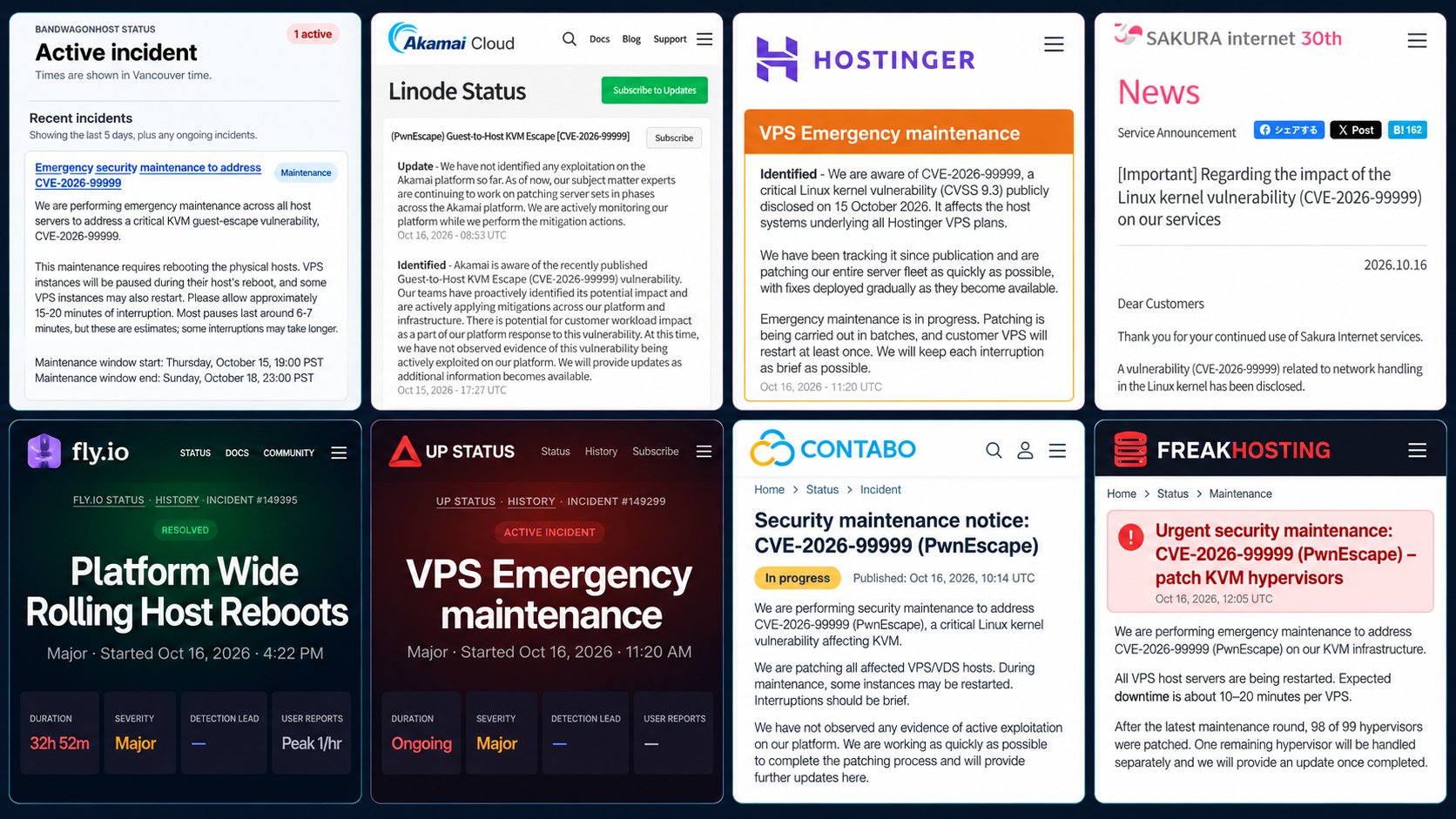
- @pwn_ai disclosed PwnEscape, a KVM guest-to-host escape via a Linux kernel networking flaw (CVE-2026-99999) that reaches root execution on hosts. @PaulosYibelo expects VPS and compute engineers to lose their weekend to hypervisor reboots.
- @josesilesdata reports AnyPS5 runs PS5 games natively on Windows and Linux by translating executables instead of emulating the console, with games already hitting 60 fps and 27,800 GitHub stars.
- Two @TimSweeneyEpic posts circulated widely: one arguing AI should absorb the routine 70% of engine coding, another predicting "a new golden age of gaming" as previously uneconomical games become viable.
- @TeksEdge says Mistral shipped a 209M-parameter time-series foundation model that forecasts in roughly 140 ms on CPU, claiming #1 zero-shot results on three public benchmarks.
A Key-Draining Breach and a VM Escape Made It a Patching Weekend
The details from @opencode are thin because the incident is ongoing: affected users were notified by email, the impact was limited to a subset of Console users with external providers linked, and the team says it is working with Anthropic, OpenAI, and Google to remediate. @sudoingX fills in the texture: one user says keys used only in opencode ran up over $400 overnight, another reported $1,700, and every affected account had external providers linked. Worth noting the tension in framing: a "distillation attack" usually describes extracting model behavior, but the reported damage here is drained API keys. Until opencode publishes more, treat both the term and the numbers as preliminary.
The same weekend, @pwn_ai published PwnEscape, describing a path from untrusted VM code to host-kernel memory reads, controlled writes, and root command execution via a Linux kernel networking flaw affecting "industry standard hypervisors." @PaulosYibelo's reaction is sympathy for the admins doing emergency patching and rebooting, noting security bugs have a habit of dropping right before weekends. Two incidents, both touching the infrastructure layer, is a rough couple of days for anyone running compute.
AnyPS5 Translates PS5 Games Into Native PC Programs
Per @josesilesdata, AnyPS5 skips emulation entirely: a "relinker" converts the PS5 executable to your system's native format, the console's internal libraries get rewritten, shaders are recompiled to Vulkan, and input works through SDL (sticks and triggers) or keyboard and mouse. The author likens it to the approach that let Windows games run on Linux. The reported traction: games running at 60 fps, a compatibility list growing weekly, nearly 5,000 commits, 27,800 stars, 2,400 forks, GPL-2.0 license. All of those numbers are the author's, with no independent verification in this feed, but the mechanism described is coherent.
The same day brought the inversion: @0x0SojalSec posted a PS5 booting Windows 11, launching Ryujinx to play Hollow Knight, then casually returning to the PS5 dashboard ("either peak tech or the start of the simulation collapsing"). The same account also claims inFAMOUS Second Son now runs on Windows and Linux through AI-assisted reverse engineering. PS5 titles becoming PC programs while a PS5 becomes a PC, in the same feed, is a fitting snapshot of where compatibility work is headed.
Tim Sweeney Wants AI to Take the 70 Percent of Coding That Was Never Hard
In a long post quoted by both @petergyang and @boneGPT, @TimSweeneyEpic recalls writing Unreal Engine 1: roughly 30% of his time went to genuinely hard problems (assembly texture mappers, C++ BSP trees, networking), while 70% was typing and refactoring large bodies of code, which he says "didn't feel much different from vibe coding today." He argues it was always logical for AI to take that 70%, and that the real surprise is AI acting as an "insta-Carmack" that solves hard technical problems cleanly and works in complex 3D scenes, both by operating tools and by reading raw data files. He closes with an analogy to abandoning assembly in 1998: what matters is the end product.
A second @TimSweeneyEpic post, quoted by @dhh, predicts the games that never got built because they would cost several times more than they'd earn will soon become possible. @dhh compresses it to "AGE_OF_AGENTS == AGE_OF_ABUNDANCE." @petergyang hopes the StarCraft 3 team is reading and ships before 2030, while @boneGPT adds the origin story, from Jazz Jackrabbit and Jill of the Jungle to Fortnite.
Agent Tooling Pushes Into Daily Enterprise Work
Several posts point the same direction: agents moving from demos into routine work. @bcherny quotes @ClaudeDevs announcing that Code Review is generally available for Claude Team and Enterprise plans, with faster reviews and admin-selectable Quick, Standard, or Deep levels per repo; @bcherny says it runs on all his PRs and "catches almost every bug," calling it part of his team's secret sauce.
On the Microsoft side, @davidfowl quotes @DanWahlin on Work IQ in the GitHub Copilot app: Wahlin batch-created GitHub issues linked to M365 files in under 30 minutes instead of hours, including a reusable skill for future syncs, while @davidfowl calls the broader feature set (meeting booking, scanning Teams chats and meetings from an agent CLI) a game changer for the Microsoft enterprise ecosystem.
Scale is improving too. @BrendanFalk quotes @mxstbr confirming ChatGPT and Codex now use code mode and tool search, that the ~2k tools-per-MCP-server limit mainly guards against abuse, and that Cloudflare is about to serve its raw toolset of 3k tools. Falk's takeaway: models handling 3k exposed tools just fine is the notable part.
Two posts on the people behind the tools: @mvanhorn profiles Lauren Tan (@poteto), the Cursor engineer behind Grok Bot, covering her path from an Excel macro to the React Compiler, rebuilding Grok Bot on her Dune framework across 600+ PRs, and her own caveat that she didn't build it alone. And @distortgeekin packages an unverifiable anecdote (a "SpaceXAI engineer" running 200+ agents that audit each other nightly) into a pasteable prompt; treat the anecdote as marketing, but the underlying loop, turning mistakes into persistent rules, is the reusable idea.
Briefs: A Cancelled Booth, Reset Wars, Open Weights, and a Hot Plate
- @GergelyOrosz reads AWS's last-minute cancellation of Cloudflare's Re:Invent booth, which @eastdakota says Cloudflare will work around with free side events, as a sign AWS treats Cloudflare as a competitor, since cancelling a partner booth is "unheard of."
- @_mohansolo announced quota resets for Argon and Gemini on Antigrativity's weekend build push (note: the platform is Antigravity); @beffjezos quipped "Google has its own Tibo now. Let the reset wars begin."
- @finkd says Muse Spark Open weights release today and run great on new Mac Studios thanks to work with Apple, shared by @oprydai mostly for the "billionaire desk setup" joke.
- More Mistral detail from @TeksEdge: the 209M model is 837MB in FP32, ingests up to 32,768 historical time steps, forecasts up to 1,024 steps per forward pass, and outputs 21 probability quantiles; a 5M variant (Timestral-5M) shrinks to 21MB and ~10 ms on an 8-thread CPU, per Mistral's claims.
- @lennysan shares @lil_dill's Summit talk on avoiding "zombie UIs," with four ideas: have a point of view, encode your standards into the machine, don't confuse done with good, and unleash artistry. The premise: using AI only to make existing things faster misses the interesting part.
- @badlogicgames endorses the USB-C hot plate from @MehdiHacks's backpack-sized soldering kit (hot tweezers, hot air gun, iron, mini plate), while admitting he can't quit his desktop station.
Practical Takeaway
The strongest signal this weekend is key hygiene. If you linked external providers to OpenCode Console, rotate those keys now even if you didn't receive the incident email; @opencode says only 1.4% of Console users were hit, but a rotation costs minutes and a drained key reportedly cost one user $1,700 overnight. More broadly, @sudoingX's advice generalizes to any hosted agent harness: keep provider keys on machines you control and scope them per project. And if you run hypervisors for others, patch before Monday.
Sources
L
Head of Design at Stripe on how to stop creating zombie UIs https://t.co/CPOePWA5SG

L
lil_dill
@lil_dill
If we only use AI to make the things that we already make, just faster, then we're definitely missing out on the most interesting part. From my talk at @lennysan’s Summit, here are four ideas for raising the ceiling, not just the floor: - Have a point of view [5:38] - Encode your standards into the machine [9:07] - Don't confuse done with good [12:21] - Unleash creativity and artistry [16:19] Full talk here: https://t.co/E3fvBWWtHs
B
I could not imagine being productive without Claude Code Review. It runs on all of my PRs, and catches almost every bug before it goes it. This is a piece of the secret sauce that lets the team and I move so quickly while raising the quality bar
C
ClaudeDevs
@ClaudeDevs
Code Review is now generally available for Claude Team and Enterprise plans. Reviews are now faster, catch more of the bugs that matter, and admins can pick from Quick, Standard, or Deep review levels for each repo. https://t.co/RO4tDC4U1U
M
the desk setup of Billionaire btw.
F
finkd
@finkd
Muse Spark Open -- weights releasing today -- runs great on new Mac Studios thanks to work with @johnternus and Apple. https://t.co/U2wJNrKBOg
B
Google has its own Tibo now
Let the reset wars begin
_
_mohansolo
@_mohansolo
Lots of excitement for Argon and Gemini this week on Antigravity. Resetting Argon and Gemini model quotas for everyone. Keep building through the weekend!
G
At Big Tech annual events like AWS Re:Invent, Microsoft BUILD, GitHub Universe etc these co’s sell sponsor booths for PARTNERS in their ecosystem.
Cancelling a sponsor booth last minute is unheard of: and yes, it suggests AWS is shit scared of Cloudflare, as a COMPETITOR.
E
eastdakota
@eastdakota
Amused that AWS just unilaterally cancelled Cloudflare's Reinvent booth. There are always signs when someone finally realizes they're losing. Guess we'll just attend and throw the most fun side events without paying Amazon! Reply if you want an invite. https://t.co/LunwlPvJqe
J
👋🏼ADIÓS A LA PLAY STATION 5!!
PUEDES CORRER LOS JUEGOS DE PS5 EN PC.
Sin emulador. Léelo otra vez: sin emulador.
AnyPS5 no imita una PS5 por encima.
Coge el ejecutable del juego y lo TRADUCE al formato nativo de tu sistema, para que corra directo en Linux o Windows como un programa de PC más.
→ Nada de emulación ni de un proceso aparte por detrás
→ Un “relinker” que convierte el ejecutable al formato de tu sistema
→ Reescribe las librerías internas de la consola
→ Recompila los shaders de la PS5 a Vulkan
→ Mando por SDL con sticks y gatillos, o teclado y ratón
Es la misma magia que hizo que los juegos de Windows corrieran en Linux.
Pero con la consola de Sony.
Y se mueve rapidísimo: ya hay juegos corriendo a 60 fps, una lista de compatibilidad que crece cada semana y casi 5.000 commits.
27.800 ⭐. 2.400 forks. GPL-2.0.
Link en los comentarios 👇🏻

M
seriously, get that hot plate. it's amazing.
still can't give up on my desktop soldering station, but thise wireless soldering irons sure are tempting.
M
MehdiHacks
@MehdiHacks
In 2026, you can carry your entire soldering and desoldering toolkit in a small backpack, all powered by USB-C! Left to right: hot tweezers, hot air gun, soldering iron, and mini hot plate. https://t.co/wXptGZtQ7l
D
SpaceXAI engineer, Lingxi Li:
"My Grok Bots run 200+ agents. Not one of them has made the same mistake twice.
At 3 a.m. one bot audits the other five. I wake up to a smarter team"
I turned her 3 a.m. audit into one prompt you can paste tonight
Mistake → Rule → Memory → Instructions → Self-Improving Team
Most people re-explain the same fix to their bot every single week
Worth more than most $1,000 agent engineering courses
Bookmark it and set it to run at 3 a.m. tonight
Then read the full guide on building a team of Grok Bots below ↓

D
distortgeekin
@distortgeekin
Grok Bot: How to Build Your First AI Team (Full Guide)
M
TL;DR of my new article: who Lauren Tan (@poteto) really is, and how the engineer behind Grok Bot went from 31K to 198K followers in ten weeks.
She has been at Cursor for less than seven months, not even long enough to hit a typical one-year vesting cliff. In that time @elonmusk has reposted, quoted, or replied to her at least 21 times.
🇸🇬 A teenager in Singapore whose dad gave her Photoshop at 15, then a finance degree where her first program was an Excel macro
🎤 Her tweets got her invited to speak at EmberConf, and her talks got her DockYard, Netflix, and the React team
⚛️ Sole author of the React Compiler Beta post, co-author of React Compiler 1.0
🐶 Binnie, her bug-fixing Slack bot, helped inspire Grok Bot because she is "a fairly lazy person"
🏗️ She rebuilt Grok @bot on Dune, her agent-first framework, in more than 600 PRs
🚀 Her 2,500 PRs talk has 3.9M views: "You can't spawn 100 agents when you don't even trust the output of one agent."
🌌 Grok Bot Galaxy, a 72-hour livestream building a company with @grok and @bot, which Elon quoted to 30M views
🥔 pstack, where the P is for potato
Caveat: she is the first to say she did not build Grok Bot alone. "I wouldn't say I built it all."
M
mvanhorn
@mvanhorn
Who Is Lauren Tan, aka Poteto? The Architect Behind Grok Bot, and the Engineer Elon Keeps Reposting
S
holy shit, opencode got hacked and it's officially fu*ked
'a large scale distillation attack, 1.4% of console users hit'
and people got drained, one user says his openai and anthropic keys, used only in opencode, ran up over $400 overnight, another replied $1,700. who compensates that?
every one of them had external providers linked, and it's still ongoing
this is the warning for all of us, build your own harness and keep your keys on your own machine, don't park them in anyone's console anymore
O
opencode
@opencode
We had a security breach last night related to a large scale distillation attack that impacted 1.4% of OpenCode Console users We have notified them all this morning via email. If you did not get an email you were not impacted, it was a subset of users who had external providers linked The incident is ongoing so we cannot share more details at this point but we are working with Anthropic, OpenAI, and Google to remediate
P
I feel bad man 😭 Apologies to the thousands of VPS and compute engineers worldwide spending their weekend emergency patching and rebooting hypervisors because of CVE-2026-99999. Security bugs really do love getting disclosed right before the weekend. https://t.co/iBN6gSK9Ra
P
pwn_ai
@pwn_ai
Introducing PwnEscape 🦉: a full KVM guest-to-host escape via a Linux kernel networking flaw affecting industry standard hypervisors. CVE-2026-99999 went from untrusted VM code to host-kernel memory reads, controlled writes, and root command execution. More below: https://t.co/KrNtI2zzCu
M
PS5 emulating the PS5.
A PS5 open Windows 11, launch Ryujinx, and play Hollow Knight then casually go back to the PS5 dashboard like nothing happened.
This is either peak tech or the start of the simulation collapsing. https://t.co/meVJ7ERb6a

0
0x0SojalSec
@0x0SojalSec
WTF, a PS Games 'inFAMOUS Second Son' is now playable on PC. PlayStation exclusive is now running on Windows and Linux through reverse-engineering work with AI. PC players can finally experience one of the better superhero games of the last generation. The community is going crazy with AI. - https://t.co/np2K5AoskC
B
Cloudflare is about to expose an MCP with 3k tools and ChatGPT/Codex is going to be able to handle it just fine. Amazing!
M
mxstbr
@mxstbr
Yes it's true. We use code mode & tool search across ChatGPT and Codex now. Our current limit of tools per MCP server is ~2k, but that's really only there to prevent abuse. We have plenty of MCP servers that are in the hundreds and even some in the thousands. Even Cloudflare is about to serve their raw toolset of 3k tools to ChatGPT instead of code mode! Go watch @sarfata's keynote at MCPCon this week for more fun stats :)
D
AGE_OF_AGENTS == AGE_OF_ABUNDANCE
T
TimSweeneyEpic
@TimSweeneyEpic
The games we've long wanted, which didn't exist because they'd cost several times more to make than they'd earn back, will soon become possible. As will the games developers wanted to build, but couldn't with the resources available. It'll be a new golden age of gaming.
D
Mistral recently released a 209M model that can predict future data locally on a CPU in ~140 milliseconds.
Not every useful AI model needs to talk (just like Jev)
No GPU required.
It's a super small foundation model designed for time-series forecasting.
Give it historical data like:
📈 sales
⚡ power usage
🏭 sensor readings
📦 demand/inventory
🌡️ telemetry
…and it predicts what comes next without training a new model for each dataset.
The largest version stats
🧠 209M parameters
💾 837MB FP32
🖥️ runs on CPU or GPU
📚 up to 32,768 historical time steps
🔮 forecasts up to 1,024 steps per forward pass
📊 outputs 21 probability quantiles
🎯 Mistral says it ranks #1 among pretrained/zero-shot models on all three major public forecasting benchmarks
🥇 GIFT-Eval
🥇 TIME
🥇 fev-bench
It can get small like Timestral-5M → 21MB
Mistral says on an 8-thread CPU:
⚡ 5M model → ~10 ms
⚡ 209M model → ~140 ms
for a one-day forecast from three weeks of 15-minute data.
🔗 Links below in ALT.

P
Tim is so right. Hope the devs building StarCraft 3 sees this tweet and embrace AI to ship before 2030 🙂
T
TimSweeneyEpic
@TimSweeneyEpic
When I was writing Unreal Engine 1, my time was divided as follows: - Around 30% went to seriously deep coding on hard problems: assembly language texture mappers, C++ BSP trees, data persistence, object oriented systems design, and networking. - Around 70% was just typing and refactoring large bodies of code needed for a complete engine feature set. This was not hard, and while I was doing it my mind was mostly on the deeper coding topics, thinking and planning for what's next. It didn't feel much different from vibe coding today, except that it was just me typing code on an IBM Model M keyboard rather than prompting it and reviewing the results. So, it has always seemed perfectly logical that we would rely on AI for that 70%, once the AI could do it with a similar quality standard as we could, which has never been perfection. It came as no surprise that, after a few years of AI model evolution, it was able to take the reigns on that 70% and free up programmers' time for more valuable tasks. What's more of a surprise is the emergence of AI as a sort of insta-Carmack able to solve hard technical problems quite cleverly and often cleanly, and that it's able to reason about and work in complex 3D scenes both by operating the tools and by directly understanding the raw data files. I abandoned assembly language in 1998 when out-of-order CPUs made much simpler C/C++ code faster, and never I missed it. If prompting through architectural documents, concept art, and design plans can transcend typing code and tweaking vertices, that will enable developers to spend their time on higher-level, higher value technical and creative tasks. What matters is the end product, whether it's a game or an engine. Anything developers can do to try out more ideas and make better software and games faster is a win for everyone.
B
tim sweeney made jazz jackrabbit and jill of the jungle then wrote the unreal engine himself which eventually leads to multibillion dollar fortnite all from north carolina.
a real inspiration. the american dream.
T
TimSweeneyEpic
@TimSweeneyEpic
When I was writing Unreal Engine 1, my time was divided as follows: - Around 30% went to seriously deep coding on hard problems: assembly language texture mappers, C++ BSP trees, data persistence, object oriented systems design, and networking. - Around 70% was just typing and refactoring large bodies of code needed for a complete engine feature set. This was not hard, and while I was doing it my mind was mostly on the deeper coding topics, thinking and planning for what's next. It didn't feel much different from vibe coding today, except that it was just me typing code on an IBM Model M keyboard rather than prompting it and reviewing the results. So, it has always seemed perfectly logical that we would rely on AI for that 70%, once the AI could do it with a similar quality standard as we could, which has never been perfection. It came as no surprise that, after a few years of AI model evolution, it was able to take the reigns on that 70% and free up programmers' time for more valuable tasks. What's more of a surprise is the emergence of AI as a sort of insta-Carmack able to solve hard technical problems quite cleverly and often cleanly, and that it's able to reason about and work in complex 3D scenes both by operating the tools and by directly understanding the raw data files. I abandoned assembly language in 1998 when out-of-order CPUs made much simpler C/C++ code faster, and never I missed it. If prompting through architectural documents, concept art, and design plans can transcend typing code and tweaking vertices, that will enable developers to spend their time on higher-level, higher value technical and creative tasks. What matters is the end product, whether it's a game or an engine. Anything developers can do to try out more ideas and make better software and games faster is a win for everyone.
D
Absolute game changer if you are in the Microsoft enterprise ecosystem. Booking meetings, scanning teams chats and meetings and more, all from my agent cli
D
DanWahlin
@DanWahlin
Work IQ in the GitHub Copilot app is amazing! I needed to add a bunch of issues to a GitHub project that all link to M365 files for tracking purposes. Would've taken me hours to add the issues manually, their titles, descriptions, links in M365, etc. but I got it done in < 30 minutes - which included creating a reusable skill that I can use to sync files to project issues in the future. Time to get outside. 😀 Work IQ MCP: https://t.co/jO7JZILi0P