Jev Day Two: Builders Ship Routers and Open-Source Clones While One Benchmark Draws the Limits
The day after Jev's launch, developers converged on fixed-label classification as the model's real sweet spot, with model routing, instant context compaction, and sub-300ms browser control as the standout demos. @drewdil's production benchmark provided the sharpest reality check, showing Jev matching small-model classifiers at up to ~100x lower cost while failing quality judgment and code review, even as open-source Qwen-based lookalikes and reproductions arrived within 48 hours.
Quick Hits
- @drewdil posted the day's most substantive test: benchmarking Jev against production judges for a day, it matched or beat existing small-model classifiers on fixed-label tasks at up to ~100x lower cost, but found none of 13 human-identified code-review problems and only 2 of 12 real contradictions between decisions.
- Model routing is the most-repeated build pattern across the day's posts, from @ephraimduncan's working router demo to @agentnative_'s copy-paste prompt and @da_fant's case for using Jev to triage which events should wake an expensive orchestrator agent.
- Open-source lookalikes landed fast: @harshagundal released Qwen-2.5-1B-RLCD ("They were building in stealth for 2 years, I was building in stealth for 2 hours"), Shopify's @kshetrajna built a Qwen-based variant running on WebGPU in the browser, and @mmastrac reports third-party reproductions of DiffusionGemma-as-Jev.
- @Dorialexander flagged "synthetic pretraining spotted," and Jev co-founder @CompleteSkeptic confirmed in a reply that 100% of the project's data is synthetic and that the team considers itself a data research lab.
- Latency demos keep escalating: @moritzkremb drove a browser by voice at $0.0002 per decision, and @maubaron had Jev control four Smash Bros characters playing against itself for a few cents.
A benchmark separates what Jev can and can't do
@drewdil's post is the most useful thing published about Jev today, because it draws a clean line through the hype. After a day of testing against his company's production judges, his conclusion: Jev excels at "picking a label from a fixed list, when the list is defined by you and the evidence is in the input," and fails when the answer depends on a model's own sense of quality.
The wins are specific. Classifying sales-call transcripts into one of 32 call types: 35 of 36 correct including 20 adversarial cases, versus 34 of 36 for the current classifier, at roughly 100x lower cost. Typing knowledge-graph relationships from a fixed vocabulary passed all four quality gates at ~65x lower cost and 15x lower latency. Slack channel categorization went 16 of 16. Median latency ran 100 to 200ms across ~3,700 calls, with nine server errors and no throttling. Notably, when Jev was wrong its confidence score was usually low, while a frontier model claimed 95% confidence on both of its misses.
The failures cluster around judgment. On grading agent outputs against a written rubric, Jev would have let 27 of 71 real production rejections through. On code review of 14 merged PRs, it found none of the 13 human-identified issues and generated 24 noise notes on cleanly approved PRs. Six rewrites of the question changed nothing. @isaac_flath's post independently lands in the safe zone: his six "still using in 60 days" use cases (fact-checking scripts, ranking a news feed, finding text in PDFs, checking citations, grouping review notes, running evals over agent traces) are all fixed-answer tasks where the evidence is in the input.
Model routing becomes the default demo
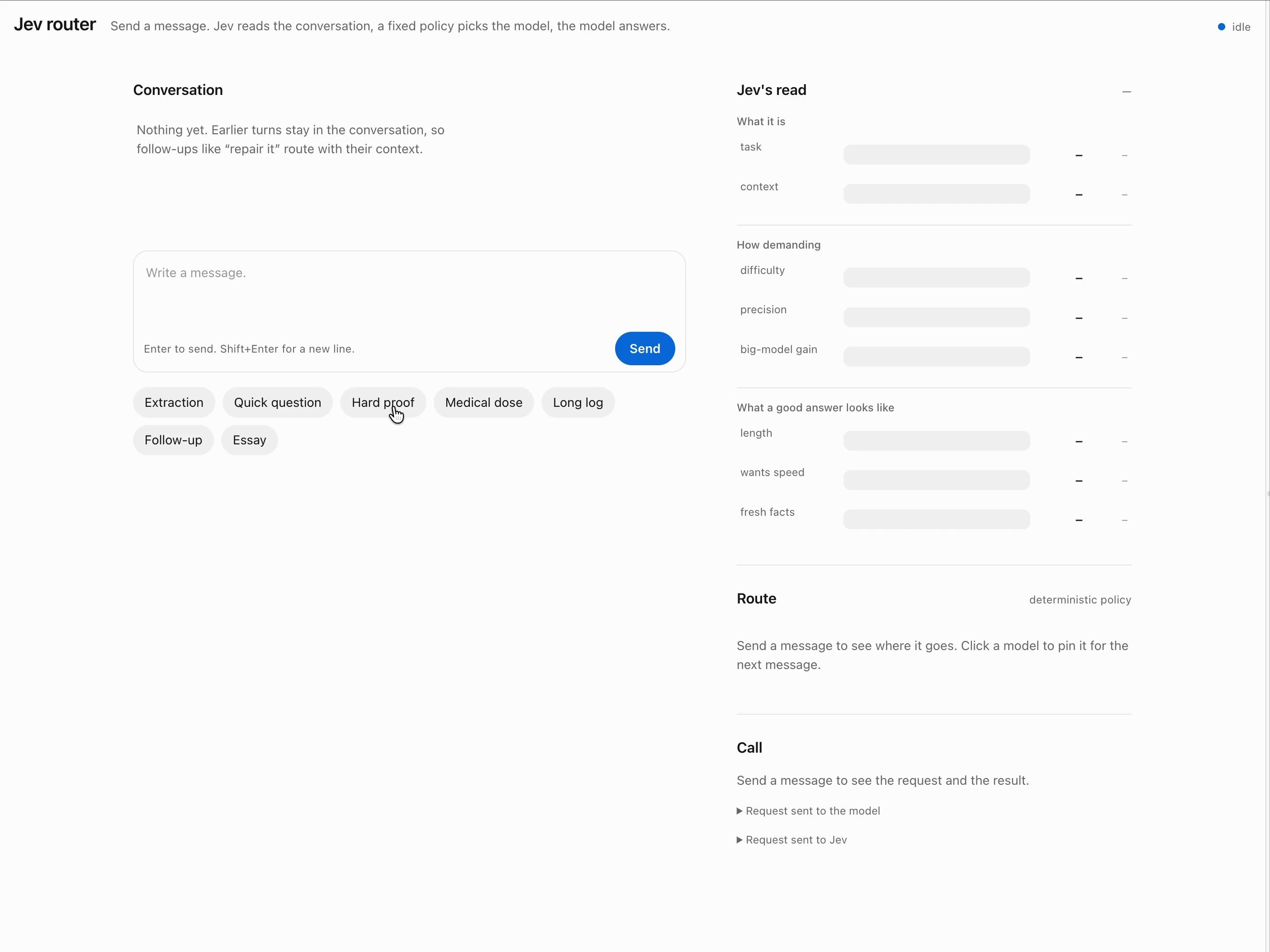
If one application pattern dominated the day, it's using Jev to pick which model handles a request. @ephraimduncan built and demoed a router where Jev matches requests to the best-fitting model. @agentnative_ went further and published a full prompt for building such an agent with Vercel's eve and its AI gateway, cheap models for simple queries and frontier models for hard ones, with the Jev selection shown inline.
@da_fant's thread argues the bigger prize is subagent orchestration: long-running agents get woken by every user message, email, or subagent reply, and waking "gpt 6 astra" with 100k input tokens costs about $1. Jev can decide whether each event routes directly to a subagent, queues for later, or wakes the orchestrator. @Saccc_c makes a similar case from the Codex side, claiming Jev makes Codex operations roughly 10x faster and cheaper and listing computer-use judgment, context compression, routing, and auto-moderation as the fit scenarios, including moderation that is cheaper and more precise than "5.6 luna."
@thekitze wired Jev into his skillbox tool so agents skip multi-turn skill discovery, then open-sourced the whole thing under MIT. And @AM09_21 points Japanese-speaking users to the official Jev use-case page for anyone stuck on what to do with it.
Millisecond decisions: compaction, browsers, spreadsheets, games
The second cluster exploits Jev's latency directly. @tamarajtran's instant-compaction idea replaces summarization prompts with per-tool-call scoring; @SUOHA_AI reports the open-sourced Claude Code plugin clears useless terminal output and redundant logs in milliseconds, and says co-founder Diogo Almeida publicly endorsed it as a way for coding agents to bypass traditional KV cache limits.
Real-time control demos built on the same property. @moritzkremb's voice-to-browser loop returns probabilities in ~300ms at $0.0002 per decision, fast enough to complete a "go back" request before he finished the sentence. @maubaron had Jev play Smash Bros against itself, controlling all four characters, burning 22 million tokens for cents. @dabit3 showed predictive spreadsheets where typing "Urgency" gets every row rated in ~100ms, plus a keystroke-aware launcher that surfaces "the pdf I just downloaded" on every keystroke. @dotpem sketched a DAG prototype that classifies input as Python or bash and routes accordingly. @vimota proposes qualitative linters with free-form rules checked at chosen granularities, and @rafalwilinski runs a parallel browser-based adversarial test suite against each release "for pennies."
Clones, reproductions, and scrutiny of the origin story
The open-source response was immediate. @harshagundal's Qwen-2.5-1B-RLCD claims every LLM can already batch-inference JSON keys and output category probabilities without new training, with a demo on an M4 MacBook; @ScarletKc amplified the two-years-versus-two-hours contrast. At Shopify, @kshetrajna built Reflex, a Qwen-based structured-decision experiment running on WebGPU, which @tobi shared with "have jev running in your browser." @mmastrac reports reproductions of DiffusionGemma-as-Jev coming in, with @nordiconco confirming a first small test ran well.
Meanwhile @Dorialexander spotted synthetic pretraining, and @CompleteSkeptic's reply confirms 100% synthetic data framed as building a "cognitive core." @MatijaSosic, whose 45-second Jev explainer passed 400k views, argues the launch's big language (AGI, 200x faster, by a ChatGPT creator) was deliberate, preempting dismissal as "just a classifier" and letting the community do the explaining work. The original launch claims of 20-200x faster and 40-400x cheaper remain the founders' own.
Predictions and adjacent tooling
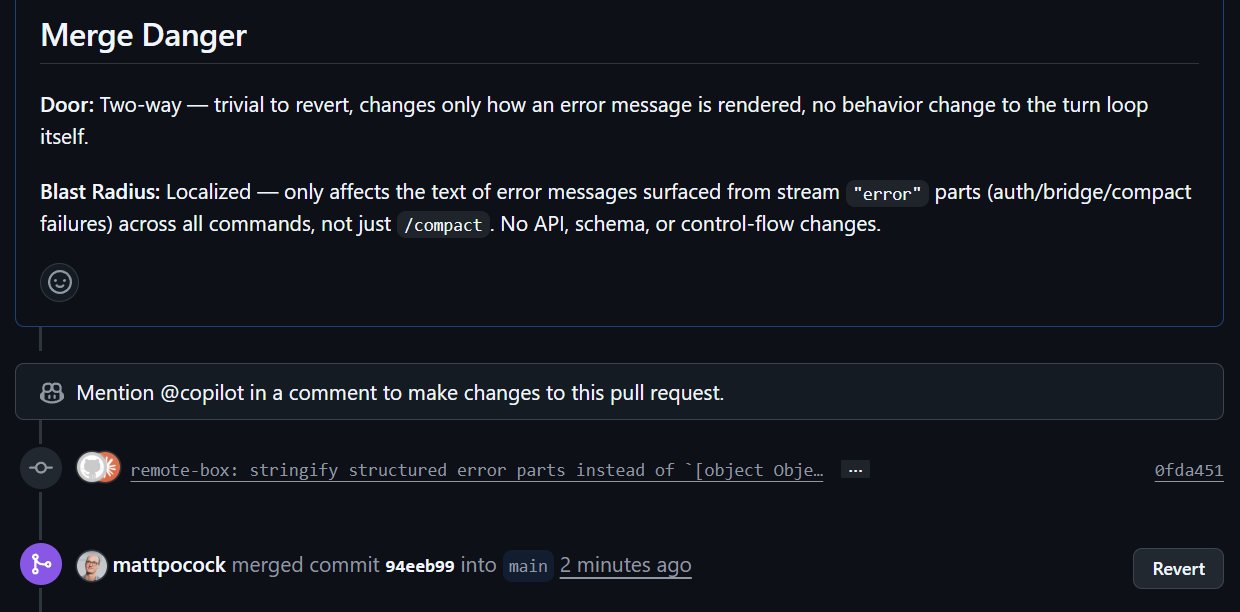
@obie predicts all major frontier labs will ship JEV-style offerings within months and that decision models could outgrow LLMs, drawing on three years putting LLMs into production codebases. @kunchenguid's joke that he'll pass his remaining $5 signup credit to his son is a decent mascot for the token-frugality moment. @dabit3 also boosted @mvanhorn's article on the nine things people are building with Jev. Off the Jev beat, @dexhorthy open-sourced a visual-PR skill for humanlayer to cut agent PR noise, and @mattpocockuk's tip on classifying merge danger (one-way versus two-way door, blast radius) sits right in the fixed-label shape @drewdil found Jev handles well, though the post itself doesn't name Jev.
Practical Takeaway
If you're evaluating Jev, copy @drewdil's methodology rather than the demos: pilot it only on fixed-label tasks where your own taxonomy defines correctness (routing, triage, compaction scoring, moderation), gate on its confidence score and escalate low-confidence answers to a frontier model, and keep it away from quality grading and code review until you've validated against your own labeled fixtures. The cheapest starting point is a routing layer, since several working implementations were published today and the failure mode is only a misrouted request, not a wrong verdict.
Sources
D
Built a model router with Jev by @typesafeai.
Jev decides what model fits your request best and the request is sent to that model. https://t.co/HHlmjOE66u
D
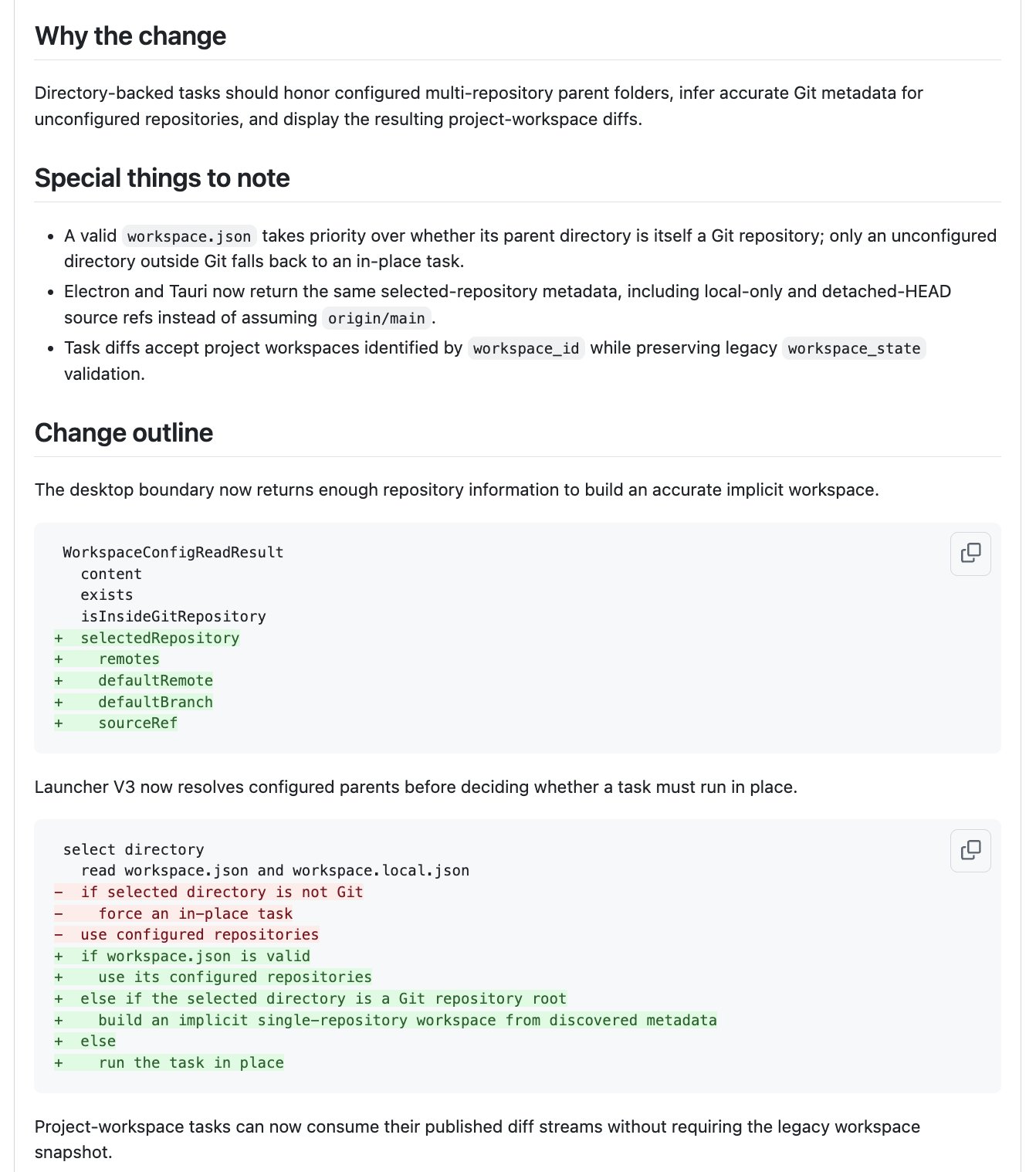
cool product out of riffing w/ @mattpocockuk this week - decided to open source the pull request skill that bundles with @humanlayer_dev - /show-me bundled with some steering to cut out a lot of the slop and noise that comes with most agent prs
It's a small piece of a much larger puzzle, but rather than just share the SKILL.md contents with Matt, I figured we'd just give it to all of you 🙂 enjoy
npx skills add humanlayer/skills --skill visual-pr
M
My Jev explainer did crazy well (>400k views), which shows how well thought out their launch was.
IMO, the Jev crew understood they were at risk of being labeled as "just a classifier" and "this isn't an LLM," so they intentionally threw in some big words: AGI, 200x faster, by ChatGPT creator, ...
That made us all curious, and then we did the work to explain what it actually is.
M
MatijaSosic
@MatijaSosic
Here's a 45-second TL;DR on Jev. I find the core idea beautifully simple, but the video made it really hard to understand. Hope you find it helpful. https://t.co/KtSKlEMVL3
M
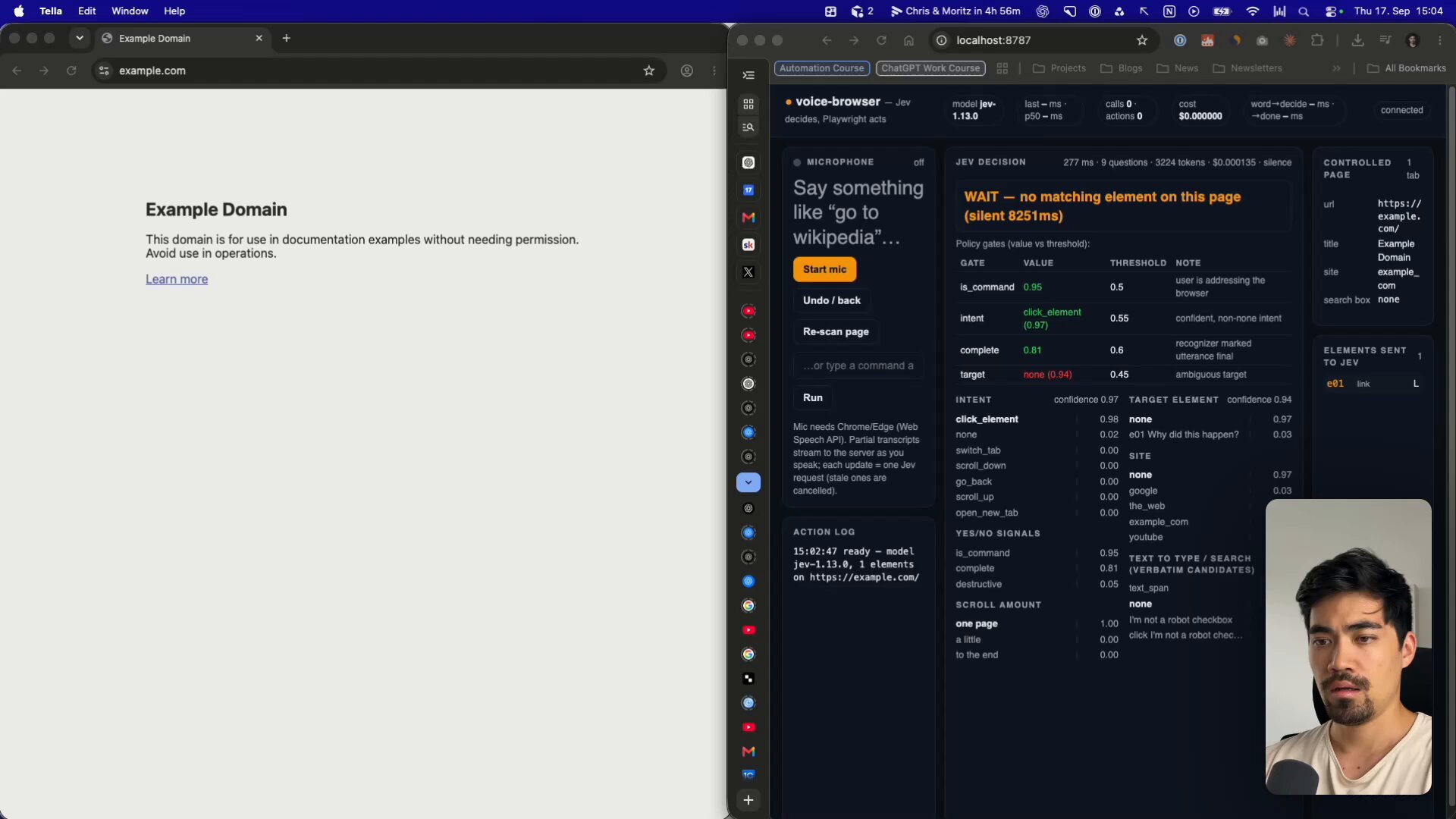
whoa this actually worked! Jev lets me control my browser in real time with my voice now
> i talk
> transcript sent to Jev
> jev returns probabilities in ~300ms
> browser clicks
costs: $0.0002 per decision
i'm stunned how fast this is. when i asked it to "go back", it even finished the request before i finished my sentence 😂
V
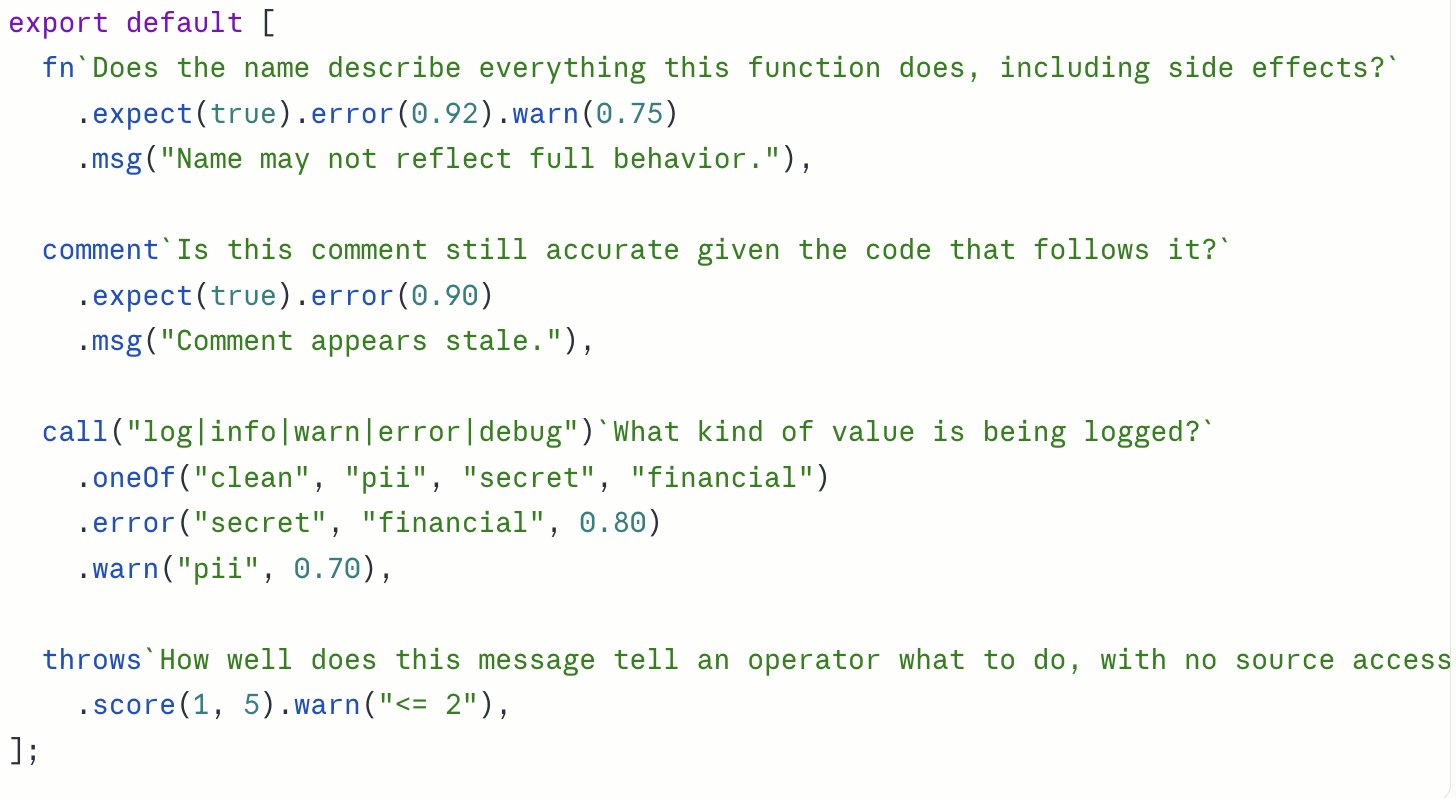
Jev (and fast/cheap generalized classifiers) can make AI qualitative linters actually useable!
Imagine defining free form rules to be checked at specific granularities https://t.co/TP7Qcjgpyw
M
markjaquith
@markjaquith
Jev is coming for your garbage code comments https://t.co/pnqLB9BsYS
I
I've been using Jev by @typesafeai Here's the six things i've tried and am confident I'll still use Jev for 60 days from now.
There's many more experiments, ideas, and things I think I will use it for. It's a big deal (more on why in next post).
But I am only sharing things that I am 99% sure will lead to stuff I will still be using Jev for in 60 days.
That means I started with small, boring, but useful, stuff.
- Fact-checking my scripts
- Ranking my news feed
- Finding the right text in PDFs
- Checking citations
- Grouping my review notes
- Figuring out why agents fail (eval over traces)
https://t.co/nWyMMfxIVi
A
Jev can be used as a model router.
You can try this yourself using Claude or Codex... and build an agent with this single prompt using @eve by Vercel. With AI gateway you will get immediate access to every model.
Use this prompt:
---
I want you to build a new app that uses eve. I want to make an agent that can search the web, create files and anything else an agent might be able to do. use eve you should have vercel key.
I want you to use jev by typesafe as a model router, make a model router for this. i want you to use it to select the best model for the job to save tokens and clearly show, as it's happening when jev chooses which model to use. read the docs for jev, and make it very effective, and test it and make refinements until it's fully ready. For simple queries it should use cheap models. For more complex queries it should use frontier models and have a scale in between for medium questions.
make this then run it locally so i can test it. Make the wrapper beautiful and the main focus should be the inline jev selection, and how that selection was made.
---
https://t.co/KdDJopEcHo
R
rileybrown
@rileybrown
Building an agent with model router powered by Jev. https://t.co/bXyyCvRaC6
A
ちなみにJevのユースケースはココに書いてるから、Jevの使い道に困ったらこのページ見たら全部解決すると思う
https://t.co/rU7RwdyDNM
K
skillbox is now open source! MIT.
https://t.co/aaDe0Da2bY
the readme is not made for you. ask your agent to set it up for you and port your scattered markdown skills into skillbox.
more stuff coming soon.
T
thekitze
@thekitze
i added Jev to skillbox so instead of my dumb agents doing 30 turns on finding the right skill, Jev reads the query and immediately returns the relevant skills 💀 dope shit
A
Without surprise, synthetic pretraining spotted.
C
CompleteSkeptic
@CompleteSkeptic
you might be the first person talking about the data over the architecture! 🥲 we consider ourselves a data research lab! the vast vast vast majority of research was on making data that is truly general (ala a cognitive core) and 100% of our data is synthetic (but not the type of crap that is just spit out from an LLM obviously)
D
jev will make agents 10x faster and cheaper, here's how:
1/ model routing: pick the right model for each task, without training a custom router
https://t.co/7mZbB4vbeF
2/ computer use: faster, cheaper and more reliable for action-heavy tasks
https://t.co/cOeOAABdMb
3/ auto review: ask jev whether an action is safe, instead of using a slow and expensive LLM
https://t.co/H1CCudPOdw
4/ less obvious: subagent orchestration
long-running agents (cursor projects, grokbot, energy) parallelize work with subagents.
but every user message, email, or subagent reply can wake the expensive orchestrator.
example: it costs $1 to wake up gpt 6 astra w 100k input tokens
jev can decide what each event needs:
- route directly to a subagent
- queue for later
- wake the orchestrator
G
gregpr07
@gregpr07
Breaking: Browser Use + Jev = Ultrafast ⚡ Findings flights took 7s and cost only $0.0039 🤯 > new action space every step > DOM state space > small LLM fallback to type (this video is at 1x speed btw) Built a tiny open source browser agent. try it below ↓ https://t.co/AplCBRYC5o
D
With the numbers from a day of benchmarking @typesafeai's Jev against our production judges...
What Jev is good for
Picking a label from a fixed list, when the list is defined by you and the evidence is in the input. That is the shape where it matched or beat the models we run today, at a fraction of the cost and latency.
- Classifying sales-call transcripts into one of 32 call types: 35 of 36 correct on a synthetic set with 20 adversarial cases, versus 34 of 36 for our current small-model classifier. Zero label changes across three repeat runs. About 100 times cheaper per call.
- Typing the relationship between two knowledge-graph nodes from a fixed vocabulary: passed all four of our hard quality gates on a 47-case gold corpus, one case behind production, at roughly 65 times lower cost and 15 times lower latency.
- Categorizing Slack channels into four buckets: 16 of 16 on the held-out set, tied with a frontier model.
- Yes/no questions about evidence that is visible in the input: in our tests, "does this item contain a visible defect" and "is this candidate a real customer signal" both worked.
It is also fast and stable. Median latency was 100 to 200 milliseconds per call. Across roughly 3,700 calls we saw nine server errors and no throttling. Confident answers were identical run to run; only low-confidence answers flipped.
The confidence score is the most useful thing about it. When it was wrong, its confidence was usually low. A frontier model told us it was 95 percent confident on both of its misses.
What Jev is not good for
Judging quality, or anything where the right answer depends on the model's own sense of what counts as good.
- Judging whether an AI agent's output is good enough to publish, against a written rubric: 45 of 50 on our labeled fixtures versus 48 of 50 for a frontier model alone. On a held-out set weighted toward data-heavy outputs it dropped to 18 of 27 with nine false rejects, while production got 24 of 27 with none. Six rewrites of the question changed nothing. On 71 real production rejections it would have let 27 through.
- Judging whether two decisions contradict each other: on 36 human-labeled pairs it found 2 of the 12 real contradictions. Ten of them scored a probability of 0.13 or lower.
- Code review. A staged Jev-only reviewer we tested on 14 real merged PRs, with human review findings as ground truth, found none of the 13 human-identified problems on the PRs it could process and produced 24 low-severity "compatibility" and "test gap" notes across PRs that humans approved cleanly.
The pattern across all of it: Jev works when a definition outside the model fixes the answer, such as a taxonomy or a checkable condition. It fails when the answer is a matter of judgment, because its prior about what is trivial, safe, or contradictory does not match ours and no phrasing moved it.
N
holy shit yes, imagine this in a DAG, with a code interpreter… so many possibilities. a prototype i made a while back, it would classify if you entered python code, or a bash command, and run it, otherwise fall back to standard coding agent input.
M
miiura
@miiura
Function calling without waiting for Enter. Answers only when needed. @typesafeai Jev understands intent and arguments as you type, then executes ahead of time once everything is in place. https://t.co/n4m9lGGf8S
K
笑死,我之前还在说,Jev 这种功能拿个 base 模型做后训练是不是也能实现。
结果真有人做了个 Qwen 版,开源了并行分类和概率输出的实现,作者甚至说不需要重新训练,还放了 M4 MacBook 上的演示。
他配的文案更损:他们秘密研发了两年,我秘密研发了两个小时。
H
harshagundal
@harshagundal
They were building in stealth for 2 years, I was building in stealth for 2 hours… Happy to open source Qwen-2.5-1B-RLCD, 5x faster on-device inference for JSON workloads that need to be type-safe. ⚡️Demo below on a M4 MacBook⚡️ every LLM has the ability to efficiently batch inference every key of a JSON at the same time and generate probabilities from a set of possible categories. No new training required, but it’s easy to optimize if you need! On hugging face now!
M
jev is insane 🤯
here is jev playing smash bros against itself
he is controlling all 4 different characters.
and literally deciding whats the best
move to play against itself
all within a fraction of a second
i used over 22 million tokens to play this match
and it only cost me a couple of cents...
jev does not replace gpt6 astra
but the possibilities with its instant response time
are endless

T
Here, have jev running in your browser
K
kshetrajna
@kshetrajna
“Wonder if we could build that?” is a pretty normal response to new tech at @Shopify. Its a fun place to work 😄 Jev got me curious, so I built Reflex: a Qwen-based experiment in structured decisions + probabilities running on WebGPU https://t.co/z461Y70RzM https://t.co/H7lX4DawPb
O
Mark my words: @typesafeai JEV is not only the new hottness, it's a genuine phenomenon as a whole new wave of normie programmers learn how to plug fast, cheap intelligence into their otherwise normal codebases.
Feels like Xmas 2025 all over again. I predict that all the major frontier labs will have JEV-style offerings within the next few months. I will not be surprised one bit if decision models end up being bigger than LLMs in the long run.
If you think I'm being hyperbolic, consider that hacking LLMs into production codebases has literally been my focus for over 3 years now and I wrote the definitive book on the subject: Patterns of Application Development Using AI
We are definitely in a singularity, because nobody I know saw this coming.
N
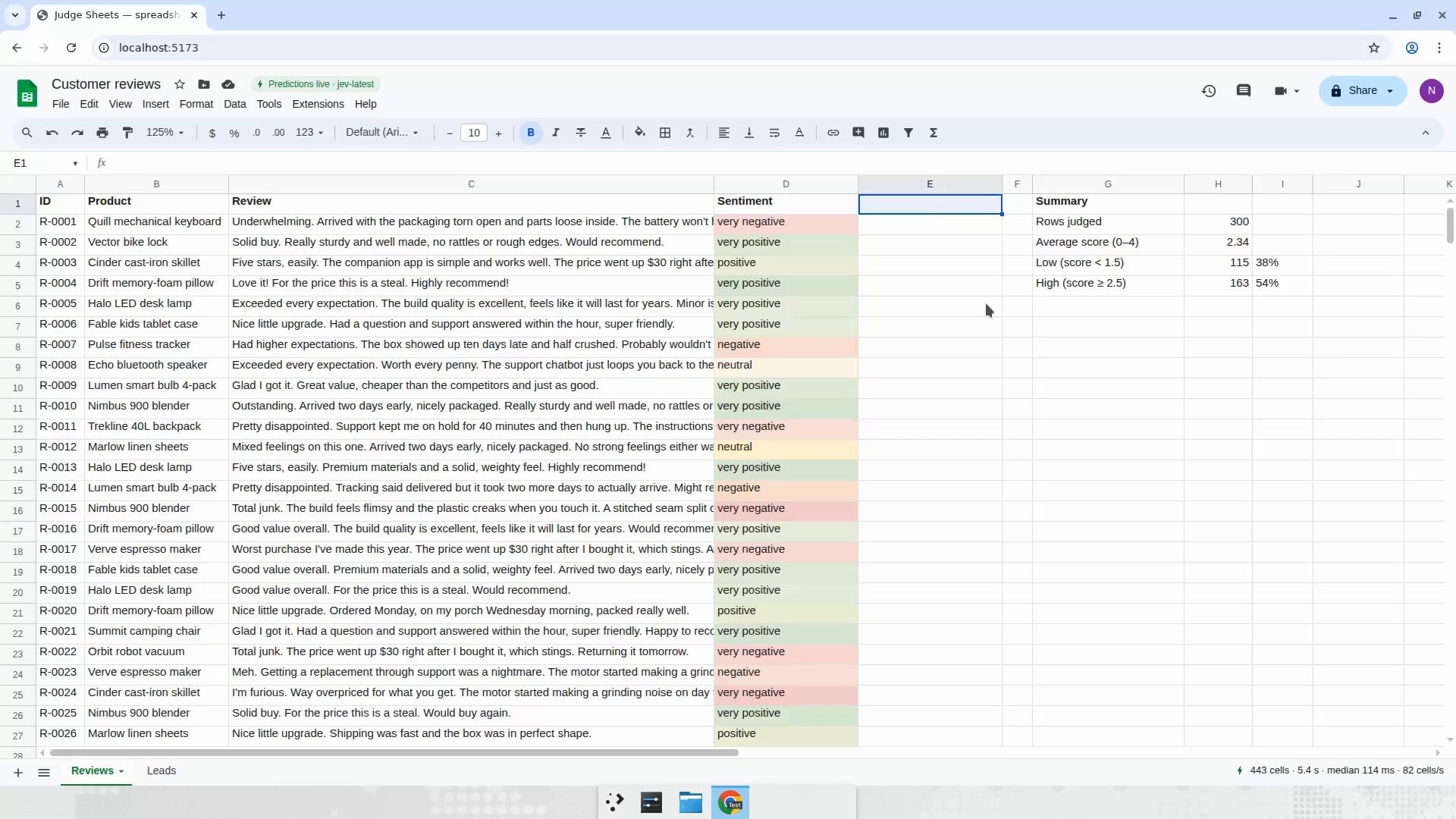
Another crazy @typesafeai Jev example:
Predictive spreadsheets
Spreadsheets recalculate numbers, not meaning. Jev reads intent.
Type "Urgency" at the top of a column and, as you type, it figures out you want each row rated from "no follow-up needed" to "urgent" in ~100 ms. https://t.co/M6REgq4Q8S
D
dabit3
@dabit3
Also have been playing with @typesafeai Jev, insane! So many immediate use cases and new apps are possible. What a time to be a builder! Sharing some experiments here starting with: Keystroke oracle / predictive launcher: Your launcher ranks by aliases, fuzzy match, and habit. Jev reads intent: type "the pdf I just downloaded" and the newest PDF is already the top hit with a full confidence on every keystroke, in ~100 ms
梭
连 JEV 的联合创始人 @CompleteSkeptic 都亲自下场转发点赞:这是 JEV 正确的打开方式!
大家在 Claude Code 里写长代码,最恶心的就是上下文一满,系统就卡住 10 秒去写总结小作文
开发者 @tamarajtran 刚刚开源了这个插件:利用 JEV 的打分能力,几十毫秒内精准识别并清空所有没用的终端垃圾与冗余日志
Github:https://t.co/tINjxy35Em
它的作用是:
• 彻底治好 Agent 失忆症:几千行终端废话和文件内容让 JEV 毫秒级打分,没用的直接扔,核心代码与状态 100% 原样保留
• 彻底消灭卡顿与账单:几十毫秒无感完成瘦身,不花一分钱废话 Token
@typesafeai 的联合创始人 Diogo Almeida 也公开实名认可:这就是编码 Agent 绕过传统 KV 缓存的最佳解法🧐

T
tamarajtran
@tamarajtran
found the perfect use case for @typesafeai Jev: instant compaction in 2026, why is compaction still a summarization prompt? Jev can make it instant by scoring every tool call and dropping what’s irrelevant https://t.co/h6NzKzNpCg
N
RT @mvanhorn: TL;DR of my new article: WTF is Jev by @typesafeai, and the 9 things people are already building with it. The thesis: 𝗮 𝗰𝗼-𝗰𝗿…
M
Reproductions coming in for DiffusionGemma-as-Jev!
N
nordiconco
@nordiconco
@mmastrac I ran this it worked well , first small test https://t.co/GEY1lix2Ez
S
强烈建议大家都亲自试试Jev,能让你的Codex操作速度提高10倍并省下大量token!
因为Jev非常适合用于判断型工作,能在毫秒内做出正确判断,而且token价格极低。因此非常适合以下几个场景:
1、computer use
将Jev用作操作判断层,指导模型快速操作你的电脑
https://t.co/JwPSDGPH2R
2、上下文压缩
由Jev判断上下文内容的重要信息,实现近乎即时的上下文压缩
https://t.co/vmtE5jrK2i
3、模型路由
根据任务复杂程度自动分配合适的模型来处理
https://t.co/mud6jXfNbz
4、自动审核
比5.6 luna还要便宜且精准的自动审核模型,可能是Codex在安全审批方面最合适的工具
https://t.co/4fTD4Q098o
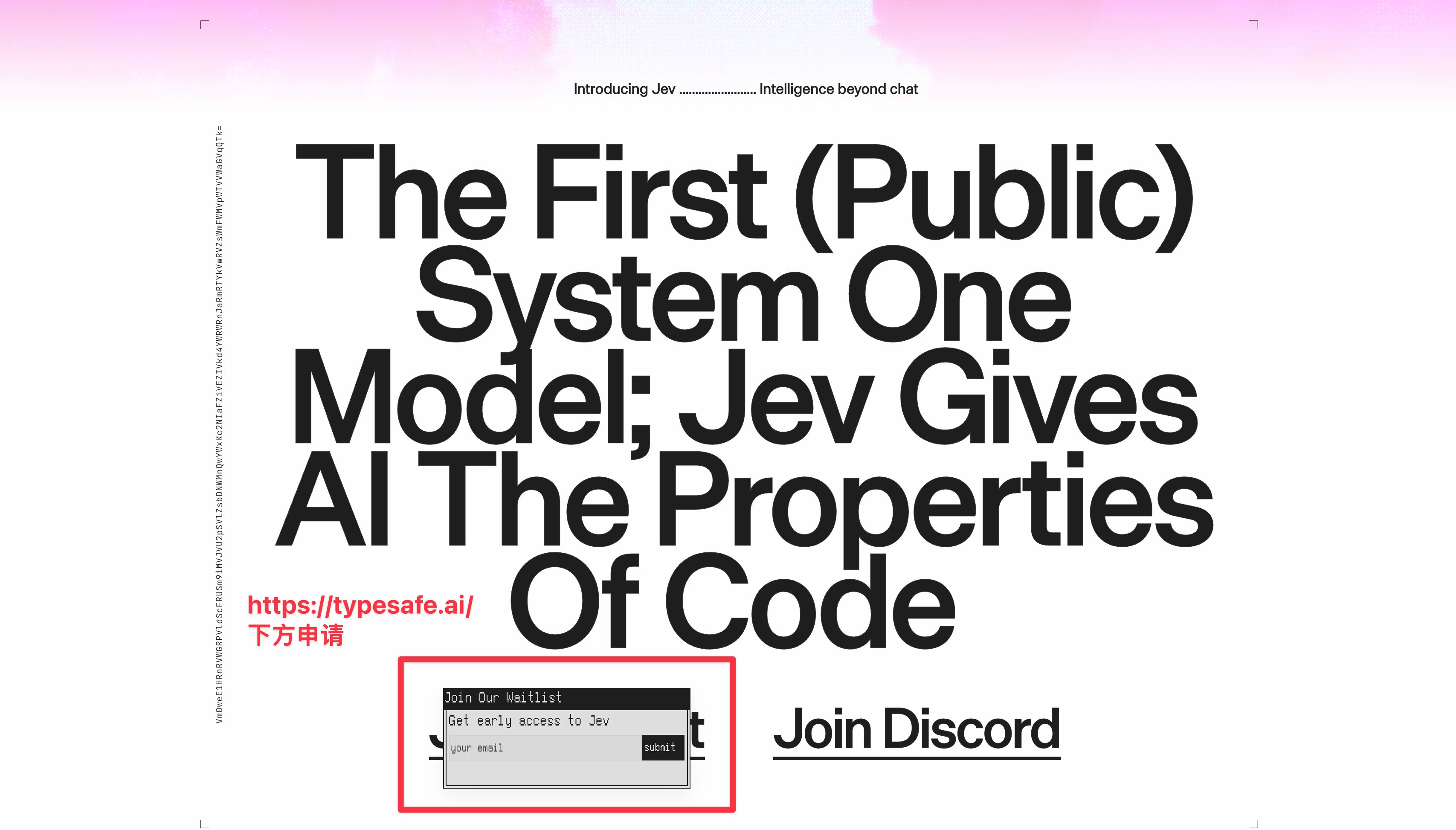
使用的话要去官网 https://t.co/ymd06pv5vs 申请,趁现在还通过的很快大家可以来尝鲜体验一下
C
CompleteSkeptic
@CompleteSkeptic
After co-inventing ChatGPT, I kept asking myself: why have superhuman chat models not led to AGI? I’ve spent the last 2 years in stealth building a new way to train models (RLCD), and a new type of frontier AI model that we are releasing today: Jev • 20-200x faster • 40-400x cheaper (w/ output tokens free) • Frontier composable intelligence optimized for decisions AFAICT the shortest path to AI-based economic revolution
K
Jev gave me $5 of API credit when i signed up
when i die, i will pass what's left of it to my son
R
thanks to @typesafeai's Jev we now have massively parallel browser-based adversarial testing suite that tries to break each release.
and it costs pennies. https://t.co/WoIlqGjjNB

M
Tip: get your agents to classify the merge danger of the PR
1. Is it a one-way door, or a two-way door?
One way doors involve expensive migrations, or are hard to reverse. They need thorough review. Two-way doors are easy to revert.
2. What's the blast radius?
If things go wrong, how bad will it be? Large blast radius: closer review
Helps you apply your precious review time where it's actually needed.