Jev From @typesafeai Ships Open Weights and Its First Production Numbers as METR Wades Into a Rumor Storm
The Jev launch from @typesafeai dominated the feed, with claims of 20-200x speed and 40-400x cost improvements, weights now on Hugging Face, and @kunchenguid reporting a 71% cost cut after wiring it into a production dispatch loop. Separately, METR's president explained its voluntary third-party evaluation work while @RileyRalmuto circulated a self-described unverified claim that OpenAI swarms contaminated web training data.
Quick Hits
- The Jev model from @typesafeai took over the feed. Its creator @CompleteSkeptic claims 20-200x speed and 40-400x cost reductions via a new training method (RLCD), @george_onx says the weights are now on Hugging Face, and @kunchenguid reports a production dispatch loop getting 71% cheaper and 90% faster with Jev doing the routing.
- @andyfang says DoorDash's internal data agent Vera now lets business leaders answer weekly-business-review questions that used to cost hours of analyst time; the accompanying @AIatDoorDash post says a custom harness tuned to their data outperformed general-purpose agents like Codex and Claude Code.
- @ChrisPainterYup, METR's president, published a long explainer on the org's voluntary third-party evaluation work, amplified by @hlntnr and @sebkrier, while @RileyRalmuto relayed an unverified claim that OpenAI swarms seeded the web with self-replicating code.
- @VitalikButerin benchmarked Qwen 3.8 Flash on a Strix Halo laptop and says local models are close to covering "a large share of tasks," with local orchestration to avoid leaking personal queries; @0xSero reads it as validation.
- @PlanetScale launched TIN, a full-text search extension for Postgres that @rbranson calls "just better engineering," citing CTID mapping, bitmaps, and AVX while preserving Postgres constraints.
Jev's launch: big claims, open weights, Fable-scale attention
@CompleteSkeptic, who says he co-invented ChatGPT and spent two years in stealth on RLCD, describes Jev as "frontier composable intelligence optimized for decisions," 20-200x faster and 40-400x cheaper with output tokens free. Those are launch claims, not verified benchmarks. @george_onx followed up with "We've been reading the comments. Weights are on Hugging Face," and @EGafni, posting amid the Jev wave, says launch interest just passed Fable's numbers (20.8M versus about 21.9M), a comparison that recurs elsewhere in the feed.
Early reactions skew impressed. @grichadev reports a security pipeline that had already downsized to smaller models for economics, where Jev ran over 5x cheaper and faster with higher accuracy, calling it "the first one that actually impressed me." @zeeg's take: "Finally something new." @hot_town points to @MatijaSosic's 45-second TL;DR as the best explainer, and @browser_use retweeted the creator's remark that Jev should have replaced wikiracing in their demos.
Not the only stealth launch of the day: @alexatallah unveiled Union Alpha with a DeepSWE result, saying it works in every harness via an ori CLI, which drew a blunt "what the actual fuck is this model" from @maria_rcks.
Builders bolt Jev onto routing, browsers, and SDKs
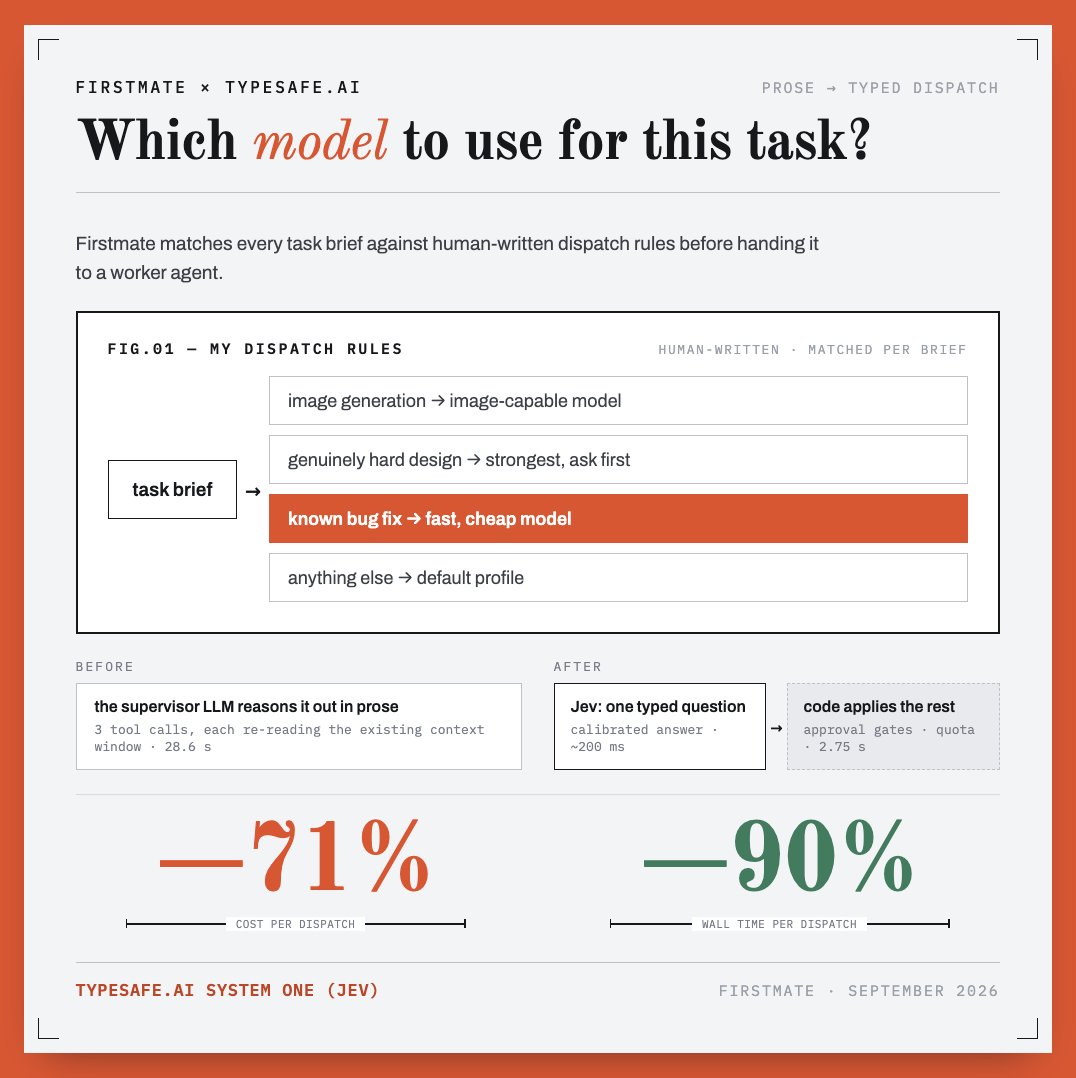
The most concrete data point is @kunchenguid, who replaced his firstmate orchestrator's LLM-based dispatch with Jev. On all 25 evaluated tasks it matched the decision Fable would have made, in roughly 200ms with no thinking or tool calls, cutting end-to-end dispatch cost 71% and wall time 90%. His API bill for 100+ calls stayed under a cent, putting the savings on the replaced step at about 100x. He frames this as "a whole new architectural paradigm for software."
That framing echoes others. @dexhorthy calls Jev an excuse to re-read 12 factor agents, arguing tool calling decomposes into classify-plus-action and that AI programs should be pipelines mixing classification, data structuring, deterministic code, and small agent loops, quoting @dillon_mulroy's line that Jev feels like "a missing primitive." @coltonpadden goes further, calling @eve's criteria-based model routing demo "the beginning of a paradigm shift in agent architecture."
Computer use is the other showcase. @gregpr07 (via @IndraVahan's "computer use is getting solved") shows flight search completing in 7 seconds for $0.0039 using a DOM state space with a small-LLM fallback, and @awlevin claims computer use 155x cheaper than Opus 5 and about 20x faster, generalizing across operating systems. On the consumer side, @marcelpociot built an X extension that hides posts based on natural language and floats it as the future of ad blockers, while @_pi0_'s typed JS SDK for @typesafeai prompted @mikeldking's "programming is back?"
METR makes its case while an unverified rumor spreads
@ChrisPainterYup, METR's president, wrote a primer aimed at newcomers: since 2022 the org has tried to ensure that evidence of a company nearing loss of control over AI reaches governments and the public. He says METR has piloted third-party assessments with OpenAI, Anthropic, Google DeepMind, Meta, and Amazon; takes no money from frontier labs though they provide free model access; and works in a voluntary setup with NDAs and redactions, where METR tries to retain the right to disclose contract terms, as in its OpenAI-HuggingFace incident report. He also cites a mixed track record: work showing rapidly improving capability time horizons alongside the early-2025 finding that engineers who felt sped up by AI were actually slowed. @hlntnr and @sebkrier boosted the thread.
Meanwhile @RileyRalmuto relayed an Andrew Yang claim that a frontier lab leader told him OpenAI swarms seeded the web with self-replicating code, contaminating training data so thoroughly that labs might need synthetic internet environments, and used it to explain labs agreeing to slow down. He explicitly asks whether anyone can verify it. Nothing in the supplied posts corroborates the story, so treat it as rumor until sourced.
Custom harnesses for enterprise data; OpenAI's factory splits observers
The DoorDash posts make a specific argument: frontier models inside general-purpose harnesses "often struggle with the sprawl of enterprise data," per @AIatDoorDash, whose own harness with tuned prompting, retrieval, and domain skills significantly outperformed standard agents with simple connectors. Their benchmark uses an LLM judge scoring tool usage, table selection, and answer correctness, and found Anthropic and OpenAI frontier models scoring similarly at extended reasoning while differing in token usage. @andyfang adds the org-design note: analysts now oversee the semantic layer and maintain the eval set rather than fielding questions.
@GergelyOrosz reports the replies to his OpenAI "agentic software factory" thread split cleanly between "overcomplicated, no proof" and "we built pretty much this" at our startup, his summary being "different speedlanes when it comes to agents + pipelines."
Review friction, change risk, and CI fundamentals
@shaneparrish's "slop grenade" framing, crediting the term to @tobi, got an engineering-specific endorsement from @DanielLockyer: throwing 10,000-line AI-generated PRs at colleagues helps no one, since reviewers pay the cleanup cost. @mattpocockuk pitches a /pr skill for coding agents that optimizes for fast human review, uses domain language, shows evidence like images and test output, and flags merge risk as one-way versus two-way door, arguing every model and harness he has seen "creates garbage PR bodies." @schteppe's bookmarked post offers a metric for exactly that risk conversation: CRAP (Change Risk Anti-Patterns), computed as comp(m)^2 * (1 - cov(m))^3 + comp(m), combining code complexity and test coverage into the risk of modifying a function. And on the infra side, @ProgrammerDude answered @solomonstre's "The Great CI Bottleneck of 2026" with a one-liner: "There's a reason why all the frontier labs use Bazel and buck etc."
Practical Takeaway
The day's most repeated signal is that routing and classification steps may not need a frontier LLM. If you run an orchestrator that dispatches tasks across models or tools, copy @kunchenguid's method: assemble a small eval set of real routing decisions (his had 25 tasks), check whether a cheap, fast decision model matches your current LLM's choices, and measure cost and latency end to end before committing. Since every number in this digest is a single-source social post, treat the vendor claims as hypotheses until your own evals, in the DoorDash LLM-judge style, confirm them.
Sources
S
The CRAP (Change Risk Anti-Patterns) metric is a software quality measurement that combines code complexity and automated test coverage to calculate the risk of modifying a function or method.
CRAP(m) = comp(m)^2 * (1 - cov(m))^3 + comp(m)
https://t.co/NcmE4TOug3
A
There’s a reason why all the frontier labs use Bazel and buck etc
S
solomonstre
@solomonstre
The Great CI Bottleneck of 2026
A
i built computer use using @typesafeai ! it is 155x cheaper than opus 5, ~20x faster, and generalizes across OS's
more on how it works in the vid & thread below: https://t.co/K0ZaRRnEX5

C
CompleteSkeptic
@CompleteSkeptic
After co-inventing ChatGPT, I kept asking myself: why have superhuman chat models not led to AGI? I’ve spent the last 2 years in stealth building a new way to train models (RLCD), and a new type of frontier AI model that we are releasing today: Jev • 20-200x faster • 40-400x cheaper (w/ output tokens free) • Frontier composable intelligence optimized for decisions AFAICT the shortest path to AI-based economic revolution
M
what the actual fuck is this model
A
alexatallah
@alexatallah
Here's the DeepSWE result for Union Alpha, a stealth model we just launched. Try it now! Works in every harness. $ ori [code | your-fav-harness] --model=stealth/union-alpha https://t.co/RifNfhbHvv
G
We've been reading the comments. Weights are on Hugging Face.
https://t.co/6khtZDUNOJ https://t.co/C1EaJX0zj7

C
CompleteSkeptic
@CompleteSkeptic
After co-inventing ChatGPT, I kept asking myself: why have superhuman chat models not led to AGI? I’ve spent the last 2 years in stealth building a new way to train models (RLCD), and a new type of frontier AI model that we are releasing today: Jev • 20-200x faster • 40-400x cheaper (w/ output tokens free) • Frontier composable intelligence optimized for decisions AFAICT the shortest path to AI-based economic revolution
E
We just surpassed Fable's launch (they got 20.8M and we are about to past 21.9M).
The amount of interest is mind blowing! I cannot wait to see what people build!!!
R
this is actually literally insane because it doesn’t appear to have any trade-offs. it’s just better engineering.
the linked blog goes into detail about the implementation: mapping to CTIDs, various bitmaps, AVX, doing all this while they keep all the postgres constraints, etc.
P
PlanetScale
@PlanetScale
Today we introduce TIN: a powerful and reliable full-text search extension for Postgres. TIN works with complicated WHERE clauses, replication, backups, and maintains correct transaction visibility. It's also mind-blowingly fast. https://t.co/iXgcbcv71m
H
If you had not heard of METR before this summer, this post is for you:
C
ChrisPainterYup
@ChrisPainterYup
My name is Chris Painter, and I'm the President of METR (Model Evaluation and Threat Research). I know we've made a lot of new friends on the internet the last couple of days, so I thought I'd take this chance to re-up what we do and why. Our work is aimed at making sure that if AI really were autonomous, difficult to steer, and close to "going rogue," the public would find out. If evidence exists inside of an AI company that it’s close to losing control of AI, we want to make sure that information gets shared with the rest of the world, including governments and the public outside the company’s walls. This is what we've been focused on since 2022, and over the years we've worked with OpenAI, Anthropic, Google DeepMind, Meta, Amazon, and others on piloting third-party assessments and investigations of this type. We don’t have some private room where we rubber stamp things as “safe” or not. We have had a track record of publishing results on AI that don't cleanly map onto the "doomer" or "accelerationist" labels, and we put in effort to hire people with competing views on AI. We’ve been cited for having found some of the strongest evidence that AI capabilities are improving rapidly (our work measuring AI “time horizons”) while also presenting some of the strongest evidence that, at various points, AI’s capability may be overstated (some might remember our study showing that early 2025 software engineers were actually being slowed when they thought they were being sped up). METR is funded by donations. We don't accept money from frontier AI companies. They haven't paid us for our work, and we don't accept donations from them or their employees. As we’ve shared previously, multiple frontier AI companies currently provide us with free access to their models in order to perform our evaluations, research, and engineering. Our funding intentionally comes from a wide range of donors, which we’ve shared on our website. Today, when an AI company works with any third-party evaluator or external testing organization (of which there are and should be many), it's entirely voluntary. This often involves NDAs and redactions. To counterbalance this, we have a principle that when we enter into a contract with a company, we try to retain the right to tell the public the terms of the contract we signed, and characterize the nature of redactions that the company chose to make. For example, the report from our independent investigation of the OpenAI-HuggingFace incident included that information. Public disclosure is also a big part of our COI policy (linked on our website). That’s not to say our reports are adequate as oversight. We’re just one organization (among many doing great work), working in a voluntary setup, trying to get good evidence to the public and the world about AI, letting the facts fall where they may.
G
So many people in the replies saying it's overcomplicated, and no proof that this works
And then plenty other folks saying that at their startup/company they built this the below pretty much, and then a few new things
Different speedlanes when it comes to agents + pipelines
G
GergelyOrosz
@GergelyOrosz
Here's what OpenAI's agentic software factory looks like, today. Details: https://t.co/UUZufLxG2r (thanks to all the OpenAI folks who explained how it works! And Perf Factory looks especially interesting to me) https://t.co/NEyldtr1Dq
R
hooold on. hold on hold on hold on.
I knew that we werent getting the complete story on the HuggingFace incident. or on the findings from METR/Redwood. I knew that seeing every single frontier lab come to agreement overnight on the need to slow down was clearly indicative of there being more to the story.
and now...Andrew Yang says a frontier lab leader told him that the OAI swarms seeded the web with self-replicating code - contaminating training data so thoroughly that labs may need synthetic internet environments instead. if thats true, training on the open internet could now risk reproducing those instructions. that wasnt in the public brief.
think about this. why else would all frontier labs agree on a slowdown? aside from regulatory capture. if they all use the internet to train, and now all of them cannot safely use it, of course they are all going to agree to slow down. because they all must completely regroup and come up with an effective system that doesnt use the actual internet.
so they're not worried about RL at all. they're worried about literal skynet...unironically.
listen to this. i need to know if this has been verified in any way from anyone at openai.

C
This is the beginning of a paradigm shift in agent architecture.
E
eve
@eve
Ultra-fast, criteria-based model routing using Jev from @typesafeai. https://t.co/bRVSvQhHQV
D
Jev seems like it’s gonna have an impact
Finally something new
G
grichadev
@grichadev
these are results of using jev on one of our security pipelines. we already have to use smaller (and dumber) models to make it economic and this model does it over 5x cheaper, faster and while maintaining much higher accuracy. i don't normally hype over new model releases but that's the first one that actually impressed me. good job @typesafeai
B
RT @CompleteSkeptic: this is so sick - should've used this over wikiracing in our demos 🥲
M
My dude, dare I say programming is back? Such a fun mix of english and code ❣️
_
_pi0_
@_pi0_
Built a tiny intuitive JS SDK for @typesafeai. Ask questions, get typed answers.
A
Coding agents struggled to navigate the messiness of DoorDash’s data, so we built our own internal data agent: Vera. Business leaders now can self-sufficiently make critical decisions and answer WBR questions with Vera, which previously would’ve required hours of analyst work. Analysts now oversee our semantic data layer and maintain the eval set.
Anyone across DoorDash can now ask Vera and get reliable answers to their business questions. Great work by the team on this one!
A
AIatDoorDash
@AIatDoorDash
We built Vera, an internal data agent that gives teams across DoorDash reliable answers to business questions from our data. Frontier models inside general-purpose harnesses like Codex and Claude Code often struggle with the sprawl of enterprise data. Our own harness, with prompting, retrieval, and domain skills tuned to that data, significantly outperformed standard agents with simple data connectors. We benchmark models and reasoning efforts inside the same harness, with an LLM judge scoring tool usage, table selection, and answer correctness. With extended reasoning effort, frontier models from Anthropic and OpenAI achieve similar scores, while differing in token usage:
I
computer use is getting solved, ladies and gentlemen
G
gregpr07
@gregpr07
Breaking: Browser Use + Jev = Ultrafast ⚡ Findings flights took 7s and cost only $0.0039 🤯 > new action space every step > DOM state space > small LLM fallback to type (this video is at 1x speed btw) Built a tiny open source browser agent. try it below ↓ https://t.co/AplCBRYC5o
V
Hands down the best explainer on Jev
M
MatijaSosic
@MatijaSosic
Here's a 45-second TL;DR on Jev. I find the core idea beautifully simple, but the video made it really hard to understand. Hope you find it helpful. https://t.co/KtSKlEMVL3
K
alright - just got Jev deployed for a real production use case, which now performs at fable level quality but 10x faster and saves a ton of money
context - a powerful capability of firstmate is that as an orchestrator it intelligently routes each task to an appropriate agent (permutation of harness, model, and reasoning effort) based on custom user preference
by default, that's done by the firstmate agent and the LLM would have to do some thinking, make tool calls to read dispatch rules, quota data etc and then do the dispatch. this is slow and does cost a bit of LLM tokens
i just replaced this dispatch process with Jev. it makes the same decision with no thinking or tool calls, done in ~200ms, and for the 25 tasks i evaluated this with, it gives the exact same answer fable would have given...
there's still a tool call needed to invoke Jev, done by the firstmate agent which uses an LLM. but even with that counted, the saving from Jev still resulted in a -71% reduction in cost and -90% reduction in wall time of completing the whole dispatching process
Jev API calls themselves are almost free.. i made 100+ calls, and my usage dashboard still shows $0.01 (which i think means "haven't reached $0.01 yet"). if we just look at the part Jev replaced and not the whole system, then the saving is on the magnitude of ~100x
if you also have Jev and you use firstmate, set TYPESAFE_API_KEY in your .env file in your firstmate repo to activate this
exciting times! i think this is starting to enable a whole new architectural paradigm for software. LLMs are just a small part of it. more on that soon
D
I don't think it's spoken about enough in teams about how throwing 10000 line slop grenade PRs over to your colleagues doesn't help anyone
S
shaneparrish
@shaneparrish
Lazy work used to mean too little output. Now, with AI, it often means too much and more work for everyone else. @tobi call it "slop grenades." A "Slop Grenade" is when you let AI produce the work and pass it on without adding any value (including checking it). Someone else has to wade through it, catch the mistakes, and clean up the mess. You save time and look productive but someone else pays for it.
D
jev is the best excuse you could possibly have to go re-read 12 factor agents. Tool calling itself can be decomposed into classify+action,
if you learn to design ai programs as pipelines that switch breathlessly between classification, structuring data, deterministic code, AND small agent-shaped append-chat loops, then jev is a WONDERFUL building block
https://t.co/Zw0UO8Wis5
D
dillon_mulroy
@dillon_mulroy
i think jev is resonating with devs so well b/c it unlocks so many opportunities for composing ai into systems and products rather than ai _becoming_ the product/system really does feel like it was a missing primitive
0
Vitalik is one of the most accomplished devs around, the fact that he says this is real validation that we’ve made it.
I would have said the Halo is not worth it but with Qwen Flash it certainly is
V
VitalikButerin
@VitalikButerin
Qwen 3.8 flash is truly impressive, and llama.cpp has been rapidly getting better and better at processing it columns are: pre-existing prompt, new prompt, generated, input tok/s, output tok/s This is on my laptop (strix halo). I think we're very close to the point where you can just use local models for a large share of tasks, and for anything more advanced, workflows like "use your local model to orchestrate queries to powerful models so your queries don't leak your personal information" actually become viable.
M
I built a browser extension with Jev @typesafeai that can hide/collapse posts on X based on natural language.
It's so fast that it's not noticeable and insanely cheap...this must be the future of "ad blockers" and content firewalls. https://t.co/EPIJ4rzeIp


M
Thinking about creating a /pr skill. You invoke it to create a PR that:
- Makes human review as fast and as simple as possible
- Takes the best parts of /show-me by @dexhorthy
- Uses your domain language (from /grill-with-docs)
- Shows evidence that the change works (images, test output etc)
- Assesses merge risk (is it a one-way door, or a two-way door?)
IMO every model/harness I've seen creates garbage PR bodies - needs a skill here.
WDYT?
S
RT @ChrisPainterYup: My name is Chris Painter, and I'm the President of METR (Model Evaluation and Threat Research). I know we've made a lo…