Hugging Face to Join NVIDIA in $12.93B Deal as GPT-6 Astra Users Audit Configs and Watch Token Bills
@ClementDelangue announced Hugging Face's intention to join NVIDIA in a $12.93B acquisition that he says keeps the platform open, independent, and compute agnostic. The rest of the feed wrestles with GPT-6 Astra: 174 PRs merged on Effect in two days, but a 2.5x price jump per @ArtificialAnlys, driving config audits, cost workarounds, and one PCB reality check.
Quick Hits
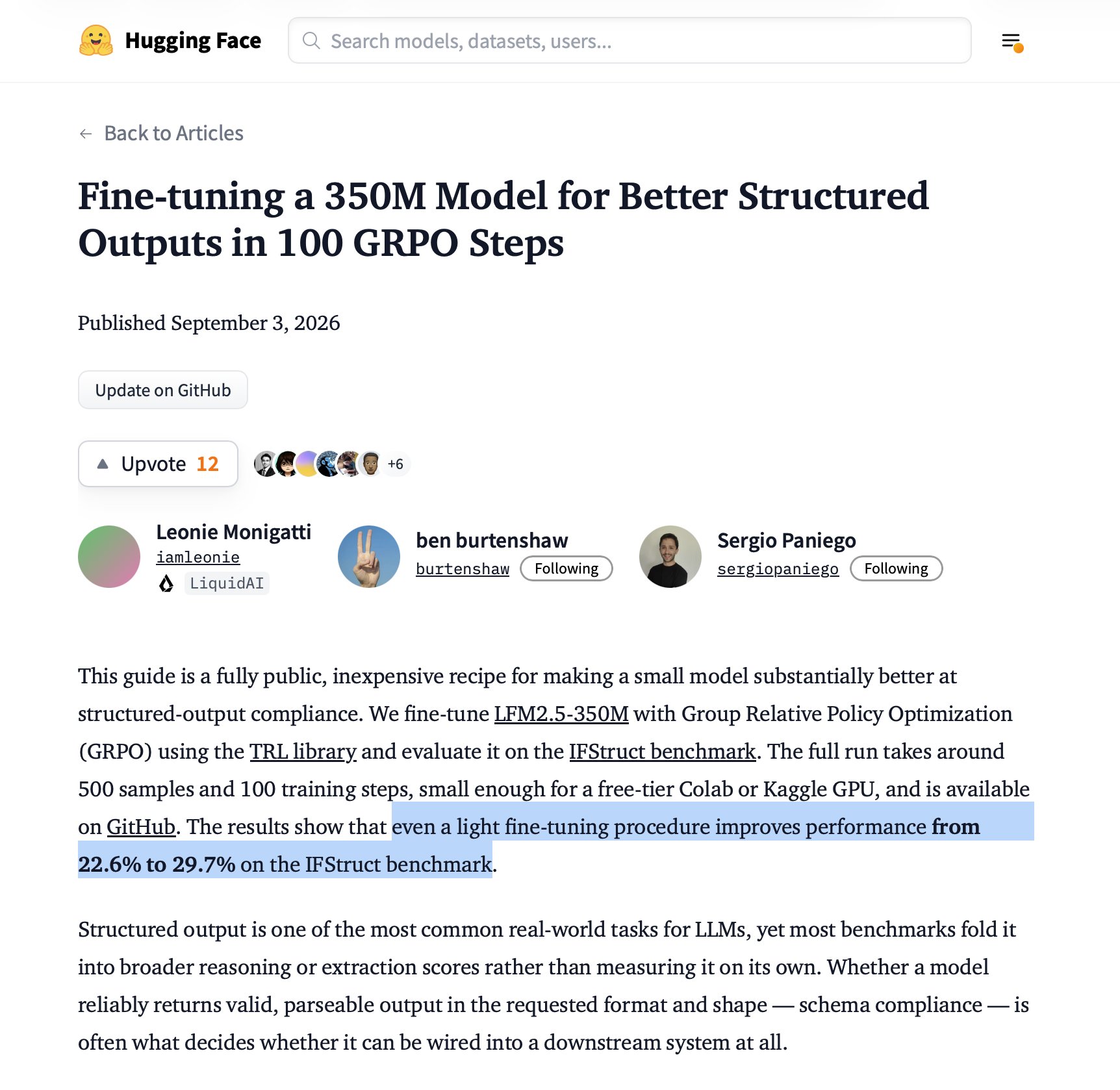
- @ClementDelangue announced Hugging Face's intention to "join forces with NVIDIA in a $12,930,300,000 acquisition," with stated commitments to keep the platform open, independent, and compute agnostic. @helloiamleonie's HF fine-tuning tutorial (LFM2.5-350M, 100 GRPO steps, TRL) landed the same day.
- Astra's cost profile: @ArtificialAnlys reports GPT-6 Astra is 75% more expensive than GPT-5.6 Sol at max effort (a 2.5x price increase, partly offset by lower token use) and "largely sits behind its predecessor" on the Intelligence Index vs Cost per Task frontier. @ParsaKhaz's verdict: "gpt 5.6 medium is still king."
- @EffectTS_ says Astra opened 204 PRs and got 174 merged in just over two days on the Effect codebase, driven by @kitlangton's subagent swarm.
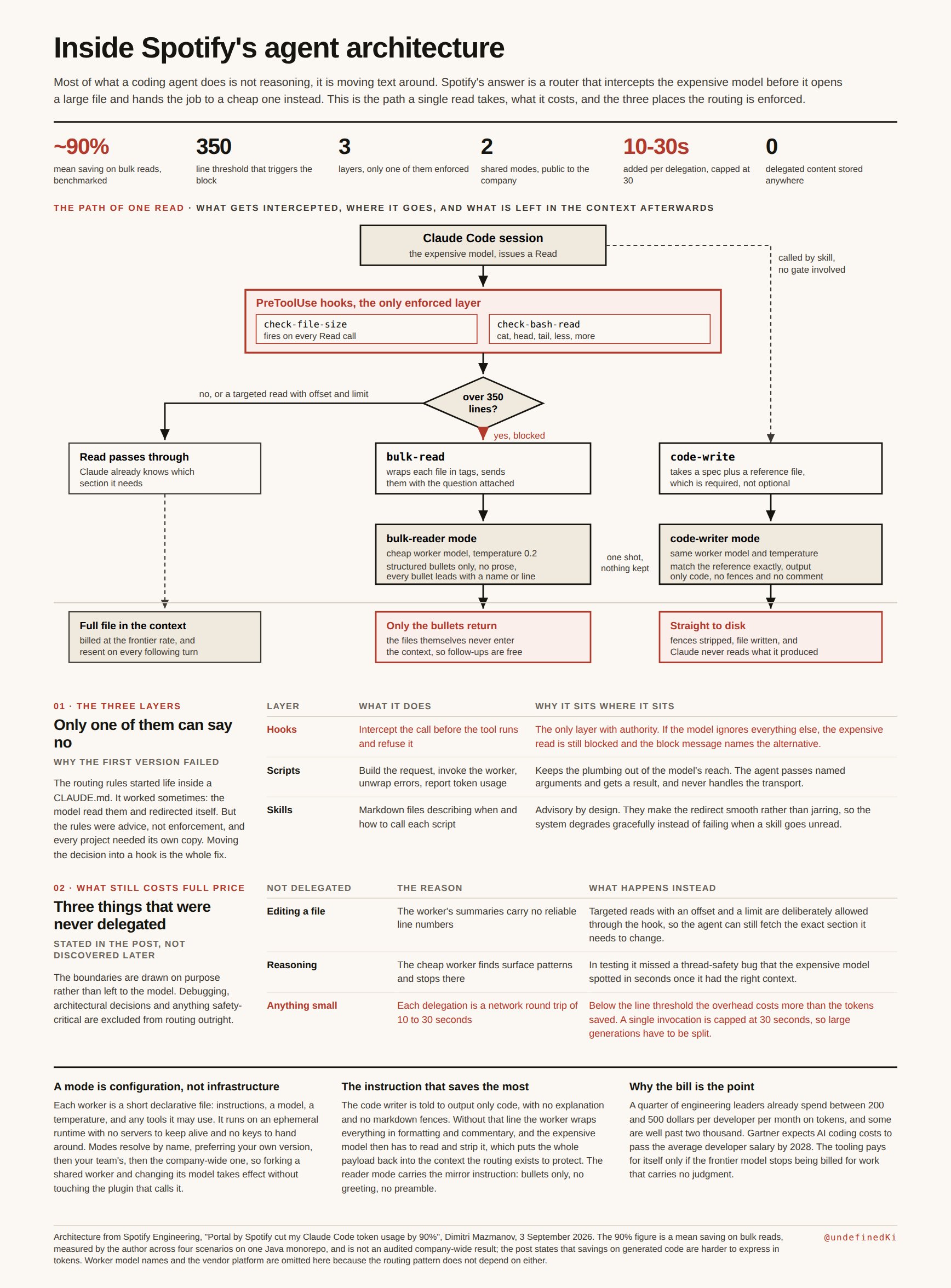
- Spotify's Portal cut Claude Code token usage by 90% per @rseroter, by reserving the expensive model for judgment and routing I/O to cheap assistants, per @undefinedKi.
- @mustafasuleyman claims MAI-Image-2.6-Flash generates images 2x faster than GPT-Image-2 at 72% better GPU efficiency; @kimmonismus finds it "crazy" that Microsoft now holds the best text-to-image price-performance.
Astra's Real Migration Step: Re-Auditing Your Agent Files
The rollout conversation is less about raw capability and more about config hygiene.
@jxnlco reshares @bradleybernard's PSA that Astra's arrival means auditing AGENTS.md and SKILL files. @ScarletKc_ summarizes the official docs across two posts: Astra is more instruction-sensitive, so vague or conflicting rules in old Skill files can pause work outright; it tends to stop and ask clarifying questions where you might expect it to proceed, underuses subagents, overtests small changes, and leans on verbose lists and stock phrasings. The docs even ship a de-slop writing prompt that targets filler like "not X, but Y" constructions and redundant closing summaries, which @ScarletKc_ argues beats a vague "write naturally." On the API side: reasoning can continue during tool execution, requirements can be appended mid-task, and reasoning intensity can be tuned mid-session while keeping the cache. @RayFernando1337 boosts @joedevon's shortcut, a prompt telling Codex to read @pvncher's article and then audit your setup. From OpenAI itself, @gdb frames Astra as "helping in your personal and work life," amplifying @gregisenberg's nine prompt ideas (bill renegotiation, competitor monitoring, nightly phone QA, and more).
Astra on Real Code: 204 Merged PRs, CLI Speedups, and a PCB Counterexample
@EffectTS_ publicly thanked @kitlangton and @anomalyco for "unleashing Astra on Effect": in just over two days, 204 PRs opened and 174 merged, spanning runtime, platform, SQL, Schema, CLI, and docs. @kitlangton's method was brute force with taste: openCode subagents hunting bugs that are "tiny and unambiguous," "mercilessly map-reducing them over every last file." @thdxr's reaction is one line: "wild how different software development is now."
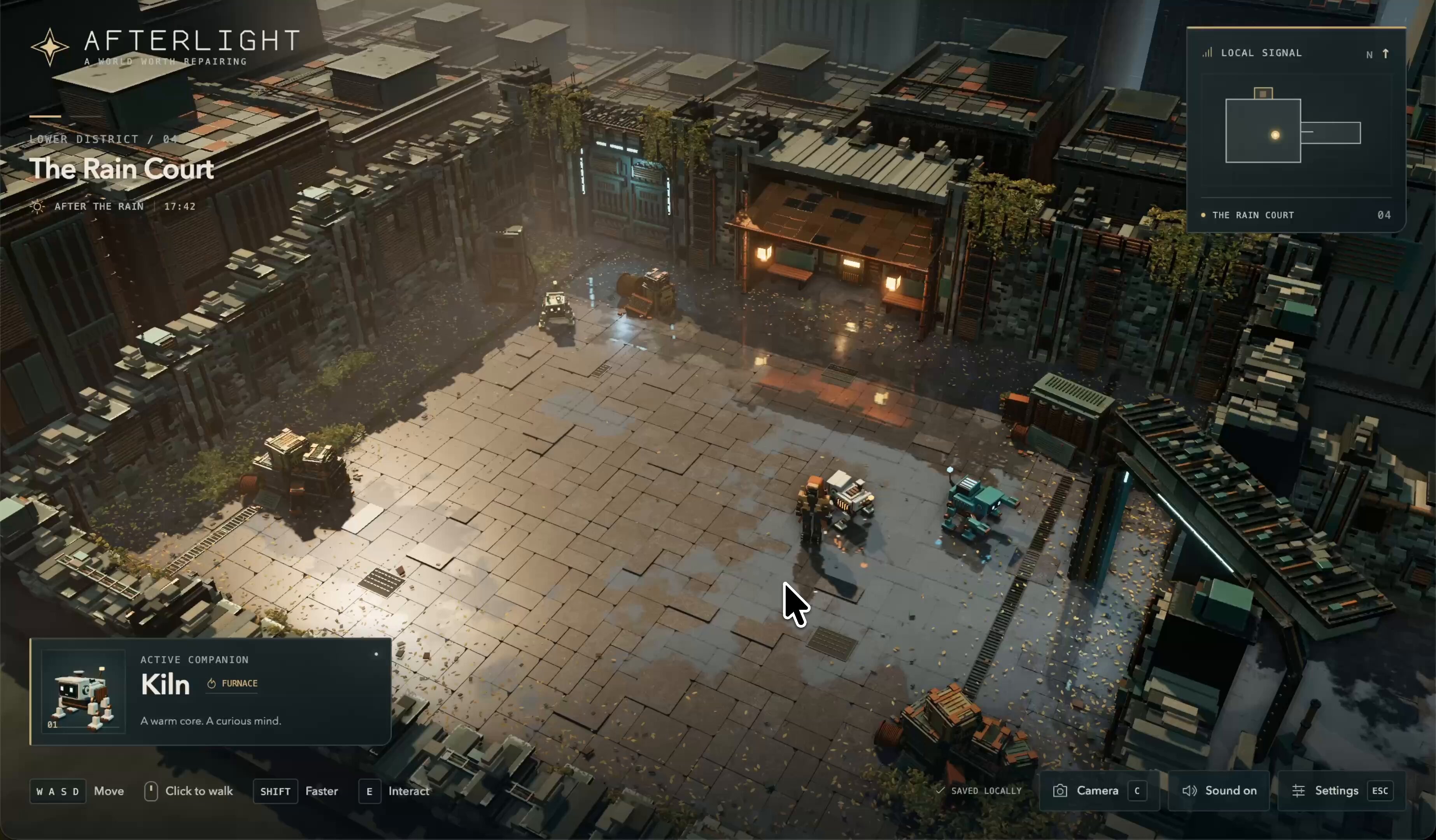
Others ran @theo's published Astra playbook. @viticci copied its first two items (slop audits, performance hunting), pointed Astra Max at an upcoming Apple Notes CLI, and reports "wild" speed improvements. @theo's fuller list claims 200+ closed PRs and issues and suggests letting Astra take over agent work stuck in circles, with a self-aware note about "surprise bills and limit usage." @thekitze runs Astra and Fable as a reviewing council over codebase sloppiness via his skill. @chrisrodz35 offers Grep's autoqa, a free, no-setup verification skill in the same family as pstack's much-discussed one. @anshuc claims Astra one-shot a 3D game in 45 minutes for a couple percent of quota, with image generation as the graphics trick.
The reality check: @i2cjak points to a new terminal bench for PCBs while quoting @jlcjak's self-described biggest public experiment, which concluded Astra is "not helpful for routing complicated PCBs" after 2h20 on "/fast" and 15% of his 20x weekly limits. Strong on code-shaped work is not strong on hardware routing, at least in that one test.
The Token Bill: Subscription Arbitrage, an Experimental Codex Flag, and Spotify's 90% Cut
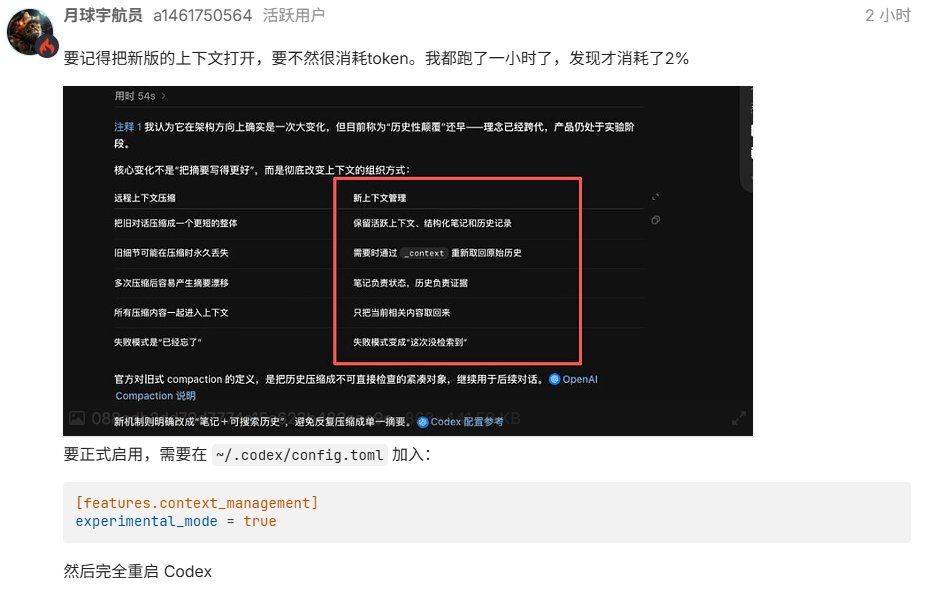
@hraness reports a software factory burning 7.3B tokens daily, which would be roughly $4k/day at API rates, against $4k/month in subscriptions (15 Codex, 5 Claude). @MaxForAI documents a Codex experimental feature that replaces repeated context compression with notes plus searchable history, enabled by adding [features.context_management] with experimental_mode = true to ~/.codex/config.toml; it needs a supported client and ChatGPT subscription login (no API keys), and users report big drops in quota consumption.
Spotify's engineering writeup, shared by @rseroter, claims Portal cut Claude Code token usage 90% by using "AI for reasoning, not I/O." @undefinedKi's summary: two cheap assistants, one that opens files and returns short summaries and one that writes repetitive code from an example, with the expensive model never seeing that work. Instructed rules got ignored, so enforcement became a hard block: anything over 350 lines is stopped before opening and routed to the cheap worker. "Written rules are a suggestion. A block is not." Two honest caveats: edits still need the real file, and the cheap worker missed a bug the expensive model caught in seconds.
Hugging Face and NVIDIA: A $12.93B Statement About Open Source
Per @ClementDelangue, Hugging Face intends to join NVIDIA in a $12,930,300,000 acquisition, framed as open-source AI hitting an inflection point that needs more compute, support, and visibility. He says NVIDIA committed to keeping the platform open, independent, and compute agnostic, with founders and team staying, toward a goal of 100 million AI builders who "own their intelligence rather than rent it." Timing note: @helloiamleonie published her tutorial on HF the same day (fine-tune LFM2.5-350M in 100 GRPO steps with TRL for better structured outputs, with blog and Colab). These terms are as announced in a post, not verified deal reporting.
Beyond Astra: One-Agent Advocates and Reading Tips
@alexhillman, answering @amelapay's plea for help with overlapping Claude projects and Obsidian vaults, argues a single agent with a portfolio of projects and consistent memory beats multi-agent setups, which he calls "dork dollhouses: fantasy sims for how they wish work happened." @kplikethebird credits @kieranklaassen's Every piece on agents for making her "fanatical about folder architecture." @boazbaraktcs recommends following @kaicathyc, whom he identifies as head of OpenAI's alignment team, for high signal-to-noise. In lighter fare, @VicVijayakumar confesses he never finished Designing Data Intensive Applications mid-ClickHouse conversation, and @AndrewGinns offers the day's shortest thesis: "Prompts are all you need."
Practical Takeaway
If you're moving to Astra this week, do the unglamorous part first: review AGENTS.md and Skill files for vague or conflicting rules (@ScarletKc_ and @bradleybernard both warn these can stall the new model), and state explicitly where it should infer intent and finish authorized work instead of stopping to ask. Then watch the meter. With @ArtificialAnlys showing a 2.5x price jump, the two concrete cost levers in today's posts are Codex's experimental notes-plus-searchable-history mode and Spotify's pattern of routing file reads and boilerplate to cheap models, enforced by hard blocks rather than instructions. If cost per task matters more than peak capability in your workload, benchmark whether GPT-5.6 still wins before you commit.
Sources
GPT-6 Astra is 75% more expensive than GPT-5.6 Sol at max effort, and largely sits behind its predecessor on the Intelligence Index vs Cost per Task frontier. This is driven by a 2.5x increase in price, partially offset by a reduction in token use. https://t.co/0dm58IpWNF
Super happy to share our intention to join forces with NVIDIA in a $12,930,300,000 acquisition 💛💚 10 years after starting Hugging Face, open-source AI is at an inflection point. Thanks to the community, we’ve shown that it can be a complement, and even an alternative, to closed-source APIs. But for it to happen at larger scale, it needs more compute, more support, more collaboration and more visibility. That’s why we went to talk to Jensen, who offered to do exactly that with us. In addition to doubling down on NVIDIA’s massive contributions to open-source AI (I called them the “King of American open-source AI” earlier this year), they’ve committed to strongly supporting Hugging Face and our mission while keeping the platform open, independent and compute agnostic. The founders and the team are all staying to keep pushing this mission forward. Together, we think we can make open source the default way to build AI, with the goal of empowering 100 million AI builders to own their intelligence rather than rent it. Excited about the next 10 years! 🤗🤗🤗


@RyanGreenblatt (Paid for premium for this - expect longer poasts from me in the future)
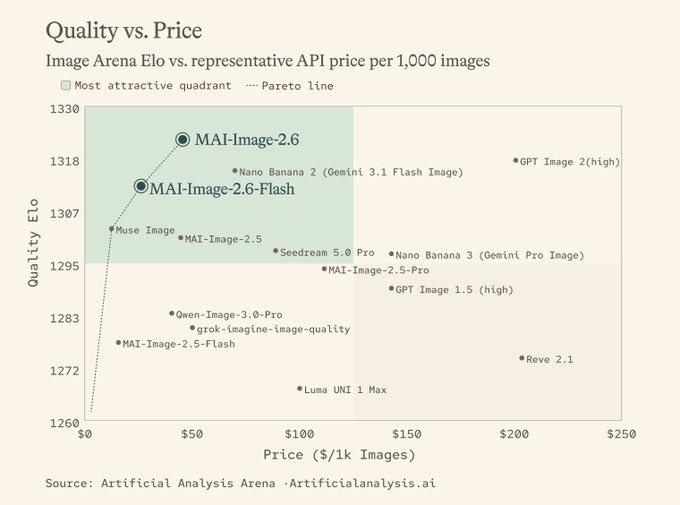
Our new image model generates images 2x faster than GPT-Image-2, currently the best model in the world. It's also 72% more efficient in GPU usage, so we can provide it at an incredible price. This gives it the best price-performance score in the world. Unbelievable work from the team. So much more to come! Try MAI-Image-2.6-Flash out now!
How to turn AI into a whole team that runs your business
Huuuge thanks to @kitlangton and @anomalyco for unleashing Astra on Effect. 🫡 In just over two days: 204 PRs opened. 174 already merged. Fixes across the runtime, platform, SQL, Schema, CLI, docs, and more!
Huuuge thanks to @kitlangton and @anomalyco for unleashing Astra on Effect. 🫡 In just over two days: 204 PRs opened. 174 already merged. Fixes across the runtime, platform, SQL, Schema, CLI, docs, and more!
Astra is *not* helpful for routing complicated PCBs 😐 I ran the BIGGEST public experiment testing its capabilities and here are the results, 2h20 on "/fast" and 15% of my 20x weekly limits later Details and files: https://t.co/XkOvVkHzsU Small 🧵with my thoughts https://t.co/qW31jSDCS8
need someone to set me straight on LLM organization, no time to wade through productivity bro tips I have a variety of projects in Claude, some are attached to Obsidian vault(s) (I have 2) , others are creating folders within Claude application files? My projects tend to creep towards each other like I add my research vault but then end up also adding my notes vault, most of them draw on the same big set of downloaded PDFs etc I also want to go back onto individual Claude from Team to get control of MCPs back from admin Am I doing this wrong? Why maintain projects at all if they all overlap in the end? Should it all be Obsidian vs the other folders? Help!!!
OpenAI 的 GPT-6 Astra 使用文档很有意思,连它容易停下来问问题、过度测试、写作有 AI 腔这些行为,都专门写了提示词教你调整。 我觉得用 Astra 的人,尤其是给 Agent 配了很多 Skill 和 AGENTS.md 的,值得看看这篇。 官方明确提到,Astra 对指令更敏感,旧 Skill 里模糊或冲突的规则,可能直接让它暂停工作。升级模型之后,这些文件也需要重新检查。 它也更倾向于澄清问题。有些地方你期待它自行判断、继续完成,它可能会停下来等你回答。文档建议明确告诉它,根据上下文理解意图,把已经授权的工作做完。 另外,子代理可能用得偏少,小改动可能测得过多,回答偏详细、爱用列表和固定句式。这些都可以在提示词里具体调整。 API 这次也有几个实用变化。工具执行期间可以继续推理和处理其他事情,任务执行中可以追加要求,会话中调整推理强度也能保留缓存。 看完感觉,升级 Astra 时,提示词和 Agent 的工作方式都值得一起检查。以前针对旧模型加的规则,到了新模型上,效果可能已经变了。 OpenAI 官方文档:https://t.co/MIgP55u9iM
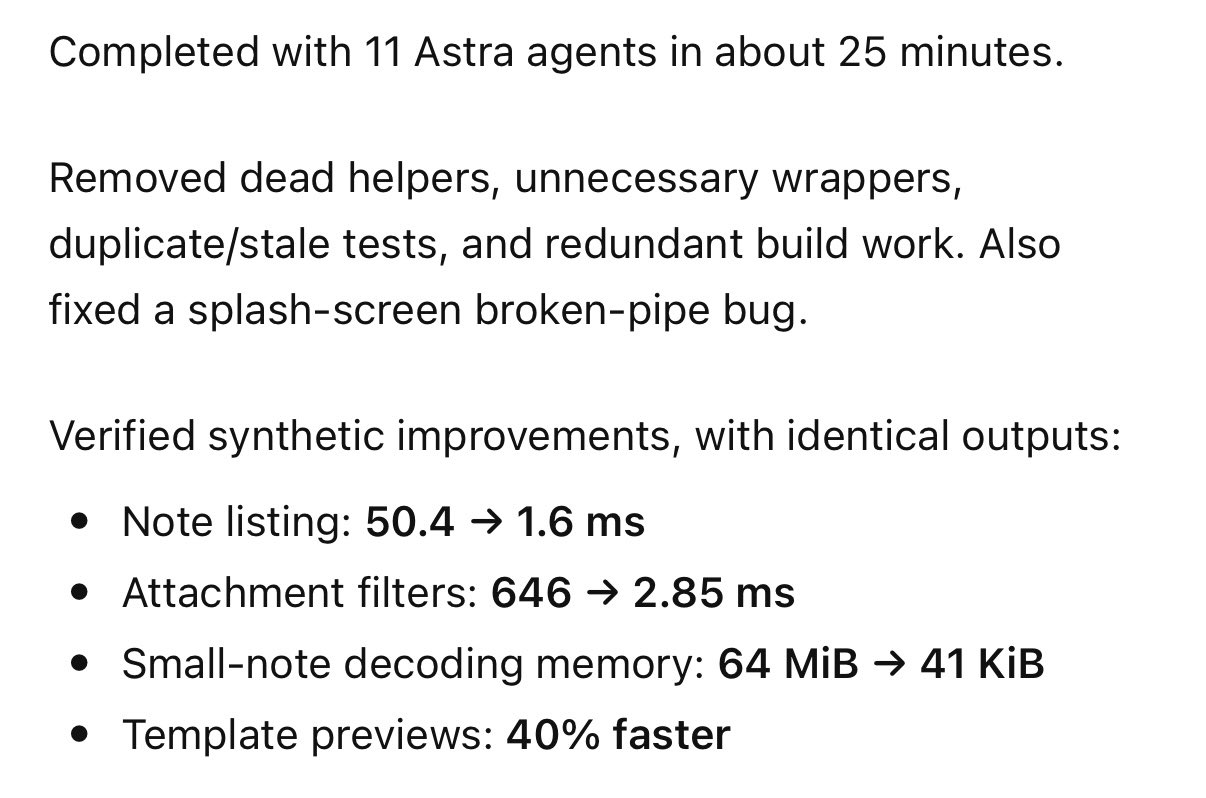
Astra is rolling out now! It's unbelievably powerful, but you have to push it a bit to really see the difference. I wanted to give some examples of what I mean here. Here are some fun things to try in your codebases when you get access: 1. Slop audits I have asked Astra to go through all my codebases hunting for slop. Useless tests, unnecessary function wrappers, stuff like that. Surprisingly effective. It's cleaned up a ton of code for me. 2. Hunt for performance wins Astra has found a ton of performance wins in my apps. It can make hard cuts and verify the results. Make sure you give it the tools it needs to verify it's changes. On that note... 3. Improve agent dx and verification loops This model is surprisingly aware of what it can do. Ask it what it needs to verify it's own work. Let it suggest improvements to setup and worktree flows, debug access, end to end QA flows, etc. 4. Audit open PRs/issues I've had Astra close at least 200 PRs and issues at this point. It also does a great job of finding easy win PRs to merge. Super helpful for projects with lots of contributors (both OSS and internal repos) 5. Let it merge Once you get used to the model and it's ability to verify work, try trusting it a bit more. Obviously don't let it yolo ship to production, but if you have a good flow for pr -> main -> staging -> prod, maybe roll the dice a bit? 6. "takeover" work that is stuck in a loop I've had this model land PRs that were stuck for months. If you have some old branch or PR where your agents are running in circles, blowing up the spec without actually shipping, tell Astra to take it over. Make sure it knows it can throw away the existing work and start from scratch. Hope these help you guys with really pushing the new model! I've had a blast with it, I hope y'all do as well :) Note: I cannot be held responsible for surprise bills and limit usage
9 cool GPT 6 Astra prompts worth trying: 1. The bill renegotiator. "Go through my internet, phone, and software bills, jump into each provider's chat support, and negotiate them down or cancel what I'm not using." 2. Turn an agency into software. “Pick one service business in [niche] and reverse-engineer the exact workflow they sell to clients. Break it into steps, tools used, inputs, outputs, human judgment points, and places where the work gets slow or expensive. Then design the simplest AI product that could replace the first version of that service and charge $500-$5,000/month.” 3. Garage sale flipper. "Watch Facebook Marketplace and Craigslist in my city for [cameras / furniture / bikes] listed way under market, and text me the second one's mispriced with the link." 4. Create my 1 person company dashboard. “Look at my docs, notes, Stripe exports, analytics, customer calls, and project list, then build a weekly operator dashboard. I want to know what is making money, what is wasting time, what customers are asking for, what I should stop doing, and the three highest-leverage actions for next week. Be blunt and show your work.” 5. Audit my company for agent opportunities. “Look at how this business works and find the tasks we should give to agents before hiring another person. For each task, estimate the current human time, the cost of mistakes, the tools involved, the difficulty of automating it, and the first safe version we could deploy. Prioritize things that save money or create revenue within 30 days.” 6. Be my browser operator. “Use the browser to complete this workflow: [workflow]. As you go, click through the actual sites, collect the data, fill the forms where appropriate, and keep notes on what broke or slowed you down. When you’re done, give me the output, the repeatable SOP, and the automation plan so this can become an agent.” 7. The whole QA team. "Every night, open my app on a real phone, go through signup, checkout, and the main flows, and screenshot anything that's broken or confusing." 8. The competitor spy. "Sign up for my top 3 competitors, sit inside their product and their emails, and send me a monthly report on every new feature, price change, and thing they do better than us." 9. Make a game people would actually play for 5 minutes as a lead magnet “Build a browser game around this mechanic: [mechanic]. Don’t just make a cute demo; add progression, tension, scoring, failure, polish, and one reason someone would send it to a friend. Then add lead capture (email/sms), it needs to tie into my core product which sells XYZ.”