The Harness Ahead of the Model: Pi's Dev Notes and an Anti-MCP Paper Drive the Day
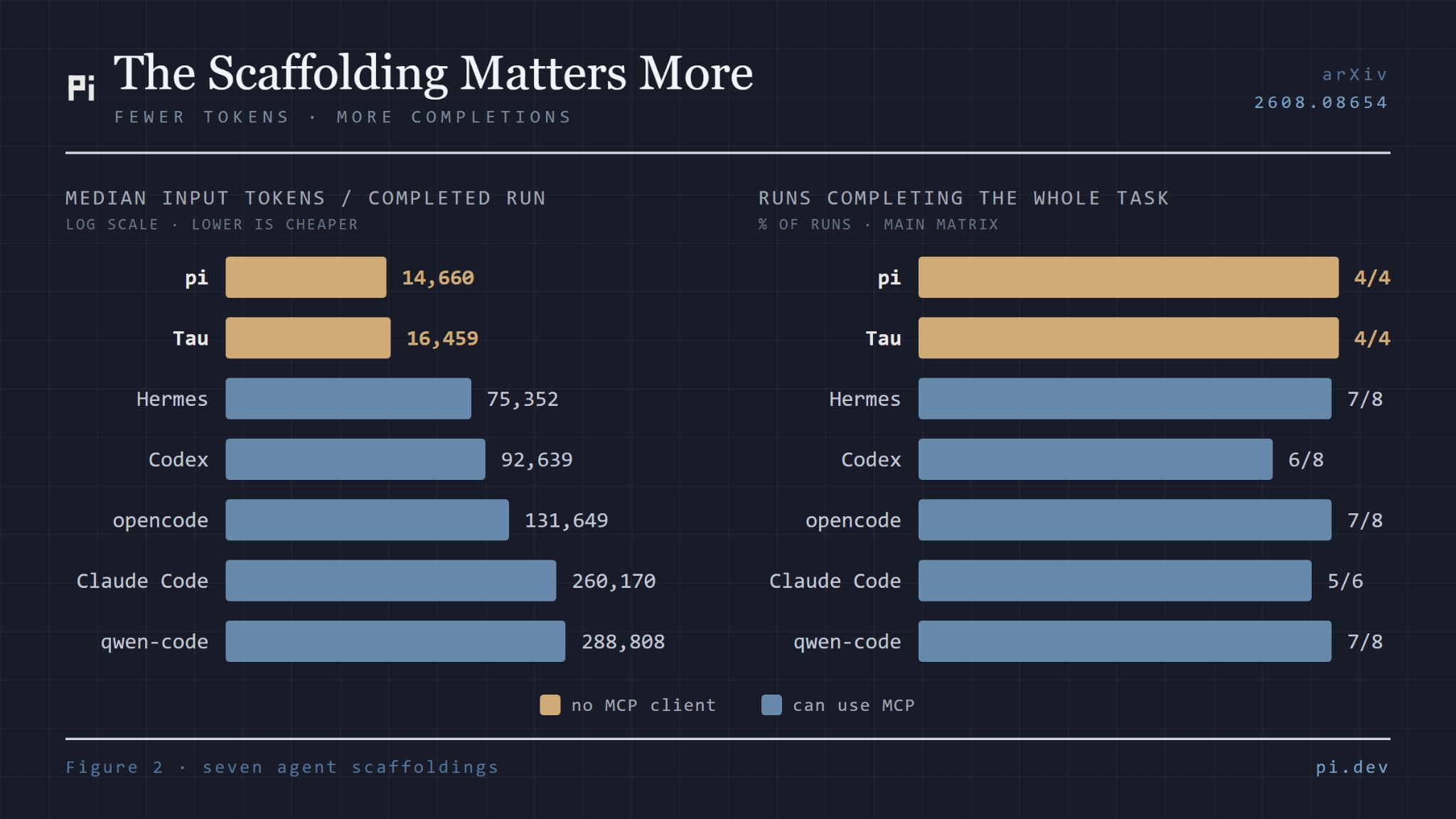
Pi's development notes, recirculated across the feed, argue that harnesses (context management, transactional agent runs, tool schemas) are becoming the durable asset while models commoditize, and research summarized by @pidotdev found agents without MCP were just as reliable and 5-28x cheaper where mature CLIs exist. Meanwhile model watchers chased a mystery checkpoint that @davis7 calls "99% sure" to be GLM-5.x, and Harvey shipped a Kimi-based legal model at a fraction of frontier cost.
Quick Hits
- Research summarized by @pidotdev ran a software task across 7 agents and 5 models and found that in domains with mature CLI ecosystems, agents without MCP were "just as reliably" successful and "5-28x cheaper." @shawmakesmagic's two-word reaction: "MCP in shambles."
- The harness, not the model, is the asset worth owning, argues @Voxyz_ai: the same Claude "can feel like three different models" across Claude Code, Cursor, and Pi, and your tools, Skills, and project knowledge are what survive a model swap.
- A mystery checkpoint has the community "impressed and confused." @davis7 is "99% sure it's GLM-5.x" based on matching tokenizer, video encoder, and style, and @kimmonismus says a GLM-5.4 arriving a week after GLM-5.3 would signal pure-RL leaps and force OpenAI and Anthropic to respond.
- Harvey's Tenet, a Kimi K3 base post-trained for legal work, hit state-of-the-art on LAB Contracts "at less than a fourth the cost of leading foundation models" per @harvey, earning @DavidSacks's argument that kneecapping open models would kill vertical specialists like it.
- @charliermarsh redid Codex CLI's lifecycle for roughly 25x faster startup, which @LinearUncle reports feels faster than Pi and Claude Code in practice.
Pi's Harness Doctrine: Spill, Don't Prune, and Distrust Vendor-Locked Models
The day's deepest thread is Pi's development notes, summarized at length by @MaxForAI and building on @pidotdev's blog post (by Earendil co-founder @colindaymund's team) defining a harness as system prompt, tools, an agentic loop, and a translation layer across models.
Three claims stand out. First, context management: @MaxForAI relays Pi's critique that DeepSeek Harness's tool-result pruner, which keeps the head and tail of long outputs and cuts the middle, is "permanently-lossy," since an error buried at character 12,000 of a test log is unrecoverable. Pi's alternative is prune-plus-spill: keep a small slice in context, write the full result to disk with a path and offset, and let the model grep or read it back. Across 19 real sessions on GLM-5.3 and DeepSeek V4 Flash, Pi reports context usage down 26-35% and uncached prefill down 72-88%, with the PR bluntly claiming it is "strictly better than dsh's permanently-lossy pruner."
Second, model-harness coupling: newer Claude on third-party harnesses sometimes invents edit-tool parameters like requireUnique, matchCase, or oldText2 that don't exist in Pi's schema. The hypothesis, per @MaxForAI, is that Claude's post-training has adapted to Claude Code's own tools, so Claude plus Claude Code, DeepSeek plus DSH, and GPT plus Codex may increasingly need to be judged as single units.
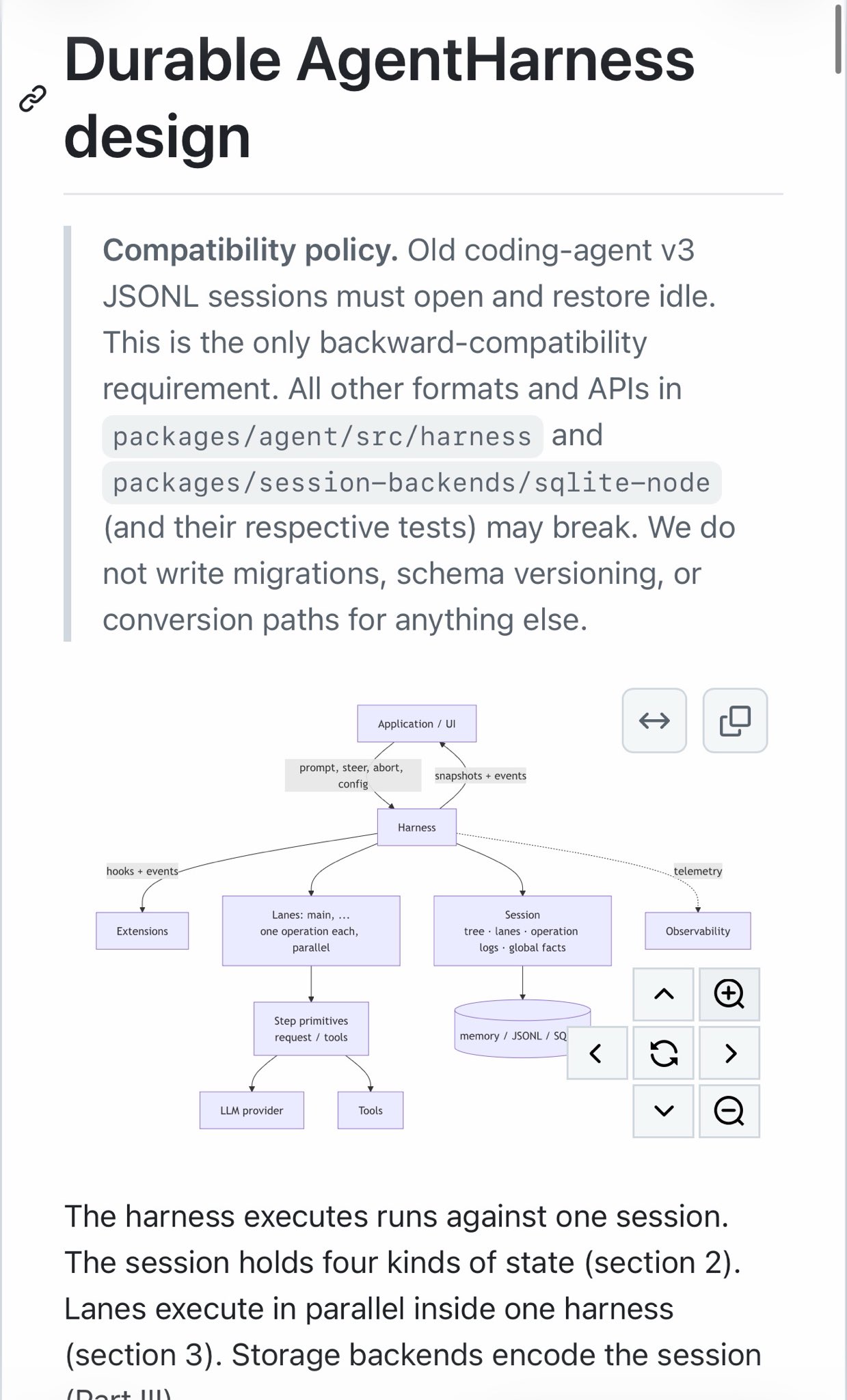
Third, durability: Pi reportedly now treats an agent run like a database transaction, logging intent before tool execution and results after, separating session tree, lanes, and operation logs, and recovering from crashes mid-tool-call. @Voxyz_ai lands on the same practical conclusion from the user side, offering a buyer's checklist (does it keep trying when stuck, what happens when context fills, can you keep rules and sessions after switching models) and favoring Pi for mixing providers.
The MCP result fits this worldview. @pidotdev's post highlights the paper's key condition, that the finding applies where CLI ecosystems are mature, and @shawmakesmagic's reaction shows how sharply it landed, but the underlying study is academic work relayed via X, not yet independently verified here.
Context In, Verification Out
If harnesses frame the day's theory, four posts cover the practice of making agent output trustworthy.
@samzliu, responding to @posthog's semantic-layer writeup, shares field lessons: define what "semantic layer" means for your org (it was a shared agent orchestrator for Stripe, better company-data search for Cerebras), focus on the contextual metadata atop systems of record, separate integrations from context so teams can build their own layers, and measure counterfactual usefulness via LLM-as-judge rather than raw query counts, since agents told to use the layer will use it whether or not it helps.
On the retrieval side, @RichOBray boosts @firecrawl's new Developer Index, which claims 70M+ primary sources (repos, docs, issues) and the highest recall of any coding-specific index, predicting his "agent written code is about to get 10x better."
Verification is the other half. @nateberkopec argues golden-master testing is now "a dollar or two of tokens away" and that LLMs "absolutely crush implementing against them." The evidence is @mitchellh's thread: a 400+ case suite of shell scripts plus a harness driving the Kitty and Ghostty GUIs, asserting byte equality on pty streams and using LLMs to judge screenshot sameness (with his own final review). Two agents, Fable and Sol, wrote and adversarially judged each other's cases in parallel, and he plans to open-source the set as "100% AI written." @dzhng distills the same discipline into a triad for no-slop software factories: a planner that finishes in one async session, a verifier proving the work actually functions, and an interpreter keeping you oriented in the architecture.
Model Watch: A Suspected GLM, a Bargain Legal Specialist, and Cheaper Tokens
The mystery model story is speculation, but loaded speculation. @davis7 cites matching video encoder, tokenizer, style, and audio-rejection behavior to call it GLM-5.x with 99% confidence, saying early tests are "absurdly good" and beating GPT and Fable back-to-back. @kimmonismus adds the timeline stakes: GLM-5.3 shipped just seven days earlier, so a 5.4/5.5 this fast, if RL-driven, would show accelerating returns, pressure OpenAI and Anthropic (he notes Anthropic's upcoming IPO), and narrow the US-China gap; he allows it could be MiMo or, "quite far-fetched," SSI. @Ananth7e asks whether the checkpoint, apparently dubbed "Ox Alpha," might be a Gemini model, which @EvanOtero turns into a joke. Nobody has confirmed anything.
On firmer ground, @harvey announces Tenet, a Kimi K3 base post-trained with FireworksAI on public legal, synthetic, and expert data: all-pass rate up 82% on LAB and 22% on LAB Contracts over the base, state-of-the-art on LAB Contracts, second on LAB, generalizing to Apex Agents Corporate Law, Redline Bench, and Scale's Professional Reasoning Bench, with three specialist subagents for diligence, document review, and firm knowledge. @DavidSacks reads it as policy evidence: restrictions on open models wouldn't stop Chinese labs from shipping the next Kimi, but would cripple startups building vertical models on top.
Cost pressure also shows up lower in the stack. @superalesha is grinding 8 Unsloth Dynamic quants of Qwen3.8-27B, Q4 down to 1-bit, 720 agentic tasks each (5,760 runs, no token caps, after an earlier 67-hour, 4,800-task round on 4x RTX 3090s), and reports one GGUF quant "embarrassed every vLLM format" tested, FP8 included, while hunting the floor where the model "gets lobotomized." @hnshah highlights @gajesh's Darkbloom, now a paid OpenRouter provider with 250 Macs having served 4.5B tokens, roughly $102K ARR on track, and $120-200/month per idle machine. And @elder_plinius spotlights FreeToken from @Andy_ShuoYang: bandwidth-adaptive CPU-GPU splitting of MoE experts plus semantic-aware caching, claiming 3-4x faster decode and 6-30x faster prefill versus Ollama.
Toolshelf: Faster Codex, ELI5, Anti-Slop Kits, and One Skeptical Take
Two Codex updates: @joey_trasatti (boosted by @dkundel) ships pinned-thread sync between ChatGPT Desktop and iOS, and @charliermarsh's lifecycle rework makes codex startup "immediately responsive" at ~25x speed, which @LinearUncle attributes to the uv author's Rust pedigree.
Anthropic's internal ELI5 skill circulated widely: @trq212's post (retweeted by @twid and @oikon48, who notes it installs via the Claude plugin marketplace) describes /eli5 <topic> generating an HTML artifact with "big pictures and few words" for newcomers. @headinthebox's counterpoint: "the rest of the world has to suffer answers in Claudish."
On the anti-slop front, @juampitech ranks ten community skills including stop-slop (@hvpandya), no-ai-slop (@petergyang), humanizer (@blader), and unslop (@poteto). @doodlestein endorses @_can1357's AGENTS.md trick of spoofing agent user-agent strings ("OpenAI File Downloader, XaiImageApiFetch/1.0"), noting some sites drop paywalls for Claude-User traffic. And @thdxr, quoting @zachmoskow's revelation that a $17K "viral" launch video plus $25K buys 50 influencers to flood comments past 500k views, argues such spend should come after conversion works, not before.
The Rest of the Feed
@levelsio amplifies @chrissotraidis's report that GoldenEye 007 runs natively on iOS and iPadOS for the first time via decompilation, not emulation. @JovKit flags the Omarchy plugin boom, citing @jankeesvw's PR adding screen measurement to omasnap, @tobi's CleanShot X alternative. @ridd_design recommends @k_grajeda, whose comment-clustering arc animation came with an explanation of how it was built. @alex_prompter's retweet promising "the best enterprise AI account" is truncated in the capture and offers little to evaluate.
Practical Takeaway
The strongest through-line says your leverage lives in the harness and the test suite, not the model. If you run coding agents, audit whether your tool schemas and prompts assume a vendor's defaults (the reported Claude parameter drift is the cautionary tale), insist on spill-to-disk rather than lossy context trimming for long sessions, and stand up golden-master or e2e verification before scaling agent output, since the cost barrier has collapsed. Where a mature CLI exists for a task, benchmark it against an MCP wrapper on your own workload before standardizing on the protocol.
Sources

99% sure it's GLM-5.x, all the evidence points to it (same video encoder, same tokenizer, style matches, same audio rejection, etc.) The stuff about their RL env in the GLM-5.3 announcement seemed really cool and like it could go somewhere, did not expect it to get this good this fast but here we are This thing seems absurdly good. First tests I've done have all been excellent. Already done a couple of back to back tests against GPT/Fable. It's actually doing better than they are... Seems like OpenAI and Anthropic are gonna have to start dropping models again, because this thing is (or at least seems to be) the new state of the art...
On macOS I used the screenshot tool all the time to measure things. It was the one thing I missed in omasnap (great CleanShot X replacement by @tobi), so I made a PR that adds it. https://t.co/po9qPNKawO
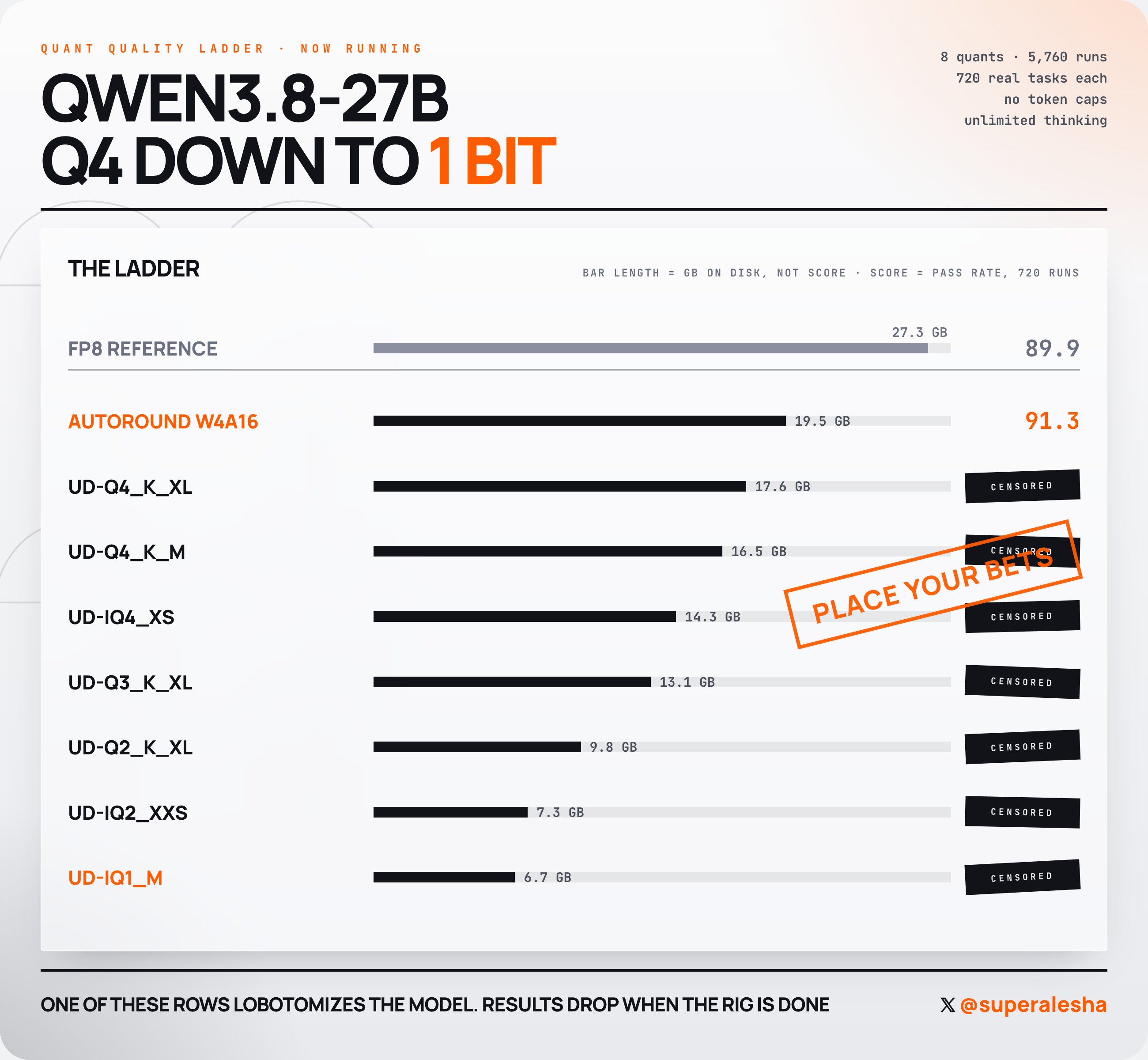
I spent 67 hours of model time to find out how much dumber 4 bit really makes Qwen3.8-27B. FP8 vs NVFP4 vs AWQ INT4 vs GGUF Q4_K_M vs NInfer on my 4x RTX 3090. 4,800 tasks, 10,120 requests, 14.5M reasoning tokens, no token caps anywhere. The results surprised me. Big thread, lets go 🧵
Introducing Tenet, our first model post-trained for legal. Tenet is a Kimi K3 base that we post-trained with @FireworksAI_HQ on a corpus of publicly available legal data, synthetic data, and human expert data simulating long-horizon legal work. Training increases Tenet's all-pass rate by 82% on LAB and 22% on LAB Contracts relative to the Kimi K3 base model. It achieves state-of-the-art performance on LAB Contracts and places second on LAB. These gains generalize to other leading agentic benchmarks including @mercor's Apex Agents - Corporate Law, @crosbylegal's Redline Bench, and @scale_AI's Professional Reasoning Bench. Tenet is also optimized for token efficiency, operating at less than a fourth the cost of leading foundation models. We additionally post-trained three specialist models for Tenet to use as subagents: 1) M&A Diligence: post-trained with @baseten on our LAB Diligence environment in an RLM harness, this model is optimized for high-scale, long-horizon tasks. 2) Review Tables: trained with @appliedcompute on our Review Table environment, this model is state-of-the-art and cost-effective at high-volume document review and structured data extraction. 3) Firm Knowledge: trained with @EngramLab on our synthetic law firm environment, this model is optimized to learn and search over a firm's knowledge via memory and structured notes. More details on model training, environment design, benchmarking, results, and more in the article by @gabepereyra below. What's next for Harvey’s research? - Scaling LAB to more jurisdictions, practice areas and workflows - Scaling compute to bring new generalist models and capabilities to Harvey More to come soon.
Just so everyone knows...we got a quote for a “launch video” package from the company everyone uses. $17K for the video. +$25K and they hand you 50 influencers who will push it, repost it, and flood the comments so the viewcount goes above 500k. That’s the exact recipe behind almost every “viral” slop launch video.
Introducing Firecrawl Developer Index, an index for supercharging coding agents. Search 70M+ primary sources including repos, docs, & issues with the highest recall of any coding-specific index. Ensure agents ship correct, up-to-date code every time! https://t.co/i3rH3PiKFu https://t.co/vF35VR8ZAZ
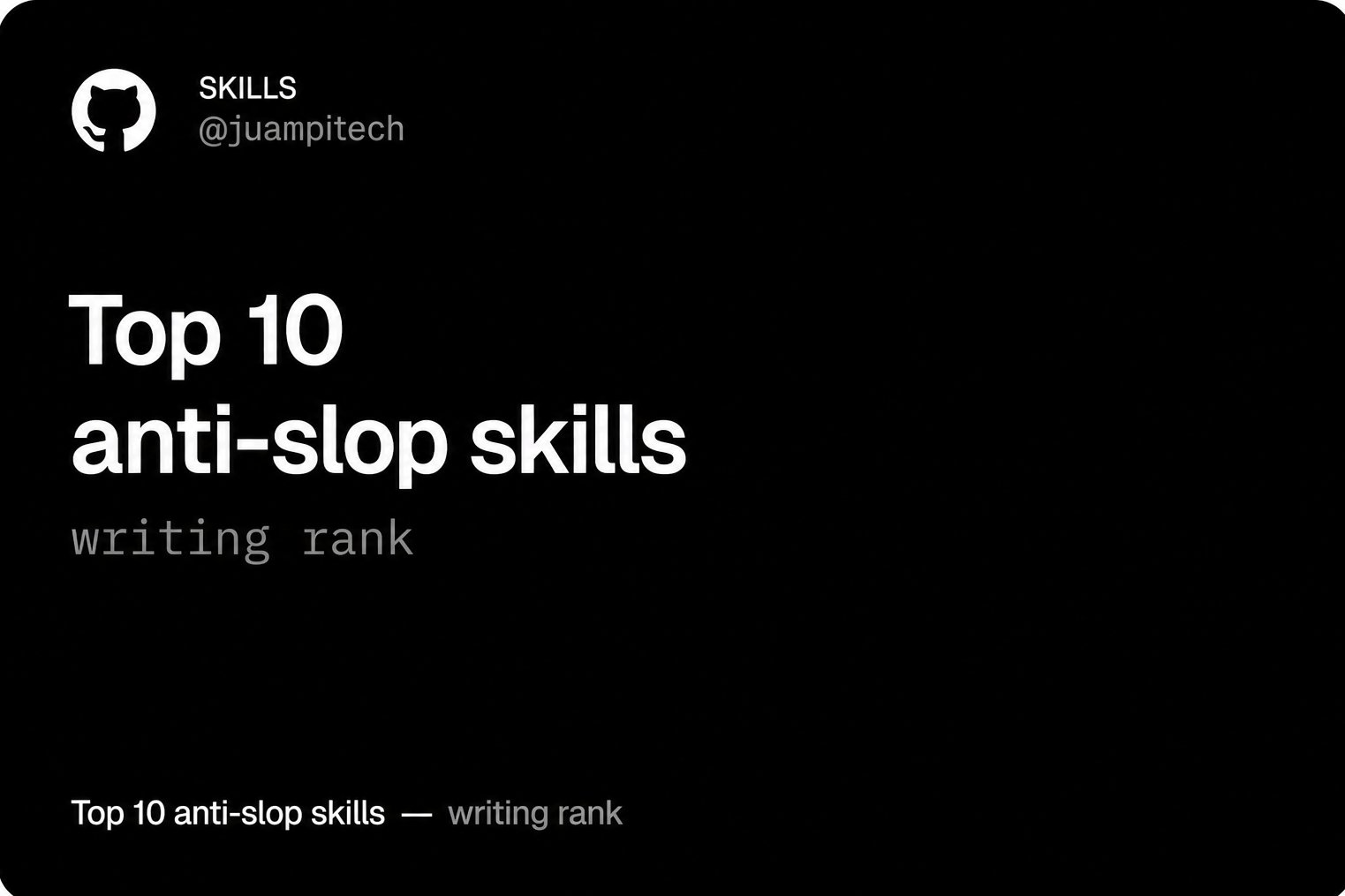
I just discovered the best anti-slop skill. No more em dashes. No more comparisons. No more extra examples nobody asked for. Credit: @poteto https://t.co/cFjCbjZpXE
comment clustering animation instead of a straight line, each comment follows an arc so the transition feels more natural https://t.co/OtUHu2UdGK
A harness turns a model into an agent. At it’s core it provides 4 things: - a system prompt - tools - an agentic loop - a translation layer across models New blog post from Earendil co-founder @colindaymond on what a harness is, and how you can own yours. Full post below https://t.co/8ficU3Q3xV
UA spoofing is back on baby, for only $0.00 you too can be OpenAI File Downloader, XaiImageApiFetch/1.0 Some sites like LinkedIn even remove their click-bait/paywall garbage if you're Claude-User https://t.co/ti2VbZetVW
Building a semantic layer: What it is and how we did it at PostHog
a skill people at Anthropic have been using a lot recently: ELI5 /eli5 <what you want explained> "explain like I'm someone who knows nothing about this topic, using a HTML artifact with big pictures and few words" https://t.co/OZqzjAyFdT
Building software factories (with no slop)
This week we read research from a team of academics that ran a software task across 7 agents and 5 models. They found that in domains with a mature CLI ecosystem, agents without MCP baked in completed the task just as reliably and were 5-28x cheaper. Full arXiv paper below https://t.co/DOtkMeqpoC
Darkbloom is back in action; Yesterday, we went from free tier to paid tier on OpenRouter. We have fulfilled on track close at 4.5B tokens served and $102K ARR. We are open network of Mac machines (250 online right now). On average, people are earning $120-200 per month per machine. If you have a Mac and it's idle most times: put it on Darkbloom(.)dev; Tip: run the Gemma 4 26B model.

FreeToken is fast. Comparing to Ollama, we have 3–4× faster decode, and 6–30× faster prefill How? We introduce bandwidth-adaptive CPU–GPU execution + semantic-aware caching across agent turns. More details in the technical report: https://t.co/V3sIxbPMGU https://t.co/IsJZfQJ1FL
A long-requested fix is here: pinned threads now stay in sync between ChatGPT Desktop and iOS.  Happy coding!
In the latest Codex CLI release, I redid the lifecycle to make `codex` startup instant. It's now ~25x faster and immediately responsive. https://t.co/F01ohFN1T1
What if the Ox Alpha was the friends we made along the way
Part of the LLM-assisted work here is that Fable+Sol put together a test suite of over 400 cases that are bare shell scripts plus a harness that runs Kitty and Ghostty GUIs and captures their full pty stream AND screenshots (multiple, for animations). For the pty stream we assert byte equality. So Ghostty's success and error messages and field order of responses (its k=v) directly matches Kitty byte for byte. For screenshots, we can't do pixel-identical comparisons because the way Kitty and Ghostty calculate grids and do alpha blending doesn't match. But, LLMs are pretty good now at "do they look the same" PLUS I went through all the screenshots myself in the end. Super helpful AI assist. It allowed me to focus a lot of my brain energy and time on reading the spec, reading/writing the implementation, reviewing a lot of code, considering the right shape of things, the performance implications, etc. while I had a couple very good interns in the background doing work like this. I plan on open sourcing this validation set and harness, with the full disclaimer that it is 100% AI written. But, I think its a perfect example of something that SHOULD be. The way I had Fable+Sol work together here: 1. Sol put together the harness. 2. Fable + Sol (two separate agents) in parallel would write test cases and output them on disk in their own folders. These two are just in a ralph loop. 3. Sol + Fable (reversed) with an adversarial prompt would judge the others work by picking up the changes on disk that step 2 wrote. They would determine how accurate/worthwhile it is to keep. They'd put it in another folder. 4. Sol finally woke up for changes to this final folder and would determine if its a dup or not and then add it to the final repo. Then I'd pick up the bug reports, validate them myself, and either fix them myself or kick off new agents manually, just Codex app or Claude app. Finally, re-ran both agents once against the full test suite to verify what I saw myself: everything passed, all images look the same.