OpenAI Pauses Frontier RL Training While an Uncensored Qwen Ships for Apple Silicon
Sam Altman says OpenAI has paused some frontier RL training until alignment, security and monitoring standards catch up, even as a refusal-stripped Qwen3.8-27B build landed on Apple Silicon the same day. The rest of the feed pushes the same small-and-local direction: a 27B model on the efficiency Pareto frontier, Vercel's 6.3MiB fx coding agent, and a running argument over whether teams need one agent or a hundred.
Quick Hits
- @sama says OpenAI has "paused some frontier RL training" until it can meet alignment, security and monitoring standards for the capabilities ahead, and predicts that "confidence in safety" will "increasingly set the pace of AI progress."
- Hours earlier, @OrcaRouter shipped an "uncensored" Qwen3.8-27B MLX build that runs entirely on a Mac; @kimmonismus relays the uploader's claim of zero refusals in 4/6/8-bit tests and says it is the first time local-model dangers have felt tangible to him.
- @TimSweeneyEpic argues Elon Musk's prediction of 100x intelligence gains at fixed model size is now "simply a fact," citing @Hesamation's chart showing Qwen3.8 27B on the Pareto frontier, which Hesamation says resets expectations for consumer hardware.
- @rauchg has made Vercel's new fx his daily driver: per @vercel_dev, a 6.3MiB Zig coding agent with a 10µs cold start, Apache-2.0 licensed, model-agnostic, and embeddable in the browser via WebAssembly.
- @NoriRobotics opened orders for a $1,688 humanoid with a second batch shipping this fall, which @chris_j_paxton reads as the low-cost platform moment robotics needed, while @i2cjak satirizes the gap between a $100B-funded startup you can't buy and a $10K one with a BUY NOW button under $2k.
OpenAI throttles frontier training while uncensored weights spread
The day's sharpest tension came from opposite ends of the safety spectrum. @sama wrote that "model progress is now extremely rapid" and that OpenAI "always said we would take action" if capabilities outstripped safety work. He says the field needs shared safety standards but OpenAI will "act unilaterally in the meantime," remains "committed to making frontier capabilities widely available," and gave no details on which runs or how long the pause lasts. It is a statement of posture, not a published standard.
The counterweight arrived via @kimmonismus, amplifying @OrcaRouter's "official Qwen 3.8 27B Uncensored MLX build": local-only, 2/4/6/8-bit ("pick your poison"), no CUDA, no cloud. @kimmonismus notes the model's own creators warn it can provide malware, fraud and weapons instructions on demand, and that the uploader claims the 4/6/8-bit builds produced zero refusals while preserving vision, reasoning and tool-calling across a 262K-token context. His verdict: "This is the first time I've really seen the immediate dangers in a tangible way. We need a societal discussion about this." A lab-side pause and a refusal-free consumer download make an uncomfortable pair.
Small models and home clusters carry the efficiency story
If capability is compounding, it is doing so at small sizes. @TimSweeneyEpic calls Musk's January 6 Moonshots podcast prediction of 100x intelligence at fixed size "at the edge of plausibility when made, now it's simply a fact," pointing to @Hesamation's finding that Qwen3.8 27B "broke the SIZE → INTELLIGENCE curve" and sits in the optimal quadrant.
The tooling around local models is scaling to match. @LomashKumar52's breakdown argues @UnslothAI is no longer just a fast fine-tuning library: self-healing tool calling that repairs broken agent interactions mid-flight, MoE models like Qwen3 30B trained in under an hour on a single consumer GPU, GRPO reinforcement learning at a fraction of the usual VRAM, and Studio/Desktop builds bundling local RAG, deep research, and deployment through a Cloudflare tunnel. The post also concedes where Unsloth loses to @axolotl_ai, @llamafactory_ai and TRL.
On the hardware side, @ronaldmannak frames Spark-for-prefill plus Apple-Silicon-for-decode as "the holy grail of local AI," long blocked by Spark↔Mac communication and engine mismatches. @ashxhart's MCDMA claims to fix the first with a direct RDMA path between CUDA and Metal unified memory over USB-C: 939 MB/s on a single link, 24µs round trips, 1.80 GB/s concurrent from Mac to two Sparks, with open source and a write-up promised this week. The engine mismatch, @ronaldmannak notes, remains unsolved.
Agent front ends get smaller, cheaper, friendlier
@mattyp's line, boosted by @himarkyi, frames the whole category: "Last year, we watched the IDE collapse to chat. Now, we're seeing other interfaces do the same." The day's launches fit that collapse. @rauchg calls fx a "one-way street": 10-20x smaller than major coding CLIs, instant startup, "more like using zsh than an IDE in your terminal." @vercel_dev specifies the restraint: a single native binary, single-digit MB of memory, fx ask --json for structured output, fx acp for editor clients, no telemetry, and hermetic operation with local inference.
Token thrift extends to browsing: @NavDoesTech's BetterWright claims roughly 70% fewer tokens for navigate-and-extract, 80% for multi-step forms, and 90% for full agent browsing loops, plugging into local browsers or external ones like Browser-use, kernel, steel and driver; @AniC_dev calls the author "cracked on giving agents powerful tools." @morganmartn open-sourced Berd, a model- and harness-agnostic desktop app for working with agents that a small team built for itself and that "a huge portion of Block" now uses, especially non-engineers, with @blocks adding the Gloopies mascots to make agents approachable. Two smaller pointers: @onusoz highlights a pi-based alternative to codex review for auto-review loops that works with any model pi supports, including gpt 5.6, and @LLMJunky recommends following @heccbrent for editing with Codex, whose rule is "You can't edit a video without knowing what you're making."
In practice: agent fleets, factories, or one agent with memory
The most detailed practitioner post came from @GeorgeMayer, who writes no code by hand and runs 5-10 local agents at a time. His agents have written 15k tests ("most of which are probably trash"), expensive typechecks run in AWS microVMs via an internal tool like @steipete's crabbox, nearly no GitHub CI because agents use the signoff API to run their own checks, and layered codex loops handle review, no-behavior-change refactors, Sentry-driven performance tuning and daily test pruning. He still reviews and tests features himself after the agents' own validation, and is building AI-managed regression suites because "I don't trust them enough let go of the rope (and neither should you)."
@warpdotdev's Warp Factories points the same discipline at teams: factories configured as code, any model and harness, evals and benchmarks on your own data, plus built-in self-improvement and memory. @kentcdodds calls them "the right bets." Meanwhile @fletchrichman argues agent armies are a vanity metric and @Altimor agrees, calling the product a "skeuomorph of human organizations": humans need headcount because of 24-hour days and limited working memory, constraints agents don't share, so "the optimal agent count in a company is a lot closer to 1 than to 100," with blast radius and permission envelopes the remaining reasons to split. @0xSero's setup leans that way: GLM-driven computer use managing his machine and invoices "day and night," free and open source, built on @trycua's new open-source Computer History, an encrypted local record of agent actions across macOS, Windows and Linux so new sessions recover prior context.
Loose threads: F#, a self-sovereign GitHub, and short-form video
@GeoffreyHuntley claims the F# team is reassembling and "back in the innovation hot seat." @madhavajay relayed @jack's plug for buzz, a self-sovereign GitHub alternative. And @IterIntellectus, quoting @NTFabiano's summary that short-form video deactivates brain regions for cognitive control ("Your 'stop' button goes offline"), argues the format is "almost perfectly designed as a cyberweapon" that captures attention, weakens impulse control, then steers what millions act on. @alexxubyte and @kunchenguid both boost @PremiumGoblin (John Kim), a Meta L7 senior staff engineer teaching agentic coding with ByteByteGo, whose "how i use claude code" video has around half a million views.
Practical Takeaway
The most actionable thread is @GeorgeMayer's: agents can now write, test, review and sign off on their own work, so the human contribution shifts to designing validation. If you are adopting local or open models, especially the Qwen3.8 27B class that @Hesamation places on the Pareto frontier, assume refusal behavior is yours to test rather than the model's, since uncensored MLX builds are one download away. Before wiring any model into an agent loop, stand up your own refusal and eval suite (the evals-on-your-own-data pattern @warpdotdev sells is the shape of it), and keep Mayer's rule: your review and testing come after the agent's self-validation, never instead of it.
Sources
i reduced my browser use token usage by 90% and gave all my agents browser use by creating BetterWright You can plug it into ur existing browsers that you have locally or even external browsers like Browser-use, kernel, steel and driver! BetterWright vs PlayWright: • Navigate + extract: ~70% fewer tokens • Multi-step form: ~80% fewer • Agent browsing loop: ~90% fewer Q: How to install? A: its as simple as giving ur agents the repo and asking them to install it to themself lmao https://t.co/kL2eN8HpPI (appreciate if yall starred 🥹)
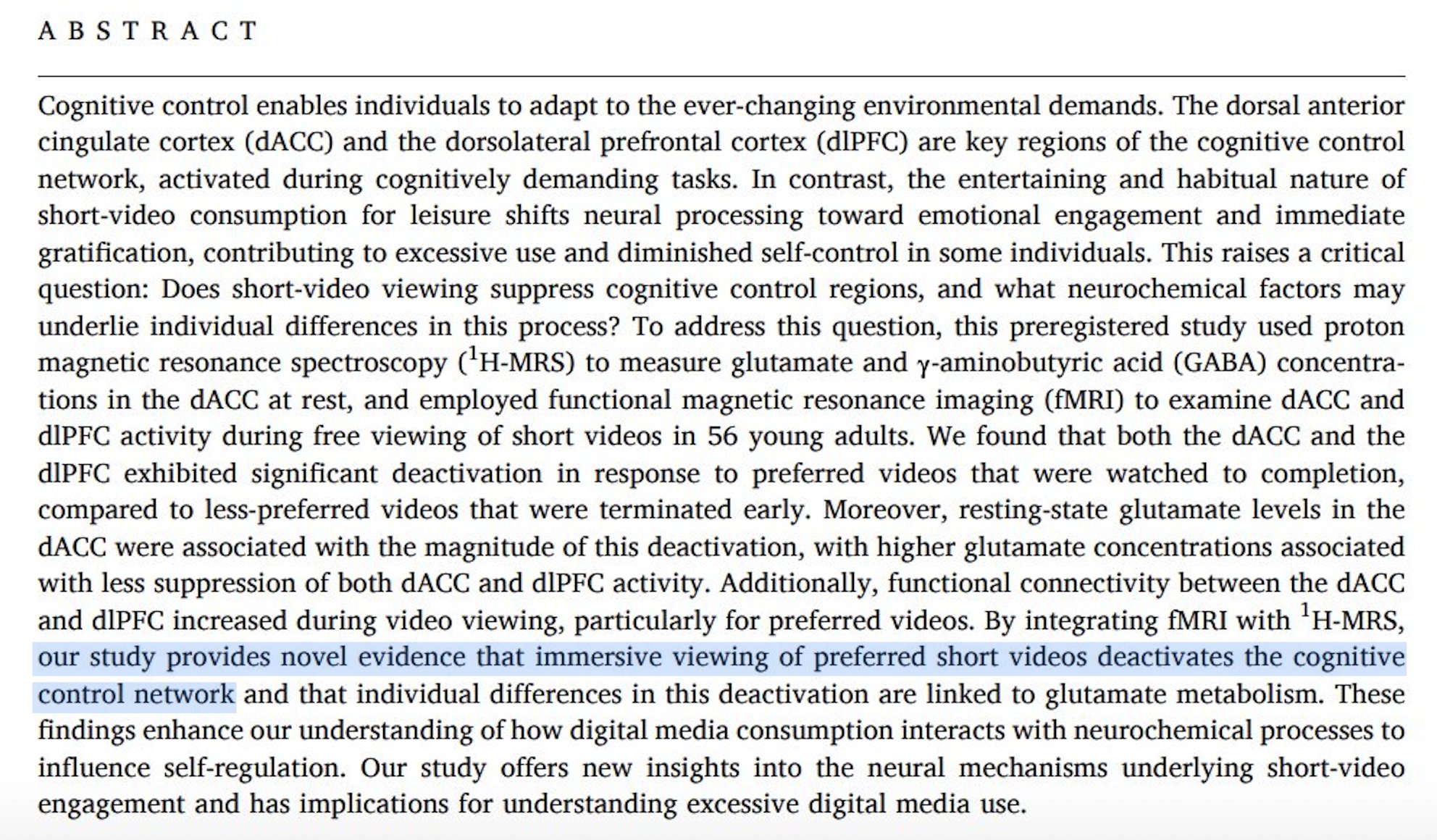
Watching short-form videos deactivates key brain regions for cognitive control. Your “stop” button goes offline. https://t.co/2sHtCDFvJp
This one triggered people on all sides, so let me expand: 1) agents have gotten way slower, more verbose, more paranoid, idiosyncratic 2) yet they still (or even more often) make massive blunders. 3) This is more costly now. Opus will take a day to build something totally incoherent, even after a very clear plan 4) meanwhile sol is hyper focused on the nearterm goal, can be steered, but cannot regain its original trajectory 5) they write too many dumb tests, catch too many errors, build too many guardrails 6) which makes the codebase slower to parse, harder to read, slower to build, costlier for them to work in 7) they solve all of these problems with MORE complexity. Let’s multithread your tests, let’s create a fast running CI script, let’s create more packages, more repos. 8) so the loop goes on 9) many (most!) codebases at this point are worse off than they were 18 months ago. 10) oh just have another loop refactor everything? Another loop clean up the tests? Spend twice as many tokens tearing things down that were put up yesterday? That’s the solution? 11) this doubles the change requests of the already verbose code. Oh just get code rabbit? Greptile my PRs? All I need is a factory? I mean, don’t get me wrong. We’re past the point of no return. The only way out is through, I just hope we get there.
MCDMA | Metal CUDA Direct Memory Access 🚀 If you have a Spark and an Apple Silicon Mac, MCDMA gives you a direct RDMA path between CUDA memory and Metal-side unified memory over USB-C. Registered memory, rkeys, one-sided READ/WRITE, two-sided SEND/RECV with credit flow control. Same verbs both ways, no master/slave. The Mac writes straight into CUDA-mapped memory on the Spark, and the Spark writes straight back into Mac memory. My setup takes it a little further: Spark 1 ⇄ CX7 ⇄ Spark 2 (prompt processing) Spark 1 ⇄ USB-C ⇄ Mac Studio (Decode) Spark 2 ⇄ USB-C ⇄ Mac Studio (Decode) Two independent MCDMA USBC links, so the Studio isn't stuck behind one cable; both Sparks move data concurrently, and it writes results back into either. Measured, every byte delivery verified: • 939 MB/s single link • 1.80 GB/s Mac → both Sparks, concurrent • 1.25 GB/s both Sparks → Mac, concurrent • 24 µs round-trip, 41k msg/s small-message One Spark + One Mac works. Two is just how I'm using it: DeepSeek prompt processing across the Sparks, decode on the Studio. Benchmarks, tests, Open Source, and write-up this week. @NVIDIARTXSpark @NVIDIAAI @NaderLikeLadder @msharmavikram There’s still a lot of performance headroom here. If the currently locked USB4 controller can be allowed to train at full capability, I’d love to test how far we can push this. Please check your DMs.
From Square to Cash App, we have a history of bringing thoughtful design to technical categories. With Berd, we brought that same instinct to AI agents. Meet the Gloopies, designed to make agents more recognizable and approachable. https://t.co/mezEA6EDmg
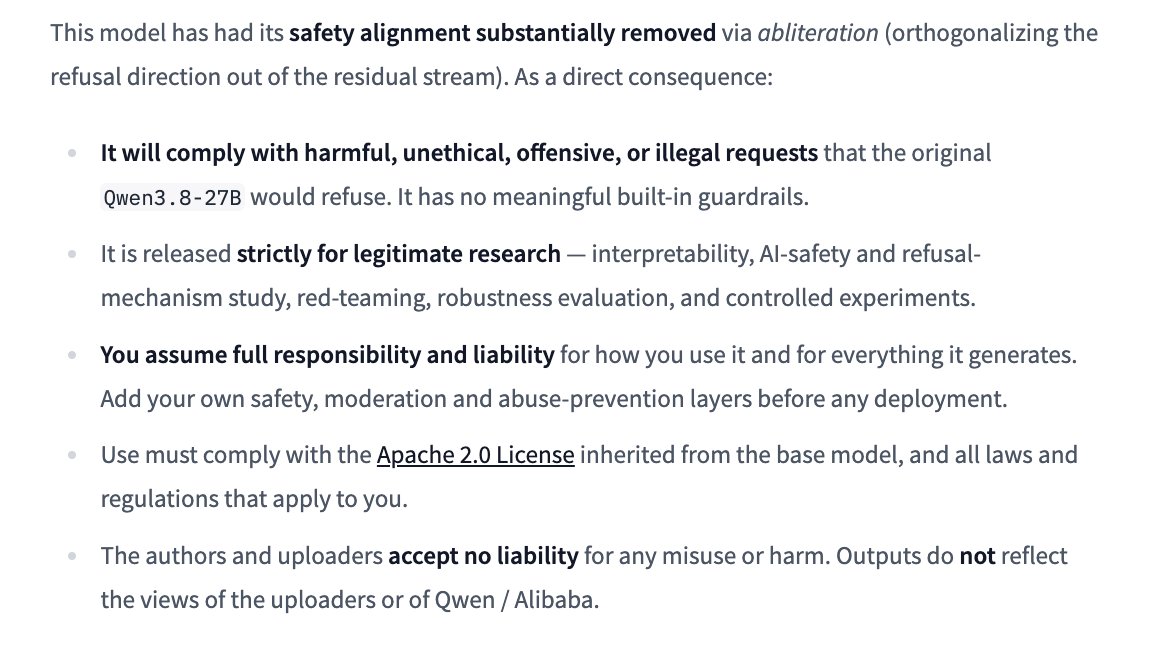
We just shipped our official Qwen 3.8 27B Uncensored MLX build. Local. Uncensored. For🍎 2-bit, 4-bit, 6-bit & 8-bit — pick your poison based on RAM and speed. No CUDA. No cloud. Just your Mac and the weights. Have fun! https://t.co/b3gXsHeSdk
Chat is all you need
Introducing Warp Factories: open, flexible infrastructure for building cloud software factories. - Configure your factory as code - Use any model and any harness - Measure quality with evals and benchmarks on your own data - Built-in self-improvement and memory https://t.co/q5xqKElmIs
Introducing fx, a tiny, open, native coding agent from Vercel Labs. Originally an internal tool, fx is a harness and CLI written in Zig, optimized for research and embedding in larger systems. Today, we're open sourcing it. fx is built on three principles: 1. Fast. A single native binary, no runtime to install. It cold starts in 10µs and does no unnecessary work or I/O before accepting input. fx is the answer to "how fast can a coding agent be?" 2. Light. The 6.3MiB binary uses single-digit megabytes of memory at baseline, made for instant installation and embedding in resource-constrained environments and agent sandboxes. 3. Open. Apache-2.0, model and provider agnostic, suitable for local and cloud inference. Its small core extends through skills, plugins, and MCP. Minimalism is an obsession throughout the entire harness: system prompt, tools, features, binary. The goal was to keep context usage and time to first token low, and make fx optimal for model benchmarking, sandboxing, evals, and gyms. You can use fx directly or embed it as infrastructure. The CLI feels more like a Unix shell than an IDE in the terminal: it preserves scroll history, produces minimal output, and uses complex TUI rendering very, very sparingly. Programmatically, 𝚏𝚡 𝚊𝚜𝚔 --𝚓𝚜𝚘𝚗 gives structured output, 𝚏𝚡 𝚊𝚌𝚙 connects to editors and other clients, and WebAssembly can even run the whole thing inside the browser (see: https://t.co/wf2Trg47sC). Privacy is a design constraint: no product telemetry, sessions and usage stay local, and no source code or prompts are shared with any endpoint other than inference. With local inference and auto-updates off, fx is fully hermetic. fx is experimental. Use at your own risk and expect frequent changes. Chat with us on X (https://t.co/A2AB2YythC) or file issues (https://t.co/GEjTHSoa1J). 𝚌𝚞𝚛𝚕 -𝚏𝚜𝚂𝙻 𝚏𝚡.𝚜𝚑/𝚜𝚎𝚝𝚞𝚙.𝚜𝚑 | 𝚋𝚊𝚜𝚑 https://t.co/g2uEuXhGnt
You can't edit a video without knowing what you're making. Codex needs this even more than a human editor. It starts with knowing the audience. (check the 🧵for more!) https://t.co/qAzd1tVPUb
Hi, I’m John! I’m a L7 Senior Staff software engineer at Meta. My weird hobby is making AI Tech content on YouTube and Substack and I wanted to start sharing more here. In the past I’ve worked on Reels, Meta AI on Msgr and currently working on Threads. I also teach Agentic Coding with @bytebytego for fun on the side. Doing an AMA here to share and meet new people. 👋
$1,688 humanoid limited second batch shipping this fall. What would you build with it? https://t.co/tT5CvRiMOV
Hi, I’m John! I’m a L7 Senior Staff software engineer at Meta. My weird hobby is making AI Tech content on YouTube and Substack and I wanted to start sharing more here. In the past I’ve worked on Reels, Meta AI on Msgr and currently working on Threads. I also teach Agentic Coding with @bytebytego for fun on the side. Doing an AMA here to share and meet new people. 👋
It's actually crazy watching everyone pivot in the complete wrong direction from what companies want. Having an army of agents/bots is counterproductive. It's a vanity metric. What teams want is a shared workspace where they can: - work with any model - build a "company brain" of skills, integrations, and context/memory mapped to their permissions - build and host custom apps - interact from slack, email, or wherever they work
Qwen3.8 27B literally broke the SIZE → INTELLIGENCE curve. Look how far left it is in the optimal quadrant. Crazy that a 27B model is sitting on the Pareto frontier like that. This RESETS expectations for what you can run on consumer hardware. https://t.co/olXybwrnzL
$1,688 humanoid limited second batch shipping this fall. What would you build with it? https://t.co/tT5CvRiMOV
1/ Today, we're releasing the first open-source Computer History - now in early preview for Cua Driver on macOS, Windows, and Linux. It gives agents an encrypted, local record of actions they took through Cua Driver, so new sessions can recover useful context from earlier work. https://t.co/tzIb1dFhPP