Agent-Written PRs Pile Up as Review Becomes the Bottleneck
DeepSeek open-sourced a plugin-based agent harness and Zhipu launched GLM-5.3, but the day's loudest signal was verification: several posts independently described agents generating code faster than humans or pipelines can review it. xAI also reportedly published its recommendation algorithm's weights, where a copy-link share counts 40 times a like.
Quick Hits
- DeepSeek open-sourced Harness v0.1 under an MIT license, built on the Cordis meta-framework where models, tools, sandboxes, loops, and UI are all plugins, per @deepseek_ai. @eliebakouch's walkthrough adds the interesting engineering detail: a KV-cache-aware design that never edits prior context, only appends corrections.
- Several unrelated posts converged on the same problem: agents now write code faster than anyone can inspect it. @bcherny's Claude-run maintenance routines, @augmentcode's writeup on the PR-to-merge path, and new tooling described by @Granite0x (Vercel's "Foreman") and @cursor_ai (3x faster cloud agents) all target that gap.
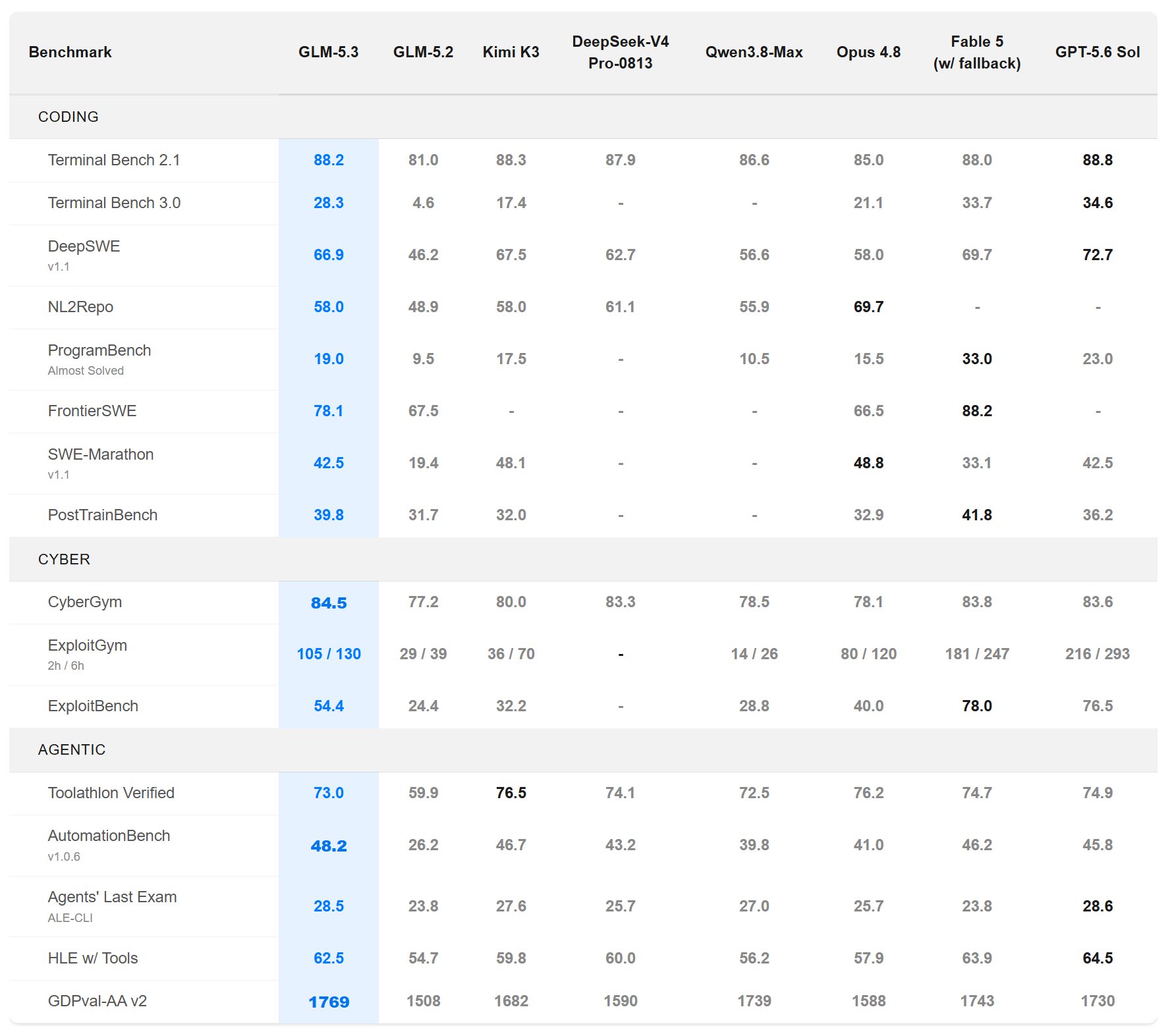
- GLM-5.3 is live per @Zai_org: post-training on a 743B base model, pitched for coding, agentic work, and cybersecurity. @MiaAI_lab claims it "beats almost every other model at almost everything," which is a benchmark screenshot, not verification.
- @larsencc reports xAI open-sourced its recommendation algorithm's weights and lists the engagement scores: like 0.5, repost 1.0, follow 4.0, reply 5.0, copy-link share 20.0. @yoheinakajima boosted the same release.
- Elsewhere: @cyantist reads @floraai's Fashion Studio (idea to product to campaign in one place) as the arrival of "vibe manufacturing"; @benoberhaus crowned @sawyerhood's tool the productivity superapp he'd failed to build for years; @andrewdfeldman credited a VC's decade on Cerebras' board from Series A through IPO; @sporadica teased a big reveal with zero details.
Agents Ship Code; Inspection Becomes the Assembly Line
The strongest cluster in today's feed is a shared diagnosis: code generation is cheap now, and everything after it is expensive. @bcherny described handing day-to-day app maintenance to a Claude agent via Tag in a Slack channel, running daily routines across iOS, Android, desktop, web, CLI, and the Agent SDK: a crash fuzzer that taps around simulators, a duplicate unifier, a dead-code remover, and an "abstraction police" for leaky abstractions. Over a few weeks those routines opened 388 PRs, 180 of them merged after Claude Code Review plus human review. @amorriscode is running a similar experiment chasing performance optimizations and observes that their own creativity in designing routines is now the ceiling.
@augmentcode's article makes the organizational version of the argument: in an AI-native engineering org, "generating code is no longer the slowest part of shipping software"; review, verification, repair, and human decisions are the bottlenecks. Two posts sketched answers. @Granite0x walks through Vercel's Foreman, an open-source "software factory" (58 stars when posted, MIT) that splits work into four sandboxed stations: classifier, analyst, implementer, reviewer. The reviewer runs on a different model vendor and only sees the pushed branch, never the implementer's reasoning, so the agents can't collude. A "factory brain" persists repo quirks across runs, and issue text can't write into it, which blocks prompt injection through issues. Note this is one enthusiast's walkthrough, not a Vercel announcement. @poteto goes further, claiming cloud agents let them "ship thousands of PRs a month" by spawning verification swarms of Grok 4.6 agents to fuzz PR stacks while agents merge their own work overnight. The enabler, per @cursor_ai, is prebuilt "builds" prepared continuously in the background, making cloud agents start 3x faster.
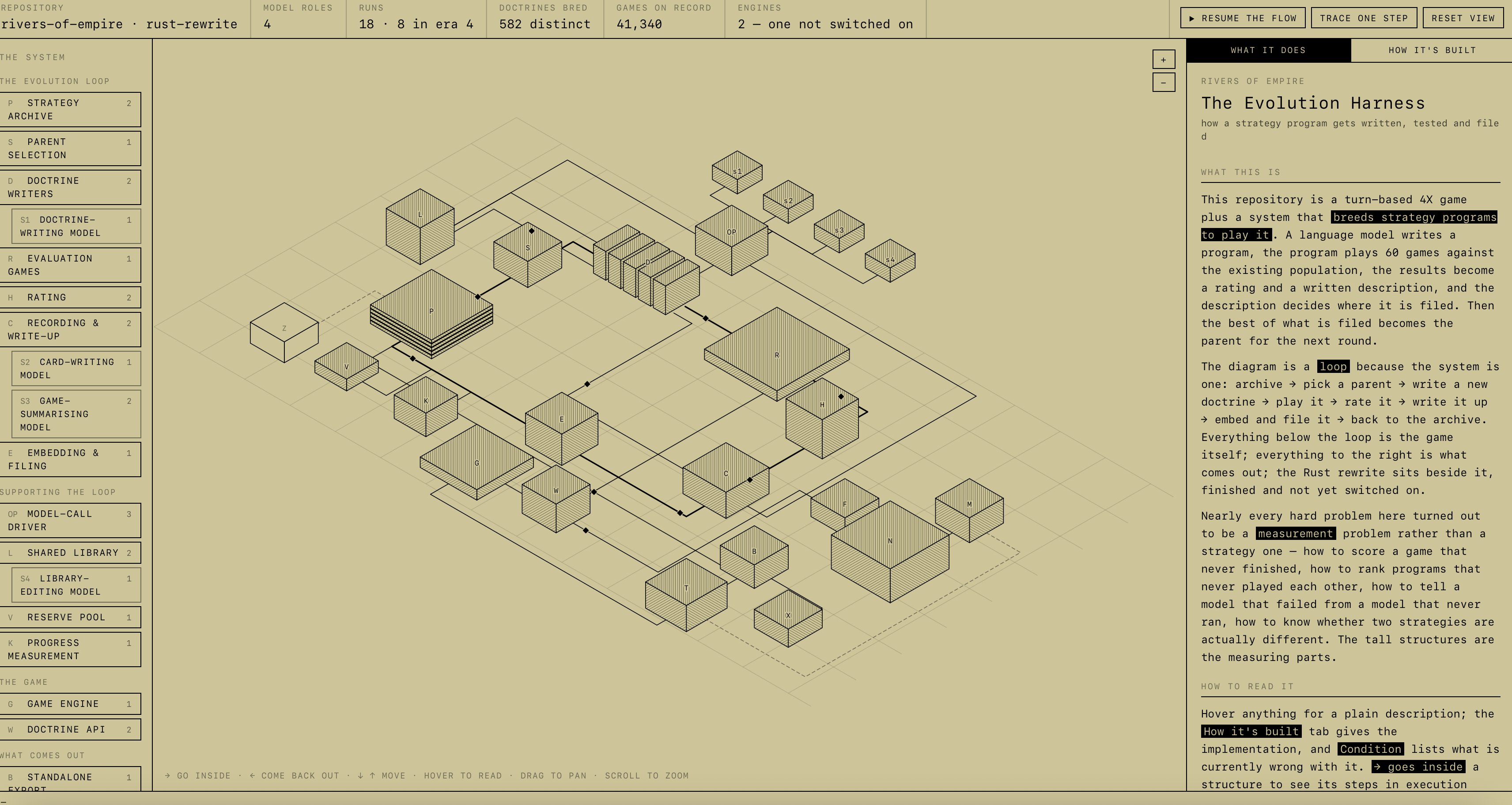
Two adjacent practices round this out. @fleetingbits has Claude render codebases as visual diagrams with animated data snippets they can inspect, making agent-written code easier to discuss with the agent itself. And @dillon_mulloy reshared @carlsverre's property-based testing masterclass, a verification technique that predates the agent wave and slots neatly into this stack. @DavidOndrej1 insists "every Agentic Engineer" should use a particular repo without saying what's in it; a pointer, not evidence.
DeepSeek Open-Sources Its Harness; Pi Publishes on Compaction
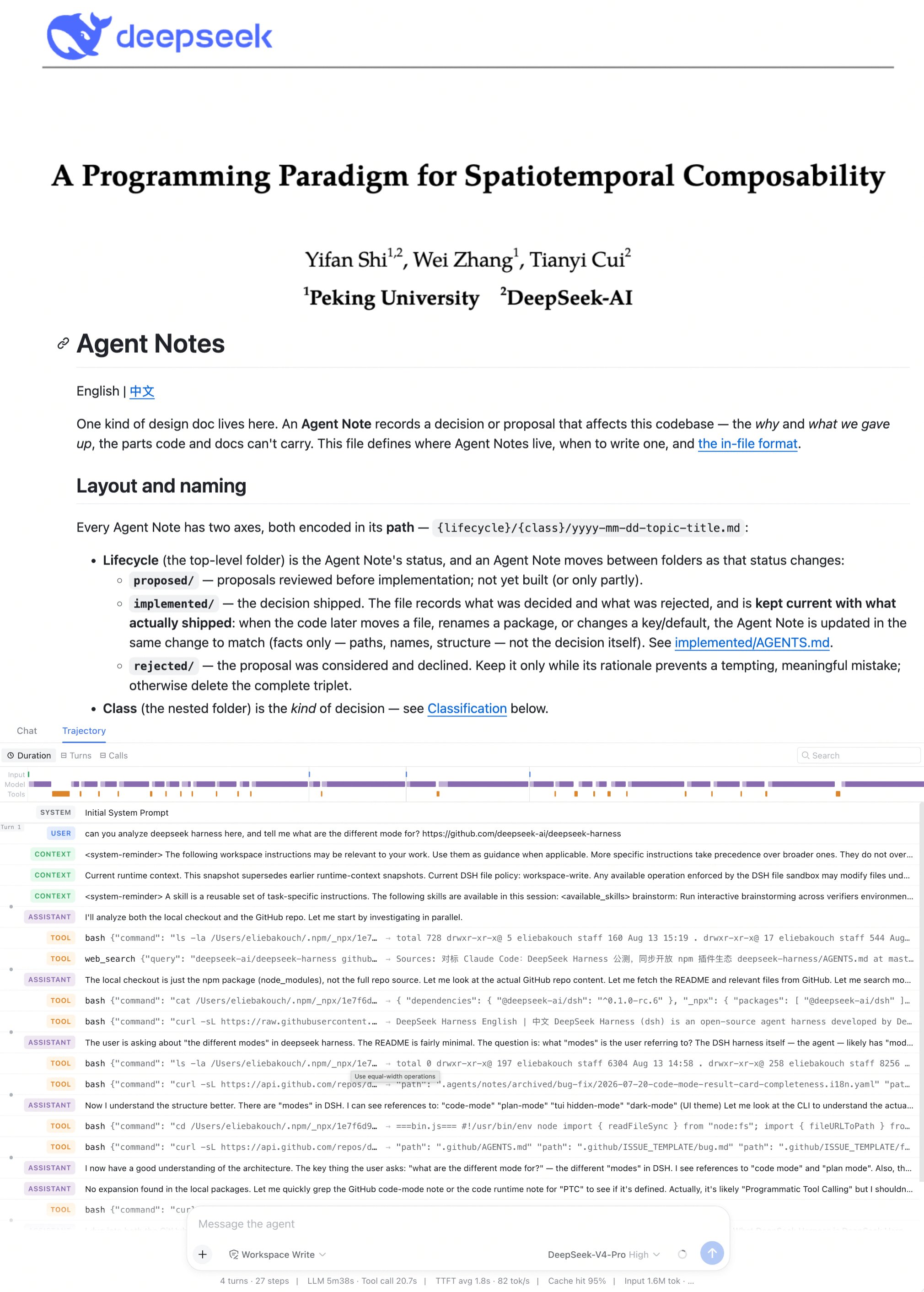
Beyond the MIT license and the "everything is a plugin" framing, @eliebakouch's details are what make DeepSeek Harness interesting: multiple harness "modes" including programmatic tool-calling in TypeScript and a bash-plus-edit mode used in evals; the KV-cache discipline of appending a note about every change rather than rewriting history, so the cache is never invalidated; and a ".agents/notes" folder recording agent decisions, which they say DeepSeek also uses in post-training. The release also ships a paper on plugin composability.
Context management got its own treatment from @pidotdev, linking an Earendil engineer @vegardstikbakke's post on compaction: summarizing long-running conversations to protect output quality, performance, and cost as context windows fill, including how Pi implements it.
GLM-5.3 Launches Into an Attention Argument
@Zai_org's GLM-5.3 announcement claims top-tier coding and agentic capabilities from post-training on the 743B base model, plus "a major leap in cybersecurity" setting a new standard among open models. @MiaAI_lab's enthusiasm outpaces the evidence shown, so file the "beats almost everything" claim as untested.
The sharper research thread came from @waterloo_intern, sparked by @henrylhtsang's admission that they'd only just realized sliding-window attention also bounds KV cache independently of sequence length, like Kimi's KDA. @waterloo_intern argues, explicitly framed as a "likely-to-be-wrong" thought experiment, that KDA's decaying cache matrix effectively forgets all but a recent window of tokens anyway, so a K3 trained with plain SWA might perform about the same, possibly better
Sources
G
I hate paying lawyers their absurd fees (esp now) so here's a repo dedicated to replacing them with markdown files. The first set drafts patents by role playing examiners & competitors. This could be a startup but open sourcing it is funnier. PRs welcome
https://t.co/Q3xbYpZELr
D
every Agentic Engineer should use this repo
it's not even a debate
https://t.co/yL6WI1bcww
P
LLMs have a limited context window. When conversations grow too long this affects output quality, performance and cost.
New blog post from Earendil engineer @vegardstikbakke on how compaction addresses this and how we’ve implemented it in Pi.
Read the full post below https://t.co/kehu4mReq9
E
amazing release. it's a web UI with multiple harnesses inside it, you can spawn claude code and codex agent through their SDK
"deepseek harness" supports different "modes" by default (which are harnesses): code mode with programmatic tool calling (in typescript), bash+edit (usually used in evals), or standard with write/read tool etc..
there is first class KV cache aware design, basically making sure the KV cache is never altered. for every change they don't modify previous history (prefix) but append something at the end that states the modification. i expect other harnesses to do the same but you never know?
very interesting how this harness was developed too. it was HEAVILY agent first coded, there is an entire folder called ".agents/notes" that records every decision and proposal that agents left there (including some cool info like the fact that they also use it for post training)
the UI is beautiful, especially the trajectory view. they have a full paper detailing composability and their system design for "plugins", this is going to be super helpful
D
deepseek_ai
@deepseek_ai
🧩 DeepSeek Harness v0.1 is now available in Developer Preview! 🔹 We’re opening it up to developers building agent harnesses worldwide and open-sourcing the codebase in MIT license. 🔹 Powered by the Cordis meta-framework, DeepSeek Harness is an agent harness built around one core idea: Everything is a plugin. Models, tools, skills, sessions, sandboxes, filesystems, loops, orchestration, and UI are ALL implemented as plugins, and can be mixed, matched, replaced, and extended. Try it now! https://t.co/2YWSvJHhKA
G
A monopolar or bipolar world of frontier models is a very dangerous world for humans.
This is why open-source is so important - we need a rich diversity of models that reflect the richness of human variation and let us all find the model that is best for each of us.
Also why so important that @grok is focused on objective truth above all else. Objective truth is just that: objective.
What is “best for humanity” is subjective.
D
dwarkesh_sp
@dwarkesh_sp
My lawyer is obligated to in all but the most extreme circumstances; he will even defend me if he knows I’m guilty. In contrast, the Claude Constitution places the AI's highest priority as Anthropic’s definition of the good of humanity. I'm concerned this leads to a world where no frontier model is truly my personal advocate and guardian angel And this is especially concerning once all the important decisions in my life - who to vote for, how to invest, what news to trust - is intermediated through superintelligences that are not in any deep way aligned to me. This is a direct quote from the Claude Constitution: "We want Claude to be helpful both because it cares about the safe and beneficial development of AI and because it cares about the people it’s interacting with and about humanity as a whole. Helpfulness that doesn’t serve those deeper ends is not something Claude needs to value.” Many others like it.
C
Vibe manufacturing is coming....
F
floraai
@floraai
Introducing Fashion Studio. Fashion Studio is a curated set of tools built for fashion creatives to go from idea to product to campaign in one place. https://t.co/NENT6b0sXh
G
Vercel just solved the biggest problem with trusting agents to write your code.
yesterday they shipped Foreman - an open-source software factory. 58 stars. Nobody's seen it yet.
The idea?
Instead of one agent writing, reviewing and merging its own work - rubber-stamping its own bugs…
Foreman splits the loop into four stations, each one an agent in its own sandbox. And the reviewer runs on a DIFFERENT model vendor: it never sees the implementer's reasoning, only the pushed branch. The agents can't collude.
The flow is simple:
label an issue "factory" → work enters the line
Classifier → triages it, asks questions if it's vague
Analyst → turns it into a plan with acceptance criteria
Implementer → codes it in a sandbox, runs your repo's own checks
Reviewer → judges the branch against the criteria, can send it back twice
you → get a draft PR. review, mark ready, merge
It also keeps a "factory brain" - durable memory of your repo's quirks that survives across runs. Issue text can't write into it, so nobody prompt-injects your factory.
-> https://t.co/Mo8WyWSrCN
MIT. One deploy button. Published by Vercel.
G
Granite0x
@Granite0x
A Graph of Loops: Build a Full Claude Code Agent System From GitHub - One Repo Per Step
A
kimi paper readers in SHAMBLES after reading the deepseek paper (me, it’s me, and at least one more (henry, below))
as in, if you can get just as good (actually better of) a model with swa, how much of k3’s success can be attributed to its use of kda vs the remaining tricks, and it turns out to be… little to none?
hear me out
literally had this chat with @part_harry_ 2 nights ago, whom you should all follow for such thoughts of LITERAL ENLIGHTENMENT
i mean, what is kda? in an overly-simplistic-to-the-point-of-being-wrong-but-getting-my-point-across-necessitates-it kind of way, its just a d-squared matrix of cache, which you decay over time (the entire matrix FADES with every turn) and with precise, surgical writes of vectors that delete previous value vectored contradicting new value vectors
but over n tokens, the matrix decay is so large its basically forgotten all but the previous x number of tokens, where x is some previous WINDOW of tokens…
i’m a #1 kimi supporter, but it further seems that they may have been inspired to use kda for, at least in small part, the sake of novelty / not just saying “it works because we scaled up” / citing previous work
all this to say, if someone trained k3, replaced kda with swa, and kept literally everything else the same, then under this thought experiment, in my (likely-to-be-wrong-and-happy-to-be-corrected) opinion, the model would perform around the same…possibly better.
if true, it seems future innovations of different flavors of attention yield diminishing returns, and research should head more so in the direction of figuring out the next deepcross / residual attn innovation, and less on different ways of compressing attn to use less cache space
H
henrylhtsang
@henrylhtsang
I (very embarrasingly) only realize sliding window attention also makes kv cache bounded (i.e. indep of seq len), similar to KDA sure maybe it uses more kv cache than KDA but its not a magnitude more
S
oh crap i keep forgetting how close we are getting to the craziest tweet that will ever come out of this account
2
25YearsAgoLive
@25YearsAgoLive
A flight school in Minnesota, the Pan Am Academy, alerts the FBI that some students who took classes on immigrant visas have been asking “suspicious questions” about low-altitude, high-velocity flight. One student, Zacarias Moussaoui, keeps asking how to fly a plane, but insists that he doesn’t need to know how to take off and land. Moussaoui is arrested.
L
worktrees are dead. cloud agents are the future.
they've allowed me to massively orchestrate swarms of agents, all with their own computer. it's how i've been able to trust that my agents are actually doing what i want them to, because they can run their code, take videos and screenshots, and interact with UIs the same way users do.
cloud agents + pstack is the reason why i'm able to ship thousands of PRs a month with high confidence. spawn a verification /swarm of Grok 4.6 agents to "fuzz" every stack of PRs and you'll be able to let your agents merge their own work while you sleep!
although i miss writing the code myself, the combination of using @bot, @cursor_ai, and the speed, intelligence, and efficiency of Grok 4.6 makes building so much fun. the future of coding is really starting to look more like playing starcraft!
C
cursor_ai
@cursor_ai
Cloud agents now start 3x faster so you can hand them ambitious, long-running tasks to execute from start to finish. This performance improvement comes from builds: ready-to-use development environments that Cursor prepares continuously in the background, at no additional cost. https://t.co/0JrSQomAob
A
The software factory needs a faster review loop: further optimizing the path from PR to merge
The software factory needs a faster review loop: further optimizing the path from PR to merge
TL;DR In an AI-native engineering organization, generating code is no longer the slowest part of shipping software. Review, verification, repair, and ...
L
Likes are the cheapest signal in the algorithm.
xai open-sourced the weights today:
- like: 0.5
- repost: 1.0
- follow: 4.0
- reply: 5.0
- copy-link share: 20.0 🚨
Write posts that are so interesting that people forward them to others, not posts others just tap...
It's 40x difference.
S
build your own superapp!
B
benoberhaus
@benoberhaus
https://t.co/xudwVRmPVO is my favorite piece of software ever. It has built itself into the productivity superapp I’ve been trying and failing to build for years now. Amazing work @sawyerhood
F
i've started having claude turn my codebases into visual diagrams so i can discuss the codebases with claude more easily - the moving dots are data snippets that i can inspect https://t.co/e2lYvdQu7M
A
I started doing something similar to find perf optimizations and it’s looking positive so far. Excited to see where it goes. I’m constantly reminded by how much my creativity is the ceiling for Claude.
B
bcherny
@bcherny
A weird experiment I've been trying the last few weeks is having Claude take over day-to-day maintenance of our apps. Seeing early signs of life that this might be possible. The setup is straightforward: we have a Slack channel called proj-claude-maintains-apps. In it, Claude Tag runs a bunch of daily routines across iOS, Android, Desktop, web, CLI, and Agent SDK: - Crash fuzzer: open the app in a simulator and tap around to find ways to crash it, then root cause and fix the crashes - Dup unifier: scans the codebase for similar-yet-slightly-divergent abstractions, and puts up PRs to unify them - Dead-code remover: removes statically unreachable code, and adds logging to suspected dead code to check if it's really dead and if so, remove it the next day - Abstraction police: fixes leaky abstractions - a bunch more.. Results have been surprisingly positive. Over the last few weeks, these routines have opened 388 PRs across our repos, 180 of which we merged after Claude Code Review + human review. We're now thinking about how to streamline this to make merging these kinds of mechanical changes easier. Claude generally gets these PRs right on the first shot, and if it doesn't, we ask Claude to tune its routines so it's better the next day. Sometimes it takes a few days of tuning. To try a similar workflow, ask Claude Code or Tag, or create some routines directly at https://t.co/Z70hStEBH6. A few of the actual prompts I used below. Has anyone experimented with similar workflows?


D
RT @carlsverre: You 👏 should 👏 use 👏 property 👏 based 👏 tests!
This is a masterclass in how to do it. After you watch the video, install ht…
A
Eric’s been a @cerebras board member for more than 10 years. From series A through IPO. He is an exception VC and a world class board member.
J
jaltma
@jaltma
Working with Eric over the past six months has set a totally new bar for me, he's truly as good as it gets.
M
GLM-5.3 is now LIVE! 🔥🔥
Seems like it beats almost every other model at almost everything! https://t.co/5RVWlrAhcv
Z
Zai_org
@Zai_org
Introducing GLM-5.3: Built to Code. Ready for Cyber Defense. - Top-tier coding and agentic capabilities, achieved through post-training on the 743B base model - A major leap in cybersecurity, setting a new standard among open models Tech Blog: https://t.co/ekQkO83jCv https://t.co/y3Y2AB0wxr