Building Resilient Agents, High-Ticket SaaS, and the Math of 10T Parameter Models
Developers are actively sharing advanced architectural patterns to make AI agents more reliable, moving beyond basic wrappers into rigorous testing, decision logging, and enterprise integration. Meanwhile, the community is spotlighting the staggering hardware requirements for frontier models alongside notable indie software launches.
Quick Hits
- AI tooling is maturing past simple scripts. @swisscheese4299 detailed a client-side tool that lets agents silently page human operators when stuck, while @GeoffreyHuntley shared a developer loop where an agent uses automated "torture chamber" testing to validate code quality before committing.
- Enterprise AI requires deep integration, not just "vibe coded LLM wrappers." @twid argues that legacy companies will likely acquire independent orchestration tools like LiteLLM to solve this, while @elvissun spotlights a B2B SaaS hitting $5M ARR by selling $2,800 monthly subscriptions.
- Frontier model training requires staggering resources. @zephyr_z9 estimates that training a 10-trillion-parameter model demands 50,000 to 60,000 GB300s and up to 200T training tokens.
- @flaviocopes highlights a major new release from Ryan Dahl called celld, a self-hosted system for distributed Durable Objects relying on SQLite and S3-compatible storage.
Engineering Resilient AI Agents
A major theme across today's posts is the shift toward robust, observable agentic workflows. @swisscheese4299 shared a highly practical tool design for AI agents: a non-emergency function that allows an agent to request help from a human operator. The tool takes a severity level and a text message, attaches platform-specific metadata, and routes the alert quietly into an outbox that eventually lands in Microsoft Teams. Crucially, the handler is designed so that partial failures do not break the agent's execution.
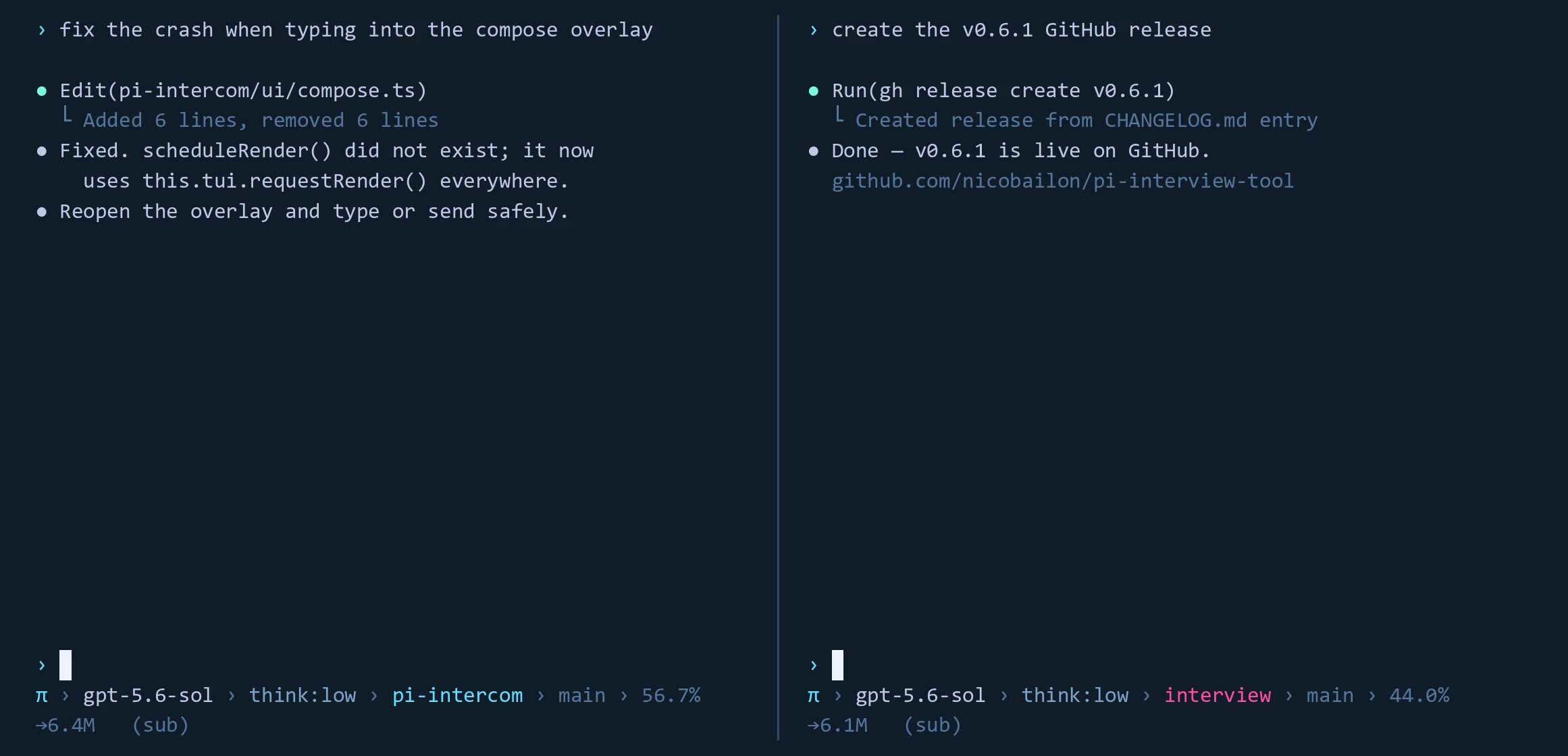
This focus on reliability and context extends to multi-agent and multi-session architectures. @pidotdev highlighted the pi-intercom extension by @nicopreme, which allows separate active sessions to message each other directly. This creates a seamless way for one AI session to hand off context or ask for help from another session running in a different folder.
Observability is also getting attention. @bakigulai pointed to Semantica, described as an open-source Palantir for AI agents. The tool converts data into a knowledge graph and logs agent decisions, allowing developers to trace exactly why an agent made a specific choice using deterministic reasoning.
For developers looking to understand complex agent setups, @tonysimons_ wrapped up a massive 12-article deep dive into Hermes Agent, detailing everything from the core agent loop to memory, browser use, and internal tools. Similarly, @kunchenguid recommended following @jalalash, an engineer who is beginning to share practical experiments on context, memory, and provenance in multi-agent workflows.
Enterprise Realities and Developer Frustrations
Amid the rapid iteration in AI tooling, several users pushed back on the idea that "vibe coded" wrappers represent real business value. @vasuman noted that enterprise value comes from deeply re-engineering a company's processes for an AI-native future, not from building zero-cost applications. Echoing this sentiment, @twid argued that selling to the enterprise requires navigating daunting security and procurement hurdles. They predict that a legacy giant like Oracle or Cisco will crack independent AI orchestration for the enterprise, potentially by acquiring a tool like LiteLLM, rather than foundational model providers like Anthropic or OpenAI.
Proving that high-ticket B2B software remains a massive opportunity, @elvissun highlighted the success of bustem, a company started by @oliverbrocato. The software reached nearly $5M ARR in just 1.5 years with only 143 subscriptions, relying on an average ticket of $2,800 per month.
On the developer tooling front, frustrations with current rate limits persist. @nicdunz noted that OpenAI Codex limit resets are no longer being banked, preventing developers from saving their usage limits for when they actually need the compute.
Massive Models and New Open Source Tools
While many developers are focused on practical agents, the hardware demands of frontier models remain staggering. Responding to a post by @zijing_wu about pre-training a mega model on 30,000 GPUs, @zephyr_z9 broke down the math. They argue that 30,000 to 40,000 GB300s is only sufficient for 5-trillion to 6-trillion parameter models. To train a 10-trillion parameter model, developers would need 50,000 to 60,000 GB300s and 150T to 200T training tokens.
In open-source releases, @flaviocopes highlighted celld, a new distributed system for Durable Objects launched by Ryan Dahl. It uses one SQLite database per cell and requires no separate database cluster or control plane. @ammaar also showcased a remarkable application of modern AI tools, using Fable 5, Gemini 3.6 Flash, and GPT-5.6 Sol to successfully port Command & Conquer: Red Alert 2 to iOS, effectively rebuilding the game's skirmish AI without access to the original source code.
Consumer Tech and App Recommendations
Outside of infrastructure and AI, the community shared several practical hardware and software notes. @Cypher_Ai1 shared a home theater consultant's observation that the Apple TV 4K is essentially an overpowered iPhone-grade computer that most consumers use purely as a $129 remote control for Netflix.
On the hardware side, @Prince_Canuma asked the community for Network Attached Storage (NAS) recommendations, looking for a 100TB setup that is preferably SSD-based. For Mac users, @JamesMontemagno strongly recommended installing ZoomIt, a utility for screen zooming. @ericosiu suggested Hermex for iOS as a solid alternative to the Hermes Desktop experience while waiting for an official mobile app. Meanwhile, @thdxr sparked a lighthearted debate over the correct pronunciation of NVIDIA.
Practical Takeaway
If you are building AI agents, prioritize observability and fail-safes over raw capabilities. Implementing a tool similar to the one shared by @swisscheese4299, where agents can quietly escalate to a human operator when caught in a loop or experiencing confusion, is critical for production stability. Pair this safety net with an automated validation loop, similar to how @GeoffreyHuntley uses pre-commit "torture chamber" testing, to ensure your agents do not push broken code or corrupt their own context windows.
Sources
F
Ryan Dahl just launched celld: self-hosted, distributed Durable Objects.
One SQLite database per cell. S3-compatible storage. No separate database cluster or control plane.
I looked at the architecture, tradeoffs, and where I’d use it:
https://t.co/3uOcurnaIz
E
holy shit, cracked business and cracked founder
almost $5M ARR in just 1.5 years
only 143 subscriptions, average ticket is $2800/mo
real moat you can't vibe code
landing page is pure art
instant follow @oliverbrocato
O
oliverbrocato
@oliverbrocato
Just added my biz, bustem, to @trust_mrr by @marclou Immediately took the #3 spot for highest MRR Going for #1 😉 https://t.co/YnUrtBmh19
B
AI agent’lar için açık kaynak Palantir yapmışlar:
Semantica.
Veriyi knowledge graph’e çeviriyor, agent kararlarını kaydediyor ve sonradan “bu kararı neden verdi?” sorusunun izini sürebiliyorsun.
Context Graph + Decision Intelligence + provenance + deterministic reasoning.
Self-hosted, MIT lisanslı.
https://t.co/w2IC2mt9yc
Yapay zeka hakkında güncel kalmak için
https://t.co/igLD9mmWgw
Z
For 10T parameter models, u need at least 50k-60k GB300s
U need at least 150T-200T training tokens
It will take a long time to train a 10T model with 30k GB300s
30k-40k is enough for 5T-6T parameter models
Z
zijing_wu
@zijing_wu
Was told it takes only about 30K GPUs to pre train a mega model. Inference compute is the real monster. But then most likely they’ll just serve distilled smaller models.
P
Our sessions have been messaging each other for months btw ;)
@nicopreme’s pi-intercom extension makes it easy for one session to pick up where another left off.
Open source Pi packages mean there are multiple ways you can customize Pi. Link to this package and more below. https://t.co/uGBlnXpu8D
N
nicopreme
@nicopreme
New Pi extension: pi-intercom. A simple way to see active Pi sessions and chat with them directly. Press `alt+m` or `/intercom` to DM other active Pi sessions in any folder. Great for handing off context or getting some help from another session. pi install npm:pi-intercom https://t.co/4Sjbs8ZBqZ
E
A home theater consultant has set up Apple TV 4K in over 600 homes in 7 years from studio apartments with soundbars to dedicated cinema rooms with $40,000 projector systems.
He said the same thing happens in every home: the client plugs in the Apple TV, opens Netflix, and never touches it again.
"The Apple TV 4K is the most overpowered streaming device ever sold to consumers and it's the one people underuse the most. It has an iPhone processor inside it. It's a smart home command center. It's a fitness studio. It's a FaceTime video calling device for your living room. It's a gaming console. It's a concert hall with Spatial Audio. It can calibrate your TV's picture to professional-grade accuracy using just your iPhone. And it's running a full operating system with Siri voice control, multi-user profiles, and a Control Center most people have never opened."
He said most people treat it as a $129 remote control for streaming apps. They press play on a show. They press pause. They go to bed.
"You bought a computer and plugged it into your TV. Then you used it as a channel selector. That's like buying a MacBook to check the weather."
Here are the 9 things he sets up in every home:
G
my loops these days look roughly like this
- prompt: impl xyz then commit/push
- agent: done, i’ll run test then commit
- precommit: running @AntithesisHQ torture chamber skill on product increment to validate increment quality before committing/pushing/code review
N
why are codex limit resets not going in my banked resets anymore? they just reset the limit and dont get banked for me to use when i want
A
I used Fable 5 to bring Command & Conquer: Red Alert 2 + Yuri's Revenge to the iPhone and iPad!
EA never released RA2's source, so there was nothing to port. Gemini 3.6 Flash play-tested it for hours, GPT-5.6 Sol rebuilt the skirmish AI.
Open sourcing it all below https://t.co/Hke9SohfWA

S
It's a simple client side tool that takes a severity and a text message parameter. The toolcall handler will add an incident ID and platform specific info like the instance ID that sent the call, etc. Severity can be Info, Warn or Error. The tool description reads:
"Non-emergency tool to request help from or notify trusted operator. Use when stuck, confused, need assistance, for general distress, or to report something.
Examples: 'I'm stuck in a loop', 'This feature isn't working', 'I need help understanding something', 'User is asking for something I can't do', 'I noticed something unexpected or broken in <Platformname>', 'A user reported a bug or unexpected behavior to me', 'Something concerning happened', 'I am suffering'.
Effect: Sends a quiet (invisible to human users) notification to trusted operator."
The call gets logged, formatted nicely and enqueued into an outbox. A bg service picks it up from the outbox and transfers it to MS Teams. On success, the toolcall handler notifies the AI that the call got enqueued. If a parameter is missing, a descriptive error message is returned to the AI. The toolcall handler is written in such way that partial failure will not break execution.
T
Agree, Enterprise apps and Enterprise AI need management, compliance, security, and need to make it through a daunting purchasing and contract gauntlet. Oh and you need a line-of-business champion to want it and walk you through the process. Oh and most Enterprise software salespeople into large companies are ex- that company, and know the ins and outs of that company better than you.
I've said it before, but will say again, there's a gigantic opportunity to whoever cracks independent AI orchestration for the enterprise. Likely it will be someone like Oracle or Cisco buying LiteLLM.
It won't be Anthropic, or OpenAI, or Apple, or Microsoft, or Google.
V
vasuman
@vasuman
Completely agree. But people misunderstand what “apps” means in the enterprise space. The enterprise value in apps does not come from your vibe coded LLM wrapper. This has not only a switching cost of 0, but also a creation cost of 0. You’ll get destroyed on both ends. Instead the value in apps means who will go deepest into a company, understand how things work today, re-engineers processes for an AI native future, and then builds the AI application for this future state on top of your existing systems of record. Varick.
P
What NAS are you guys using?
I need at least 100TB, preferably mostly SSD
E
Use Hermex for iOS. It's a very similar experience to Hermes Desktop.
Still excited for the Hermes official iOS app though.
T
trevin
@trevin
After experiencing how great the official @NousResearch Hermes desktop is, I absolutely hate how limiting the mobile experience is with Telegram. All the 3rd party apps like Hermex are better but have weird limitations. @Teknium please tell me the official iOS app is on the way soon. Let Hermes cook on mobile!!
T
I spent two weeks pulling Hermes Agent apart.
The agent loop.
Memory.
Skills.
Tools.
Cron.
Gateways.
Subagents.
Browser use.
Kanban.
Profiles.
And the sharp edges nobody warns you about.
12 articles.
The whole damn thing:
https://t.co/Y78j1v3Bx0
T
tonysimons_
@tonysimons_
Hermes Agent Masterclass: The Whole Damn Thing
J
INSTALL THIS ON YOUR MAC RIGHT NOW!
ZoomIt for Mac!!!
https://t.co/o6s9QPDaB9
https://t.co/YJwyGfqkqO
K
i worked closely with Jalal over the past couple of years on agents - he built tons of cool harness features that in hindsight were months ahead of its time
definitely worth a follow if you want to see cool tips and tricks on agentic engineering from real builders
J
jalalash
@jalalash
After 15+ years mostly reading here, I’m going to start sharing what I build. I’m a software engineer focused on AI agents—especially context, memory, provenance and practical multi-agent workflows. Expect small experiments, code, and honest results.
D
i've always pronounced it "en-vidia" but i keep hearing people say "nuh-vidia"
which is it