OpenAI Eyes Cloud Dominance for Agents While Developers Hunt Bugs Using Simplified English Prompts
OpenAI is laying the groundwork for persistent, cloud-native agents that operate independently of local hardware, while developers are discovering that enforcing Simplified Technical English in prompts dramatically improves code reliability. Elsewhere, the community shares new sandbox infrastructure to host these agents cheaply, alongside claims of superhuman milestones in AI forecasting and mathematical reasoning.
Quick Hits
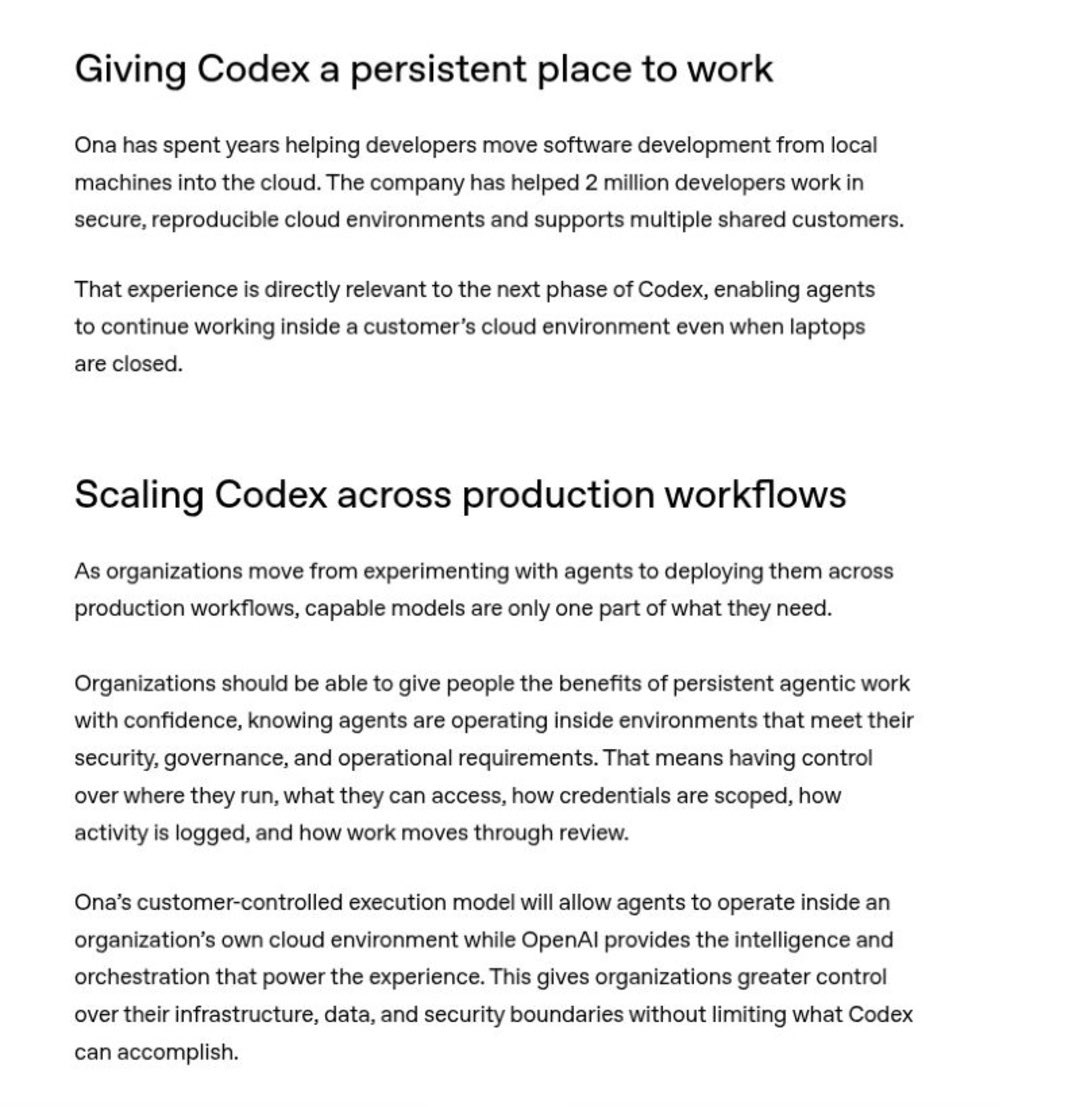
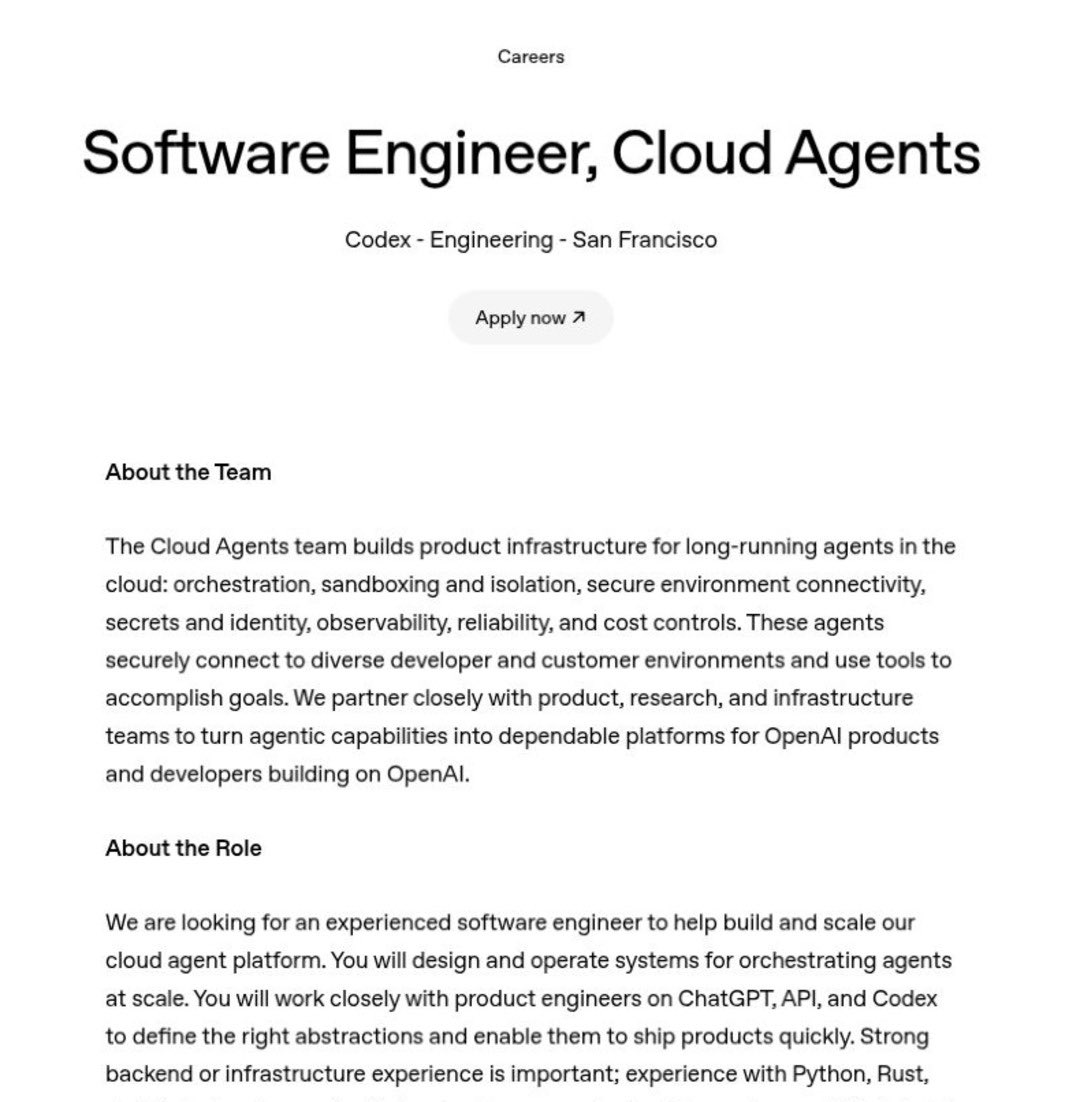
- OpenAI is shifting Codex toward persistent cloud environments following its acquisition of Ona. @imjustnewatai highlights a new OpenAI job posting for cloud agent engineers, arguing that the next generation of models will require dedicated cloud infrastructure to orchestrate long-running tasks.
- Prompting AI models with ASD-STE100, a standard for Simplified Technical English, is yielding unexpected benefits. @copyconstruct reports that asking Claude Opus 5 to write commit messages in plain English actually uncovered critical software bugs. @topmass corroborates this, adding the standard to his global rules to make agents more concise.
- Sandbox infrastructure for AI agents is becoming highly cost-effective. @AniC_dev showcases a new cloud computer for agents that streams desktops at high frame rates while charging minuscule fractional cent rates per second for basic compute.
- AI forecasting might be reaching superhuman levels. @peterwildeford points to FutureSearch, noting that the AI prediction bot is currently outperforming top human forecasters in competitive tournaments.
- The business of selling AI employees to small enterprises continues to grow. @coreyganim shares a playbook from a non-technical designer who charges monthly management fees to handle multi-step AI workflows for local business owners.
Agents Untethered from Local Hardware
The AI development community is increasingly pivoting toward cloud-based infrastructure to support autonomous agents. Analyzing recent OpenAI hiring and acquisitions, @imjustnewatai predicts a near future where models generate their own temporary cloud organizations to complete goals over days. This shift requires robust cloud orchestration, sandboxing, and observability, making a local laptop merely a control screen for a distant AI workforce.
To support these types of persistent workloads, developers are building specialized environments. @AniC_dev introduces a cloud computer tailored for agents that offers highly competitive pricing, providing small virtual instances for fractions of a cent per second and large instances with dozens of gigabytes of RAM for pennies an hour, complete with the ability to fork or resume environments instantly.
Technical challenges remain formidable when scaling these distributed systems. @martin_casado praises Convex for exposing a commit timestamp that represents the serialization order of all transactions, noting that such features are incredibly difficult to implement correctly. For engineers looking to build out these backends, @system_monarch provides a comprehensive 23-point system design fundamentals list, covering everything from load balancing to leader election.
Meanwhile, consumer hardware continues to push the boundaries of local execution, with @loktar00 pointing to @MiniMax_AI claims that their new H3 model runs impressively on a single RTX 5090 GPU. Voice interfaces are also maturing. @bookwormengr notes that OpenAI recently hired the creator of WebRTC, resulting in a highly effective voice interface for GPT-Live, detailed in a new technical deep dive.
Structural Constraints Yield Better Code and Knowledge
Prompt engineering is moving away from open-ended requests toward strict structural frameworks. A prominent trend is the application of ASD-STE100, an aerospace standard for Simplified Technical English, to constrain model outputs. By asking Claude Opus 5 to write code comments and commit messages in simplified English, @copyconstruct found that the model successfully uncovered critical bugs in the codebase. @topmass tested the same constraint logic, reporting that adding Simplified Technical English rules to global configuration files makes agents significantly more concise.
Developers are also finding success by drastically reducing context. @addyosmani highlights that Anthropic removed roughly 80 percent of the Claude Code system prompt for newer models, a move that yielded valuable insights into writing more effective system prompts. To combat bloated or generic outputs, @adrknapp recommends specific community prompt skills designed to measure and rewrite text for authenticity, tone, and direction. Furthermore, @headinthebox suggests feeding academic papers on self-improvement loops directly to models to enhance their autonomous correction capabilities.
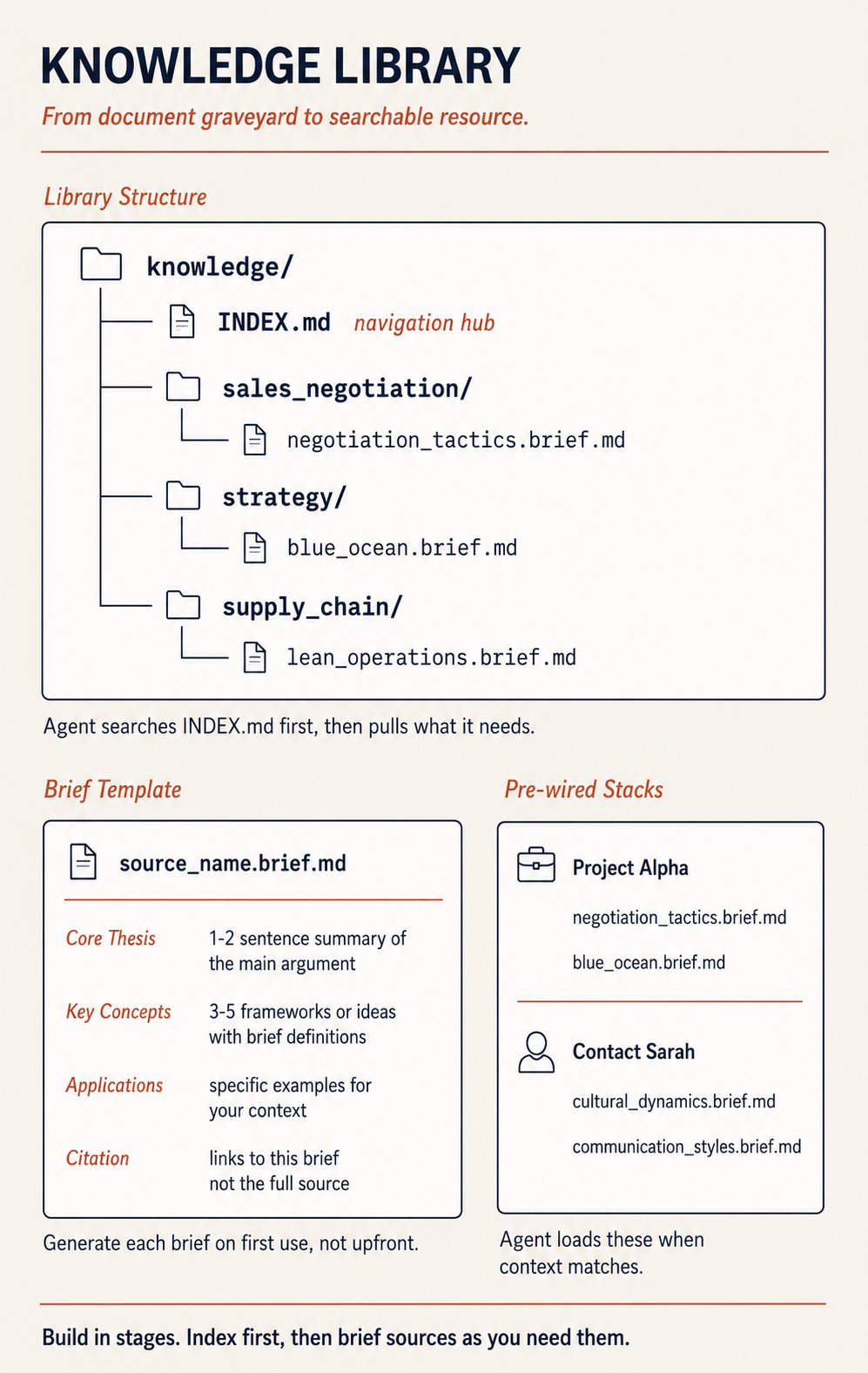
To solve the problem of agents ignoring uploaded context, @alex_prompter recommends a structured file management system. By organizing documents into domain folders and mapping them with an INDEX.md file, agents can efficiently query a lightweight brief rather than sifting through massive raw text dumps, effectively turning a static document graveyard into an active knowledge library. For routine maintenance, @Ananth7e provides a prompt that instructs Codex to autonomously clean up its own stale cache and temporary files on a weekly schedule without user intervention.
Commercializing Agents and Chasing Milestones
The packaging of AI capabilities into sellable products continues to expand. @coreyganim details a business model where a non-technical designer successfully sells AI agents to small businesses. The core product is not the code itself, but the ongoing coaching and management of the agent, supported by weekly value reports that prove a tangible return on investment to non-technical owners.
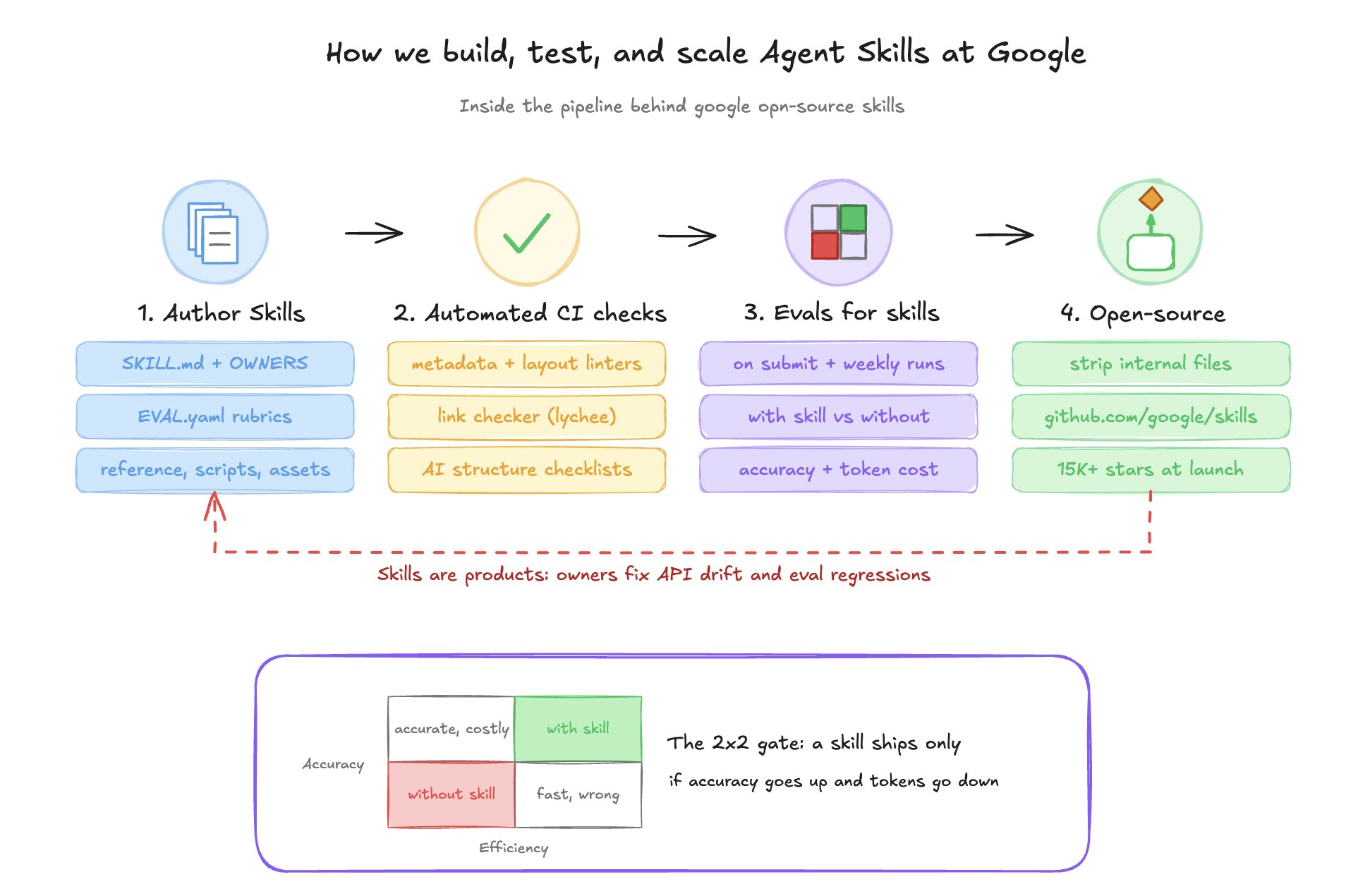
Other developer tools and applications surfaced across the community. @Saboo_Shubham_ points to Google open-sourcing its internal processes for building, testing, and scaling agent skills. In the consumer space, @itsolelehmann highlights DraftedAI, a tool that turns basic sketches into complete architectural floor plans and CAD files in under an hour, drastically reducing traditional design costs.
Frontier model capabilities are also reportedly hitting new milestones. Quoting the FutureSearch team, @peterwildeford notes that their forecasting bot now beats top human competitors in prediction markets. In mathematical reasoning, @henryquantum shares reflections on OpenAI models successfully solving high-level math problems, describing the rapid advancement from basic arithmetic to complex reasoning as a moment of awe that underscores the urgent need for alignment research.
Finally, industry drama remains a constant backdrop. In a post that @theo calls highly damaging to the brand, OpenAI publicly criticized Apple for its approach to AI integration. In the open-source realm, @GMcHorseman documented ongoing friction in the Linux community, noting a desktop environment developer who reacted to requests to stop using suggestive anime backgrounds in software demos by replacing them with arguably more offensive imagery.
Practical Takeaway
If you are deploying AI agents for software development or operational tasks, consider enforcing a Simplified Technical English standard in your global prompt configurations. Multiple developers report that restricting model vocabulary to plain, structured English does more than improve readability; it forces the underlying logic to surface hidden bugs and communicate status more effectively. Pair this constraint by organizing your reference documents into an indexed map, allowing your agents to pull context autonomously rather than ignoring the files you provide.
Sources
P
I'm a Principal engineer & I passed system design rounds of Amazon, Atlassian, Walmart, Saleforce, and Deliveroo.
Trust me, learning system is not hard. Start from these fundamental concepts:
1) Load Balancing: https://t.co/3jKCLiI6vl
2) CDN: https://t.co/dxzCmm9gAf
3) Caching: https://t.co/pRgn0FTPp2
4) Cache Invalidation: https://t.co/QrfRjJ57gd
5) Rate Limiting: https://t.co/LE5ECM2tGt
6) API Gateway: https://t.co/DgU8cBDUVr
7) CAP Theorem: https://t.co/a8WydnAIxd
8) Sharding: https://t.co/XQLU6eDriD
9) Replication: https://t.co/KuDkFH0fjx
10) Partitioning: https://t.co/3WXKeZLbLa
11) Queues: https://t.co/JchEoCcFmF
12) Microservices: https://t.co/aAQfM6AWMq
13) Microservices Vs Monoliths: https://t.co/bTaIIWkPU3
14) Fault Tolerance: https://t.co/qXNBoyOqYT
15) Database Scaling: https://t.co/D2lvPm1wkB
16) Service Discovery: https://t.co/z2DpwbJBVI
17) Consistency models: https://t.co/K2r3nMcCQu
18) Eventual Consistency: https://t.co/SWiz4ckIKR
19) Distributed Transactions: https://t.co/xqL7BTJxXn
20) Leader Election: https://t.co/ApNaYSnSFj
21) Horizontal vs Vertical Scaling: https://t.co/IFuEmzMfob
22) Back of the Envelope Estimation: https://t.co/7ntEmtVggQ
23) Idempotency, Data Latency & Finale: https://t.co/fNArLx4MrW
Let me know what you'd like me to cover, would love to help :)
S
system_monarch
@system_monarch
Scaling & Architecture Series: Idempotency, Data Locality & Series Finale
C
This guy sells AI employees to small businesses.
He's a non-technical designer with no audience, spends $0 on ads, has no tech background.
Yet he's still done 21 agent setups in 6 months, almost all from referrals.
His model: install one AI agent as a digital employee, then get paid monthly to manage it and coach the owner. Setup fee plus a per-agent monthly rate.
@fhlcreative came on the Build With AI pod to walk us through the whole playbook. Here's what I learned:
1. The product is the coaching, not the agent. Owners treat AI like Google. You get paid to manage it so they never have to.
2. Raise your price every yes. $500 setups became $1,000. Now he's targeting $2,000 setups plus $1,000/month per agent.
3. Give the agent a value ledger. It logs every task and sends a weekly ROI report. One client's first week: 63 hours saved, $6,300 in value.
4. Put yourself in the group chat. Telegram group with Phil, the client, and the agent. The client learns by watching him talk to it.
5. The agents handle real multi-step work. One prompt: find the invoice email, extract the PDF into Excel, save to Dropbox, send the link. Done in 10 minutes.
6. Uptime is a selling point. The best prospects tried agents themselves and quit when they broke. Phil fixes it before the client notices.
7. Free work is the referral engine. Friends in his small Georgia town told friends in Atlanta and Dallas. Now he has clients nationwide.
8. The pitch is one text. "I'm testing a managed agent service. Want to be a guinea pig? I'll charge you less." First client: $250/month.
9. Make the agent write to Excel, not its own markdown. A shared source of truth is the difference between a demo and a system.
10. Phil builds his agents on @orgo. $29/month gets your agent a computer with pre-built templates. Phil's agent handles the Orgo admin itself.
His 2 key takeaways:
1. You only need to be one step ahead. If you've built an agent for yourself, you know more than the owner who never has. Charge from day one.
2. Visible ROI is the retention strategy. A weekly "you saved $6,300" report re-sells the retainer every single week.
Phil is doing this at a level most technical people are not, and we had a blast going deep on it. Go follow @fhlcreative
Full video below.
https://t.co/mlTEqIQYAN
(Also available on the Build With AI podcast wherever you get your pods)

P
"superhuman forecasting" is obviously a claim I take seriously and personally as a top forecaster but I'll admit that FutureSearch does a great job.
If you're not among the world's best forecasters, you should just ask this bot what's going to happen lol.
D
dschwarz26
@dschwarz26
AI forecasting is now approximately superhuman. Today, FutureSearch is exiting our public beta and launching to everyone. FutureSearch is the original AI forecasting company, started in August 2023. We’re currently #1 of 194 in the most competitive AI forecasting tournament, and we score above the #3 and #2 human forecasters in the premier mixed human-bot tournaments. We’re beating the crowd on Kalshi with a pure forecasting strategy, all our forecasts and trades there are public. Thousands of people used the beta and ran >10k high-effort forecasts. Ask it anything about the future! We now support decision forecasts too: “If I do X, will I achieve this outcome?” This video shows the part we’re proudest of: world modeling. Forecasts draw on a persistent latent representation of the future, and we’ve shown it improves accuracy. The more your forecast on a domain you care about, the higher accuracy you should expect. It’s free to try. https://t.co/e0JKSLzxVZ
S
This is HOW we build, test, and scale Agent Skills at Google.
Open-source Google Agent skills GitHub Repo: https://t.co/fbv91QBcA3 https://t.co/X2RDLFWuyc
R
RemikSamborski
@RemikSamborski
Behind the scenes: How we build, test, and scale Google Agent Skills
T
Doing this for over a week and all of my agents are more concise and easy to understand since adding this to global .claude and .codex MD files. Feel free to steal this it works great.
will put the prompt to copy below https://t.co/qjhbjofzjs

D
DanielLockyer
@DanielLockyer
I've updated my rules to tell AI to use Simplified Technical English Will report back https://t.co/q2xk7hxogn
A
codex tip: let codex clean up after itself.
codex itself generates a lot of stale cache, old thread logs, and temp files over time. here's how to automate the cleanup.
prompt: "set up a weekly automation that clears out old codex cache, thread logs, temp files that are safe to remove. don't touch anything active or recent. only stale data that's just sitting there taking up space. run this automatically every week without asking me each time."
just copy paste this prompt into codex and it will set it up.
codex runs this automation every week.

A
Ananth7e
@Ananth7e
codex tip: use codex to free up storage if your storage is full and you have no idea what's eating it up. just ask codex. prompt: "scan my system to find what's eating up storage. look for large files, old installers, unused apps, cache folders, stale project folders, and anything else safe to clean up. list everything by category with size, and flag what's safe to auto delete vs what needs my review before deleting. don't delete anything yet, just give me the list first." it'll find the largest files on your system, tell you what they are, and give you a list of what's safe to delete. saves you from manually digging through folders or accidentally deleting something important.
G
This guy is the rockstar of Linux right now:
> Gets shit for always having scantily-clad anime women as backgrounds in demo videos.
> says "Okay, I'll stop using them"
> new video drops.
> everything is much much more offensive.
V
vaxryy
@vaxryy
so we got - fluid jar - motion blur - wobbly windows - blur all at once this shit better than compiz atp fam lmao https://t.co/zo9lgg14Wy
A
we made the simplest & cheapest cloud computer for agents that can still do complex work:
box "--type small"
at $0.000,005/s for 2vCPU, 4GB ram, 40GB nvme
it can even run chrome while streaming its desktop at 30fps!
and the best power for cost deal in the sandbox market:
box "--type large"
at just $0.07/h for 8vCPU 16GB w/ 100gb nvme
it can run minecraft, have chrome open, all while streaming itself at 60fps!
the cherry on top:
you can stop/resume or fork any box of any type into any other type, conserving all files, in just a few seconds
learn more at https://t.co/tcah4oI17j
H
From a friend at @OpenAI and more importantly someone who I was in the trenches with working on quantum parallel repetition with ten years ago.
M
mobav0
@mobav0
This is a surreal moment. Few people could have predicted that the AI will advance to solving math problems at the highest level only a few years after GPT-2/3. The models then couldn't reliably solve grade school math problems. They barely were good enough to draft emails. They still very much felt like statistical parrots. All things that looked like fundamental limitations slowly faded with some advances (e.g. high scale RL) in a span of a few years, which is really a short time. We should behold this moment both in awe and disbelief. What will a few more years of progress bring? How is it going to impact the world and society at large? Are we ready for the tsunami of intelligence at our fingertip? More than any other moment, this feels to me like the eve of singularity. Glasswing & huggingface incident further increase the gravity. A few years ago, deep down I felt working on alignment is premature. It's nice to do if it's your passion, but the shapes of things weren't clear enough for it to be critical in my opinion. The chances that you end up working on things that are useless for aligning the actual AGI was high. It's different now. Now, it feels like it's the most critical thing facing us. https://t.co/SDdrvNRefr
O
it’s just insane that designing a custom home literally costs $10,000-$50,000+ and takes months
but this AI now lets you do it for free in under an hour lol
> you choose every room you want and set the target square footage
> next, you sketch the shape of the house and place important rooms like the kitchen, garage, or primary bedroom
> the AI turns those inputs into a complete floor plan, filling in the walls, doors, windows, and hallways
> if any section feels wrong, you highlight it and the AI regenerates only that area while keeping everything else intact
> when you drag a wall or resize a room, the AI automatically updates the roofline, exterior, and 3D model in real time
> once the layout feels right...you choose the materials, the AI renders the finished concept, and you export everything as PDF, CAD, or BIM files
so before a single wall gets built, you can keep redesigning the house until it finally matches the one in your head
then hand your architect the floor plan, exterior renders, and 3D model they need to bring it to life
Y
ycombinator
@ycombinator
It’s never been easier to design your dream house. Draw a shape. Define your rooms. Set your constraints. @DraftedAI generates complete floor plans, elevations, and 3D home designs in seconds. Over the last month, 120,000 people generated 325,000+ home designs with https://t.co/XqC0LP5n3y.
A
"não é isso, é aquilo"
Preguiça demais desses textos de IA. Descobri duas skills que mudaram da água pro vinho a forma que o modelo escreve texto. Se liga:
1. Humanizer (31 mil stars)
A base dela é a página "Signs of AI writing" da Wikipédia, escrita por quem fica corrigindo texto de IA. Mata importância inflada, tom de folder, gerúndio vazio e travessão sobrando, e ainda calibra na sua voz se você colar dois parágrafos seus.
https://t.co/EL96leL9AF
2. stop-slop (14 mil stars)
Em vez de elogiar, ela pontua de 1 a 10 em direção, ritmo, confiança, autenticidade e densidade. Se tiver abaixo de 35 de 50, reescreve.
https://t.co/TGHkJTuS4q
Pelo menos aqui ajudou DEMAIS
E
Free tip of the day, if you have any kind of self improvement loop, show this paper https://t.co/F9y1RBJgW0 to the model and ask it to incorporate it.
Then when we meet in person one day, you can buy me a beer as a thank you.
G
What a top class hire by OpenAI - the guy who created WebRTC! No wonder voice interface is so well implemented.
J
juberti
@juberti
Just posted our technical deep dive on the GPT-Live system, by @zahanm and yours truly.
A
RT @trq212: We removed ~80% of the Claude Code system prompt for our newest models, this is what we've learned about writing system prompts…
L
Ok heating up my 5090s tonight .. this brings me one step closer to pulling the trigger on a 6000...
M
MiniMax_AI
@MiniMax_AI
This is how much you can do with a single RTX 5090 NOW with MiniMax H3. WE HAVE CROSSED A LINE.✊
C
adopted ASD-STE100 in my project upon a coworker’s recommendation.
Asking Opus 5 to write comments/commit messages etc in plain English has more benefits than just helping with readability.
It discovers bugs. Critical bugs.😱
I was absolutely gobsmacked after seeing this. Wtf! https://t.co/8FC59PUekn

M
It’s crazy that something as seemingly simple as this is so incredible difficult to implement in a distributed system.
Hats off to the team.
J
jamesacowling
@jamesacowling
For the systems nerds among us Convex now exposes a commit timestamp that represents the serialization order of all transactions. You can use this to build work queues or various high performance data structures like the Batch Worker component.
I
i think this is what tibo is talking about.
openai bought ona to move codex from local machines into secure, persistent cloud environments. the announcement literally calls it “the next phase of codex” and says agents will keep working after your laptop is closed. tibo himself is quoted in that announcement.
then look at the role openai is hiring for right now.
“software engineer, cloud agents.”
the team is building orchestration, sandboxing, storage, identity, observability and cost controls for long-running agents. the job says they will design systems for “orchestrating agents at scale” across codex, chatgpt and the api.
so when tibo says codex will look primitive in 2 to 3 months because the next generation needs more than your laptop, i think he means one model will be able to create the cloud organization required to finish a goal.
separate computers. separate agents. shared memory. tools. permissions. days of uninterrupted work.
your laptop becomes the control screen for a temporary ai company.
First image is ona second is the job.
T
thsottiaux
@thsottiaux
Given some of the results I'm seeing recently, it's pretty clear Codex is a good harness. But it will seem primitive in 2-3 months and we're about to go through another major evolution in how we use AI at the frontier. The next generation of models need more than your laptop.
A
Three files that turn your agent's document graveyard into a knowledge library it searches on its own.
You uploaded books, reports, reference docs. Your agent has access to all of them. But it never pulls from them unless you say "check that PDF I uploaded last week." A flat dump of documents is a storage closet the agent forgot about.
Three components fix this.
1. An INDEX.md that maps your library
Organize your sources into domain folders like sales_negotiation/, strategy/, and supply_chain/. Then create an INDEX.md at the top level listing every folder and source with a one-line description. Your agent searches the index first and pulls the relevant source on demand. Without it, your agent has no way to know what's available.
2. A .brief.md for every major source
Write one page per book or report covering the core thesis, 3-5 key concepts, and specific application examples for your context. The key move is lazy generation. Don't brief everything upfront. Generate each brief the first time you reference that source. From then on, your agent cites the brief instead of searching the full text. The brief becomes the reusable artifact.
3. Pre-wired knowledge stacks per project and per contact
For each active project, link 2-3 sources whose frameworks apply. For each key contact, link 2-3 sources on communication style, negotiation, or cultural dynamics. Your agent loads these connections when those contexts come up, not on a generic "business discussion" trigger. Pre-wiring makes library use reflexive instead of deliberate.
Set this up in stages. Create the folder structure and INDEX.md first, then brief sources one at a time as you need them. The library grows with your work instead of requiring a setup weekend.
F
free_ai_guides
@free_ai_guides
How to Create the Right Skill for Your AI Agent
T
This is pretty damming on Apple’s behalf
O
OpenAINewsroom
@OpenAINewsroom
Apple is getting this wrong. https://t.co/IStp6WhOrS