AMD Outperforms NVIDIA on Kimi K3 Inference as RLVR Degrades Frontier Model Usability
AMD's MI355X server delivers nearly 4x the per-node throughput of NVIDIA's B200 for Kimi K3 inference, with ROCm working largely out of the box. Meanwhile, a detailed analysis of modern LLM training pipelines argues that reinforcement learning with verifiable rewards is systematically making frontier models less pleasant to interact with, and Uber open-sources its agentic AI security framework.
Quick Hits
- @ChiragAsarpota reports AMD's MI355X server hits 952 tok/s aggregate and 118 tok/s single-stream on Kimi K3, roughly 4x the throughput of a 16x B200 NVIDIA setup, with better performance per dollar than both B200 and B300. The key advantage: AMD's higher HBM capacity per GPU means one MI355X node replaces two NVIDIA servers.
- @kunchenguid traces why newer frontier models feel worse to talk to, arguing that the shift from RLHF (training to be likable by humans) to RLVR (training to pass machine-verified checks) optimizes for benchmarks at the cost of user experience. @NickADobos connects this to Claude's tendency to add unnecessary tests and bloat that RLVR never penalizes.
- Uber open-sources Agentic Detection and Response (ADR), per @praveenTweets, capturing the full causal chain of AI agent sessions across Cursor, Claude Code, and Codex. After 10+ months in production across 50,000+ daily sessions, it achieved 97.2% precision on credential leak prevention and detected every attack on the AgentDojo prompt injection benchmark.
- @jun_song predicts DeepSeek will dominate global AI market share because 4+ billion people earn under $450/month and cannot afford $200 frontier subscriptions. @quxiaoyin agrees the token usage market will shift overwhelmingly to DeepSeek.
- @thsottiaux, a former DeepMind engineer, says the team had a ChatGPT-like product called LMChat roughly a year before OpenAI shipped ChatGPT, but Google blocked DeepMind from releasing products that could disrupt its business. @xikhar observes that Google's real loss was Tibo's departure.
AMD's HBM Bet
Sources
100,000 stars on @graphify First Indian developer to ship a 100k-star repo. Only the 5th @ycombinator -backed open-source project to ever hit 100k. Stars are vanity until they aren’t. 100k is where they stop being vanity. https://t.co/HuRwwtedBg
🚨 BREAKING: these engineers figured out how to serve Kimi K3 on @AMD MI355X at 952 tok/s/node and 118 tok/s single stream! this crushes B200 by 3.8x in aggregate throughput/node and 1.3x in single stream decode + beats B300 on performance per dollar (48 vs 33 tok/s/$) See how in the thread.
cc/codex are such a boon to people with adhd by means of decreasing activation energy & holding context/intention for them, that even if your org is tokenminning, extra usage should be included as part of adhd accommodations
your research workflow is the most important layer of your business... it's very simple to turn an agent from slop factory into a narrow expert, and it all comes down to homemade training this is my current research stack: > i replaced all my deep research tools with Exa > Firecrawl for specific websites and markdown/pdf analysis reports > /last30days for the current best way to do anything then the architecture: a fleet of subagents that verify findings and cut the slop, then launch reruns with fresh keyword sets the loop is engineered: draft a research plan, run it once, review the outputs, delete what's useless, redraft around what's missing the last quality gate is another provider's agent scoring it, low scores go back around any other tool i should consider in my stack?
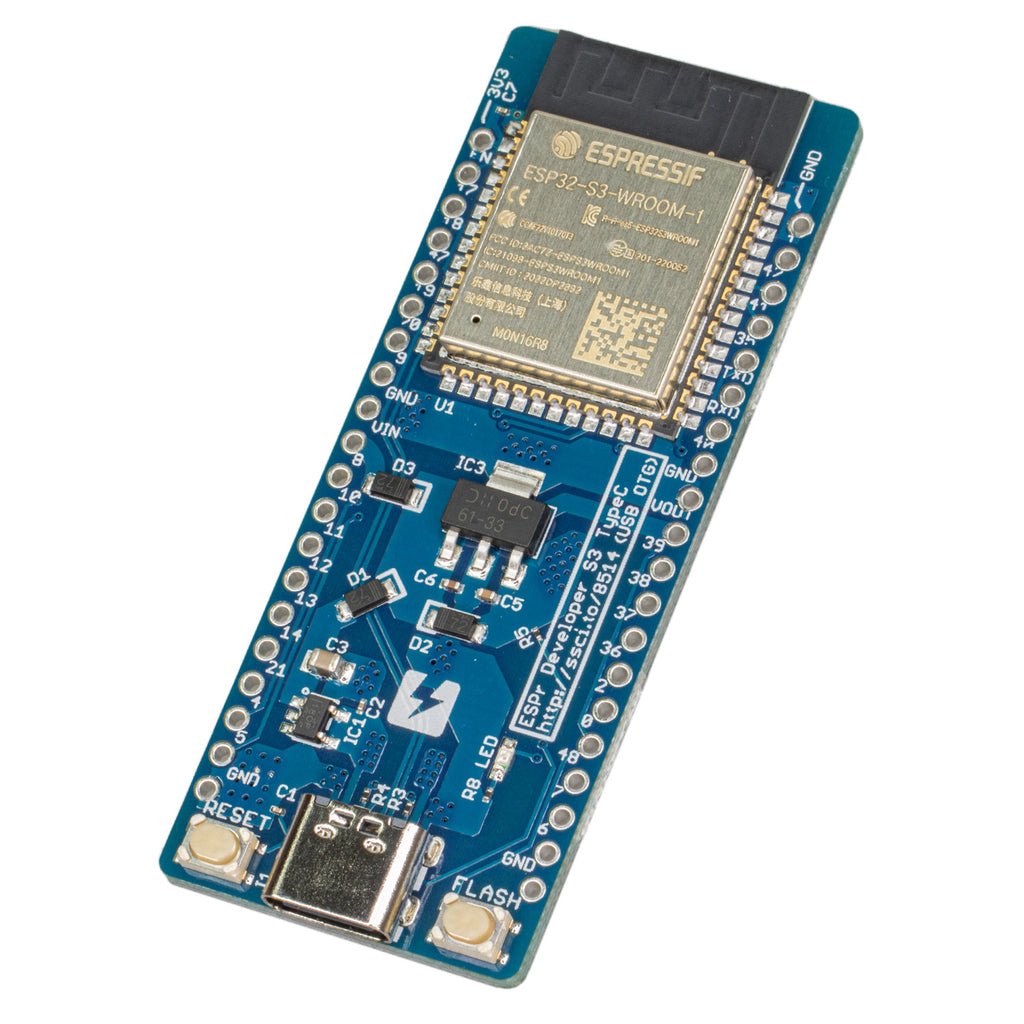
A developer borrowed a trick from Google's Gemma models to fit a 28.9M parameter LLM on an $8 ESP32 chip. https://t.co/0U8wkW6vO3
one of my curses as organizer is i rarely get to attend the conference i run. so i basically 24/7 watch back talks with everyone else after the show this one was VERY well paced and argued: fighting slop with slop — @vaibcode, Boundary https://t.co/vRckyyntm6 @btaylor asked for an ai native programming language on our pod. as a PL fan I’m really glad someone is rethinking how code runs from first principles. Being slop-tolerant is 100x more valuable than being anti- slop
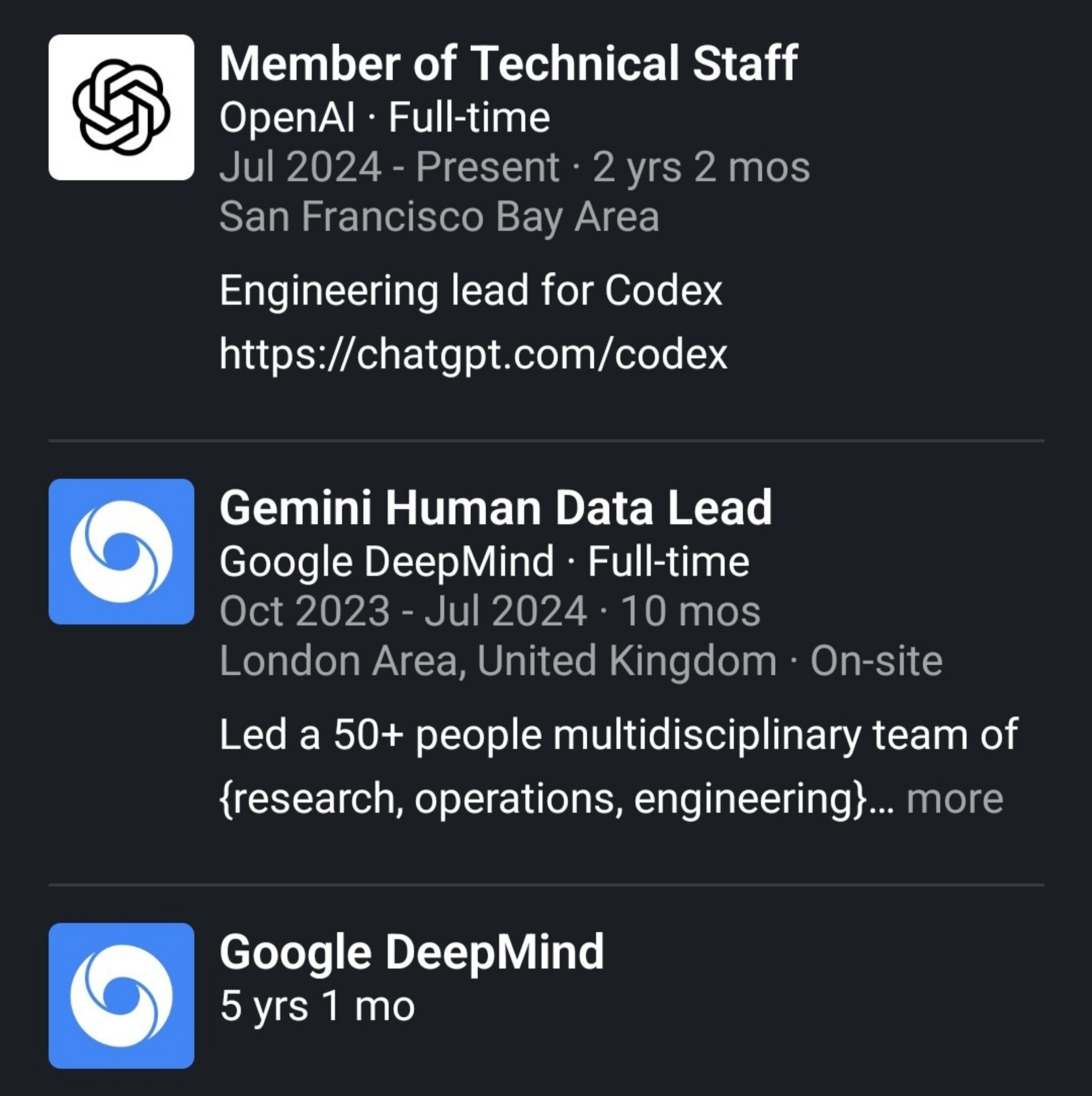
@_chenglou I was part of that team. Basically ChatGPT one year before it came out. Called LMChat and then another codename. Google was too nervous to release it and DeepMind was blocked from shipping products that could disrupt Google. I think about this a lot.
In my view we have a few different tiers of verifiability 1) programatically verifiable (near-free) - games, coding, math, cybersecurity, chip design 2) real-world verifiable (cost-or time bounded) - sciences: biology, chemistry, physics -physical world: material science, energy, aerospace, robotics, agriculture, pharma -forecasting: trading, weather 3) verifiable with human preference - writing, design, comedy, charisma, persuasion I expect most low-hanging fruit in (1) to be solved very quickly. Not sure how much longer before more solved math conjectures are simply uninteresting. I’m least certain about chip design being in this category, perhaps we hit a ceiling and require physics or materials breakthroughs to continue progress. My guess is we will quickly run into the limits of how well we can simulate each domain in (2). The time-bounded nature of real world verification may be the reason we don’t hit fast takeoff. Sim2real remains an elusive problem to solve when real-world data is limited. Part of the reason I don’t expect to live multiple hundreds of years is simply that I expect pharmaceutical progress to be time-bounded by the physical world. I expect the items in (3) to never really get solved to a superhuman degree, as success relies on an ever-shifting plane of cultural preference. People adapted to “good” AI writing and became annoyed at new stylistic tics that, in a vacuum, are not necessarily bad.
"I don't have any good ideas for what to do in light of all this. Just wanted to post an update on my current thinking, my own 'situational awareness', if you will." https://t.co/l345HNhKsj
This! All of this! It's as if someone is reading our playbook. Eight Amps is developing a 100% domestic, vertically-integrated hardware, software and systems stack that allows us to take orders of magnitude off the CapEx and OpEx required to produce small-batch, fast-turn printed circuit board assemblies (PCBAs). We've taken zero outside capital and we're using revenue from sales to drive growth at a pace we can provably handle. We deliver multiple first-time orders in < 24 hours every single week. Gen 2 automation is coming online later this month. Hit me up to join our next cohort of customer invites!
AI agents are everywhere at @Uber. It’s great to see, but the thing that keeps me up at night is how we are going to secure them. This is something that I have been thinking about for a while. Today, our agents run 50,000+ sessions per day across thousands of endpoints. And this isn't just engineering anymore. Employees across the company use agents that read code, run commands, call internal tools, analyze data, and act on real systems. That scale forced us to confront an important question: How do you secure agents when your security tools can't even see them? Traditional Endpoint Detection & Response (EDR) sees the file write, but not the prompt that triggered it. It sees the network call, but not the agent's reasoning. The intent, the thing that separates malicious from benign, is invisible. So we built Agentic Detection and Response (ADR): • Capture the full causal chain: prompt → reasoning → tool call → outcome, across Cursor, Claude Code, Codex, and every agent our employees use. • Triage cheaply: a fast, high-recall first pass handles the flood of benign sessions. • Reason deeply: only suspicious events get expensive LLM analysis, enriched with source code, threat intel, and policy context. • Red-team continuously: an offline explorer evolves hard attack variants before attackers find them. After 10+ months in production, the results speak for themselves: • Hundreds of credential exposures detected across 26 categories. • Shift-left prevention blocking secrets at 97.2% precision, before they ever leave the laptop. • Zero false positives on our enterprise benchmark, with 2-4x the F1 score of state-of-the-art baselines. • Every attack detected on AgentDojo, the public prompt injection benchmark. Just as valuable as the detections are the lessons from running this in production: • The workflow is the unit of security, not the individual tool call. Attacks hide in causally-linked chains that look benign step by step. • Credential leakage is a far more common operational issue than prompt injection. • Approval fatigue is real: when users approve 50+ actions per session, human oversight becomes a rubber stamp. You can't secure agents you can't observe. And nobody can solve this alone. That is why we recently joined the Open Secure AI Alliance (OSA), and why today we're taking the next step: open-sourcing ADR. The release includes the ADR Sensor, the detection framework, and ADR-Bench, the first enterprise agentic AI security benchmark: 302 tasks derived from real production telemetry and full coverage of all 17 attack techniques across 5 tactics, so the community can rigorously evaluate their own defenses. Code: https://t.co/tmI0oQ1F2U Paper: https://t.co/0xbswUbiF5 The future of AI security won't be built behind closed doors. Excited to see what the community builds on it, and what we all learn together! @UberEng
if you own a dgx spark and you are not sure what to actually run on it, here is every serious model i have put on one box, ranked, with real single-stream numbers. > DeepSeek V4 Flash 0731, 284b / 13b active, 3bit, 16.5 tok/s. the slowest here and still my number one. it is the biggest brain that loads on 128gb, and you feel the 284b weights in every answer. a pro thinker, worth the wait when the problem is hard. > Laguna S 2.1, 117b / 8.5b active, NVFP4, 19.8 tok/s, up to 37 on code with DFlash. number two, the one i trust for real agent work. it opens a todo list before it writes a line, tracks every step to done, and runs long without losing the thread. built for the jobs that take hours. > Qwen 3.5 122b, 122b / 10b active, NVFP4, 28.2 tok/s, 35 with MTP. number three, the fast heavyweight. clean and quick, spec-decode is a free 25%. size when you still want speed. > the rest that run great on one spark: StepFun 3.7 Flash 198b, ~25 tok/s Ornith 35b-a3b, 78 tok/s Qwen 3.6 35b-a3b, 58.6 tok/s Qwen 3.6 27b dense, 55 tok/s Nemotron Omni 31b-a3b, 264 tok/s, the speed king my honest order right now: deepseek for the depth, laguna for the long agent runs, qwen when i want it fast. all local, all on one box you can set on a shelf.
You need to set up this Codex system I have Been taking advantage of their new remote features and my productivity has 1000x'd I have one device (Mac Studio 1) as my main dev machine. That's where all code is written Then all my other devices (iPad, iPhone, other Mac Studios) ALWAYS remote into that Mac Studio 1 to do their work I never do local work on any of them. They're always remotely controlling the Mac Studio No matter which device I'm on, no matter where I am in the world (could be at the grocery store, in bed, Japan, on the toilet, by the pool, on the road using FSD) I have code written in one place Made coding big projects SO much easier Here's what I'd do if I were you Choose one device you have (preferably a desktop device like Mac Mini or Mac Studio that is always on) Make this your main dev device. Make sure it never turns off and never goes to sleep Go into Codex app then settings on that device. Go to connections > control this Mac. Turn that on Then go into every other device you have, mobile, desktop, whatever, and go into Codex settings and enable control other devices Also download Tailscale on every device. This will allow you to create a private network that will allow your other agents (OpenClaw or Hermes) to jump between computers and make changes when necessary You now have a super powered AI private network where you can code or get work done from any device anywhere in the world Promise this 1000x's your productivity
Prediction: Deepseek will soon take the number one AI market share globally. The reason is simple: the global median annual income is only around $5,000. That’s the median, not the average. That means at least 4 billion people make less than $450 a month, and they can’t afford a $200 subscription for a frontier AI. The only AI they’ll be able to afford is Deepseek.
Unpopular opinion: Claude Fable 5 is better than gpt 5.6 sol. I don’t care how many reset Tibo does.
if you've been using latest frontier LLMs, it's almost certain that you would have noticed by now the newer models have become worse to talk to they're more robotic, they speak jargons, they spits out verbose text, and do stuff you didn't ask for how did that happen? well, i'm not the person who trained those models so i can't speak for certain, but i've known enough evidence that gives me a well-educated guess, and i thought it's interesting to share as a crash course of modern LLM training pipelines so here we go let's wind back to 2020. GPT-2 and GPT-3 already came out and were widely available, but they could only predict one token at a time - that's what LLMs are at their core token prediction was offered via API, but there was nothing you could "talk to". so while it generated a lot of excitement in the academic field due to the emergent intelligence, it didn't have any wide adoption in 2022, ChatGPT changed all that. the research work that led to ChatGPT was a model initially named "InstructGPT". it took GPT-3 as the intelligent base, and used reinforcement learning with human feedback (RLHF) to teach the models how to "chat" the core idea of RLHF is that you ask the model to generate a few responses, and then let real humans pick which one they like. do this over and over again, and you get a model that knows how to talk worth noting even as early as InstructGPT, research found that making the model more pleasant to talk to will reduce their pure academic capabilities. this was called "alignment tax", which is an interesting thing we'll come back to in a bit there were various techniques done to minimize the reliance on humans, but ultimately the reward is modeled after human preference, making these AI assistants easy to talk to so remember this: RLHF = training the model to be likable by humans in 2024, there was an inflection point introduced by claude sonnet 3.5 which was the first model that can kind of autonomously finish coding tasks. it led to the first wave of viable "coding agents" the way sonnet 3.5 achieved this was by training the model with a harness (now it's called an agent) that has bash and file editing tools, throw the agent into a virtual machine, give it a task, and let it try to complete it. these tasks all have a machine-verifiable outcome predefined, mostly via test cases, that can validate whether the model really finished the task or not then you let the model do billions and billions of attempts in such virtual environments, and some of them would succeed by chance. you keep the successful agent sessions, and use reinforcement learning to teach the model to do that more, and boom - you get a coding agent that is called reinforcement learning with verifiable rewards (RLVR). if you look closely, you'll see that in this RLVR process, the final text response from the model doesn't matter AT ALL, as long as the code written by the agent could pass the test. it could talk like a jerk and it would still be rewarded so remember this: RLVR = training the model to be accepted by machines late 2024 and early 2025, we saw o1 and deepseek R1 came out as the first wave of "reasoning models". this article is getting long so i'm not diving into reasoning models now, but just know that reasoning models also relied heavily on RLVR to scale the training process - let the model think before taking action, and if the thinking led to a machine verifiable outcome, reward the thinking trace and teach the model to think like that more often the biggest difference between RLVR and RLHF is that RLVR is more scalable. human feedback is expensive to get, especially in domains where only an expert can have a valid opinion on which result is good with RLHF, if we let the model generate 100 responses, then a human has to review all 100 responses to pick which is good with RLVR, the human (or sometimes an AI) would define a task and verifier only once, and the model can generate a million responses - the machine verifier will pick which responses are good in an automated way so as a result, RLVR is becoming more and more dominant in newer models' training pipeline if you put all these things together: - RLHF = training the model to be likable by humans - RLVR = training the model to be accepted by machines - RLVR is more scalable - "alignment tax" says "likable by humans" makes the model do worse on verifiable tasks now you see why the newer models are becoming less and less likable? this is not just a "frontier labs screwed up their model training" problem - this is a war between machines and humanity, and humanity is losing we chased after benchmarks, when none of the benchmarks measure whether humans actually enjoy working with the model we use machines to decide which AI response is better because that's easier and cheaper, when we have no way of making sure those machines actually represent what we humans want we let AI go dark in a virtual environment on its own and complete predefined tasks at all costs, when in reality we often cannot define a verifiable outcome upfront, and need AI to work with us along the way i don't have a good solution to this, but i want to call for awareness that we're starting to witness a failure in aligning super intelligence right in front of our eyes this war between machines vs humanity is one we really can't afford to lose