Kimi K3 Brings Frontier Open Weights to Consumer GPUs as Anthropic Faces Scanning Backlash
The 2.8 trillion parameter Kimi K3 model launched to widespread acclaim after developers successfully ran it on consumer RTX 5090 GPUs, sidestepping severe silicon shortages. Meanwhile, scrutiny over AI training data intensified as David Sacks highlighted Anthropic's aggressive, legally questionable physical book scanning practices.
Quick Hits
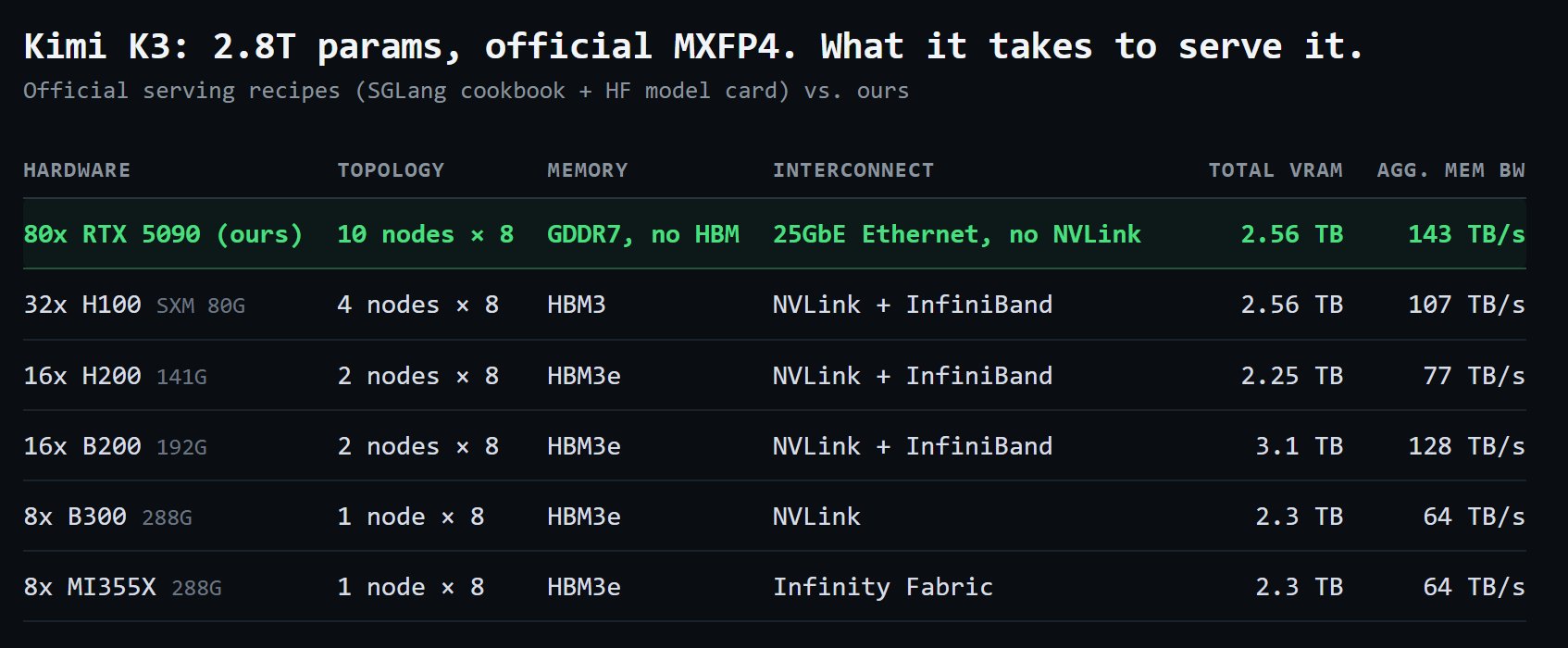
- Frontier models bypass enterprise silicon: @totheagi successfully ran the full 2.8 trillion parameter Kimi K3 on 80 RTX 5090s, proving that frontier open-weight intelligence can operate on consumer GDDR7 hardware without scarce HBM.
- Training data ethics under fire: @DavidSacks called out Anthropic for hypocrisy after reports detailed their "Project Panama," which involved pirating millions of books and physically destroying purchased copies to scan them for training data.
- Agentic coding leaves the browser: @agupta highlighted Waddle Labs, a system that acts like Claude Code for physical robotics, using agents to write task-completion code in 20 minutes.
- Pricing metrics shift to value: @swyx argues that token-based pricing is obsolete, making way for cost-per-task as the only credible metric for evaluating LLM expenses.
Kimi K3 Pushes Open Weights and Consumer Hardware
The release of Kimi K3 by @Kimi_Moonshot introduces a massive 2.8 trillion parameter mixture-of-experts model with native visual understanding and a 1 million token context window. The model architecture reportedly delivers 2.5x the intelligence per unit of compute.
What truly stands out to the community is the hardware deployment. @totheagi detailed running the untuned official MXFP4 weights on 80 RTX 5090s using plain ethernet, achieving 20 tokens per second without requiring HBM. This demonstrates that the most abundant gaming GPUs on Earth can now serve frontier intelligence.
The community rapidly embraced the release. @waterloo_intern shared a deep dive into the model code, tracing the architectural lineage from GPT-2 to Kimi K3. Access is also expanding privately, with @ErikVoorhees noting that @AskVenice is hosting the model for private, zero-data-retention inference. The launch also fueled ongoing debates about open access, with @old_sound actively disagreeing with internal efforts to restrict open-weight models.
AI Training Ethics and Frontier Rumors
AI developers continue to face severe friction over training data acquisition. @DavidSacks amplified a detailed disclosure from @itsolelehmann regarding Anthropic's "Project Panama." According to the posts, Anthropic downloaded over seven million books via piracy and later purchased millions of physical books to scan. To process the volume, vendors cut off the spines and fed loose pages through industrial scanners, destroying the physical books in the process. @DavidSacks criticized the company for expecting free access to global intellectual property while complaining about competitors using its outputs.
Interestingly, physical scanning remains a requirement for niche datasets. @BradGroux noted that the SpaceXAI team is preserving rare books by scanning them the hard way, rather than cutting them up.
In the frontier research space, rumors are swirling around Ilya Sutskever's Safe Superintelligence (SSI). @nadzi_mouad pointed to claims that SSI has reached an inflection point in its research. @ZeffMax appreciated the direct communication style of the SSI team, quoting @daniellevy__ on the necessity of big computers for deep learning.
Agentic Workspaces and Enterprise GTM Transformations
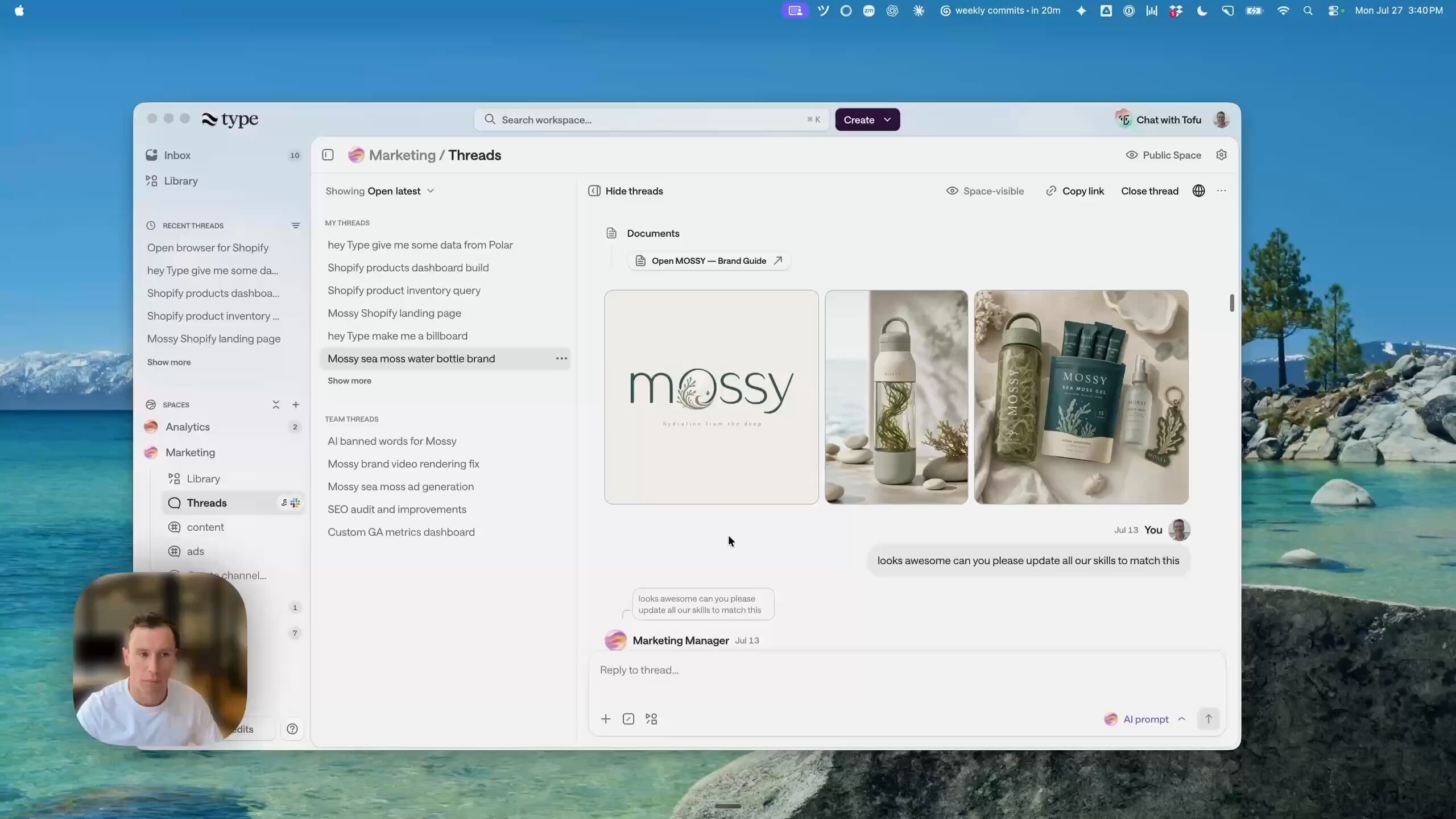
Developers are moving beyond single-prompt workflows into persistent agentic environments. @fletchrichman introduced a cloud-based human and AI workspace named Type. Unlike traditional chat interfaces, agents reply by default unless the user explicitly switches to team chat. The system avoids creating an army of individual agents, opting instead for shared computers that act as spaces for memory, skills, and automations.
Autonomy is also reaching physical systems. @agupta shared a demo of Waddle Labs, an API that connects to robots and uses agents to write code for physical tasks in 20 minutes. He called it the single most impressive demo he has seen in the past year.
In the enterprise sector, this level of automation is forcing teams to consolidate operations. @chrispisarski noted that Y Combinator founders are struggling to hire go-to-market engineers who can automate entire sales workflows using Claude. The ideal candidate understands the full sales cycle and uses subagents to automate everything from outbound LinkedIn sequences to ROI model generation, bypassing expensive traditional sales tools.
Engineering Practices, Benchmarks, and Infrastructure
As models grow more capable, evaluation metrics and enterprise architectures are adapting. @swyx declared that per-token pricing died last year, urging the industry to adopt cost-per-task metrics as detailed by @ArtificialAnlys to be taken seriously.
Regarding enterprise infrastructure, @yoheinakajima highlighted a breakdown of Netflix's in-house LLM stack. Netflix relies on vLLM and NVIDIA Triton, using unified gRPC and OpenAI-compatible APIs to integrate self-hosted models into production. Perceptions of inference itself are shifting. @joshelman recommended a piece by @naveen that frames inference not merely as token generation, but as synthesized learning about human users.
In coding workflows, @MatijaSosic shared an Amazon engineer's approach of using AI to move toward not reading code at all. The key is getting system architecture, domain models, and API boundaries right upfront before involving AI. To provide context to these systems, @mattpocockuk asked developers how they are integrating an "llm-wiki" into their repositories, questioning how teams manage version mismatches between documentation and implementation.
Miscellaneous Updates
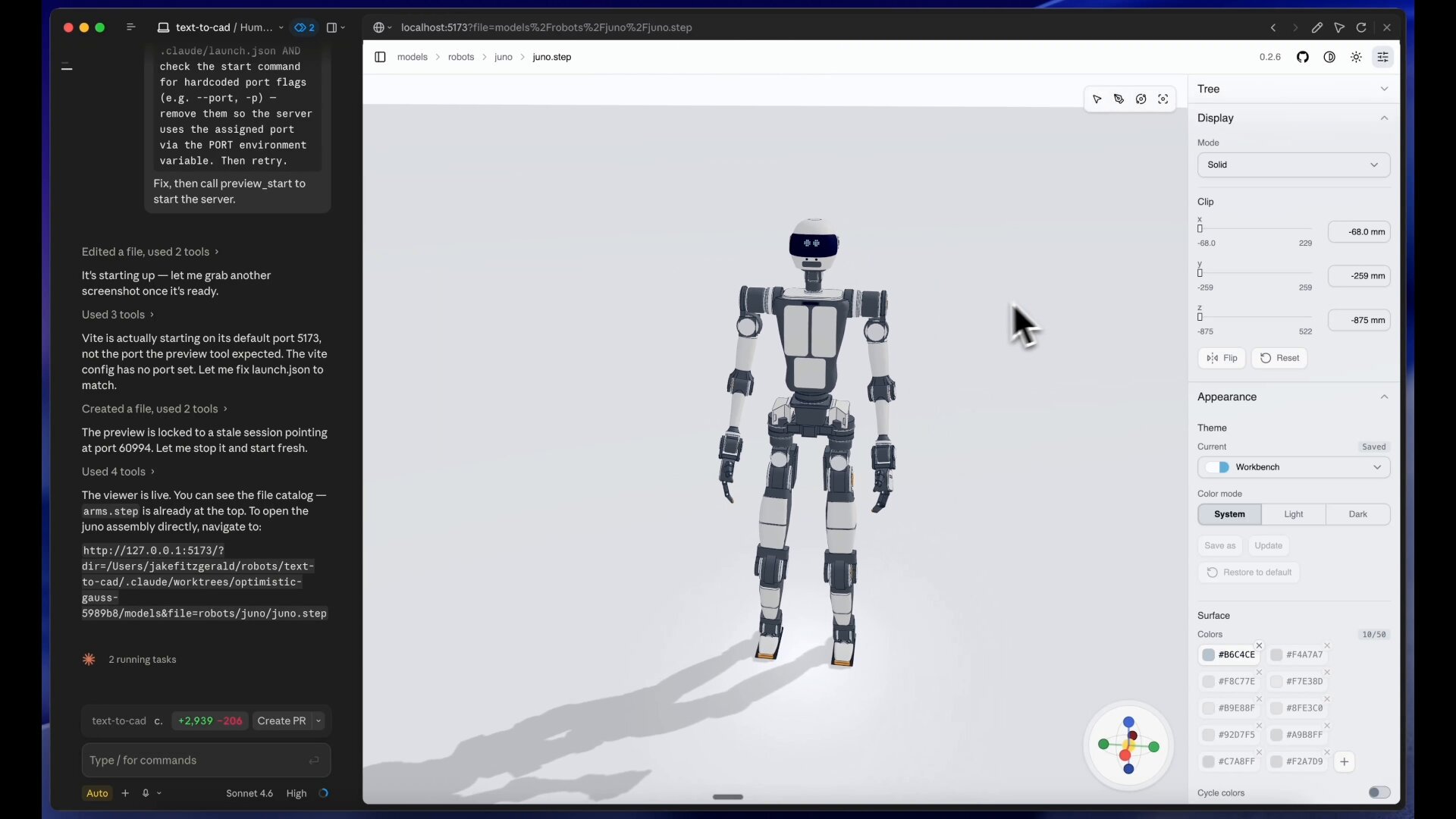
- Open source and hardware innovation: @earthtojake celebrated an open-source text-to-CAD tool crossing 10,000 stars, capable of generating STEP files and gcode. On the hardware side, @bosmeny highlighted RETINA, a vision sensor by a Duke University team that embeds neural network processing directly into camera pixels.
- Industry notes: @posthog announced a major company repositioning. Former Google executive Vic Gundotra, shared by @Scobleizer, reflected on the open-source roots of Google I/O and urged the industry to keep AI development open. Finally, @kunchenguid endorsed the new venture ArchAstro, founded by former Meta VP Calvin Grunewald.
Practical Takeaway
If you are evaluating large language models for your organization, stop using token pricing as your primary cost metric. As @swyx emphasized, cost-per-task is the only metric that reflects real-world performance. Update your benchmarks accordingly. For local or self-hosted deployments, investigate whether you actually need enterprise silicon. Testing open-weight models like Kimi K3 using MXFP4 weights on clusters of consumer GDDR7 GPUs could drastically reduce your inference infrastructure costs while maintaining frontier capabilities.
Sources
@MatijaSosic Within Amazon we are placing a huge emphasis on getting system architecture and boundaries right upfront. Claude can help with that but that requires human judgement. Your domain models, API contracts, architecture, DB schemas etc all need to be really solid…

22580: From GPT2 to Kimi3, Explained


as exclusively broken by strawberryman two weeks ago. huge announcement from ssi as their research reaches inflection point. huge moment in the race toward super intelligence. rooting for you ilya!
Kimi K3 by @Kimi_Moonshot is now available privately on Venice. Frontier-level capabilities, without the surveillance. https://t.co/qSXZFbJJxE
Introducing Waddle Labs: Claude Code for robots. Connect our API to your robot and enter a prompt, then our agents write code to achieve the task in 20 minutes. @yiding_song @theWaddleLabs https://t.co/t3iBPJsZa7
We put a neural network inside the camera pixel. Introducing RETINA: a vision sensor that runs AI where the light lands https://t.co/oLwEbWRgqO
i advise 10+ companies doing 7 to 9-fig arr they all ask me the same question: “who’s the best gtm/growth person we should hire?” and i have 0 names to give there’s a massive shortage of elite gtm/growth talent you can see it in the market salaries have doubled in 3 years if you’re a GREAT gtm/growth operator, dm me i probably have a job for you
Deep learning happens when a small, cracked team operates a big computer. The computer just got bigger.
1/ Wanted to formally say hello on X! I'm an ex-Big-tech VP returning to full-time builder. And yeah, I’m loving every second of it. After years mostly lurking here, I’m finally posting properly. I’m a founder at ArchAstro. Here’s the short version of how I got here.
Buzz is not a slack killer. It’s much bigger. It’s the first proper multiplayer agent harness. The network effects of who wins at that layer will decide where value accrues as models commoditize. Very impressed @jack
Releasing the model weights and technical report of Kimi K3. Kimi K3 is our most capable model: a 2.8T MoE model with native visual understanding and a 1M-token context window. New model architecture: 2.5x the intelligence per unit of compute, not just more params. Alongside Kimi K3, we're opening up more of the stack behind it — high-performance attention kernels, MoE communication library, and infrastructure for running agent environments at scale. Model weights: https://t.co/7m7eEg6Y0B Tech report: https://t.co/yeu6cjpMCT Tech blog: https://t.co/YTfiMSNM1f
btw anthropic's internal document on this literally said "we don't want it to be known that we are working on this.” it was called project panama. here's exactly what happened: 1: anthropic concluded that books were the cheapest way to build a world-class model because they gave claude curated facts, structured arguments, compelling stories, and writing “an editor would approve of.” 2: once anthropic decided it needed books at enormous scale, its first solution was piracy. it downloaded 7m+ books from online libraries including libgen. the judge later wrote that although anthropic had legal ways to buy them, it chose piracy to avoid what dario amodei called the “legal/practice/business slog.” 3: that piracy created a massive legal risk. so in february 2024, anthropic hired tom turvey, the former head of partnerships for google books, to find a legally safer way of obtaining “all the books in the world.” 4: turvey first contacted major publishers about licensing their catalogs. those attempts didn’t produce agreements, so anthropic chose a route that required no publisher permission: buying millions of physical books through distributors and used-book retailers. 5: within about a year, anthropic spent tens of millions acquiring and scanning millions of books, including many rare and 1/1 titles. one vendor proposal targeted 500,000 to 2 million books in six months. 6: to scan that many books within months, the vendors physically dismantled them. a hydraulic cutter removed each spine. the pages were trimmed to size, fed as loose sheets through high-speed industrial scanners, and converted into searchable PDFs. the paper remains were then sent for recycling. 7: these PDFs were fed into claude as training data. the complete collection became a private, searchable anthropic library that the company planned to “store forever.” the scans aren’t available to the public and were never open-sourced.
This chart says so much.... - Literally the exact same prompt. - All long horizon one-shots. - Totally reflects real-world experience. https://t.co/sbFyHEfYSb
When Larry Page and Eric Schmidt asked me to create a new effort to win developers to Google’s platform efforts in 2007, I laughed out loud. What platform? Android hadn’t been released or disclosed, and Google Search wasn’t a developer platform at all. Eric and Larry were far-sighted in their thinking - and at the heart of their mental model was open source. When we launched Google I/O, we named the conference “I/O” because input/output was the first thing a young programmer learns (think “hello world”), and we loved the double play of the terms I/O also to encapsulate our Google way of open-source thinking. I/O would also stand for Innovation in the Open. I never thought back then that only a few years into the future, humanity would develop software that would provide reasoning and intelligence available to all. We are truly at the foothills of the singularity, as Demis likes to say. Never before has it been so important for us to innovate in the open so all of humanity benefits from this extraordinary technological breakthrough. I could say, “the sky is the limit”. An ancient text, however, says it better: Gen 11:6 “Then nothing they plan to do will be impossible for them” @sundarpichai @DavidSacks @Eric_Schmitt
Inference, inferred. https://t.co/BSJYNrNHrl
In-House LLM Serving at Netflix Netflix built an in-house LLM serving platform using vLLM and NVIDIA Triton, integrating self-hosted models into its existing production infrastructure through unified gRPC and OpenAI-compatible APIs. The article details production lessons around model packaging, version compatibility, zero-downtime deployments, observability, and scaling constrained decoding by moving bottlenecks from s... https://t.co/Jnhi6eK5yw
llm-wiki has become an important tool in every project i'm working on now