AI Agents Reshape Software Engineering While Claude Artifacts Expose Major Privacy Flaw
Today's discussions highlight a maturing AI ecosystem where developers are shifting from basic code generation to comprehensive automated quality assurance and deep system observability. Meanwhile, a glaring privacy leak in shared Claude artifacts serves as a stark reminder of the security and operational debts accumulating in modern AI interfaces.
Daily Wrap-Up
Software development is undergoing a quiet but profound transformation as AI agents take over repetitive coding tasks, fundamentally altering the daily responsibilities of the modern programmer. Instead of spending hours writing boilerplate logic, developers are finding themselves with the luxury of time. This newfound bandwidth is being redirected toward rigorous quality assurance, system architecture, and comprehensive automated testing. Seasoned veterans and indie hackers alike are realizing that the true value of AI is not just speed, but the ability to create sophisticated testing pipelines that ensure the rapidly generated code actually meets strict functional and quality requirements. The narrative is rapidly shifting from AI as a mere copilot to AI as an autonomous worker that requires careful management and oversight.
Alongside this evolution in engineering workflows is a sobering reminder of the security and privacy challenges that accompany rapid AI adoption. When powerful platforms prioritize frictionless sharing over robust access controls, sensitive user data inevitably ends up exposed. As AI companies race to deploy collaborative features, the gap between innovative user interfaces and foundational operational security continues to widen. Features meant for private team collaboration can easily turn into public repositories of sensitive corporate data if basic search engine indexing protocols are ignored. This tension between moving fast and maintaining user trust remains the defining struggle of the current AI landscape.
The most practical takeaway for developers: audit your AI tool sharing permissions immediately, specifically reviewing any published artifacts or shared chat links that might be indexed by search engines, and transition your daily engineering focus toward building robust evaluation pipelines and observability tools rather than just writing raw application code.
Quick Hits
- Dell and NVIDIA are continuing their push into enterprise infrastructure, partnering to deliver a new AI factory aimed at advancing healthcare capabilities at Northwestern Medicine.
- Hardware enthusiasts are buzzing about a potential open-source replacement for the ubiquitous ESP-32 microcontroller, with some claiming the new framework could finally challenge Espressif's market dominance.
- Matthew Berman suggests a simple productivity hack for anyone working with AI tools: turn off your device's automatic screen lock to prevent constant interruptions during long generation cycles.
- Aaron Hammer noted that while the onboarding process for Buzz by Blocks was initially rough, the software ultimately delivered an unexpectedly delightful user experience.
- Derek Ross highlighted the decentralized potential of Buzz, imagining a future where 100,000 teams use the platform to run their own sovereign Nostr relays, creating massive, interoperable, and censorship-resistant communication layers.
- Gal Zahavi, known for work on Gemini CLI, announced they are joining a stealth startup to push the frontier of AI agents, asking the community what specific topics regarding local models and reducing code slop they want to learn about.
The Golden Age of AI-Driven Quality Assurance
As generative models accelerate the speed of raw code production, the fundamental bottleneck in software development is shifting from implementation to verification. The industry is quickly realizing that code generation is the easy part, and the real engineering challenge lies in ensuring that autonomously generated code is secure, functional, and bug-free. Developers are transitioning into highly specialized managers, utilizing AI not just to build features, but to aggressively test them.
Veteran software engineer Robert C. Martin, known as @unclebobmartin, encapsulated this shift perfectly. He noted that "AI agents can write code many times faster than a human. What this means is that you, the programmer, have a large amount of time to use those agents to write unit tests, to write acceptance, tests, to write property tests, to torture test, to mutate test, to QA test, and to otherwise ensure that the code meets its functional and quality requirements." He later reinforced this philosophy by sharing a video of his own AI agents autonomously running complex QA procedures, proving that an automated, heavily tested development cycle is highly viable.
This evolution in testing ties directly into how developers are interacting with their tools on a macro level. As @chrismaconi pointed out, deeply integrated platforms like Cursor are winning the market precisely because they understand these new workflows. Furthermore, @eyalbe demonstrated the versatility of these tools by having Claude Code autonomously audit his Mac's hard drive, successfully uncovering 42 gigabytes of hidden Apple screensaver files that traditional cleanup tools missed. Even the way developers plan their architecture is changing, with @thorstenball expressing surprise that people still manually plan out software when autonomous plan modes are readily available. As @yoheinakajima pointed out, observability is becoming the core of these systems, suggesting that in modern AI architecture, the log itself essentially acts as the agent.
The Grueling Reality of Production LLM Engineering
Building a consumer-facing AI application is no longer just about crafting the perfect system prompt. As models are integrated into complex enterprise systems, the focus has heavily shifted toward context management, memory optimization, and infrastructure resilience. The modern AI engineer has to navigate a labyrinth of competing tradeoffs regarding latency, cost, and model accuracy, making the job highly specialized and deeply technical.
Highlighting the sheer complexity of modern AI infrastructure, @divaagurlxw dropped a massive checklist of essential skills for contemporary AI engineers. The list moves far beyond basic prompting, emphasizing that professionals must deeply understand "context engineering, not just long prompts," along with "KV cache management, eviction, reuse, and memory pressure at scale." They also pointed out the critical need to grasp "continuous batching, paged attention, and throughput optimization," as well as the intricate tradeoffs between speculative decoding, quantization, and distillation.
Taming these massive, complex systems requires strict behavioral constraints and architectural discipline. Because models have a tendency to drift or hallucinate verbose jargon, developers are having to invent new ways to force computational clarity. An brilliant example of this was shared by @andrew_n_carr, who suggested bypassing conversational fluff by instructing the model to "only report to me in ASD-STE100 Simplified Technical English." This aerospace-standard constrained vocabulary forces the model to communicate clearly and concisely, illustrating how engineers must apply traditional software constraints to probabilistic AI systems.
Selling Outcomes in the Age of AI Services
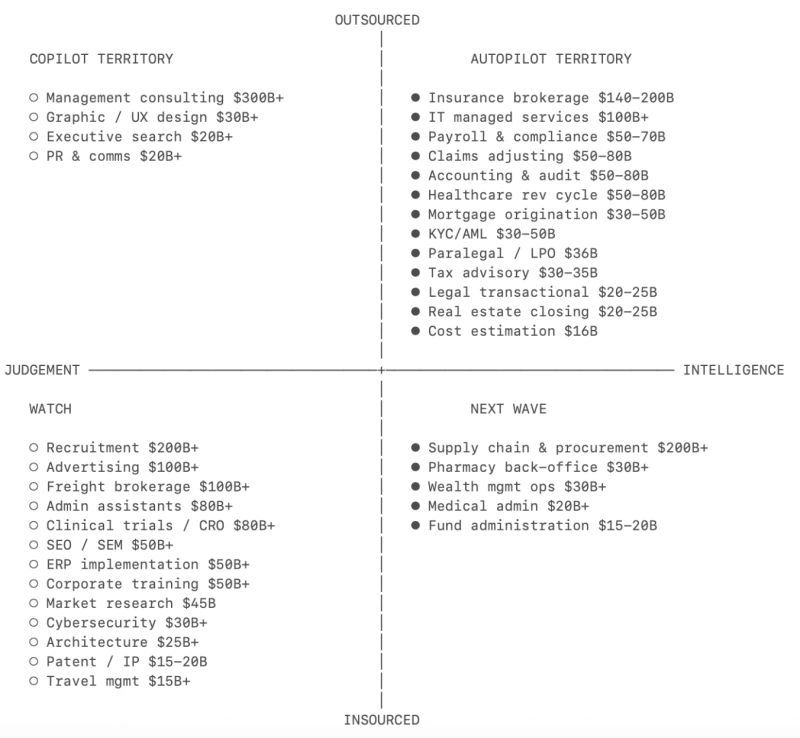
The traditional SaaS business model is facing an existential reckoning thanks to artificial intelligence. For the last two decades, software companies have charged for tools that help humans do work. However, as AI agents become capable of executing the work entirely, startups are realizing that selling copilots to legacy businesses is a fragile, easily disrupted model. The future belongs to companies that bypass the software tool entirely and directly sell the completed business outcome.
This perspective was heavily championed by @rdominguezibar, who summarized a compelling thesis from Sequoia. "SaaS chased the software dollar. AI chases the services dollar at software margins," they explained. "Sell a copilot and you compete with every model release. Sell the outcome, books closed, contracts reviewed, claims handled, and every AI improvement widens your margin instead of threatening your product." The conclusion is that the next trillion-dollar company will not build software for accountants or lawyers, but will actually function as the AI law firm or the AI accounting firm itself.
This aggressive pivot toward outcome-driven AI is heavily reliant on entirely new paradigms of human-computer interaction. Sam Altman (@sama) expressed his excitement for this future, agreeing with a viral thread by @AlexFinn about ChatGPT Voice. Finn detailed how being able to control a desktop computer via voice through AirPods while hiking completely decoupled work from the traditional desk setup. Altman noted that this seamless, voice-driven control of an autonomous, outcome-producing machine genuinely feels like the genesis of an entirely new kind of computer.
Security Wake-Up Calls: From Honeypots to Public Artifacts
The rapid deployment of collaborative AI features is continually outpacing basic operational security, leading to severe unintended consequences for user privacy. As AI interfaces become the central hub for sensitive corporate and personal data, the platforms hosting these interactions are struggling to implement fundamental web security practices. Features designed to make sharing easy are routinely exposing confidential data to the open internet, turning AI tools into massive liabilities for uninformed users.
A glaring example of this emerged today via @om_patel5, who detailed a massive privacy flaw in Claude's shared artifacts. "CLAUDE HAS A SERIOUS PRIVACY PROBLEM RIGHT NOW," they warned. "A HUGE NUMBER OF SHARED CONVERSATIONS ARE PUBLICLY INDEXED ON GOOGLE FOR ANYONE TO FIND." The thread explained that Anthropic failed to add a basic no-index tag to their shared links, resulting in sensitive dashboards, financial models, and API keys being scraped and archived by third-party search engines without user consent.
While massive platforms struggle with basic web security, independent researchers are demonstrating the extreme lengths required to catch sophisticated digital threats in the AI era. The landscape of cybersecurity is becoming highly theatrical and resource-intensive. Detailing the reality of modern vulnerability research, @C2IRIS shared how they catch state-sponsored exploits by spinning up elaborate, fake digital personas. "I mean full-on online personas of 'journalists' and 'activists'... or posing as a major drug dealer with your WhatsApp number available," they explained, noting that this intense, dedicated methodology is responsible for generating roughly thirty percent of their critical exploit discoveries.
Sources
@mark_k @SpaceXAI DM'ed you directly for feedback.

Which global VC firms backed the most future unicorns in their early rounds? 📷: Stanford GSB https://t.co/Ic4JyAoiph

CLAUDE HAS A SERIOUS PRIVACY PROBLEM RIGHT NOW, A HUGE NUMBER OF SHARED CONVERSATIONS ARE PUBLICLY INDEXED ON GOOGLE FOR ANYONE TO FIND when you use claude's share feature it makes a public link. it turns out those links got indexed by search engines, so "share with anyone who has the link" actually became "anyone can find this by searching" and people are pulling up genuinely alarming stuff: > api keys, credentials and crypto wallets > personal resumes with real names, addresses and phone numbers > a lawyer working through a potential ethics violation > an engineers internal company project details > what appear to be peoples social security numbers > and a crazy number of deeply personal chats people never imagined another human would read anthropic never added a noindex tag to those shared pages, so search engines were free to crawl and list them one line of code would have prevented the whole thing this already happened to chatgpt about a year ago, same exact issue, but openai patched it fast if you have EVER hit share on a claude chat, assume it could be public go to settings > privacy > your data > shared chats > manage delete anything you dont want the whole internet to see, especially anything personal or financial
The Open ESP-32 Replacement
I don’t think you understand what ChatGPT Voice unlocks I went on a 4 hour hike yesterday. Through the northern California redwoods. Got more work done in those 4 hours talking to Voice through my AirPods then I do in 8 hours at my desk Work can be done ANYWHERE now 45 minute drive back using self driving? Now 45 minutes I can talk to Voice and work on side projects 20 minutes in the cafe? I can sit and talk to Voice and when I get home I have drafts on my computer for my newsletter for the next month Being able to just use your voice to talk to a super intelligence that controls your computer is unlike anything we’ve ever experienced before I don’t even care that the voice sounds human like, or you can interrupt it, or any of the wild advancements they made to the tech It’s the fact that it can control my computer, meaning all I need to get incredible work done is talk through my AirPods anywhere in the world that is the major game changer for me I don’t think people truly understand the implications of this yet Why even have a desk or monitor anymore. Work can be done ANYWHERE now The key is your set up: 1. Choose one device (preferably an always on desktop) as your main “headquarters” device all your work gets done on 2. Get the ChatGPT app on all your other devices (iPhone, iPad, laptops, Mac Minis) 3. Set up ‘connections’ in your settings so that all your ‘node’ devices can control your ‘headquarters’ device 4. Go legit anywhere in the world. Turn on Voice. Ask it to brief you on your projects, give you a recommended next step, then spin up new threads to do work I really don’t think work looks the same moving forward.
The event driven future of AI
me, begging, crying, on my knees: "Please just use plain english, I don't understand what you're saying." Claude: "The right fix, and the book's lesson applies: the tutorial rotted as a front door because a front door full of claims always rots. So the new root holds only what's timeless — the thesis and three doors — and every claim lives behind it in the thing that goes red when stale."
