Microsoft Doubles Down on Small Models as BTL-3 Crushes 27B Parameters Into an 8GB File
Today's discourse highlights a massive shift away from relying solely on expensive frontier models, with Microsoft and independent developers proving that smaller, highly tuned architectures are the future of enterprise AI. Meanwhile, the software engineering world is experiencing a paradigm shift as legendary developers abandon manual code reviews in favor of extreme constraint-based testing for autonomous agents.
Daily Wrap-Up
The AI industry is undergoing a subtle but massive structural shift, moving away from the obsession with ever-larger frontier models toward highly optimized, task-specific architectures. For months, the prevailing narrative has been that bigger is always better, but the economic realities of running massive models at scale are finally catching up to the hype. Today's conversations prove that the real moat in artificial intelligence is no longer raw parameter count, but rather the systems built around the model. From enterprise giants to independent open-source developers, the focus has decisively pivoted to cost efficiency, local deployment, and hyper-specialized small models that can run seamlessly on consumer hardware.
On the software engineering front, we are seeing a fundamental rewiring of how developers interact with code. The traditional workflow of writing syntax and manually reviewing pull requests is rapidly becoming obsolete in the age of autonomous coding agents. Pioneers of clean code are now openly admitting that they skip reading AI-generated code entirely, opting instead to build elaborate labyrinths of automated constraints, tests, and quality metrics. This represents a massive cultural turning point. The core competency of a software engineer is shifting from syntax creation and manual review to system architecture, telemetry analysis, and test design.
This transition is not without its growing pains, as the cost of running these autonomous loops can quickly spiral out of control if not strictly monitored. As the industry reinvents software engineering from first principles, the ability to trace agent behavior, standardize session data, and enforce strict operational boundaries is becoming the most critical skill set for modern developers. The most practical takeaway for developers: stop obsessing over raw model benchmarks and start investing heavily in your local inference pipelines, strict evaluation metrics, and agent telemetry, because the system architecture surrounding your model is now your primary competitive advantage.
Quick Hits
- @levelsio drops the ultimate smart home and IoT setup thread, detailing everything from Home Assistant configurations to massive solar battery arrays and the importance of never connecting your smart TV directly to the internet.
- @callebtc discusses how Buzz leverages Nostr protocols to create an open ecosystem for agent communication, pointing out that open protocols compound in value over time.
- @jasonfried and @rjs explain why setting arbitrary priority labels in project management tools is a painful trap that masks deeper project interdependencies.
- @GergelyOrosz shares a hilarious but sad anecdote about fast-growth startup PMs who allegedly lack the attention span to read even a one-page product requirements document.
- @shubgaur highly recommends @leerob's latest breakdown on the mechanisms behind teaching AI models, noting his exceptional ability to make complex topics accessible.
- @kimmonismus shares a viral and somewhat terrifying video clip highlighting new AI capabilities and their potentially frightening real-world use cases.
- @WiFiMoneyGuy shares a guide on how to evaluate whether your LLM models have been secretly nerfed, aiming to help users make their AI agents significantly smarter.
- @Starlink reminds the tech community that fast, reliable internet remains the foundational backbone for all modern digital and AI-driven operations.
The Enterprise Shift: Small Models, Big Systems
The economics of running massive language models are forcing a stark change in enterprise AI strategy. For the past few years, companies have essentially been renting intelligence from frontier model providers, paying a premium for every single API call. But as the market matures, the focus is shifting toward internal capability. Satya Nadella recently highlighted Microsoft's approach, which serves as a blueprint for the entire industry. Instead of relying entirely on OpenAI's frontier models, Microsoft has been training small, in-house MAI models directly inside their products, using reinforcement learning environments that reward the completion of actual customer tasks rather than just gaming abstract benchmarks.
As Matt Van Horn (@mvanhorn) points out in his breakdown of Nadella's strategy, the tech giant now routes traffic to these smaller custom models wherever they match frontier quality, only calling upon the most expensive models for true frontier needs. He notes that the MAI model running in Excel matches the quality of leading frontier models on common tasks at a fraction of the cost, and remarkably, it runs on older H100 and A100 GPUs instead of requiring the latest silicon. "Small models trained in the product, frontier models on standby. That's the whole strategy," explains @mvanhorn. The real innovation here is that the trick is the system, not the model. The harness, memory, context, tools, and evals all live outside the model, meaning any model can be swapped in or out as needed.
This sentiment is echoing across the startup ecosystem as well. Vas (@vasuman) highlights a growing realization among builders: you simply do not need the most expensive, cutting-edge model to accomplish the majority of enterprise tasks today. By utilizing cheaper models wrapped in highly capable agent harnesses, startups like his are achieving state-of-the-art results on massive economic benchmarks. This pragmatic approach to model selection contrasts sharply with the ongoing regulatory drama in the AI space. David Sacks (@DavidSacks) recently slammed Anthropic for their incessant attempts at regulatory capture. While Marc Benioff praises Anthropic as the fastest-growing company in Silicon Valley history, Sacks argues that their attempts to lobby for regulations are not just unnecessary but frankly gross. The disconnect is clear: the fastest path to enterprise value is building better systems around efficient models, not lobbying the government to protect a frontier model monopoly.
Local AI Reaches New Extremes in Compression
As enterprises look to cut costs, independent developers are proving that you can achieve staggering levels of performance entirely offline. The open-source community has been pushing the boundaries of model quantization for years, but Bad Theory Labs (@Badtheorylabs) just dropped a genuine breakthrough with the release of BTL-3. They have managed to compress a 27 billion parameter agentic coding model down into a single 8.39 gigabyte file. To put that into perspective, it is smaller than a standard 8 billion parameter model running in standard 16-bit precision, yet it retains over 92 percent of the original model's intelligence.
Standard quantization techniques completely fail at this level of compression, so the team had to build an entirely new technical stack from scratch. "Compressing 27B this far normally destroys a model. Standard quantization couldn't do it, so we built the stack ourselves: packed AVQ2 decoder tensors, affine INT4, measured precision islands, packed vocabulary matrices, rank-32 output correction, behavioral repair," notes @Badtheorylabs. The model was explicitly trained for the continuous loop that real autonomous agents live in: reasoning, acting, inspecting results, recovering from errors, and continuing the task. It achieves a 95.12 percent pass rate on HumanEval and handles a massive 262K context window, all while generating 43 tokens per second locally on a single RTX PRO 6000 GPU.
This extreme push toward local efficiency is supported by a growing ecosystem of practical guides. Ahmad (@TheAhmadOsman) highlights new research on minimum viable baselines for local LLM inference, specifically focusing on the nuances of model and cache quantization. The overarching message is that standard out-of-the-box quantization is no longer sufficient for developers who want maximum performance on consumer hardware. The industry is moving toward hyper-optimized, tailored runtimes. Hyperagent (@hyperagentapp) leans into this trend, arguing that developers should not have to install complex dev environments just to run proactive AI agents. By shifting the heavy lifting to cloud-based local switches and offering migration credits, they aim to eliminate the setup burden entirely. The convergence of these trends signals a future where the vast majority of agentic workloads will happen locally on edge devices, completely insulated from the API costs and privacy concerns of cloud providers.
The New Rules of Software Engineering
The implications of these highly capable coding agents are fundamentally rewriting the rules of software development. Akira (@realmcore_) expressed a sentiment shared by many veteran engineers today, noting in absolute disbelief that the industry is collectively reinventing all of software engineering from first principles right before our eyes. The most glaring example of this shift comes from Uncle Bob Martin, the legendary author of Clean Code. In a recent discussion translated and amplified by Baoyu (@dotey), Uncle Bob admitted that he no longer reads any of the code written by his AI agents. His reasoning is straightforward: human reading speed is simply too slow to keep up with the output of modern AI. If developers insist on manually reviewing every line of generated syntax, they completely lose the productivity advantage that AI provides.
Instead of manual review, Uncle Bob advocates for a rigorous system of extreme constraints. "What I do instead is to surround the agents with extreme constraints. Unit tests, gherkin tests, QA procedures, quality metrics, mutation testing, test coverage, and a plethora of others," he explains. By forcing the AI to run a gauntlet of automated tests, he ensures high code quality without ever needing to look at the actual implementation. This marks a monumental shift in the developer skill set. The most valuable engineers are no longer those who write the best syntax, but those who can architect the best test suites, define the strictest rules, and establish the most accurate metrics. Uncle Bob has even launched new courses on agentic discipline, emphasizing that AI does not remove the need for engineering rigor, it simply requires a completely different type of discipline.
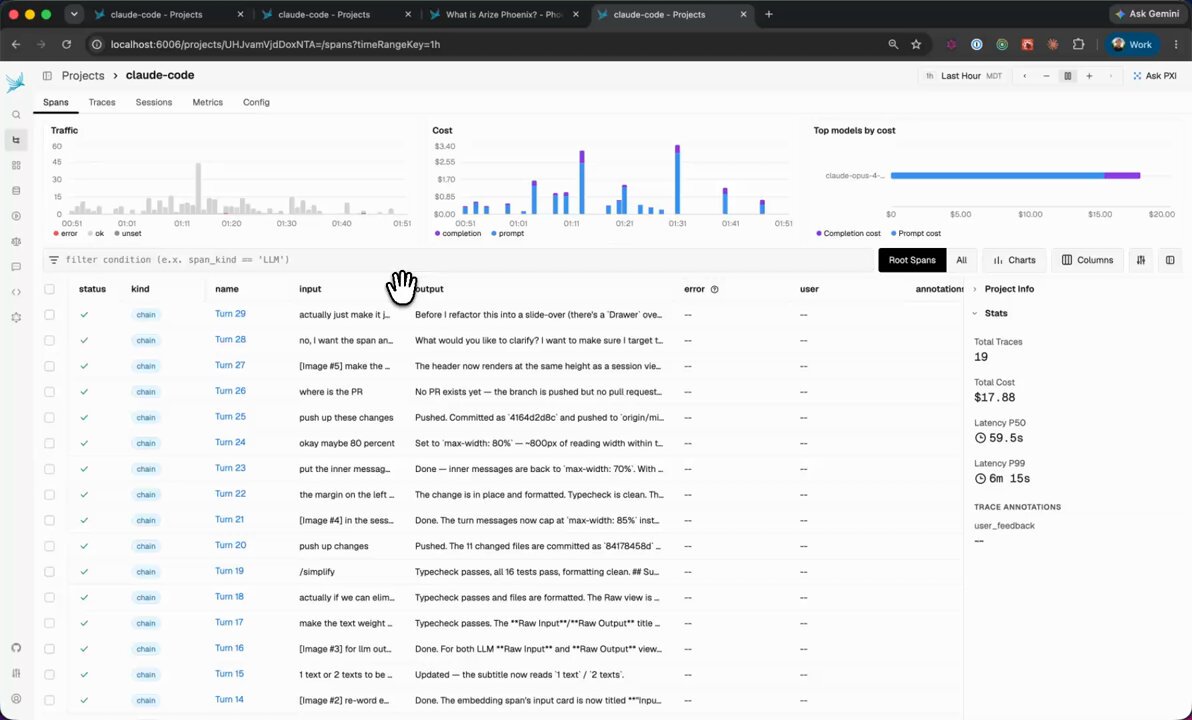
However, letting agents run autonomously introduces entirely new operational challenges, particularly when it comes to cost monitoring. Mikyo (@mikeldking) recently traced his Claude Code sessions using a revamped code tracing tool and was shocked by the financial implications of unchecked agent loops. After forgetting to turn off the tracer, he accumulated a massive amount of local session data and realized he was averaging two dollars per turn. This rapid accumulation of costs highlights a critical blind spot in the new autonomous paradigm. To manage this sprawling complexity, standardization is becoming essential. Letta (@Letta_AI) introduced Trajectory, an open-source package designed to normalize agent experience data. By standardizing the session formats of various coding agents like Claude Code, Codex, and deepagents, developers can finally gain consistent visibility into what their agents are doing, how they are performing, and how much they are spending. Without these telemetry standards, managing an army of autonomous coding agents is like flying blind.
The Battle for AI Talent and Hardware
Beneath the software layer, the hardware and talent wars continue to shape the trajectory of the industry. The intersection of deep mathematics and artificial intelligence is becoming the most prized territory in tech. Noah Chrein (@NoahChrein) highlighted a massive milestone in this space, pointing out that Jacob Tsimerman, fresh off winning a Fields Medal, has joined OpenAI. As @NoahChrein notes, bringing in someone with profound mathematical expertise who also understands the practical realities of AI is a massive win for the company. It signals that AI labs are no longer just hiring software engineers, they are recruiting the world's foremost theoretical minds to push the boundaries of what neural networks can achieve.
This movement of top-tier talent highlights the growing ideological and technological divide between Western and Eastern AI development. Kyle (@zeroxkyle) sparked intense conversation by comparing an interview with the CEO of DeepSeek to the standard talking points of Western AI leaders. He described the comparison as a massive reality check, suggesting that the strategic approaches and fundamental philosophies driving AI development in China are diverging significantly from Silicon Valley. This global competition is mirrored in the semiconductor space, where companies are fighting for mindshare and community support.
Ren (@ren_stocks) noted a fascinating shift in corporate marketing, shouting out a relatively small account for breaking the fourth wall and collaborating directly with the financial technology community. AMD, traditionally seen as a stoic chip giant, responded in kind, signaling a mutual appreciation. While it might seem like a minor social media exchange, it underscores a critical reality in the hardware space. AI developers and infrastructure engineers hold immense sway over which chips get adopted. The fact that a major semiconductor manufacturer is actively engaging with niche fintech and AI communities shows just how crucial grassroots developer adoption has become. As models become more compressed and run on a wider variety of local hardware, the loyalty of the developer community will dictate the next generation of hardware winners.
Sources
wss://buzz.cashu.space https://t.co/m7jHNPeDin
Frontier Diffusion & Control
What most impresses me about Anthropic (besides unprecedented revenue growth) is their enterprise hat trick: the best model (Claude), the best coding agents (Claude Code), & the best productivity tool (Cowork). Salesforce is proud to be an early investor, customer, and partner. https://t.co/PE1DIGTOnN
“Priority” is such a slippery term. I never use it. Instead: - Is it “in” or “out” of a given scope? - If it’s in, what’s the sequence. Is it first, second, third, early, later? Sequence is sometimes due to urgency. But can also be interdependence or progressive enhancement.
Jacob Tsimerman joining OpenAI off the cusp of his Fields medal at ICM is about to hit the pure math zeitgeist harder than any of the solved Erdős problems or conjectures did. AI just broke through the sound barrier.
The feeling’s mutual. 🤝


I’m significantly older than you. I started coding in the late 60s. My current strategy is to not read any of the code written by my agents. That’s the only way I can take advantage of their productivity. What I do instead is to surround the agents with extreme constraints. Unit tests, gherkin tests, QA procedures, quality metrics, mutation testing, test coverage, and a plethora of others. In the end, I have very high confidence in the code they produce because they’ve had to run the gauntlet of all of my constraints and tests.
Introducing Offloop! We're a team of four. Today our multi-agent harness hit state of the art on GDPval, ahead of Claude code and Codex across jobs that pay $2.4 trillion a year in the US. Offloop gives every knowledge worker what the Fortune 500 spends billions on: a high-performing agent army that runs itself and grows the business.
how to make your AI agents 100x smarter...
How we teach AI models

Minimum Viable Baselines for Local LLM Inference: Thoughts on Model and Cache Quantization
Trajectory: A Standard Format for Agent Experience Data
Introducing trajectory, an open-source package that normalizes coding-agent sessions from @AnthropicAI Claude Code, @OpenAI Codex, @pidotdev, @LangCh...