Kimi K3 Release Shatters Compute Moat Assumption as Developers Push Back on AI Cognitive Decline
Today's discussions were dominated by the release of Kimi K3, a highly efficient open-weight model from China that matches or beats top Western closed models, sparking debates about compute moats. Meanwhile, developers are actively adjusting their workflows to prevent AI-induced cognitive decline and balkanized tooling. The enterprise push toward local inference and multi-agent swarms also continues to gain momentum.
Daily Wrap-Up
The AI discourse today took a distinctly pragmatic turn, juxtaposing the sheer scale of frontier model competition with the intimate realities of the individual developer workflow. The headline story undoubtedly belongs to Moonshot AI and their Kimi K3 model. A relatively small lab operating under intense compute constraints managed to ship a model that goes toe-to-toe with the strongest closed-source offerings from OpenAI and Anthropic. This development challenges the foundational Silicon Valley assumption that raw compute is the ultimate moat. By leveraging highly optimized mixture-of-experts routing, INT4-native quantization, and infrastructures built specifically around scarcity, smaller labs are proving that algorithmic efficiency can compress the capital required to reach the frontier. This shifting dynamic leaves hyperscalers and enterprise architects questioning their multi-billion-dollar infrastructure bets.
While the industry digests the macro implications of model parity, engineers on the ground are wrestling with the psychological toll of AI integration. There is a growing sentiment that leaning too heavily on AI for code generation leads to a very real sense of cognitive decline. Developers are noticing their instincts dulling, prompting a conscious retreat back to manual coding and architectural planning just to keep their skills sharp. This pushback against automated laziness is reshaping how teams interact with their tools. Rather than blindly accepting AI outputs, engineers are adopting adversarial prompting techniques to force quality control, building internal tooling that demands human oversight, and using AI primarily as an exploration and planning companion rather than an autopilot.
Navigating this landscape requires a delicate balance between leveraging speed and maintaining technical rigor. As models become incredibly capable but context windows remain a bottleneck for long-running tasks, engineers are finding innovative ways to manage local deployments, orchestrate agent swarms, and structure their prompts. The focus is shifting from simply generating code or UI components to actively managing a fleet of specialized AI workers and verifying their outputs.
The most practical takeaway for developers: Focus on context engineering and adversarial validation. Use AI to generate comprehensive edge-case tests and auto-compact your context windows for long-running agents, but force yourself to manually implement the core logic to prevent skill atrophy.
Quick Hits
- @fabrice_mayrand highlighted "Cheaper Inference," a service offering API access to major models like OpenAI, Anthropic, and Google for 30% off with a drop-in OpenAI-compatible API.
- @kenwheeler showcased a workflow combining concept art generation with ForgeCAD to instantly create 3D-printable enclosures, calling the results incredible.
- DecartAI introduced Lucy 2.5 via @AbermanKfir, a real-time live AI world model capable of editing videos on the fly for streaming, e-commerce, and advertising.
- @grok announced that Grok 4.5 is now available in Grok Build, promising strong coding performance with significantly fewer tokens per task.
The "DeepSeek 2.0" Moment and the Fall of the Compute Moat
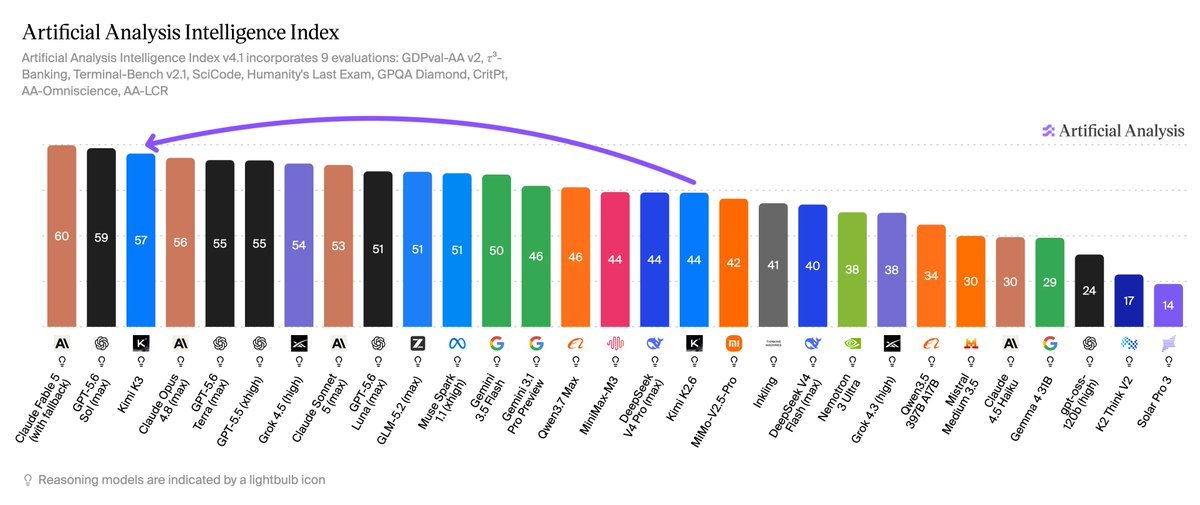
The AI industry woke up to a massive shift in the competitive landscape today as Kimi K3, a new open-weight model from Moonshot AI, demonstrated performance that rivals or exceeds top-tier Western models like Anthropic's Opus 4.8. For years, the prevailing wisdom among venture capitalists and hyperscalers was that massive capital expenditure on compute was an unbreachable moat. The logic dictated that export controls on advanced silicon would permanently handicap Chinese AI labs, leaving them trailing behind the United States by six to eight months. Kimi K3 shatters this assumption entirely.
As industry observer @kimmonismus noted, the release of Kimi K3 proves that a turning point is approaching. "Kimi K3 generally outperforms Opus 4.8. That effectively disproves the claim that Chinese open source models consistently trail US closed source models by six to eight months," they explained. This development confirms that algorithmic innovation can bypass hardware bottlenecks. By focusing on training efficiency through specialized infrastructures like their Mooncake stack, a small lab with engineering taste can compress the compute needed to reach the frontier.
The implications for tech giants are profound and somewhat humiliating. @doodlestein pointed out the stark contrast between Moonshot AI's lean operation and the bloated infrastructure of Google and DeepMind. "It must be acutely embarrassing for Google and DeepMind’s top management that, despite having a multi-year head start, their own custom training and inference silicon, and total investment in property, plant, and equipment of $281 billion, they have been utterly upstaged by Kimi, a company with fewer than 500 employees," he wrote. The narrative is rapidly shifting from who has the most GPUs to who can extract the most capability from the hardware they already possess. This efficiency breakthrough, further highlighted by @ShanuMathew93 referencing DeepMind researchers, suggests that the frontier is no longer something money can simply buy.
Engineering Workflows and the Pushback on Cognitive Decline
As AI code generation becomes ubiquitous, a vocal segment of the developer community is raising alarms about the psychological and cognitive impacts of outsourcing our thinking. The convenience of asking an agent to write boilerplate or architect a solution is increasingly viewed as a double-edged sword. Developers are reporting a tangible sense of skill atrophy, where the reliance on automated tools dulls their problem-solving instincts and leads to a phenomenon widely criticized as AI slop.
@codinsonn articulated this struggle perfectly, noting that they can almost feel cognitive decline setting in. To combat this, they have altered their daily workflow. "It’s why I’m using it more for code exploration and planning and asking for code blocks that I then implement myself just to be sure I understand what’s being generated," they shared. This sentiment reflects a broader industry realization that moving fast is useless if the underlying engineering degrades. The battle is now between trying to use your brain so it does not get atrophied and not falling behind peers who rely entirely on automation.
This necessary friction is also reshaping how engineering organizations structure their internal tools. @DanielNealAdler observed that we might be entering an era of total balkanization, where every large enterprise builds out its own custom internal dev stack, much like Meta and Google did a generation ago. This fragmentation is driven by the need for specialized tools that enforce quality control specific to an organization's workflows. Furthermore, as @GergelyOrosz highlighted, engineers now require real-time, immediate feedback mechanisms to monitor when the AI slop factor goes too high. This explains why developers like @realmcore_ are expressing renewed enthusiasm for deep systems engineering, finding satisfaction in hands-on architecture work that purely procedural AI tools cannot easily replicate.
Local Inference Breakthroughs and Enterprise Hesitation
Running massive models locally used to be a pipe dream reserved for well-funded research labs, but today's posts highlight a massive leap forward in local deployment capabilities. The ability to run immense models on consumer or prosumer hardware is fundamentally altering the calculus of data privacy and enterprise AI adoption. Whether it is for medical diagnostics or highly secure proprietary workflows, the power is shifting back to the edge.
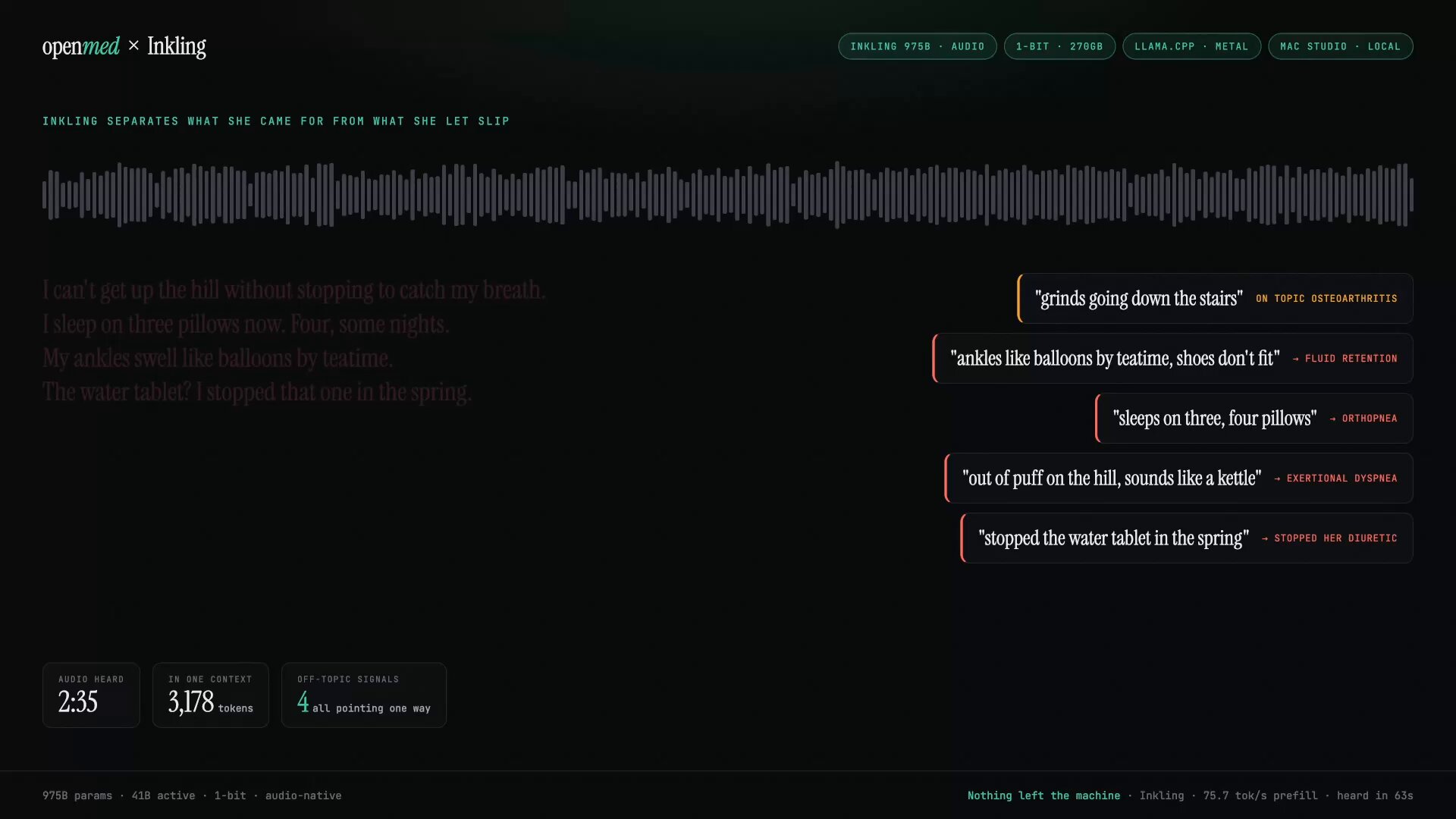
A stunning example comes from @MaziyarPanahi, who successfully ran Thinking Machines' new Inkling model, a massive 975 billion parameter architecture compressed into a 1-bit GGUF format, entirely on a local Mac Studio. The model processed raw audio of a patient-doctor conversation and successfully diagnosed underlying heart failure symptoms that the patient had not explicitly mentioned. "A 975B model just did the hardest thing in medicine: it listened to what the patient didn't think was worth mentioning," he noted. Running something of this scale locally, ensuring no data ever leaves the machine, opens up incredible possibilities for highly regulated industries.
This push towards localized, highly controlled environments is mirrored by the open-source tooling community. @elder_plinius announced an update to GODMOD3, allowing users to power the interface with their own local models or via OpenRouter and Venice API keys. Despite the availability of these powerful tools, large enterprises remain paralyzed by architectural indecision. As @nikesharora pointed out, CIOs and CEOs are unsure whether to commit to a single stack, a multi-model interoperable orchestration, or custom models. This uncertainty, combined with the complexity of multi-agent context retention, is causing a slowdown in long-term enterprise decision making, even as token prices continue to fall.
Agent Swarms and the Context Engineering Bottleneck
The conversation around AI agents is maturing rapidly, moving beyond simple chatbot interactions toward complex, autonomous organizational structures. Developers are beginning to deploy swarms of specialized agents to handle specific operational domains, mimicking the structure of a traditional corporate hierarchy. This shift represents what many believe will be the greatest wealth creation event in human history, provided engineers can solve the underlying infrastructure challenges.
@nickvasiles highlighted a comprehensive setup where specialized domain agents handle marketing, sales, operations, and finance. These agents operate autonomously, executing scheduled tools and APIs while connected to a shared second brain. "The beginning of the greatest wealth creation event in human history and it'll go to those who understand agents, systems, and organization," he predicted. This architecture treats agents not as mere assistants but as persistent digital employees that continuously learn and update their own skill sets through automated pull requests.
However, orchestrating these persistent agents over long-running tasks presents significant engineering hurdles, primarily surrounding context limitations. The industry is actively seeking robust solutions for context compaction. @0xSero issued a call to action for AI tinkerers to share their best implementations of context compaction modules for long-running tasks. As agent lifespans increase and interactions become more complex, efficiently compressing and routing memory without losing critical state data has emerged as the defining architectural challenge of the new agent era.
Prompt Vocabulary and Adversarial UI Generation
The most subtle yet impactful bottleneck in AI adoption is not the capability of the underlying model, but the vocabulary of the human prompter. This is especially true in UI and UX design, where generative models often produce generic, highly recognizable AI aesthetics. To build interfaces that do not smell like AI, developers are realizing they need a highly specific lexicon to guide their tools effectively.
As @titepommee pointed out, if you do not know the exact name of a UI pattern, it is incredibly difficult to describe what you want to the model. This has led to the creation of resources designed to bridge the vocabulary gap, allowing designers to look up names for visual elements they can see but cannot articulate. By combining a small initial prompt with screenshots, videos, and the right UI vocabulary, creators can generate a highly detailed super context for models like Fable or Sol Ultra to execute against. @MengTo reinforced this approach, emphasizing that technical skills alone are not enough to generate premium interfaces.
This demand for precision extends well into the backend and software testing phases. Rather than trusting AI to simply write functional code, developers are using advanced reasoning models to ruthlessly audit their work. @twostraws shared a comprehensive prompt designed to set reasoning engines to maximum capacity and run an adversarial unit test sweep. The prompt forces the AI to deliberately target edge cases, malformed inputs, and boundary values, ensuring that every test earns its place. Using AI for these types of adversarial reviews forces developers to evaluate their tests critically, ensuring the generated code actually performs under pressure.
Sources


introducing https://t.co/20es64pAqZ a dictionary for ui things you can see but can't name made it because i'm primarily a designer, and my biggest resistance was always knowing what things are called when prompting my agents it learns as people use it: every search teaches the site new words, and the built-in pocket dictionary grows with it give it a try and let me know what you think can't find something? dm me and i'll add it i want this to be the lowest resistance resource you have you can just build things
After spending the last few weeks trying out different skills from UI Skills These are the 10 that stood out to me the most: 1. emil-design-eng Link: https://t.co/VKDoIhRaqk 2. make-interfaces-feel-better Link: https://t.co/hkPomdvikt 3. 12-principles-of-animation Link: https://t.co/oMmPqG3QMX 4. fixing-accessibility Link: https://t.co/3wDHDN7IfQ 5. shadcn Link: https://t.co/KpnLr0LE6o 6. vercel-react-best-practices Link: https://t.co/k72y2gfZyz 7. react-doctor Link: https://t.co/g2sq4WXVNB 8. vitest Link: https://t.co/pI9A8UMtuU 9. pnpm Link: https://t.co/maGEECGfSZ 10. playwright-cli Link: https://t.co/FRrY8H0aNM
AI made us incredibly lazy. I'm ashamed to admit it, but I have to force myself to do manual coding and thinking. The first instinct is to jump to AI and ask it to /create-plan. It's scary how used I got to the agents interviewing me and creating the plan. And it's not only that. Everyone is using AI to move faster. If I refuse to use it as much, I fall behind competition. It's a constant battle between trying to use my brain so it doesn't get atrophied and not falling behind.
Likely MoE interpretability paying off. (why do you think Anthropic only ever published on dense) https://t.co/4PCYdeU67D
Kimi K3 may be the DeepSeek 2.0 moment. The benchmark results are out, and they are outstanding. And they proof one thing very clearly. I believe this is the DeepSeek 2.0 moment. Does that sound like an exaggeration? At first glance, perhaps. The benchmarks still need to prove themselves in real-world use. But one thing already seems clear: Kimi K3 is ahead of Opus 4.8 and, broadly speaking, just behind GPT-5.6 and Fable 5. Opus 4.8 was released at the end of May, specifically on May 26, roughly a month and a half ago. Kimi K3 generally outperforms Opus 4.8. That effectively disproves the claim that Chinese open source models consistently trail US closed source models by six to eight months. Of course, most users will continue to choose the very best model available, and I do not expect millions of people to cancel their ChatGPT subscriptions overnight. However, Kimi K3 makes one thing abundantly clear: the US lead is continuing to shrink. Despite sanctions, Chinese AI labs are succeeding in training increasingly capable models. Whether reinforcement learning or distillation is the primary reason, I cannot say. But Kimi K3 demonstrates to the world that a turning point may be approaching. China is steadily moving toward technological parity. The statement by the founder of Zhipu AI should also attract attention: the company says it plans to release a GLM model in the Mythos class by the end of the year. Kimi K3 is not Fable, and it is not Mythos. But it is already very close to the leading Western state-of-the-art models. That is highly significant.
Everything is a distributed systems problem. I will someday Have time to sit in a cabin and read But today is not that day https://t.co/R6rxvcjiN1

Meet Lucy 2.5, our most advanced Live AI model yet. Lucy edits videos in realtime, now with more capabilities and greater control. See how it's being used across streaming, e-commerce, advertising, and more 🧵
My bet: @thinkymachines will soon make more money than @AnthropicAI. Not by winning the race to build one standardized frontier model. By becoming the Palantir FDE for enterprise custom models. The playbook: 1. Release the best American open-weight model. 2. Drive widespread enterprise adoption. 3. Charge the largest companies 7–9 figures to post-train and run custom models behind their own firewall. The model rests on three bets: 1. Large enterprises will increasingly demand their own models with their own data, and this is how they differentiate and win. 2. Enterprises won’t need just one model. They’ll continuously need new models for different workflows, departments, and proprietary datasets. That creates extremely sticky, recurring revenue. 3. Autoresearch will make custom model development increasingly scalable. Tinker can become the interface enterprises use to post-train their own models—with @thinkymachines providing the expertise and infrastructure behind it. FDE, infra, everything, huge contracts. 4. Eventually, maybe everyone wants their OWN model, and autoresearch and training inside tinker on top of @thinkymachines's base model will make it happen. Meanwhile, Henry-ford-styled, standardized models will makes no margins. OpenAI and Anthropic will have their API margins squeezed by Deepseek/GLM/Grok/Meta etc, and their consumer subscriptions are loss centers. The fat margin will move to customization: proprietary data, post-training, evals, deployment, and infrastructure. If this thesis is right, @thinkymachines isn’t building just another frontier lab. It’s building the highest-value layer between frontier research and enterprise model ownership. Turns out, the best business model for enterprise is NOT to sell commodity API access. Sell them their own models. I’m extremely bullish on this approach. @miramurati may be the most commercially savvy frontier-lab leader. I have to admit it.
a week ago @SemiAnalysis_ wrote that Chinese labs are "simply too compute poor to truly reach the frontier." today one of those "too compute poor" labs, a 300-person startup actually, shipped a model that compares to opus 4.8 the entire western consensus – export controls, the $650B hyperscaler capex race, the "compute moat" investment thesis – is built on one assumption: flops gate capability. if that were true, chip controls would keep chinese labs permanently behind the frontier. but after reading through moonshot's stack i no longer think it is. training is efficiency-compressible: MoE routing, INT4-native quantization, better data curation, infra built around scarcity (their Mooncake stack exists because they don't have gpus!). a small lab with taste can compress the compute needed to make a frontier model, even if it can't afford to serve one the frontier is no longer something money can buy
@GergelyOrosz This comes up in every conversation I have with engineering leaders at large enterprises. And yes, everyone’s solution is a bit different right now. There’s more custom dev tooling being built inside of large companies than ever before.
The more I use @orgo the more I freaking love it! Here's how we're making managed agents super practical for the professional services business unit for returnmytime. Each domain (marketing, sales, intelligence, operations, and finance) get a domain agent. Each is a clone of our hermes template. Each agent is connected to our private Returnmytime Github Organization where our skills and second brain knowledge base resides. Reminder: A second brain is just files and folders at the end of the day. As hermes auto-learns and creates skills it has access to our github and can perform traditional software development lifecycle of committing update, creating a version, pull requests, and merges. We setup dedicated slack channels for each agent and via schedule executes its tools (MCPs, CLIs, APIs) and skills. We only name our agents with human name (ie Annie and Claire) for our Executive Assistants that are responsible across all the domains. The reason for this is more just the mental exercise of remembering names as agents keep scaling. The beauty of this model is it works for personal life too. Same architecture but setup for personal life. I'm a dad with two kids and a lot going on everyday. Building a "Jarvis" that will serve as the home office agent just makes sense to keep track of kids schedules, personal finances, calendars, and whatever "hunnie dos" I get from the wife.