Enterprise Agent Pods Reshape Workflows as Local Models Match Proprietary Speeds
Major corporations are shifting from isolated coding tools to deep workflow automation using internal AI agent platforms. Simultaneously, new open-source optimizations like Grug-12B and the TRACE training method prove that targeted fine-tuning can rival massive proprietary models in both speed and capability.
Daily Wrap-Up
The narrative around AI agents is rapidly maturing past simple code generation and entering a phase of deep enterprise integration. Today's discussions highlight a significant shift in how major companies are fundamentally redesigning their business operations around AI. Rather than just writing boilerplate code or generating marketing copy, AI is being embedded directly into complex finance, marketing, and operational workflows. The overarching theme is that the most impactful automation happens when engineers sit down with domain experts to rebuild entire processes from the ground up. This represents a critical move from task-based automation to comprehensive workflow orchestration where AI manages multi-step processes across various internal tools.
On the technical front, the relentless pursuit of larger parameter counts is being balanced by brilliant optimizations in model training and local inference. We are seeing a distinct bifurcation in the market. Massive frontier models like Grok 4.5 and GPT-5.6 are showcasing incredible raw speed and massive codebase management, yet the open-source community is proving that aggressive fine-tuning and self-improvement loops can yield highly competitive results on consumer hardware. Techniques that reduce cognitive overhead, limit excess thinking tokens, and target specific capability gaps are making local deployment not just viable, but preferable for certain agentic tasks.
Developers need to pivot their mindset from simply using AI tools to actively architecting the systems that manage them. The focus is shifting toward robust context management, durable execution, and designing interfaces that allow AI to seamlessly interact with human workflows. The most practical takeaway for developers: Start building cross-functional agent skills rather than isolated scripts. Pair up with a domain expert in your company, map out a manual workflow, and build an agent to orchestrate the entire process rather than just automating the individual steps.
Quick Hits
- @unusual_whales reported that deadly bacteria found in a major US city's water system was traced back to Mark Zuckerberg's $800 million Meta data center.
- @turingpi reminded developers that you can bring a datacenter mentality directly to your desk with compact, desk-sized hardware clusters designed for local compute.
- @RyanLeeMiniMax announced MiniMax closed a massive $2B funding round, with their CEO taking no salary until AGI is achieved and dedicating 5% of personal equity to employees and open source.
- @Jilles demonstrated the raw speed of Cloudflare Workers by bootstrapping, deploying, and connecting React, Astro, and SvelteKit apps to custom domains with AI integrations in under seven minutes.
- @lucathunderhawk introduced Honen, an interactive AI literacy platform built in partnership with NVIDIA to help bring 250,000 learners up to speed on AI fundamentals.
Enterprise AI and the Agentic Workflow Revolution
The conversation has definitively moved from whether AI can write functional code to how AI can run a business. Aaron Levie (@levie) articulated the core dilemma facing modern enterprises in a world where intelligence is commoditized. If AI models are shared amongst firms and trained on the best datasets in every industry, true competitive advantage must come from somewhere else. Levie points out that the reinforcing loop between a company's proprietary data, AI workflows, and human interaction will drive future valuations. It is no longer just about having the best AI, but about building the best environment for that AI to operate within.
This strategic philosophy is playing out in real-time at major tech companies. Uber is taking a highly hands-on approach through what they call Agentic Pods. As highlighted by Jason (@Jason), Uber is pairing their most AI-proficient engineers with domain experts across departments like finance, legal, and marketing. The results are staggering. By completely rethinking workflows around AI rather than just automating individual tasks, Uber reduced capital allocation reports from 15 hours to 30 minutes, and marketing QA from two weeks to under an hour. The biggest lesson here is that the most impactful AI opportunities are hidden inside complex manual processes and require cross-functional collaboration to uncover.
Sierra is executing a similar vision with an internal agent fittingly named Pinecone. According to Vijay Iyengar (@vijayiyengar), Pinecone runs an agentic harness in their internal cloud, automating 90% of coding, analytics, and operational busywork. It integrates seamlessly with tools like Slack, GitHub, and Clickhouse, and can even spin up a local version of the entire company infrastructure to test its own work. To facilitate these complex operations, developers are building orchestration layers. Michael Ramos (@backnotprop) introduced an Orchestrator skill designed to act as an operational plane, allowing a primary harness to manage, delegate, and steer multiple AI threads across different providers like Grok 4.5 and Claude. This type of architecture is complemented by design-focused engineering skills shared by Meng To (@MengTo), which bridge the gap between software engineering, design principles, and agent orchestration. Together, these developments signal that the future of enterprise software is a highly orchestrated, multi-agent ecosystem deeply embedded into company DNA.
Pushing the Limits of Model Capabilities and Local Inference
While enterprise deployments require heavy orchestration, the underlying models are undergoing a renaissance of optimization and speed. Frontier models are demonstrating raw computational power that borders on science fiction. At the same time, the open-source community is proving that you do not need a massive data center to run highly capable agents. The dichotomy between massive proprietary models and hyper-efficient local fine-tunes is driving the entire industry forward at a breakneck pace.
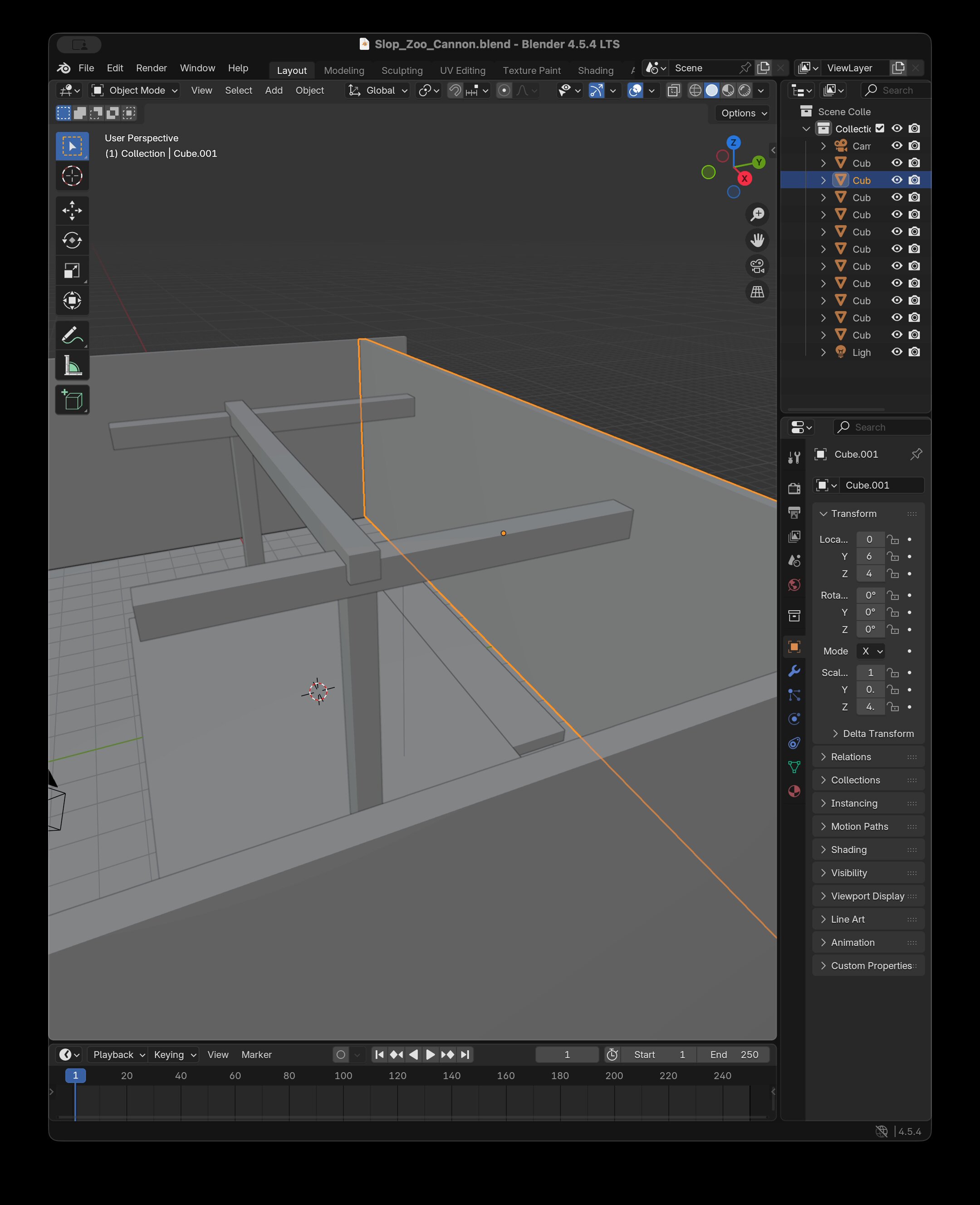
The sheer speed of modern frontier models is becoming a primary selling point. Chubby (@kimmonismus) showcased GPT-5.6 Sol generating 3D environments in Blender at a staggering 750 tokens per second. This kind of performance fundamentally changes how developers interact with AI, turning it into a real-time collaborative tool rather than a batch-processing afterthought. On the engineering side, Grok (@grok) highlighted that Grok 4.5 is explicitly built for these real-world engineering tasks. It is designed to navigate massive, multi-repository codebases while handling long-running tasks that span hundreds of agent skills and tools simultaneously without losing context.
Matching the scale of these frontier models requires clever engineering, and today offered two brilliant examples of doing more with less. Azalia Mirhoseini (@Azaliamirh) shared details about TRACE, a self-improvement approach where an agent identifies the specific capability gaps behind its own failures. By contrasting successful and failed trajectories, a TRACE-trained Qwen3.6-27B model achieved 73.2% on SWE-bench Verified, beating out massive models like Codex 5.2 while using a fraction of the training rollouts. For local hardware enthusiasts, scanfi (@GuideboardLabs) provided a deep dive into Grug-12B. This is a fine-tune of Gemma4-12B that drastically cuts down on thinking tokens to replicate the efficiency of frontier models. On a consumer 8GB RX 5700 XT GPU, Grug hits 34 tokens per second, offering developers a highly capable local model with a remarkably small capability gap. The implication here is profound. We are entering an era where generalized intelligence is being outpaced by highly specialized, ruthlessly optimized models.
Rethinking Developer Tooling and Context Management
As models grow more capable and agents take on larger workloads, the developer's role is evolving into one of context management and system architecture. The tools and frameworks being released today reflect a realization that simply throwing code at an AI is insufficient. Developers need structured ways to interrogate their own plans, manage durable execution, and clean up their agent environments to prevent token bloat and context degradation.
A major theme today is the importance of fundamental software design in the age of AI. Mario Zechner (@badlogicgames) amplified a recent talk by Matt Pocock, emphasizing that specs-to-code often produces garbage without proper guardrails. The talk advocates for ubiquitous language and Test-Driven Development as necessary speed limits for AI. Building on this concept of alignment, Nico Bailon (@nicopreme) combined the "Grill Me" skill with concepts from an article on finding unknowns. This creates an agent skill where the AI aggressively interrogates the developer to surface unknowns and establish a shared understanding before any code is written.
Once the context is established, the execution layer must be robust. Jon Morehouse (@nuonjon) discussed the massive potential of virtual queues following the Restate 1.7 release. Virtual queues allow developers to define specific control flows and business logic for how jobs are parallelized and executed across durable agents, solving a massive pain point in distributed systems. Finally, to keep these complex agent environments running smoothly, Boris Cherny (@bcherny) introduced a new /checkup command for Claude Code. This handy tool cleans up unused skills, deduplicates markdown files, breaks up massive root files into nested structures, and turns off slow hooks to save precious context. The overarching narrative across these tools is a push toward disciplined AI development. We are leaving the era of vibe coding behind in favor of structured engineering.
AI Safety, Education, and Biological Infohazards
Underneath the rapid advancement of agentic workflows, the community continues to grapple with foundational learning and emerging safety threats. As AI becomes capable of interacting with complex systems, the need to understand the underlying mechanics of both machine learning and the physical world becomes paramount.
For those looking to climb the steep learning curve of AI fundamentals, Alex Lieberman (@businessbarista) highlighted an essential new resource. Raghav Dixit's "Vectors are all you need" explainer series is being heralded as a definitive guide, joining the canonical ranks of 3Blue1Brown's neural network videos and Andrej Karpathy's tutorials. Understanding these underlying vector mechanics is crucial for developers who want to build beyond basic API wrappers and truly grasp how models process information.
However, this computational power brings terrifying possibilities. Abel Jansma (@Abelaer) flagged a deeply concerning development in neuroscience and AI crossover. Researchers have demonstrated that it is possible to algorithmically generate videos that maximally excite arbitrary brain regions. While currently a purely computational approach to speculate on brain function, Jansma warned that modern AIs might implicitly be doing something similar. The ability to automate and accelerate the creation of such specific neurological triggers represents a severe infohazard that must be strictly regulated before it manifests in the real world. These dual realities of AI education highlight that as we demystify the technology to build better tools, we must also confront the unintended consequences of highly optimized computational systems interacting with human biology.
Sources
L
Introducing Honen
Turn your company context into interactive courses that self-improve over time
We partnered with NVIDIA to bring AI literacy to 250,000 learners
We're ensuring no person or company gets left behind
Get started at https://t.co/lXLZKgr8N5 https://t.co/xFoIpd0WLs

T
datacenter mentality. desk-sized hardware.
B
New in Claude Code: /checkup
Run /checkup to:
1. Clean up unused skills/MCPs/plugins and save context
2. Dedup your local CLAUDE.md against the checked in CLAUDE.md
3. Break up root CLAUDE.md into nested CLAUDE.md's + skills
4. Turn off slow hooks
5. Update your Claude Code to the latest version
6. Enable auto mode by default
7. Pre-approve frequently denied read-only commands
.. And a few other goodies.
/checkup confirms with you before making any changes. Enjoy!
U
BREAKING: Deadly bacteria found in major US city's water system traced to Mark Zuckerberg's $800 million, $META, data center, per TechRadar
A
This is horrifying and dangerous---use of this should be *strictly* regulated.
I suspect modern AIs are already implicitly doing something similar, but this could automate and accelerate the creation of real infohazards.
Z
zamir_ar
@zamir_ar
Turns out it's possible to generate videos that maximally excite an arbitrary brain region using a simple search-based algorithm. It's a fully computational approach, so it's another way to speculate what a brain region represents, alongside other neuroscientific methods. Select an arbitrary brain region->algorithmically generate a video that jacks it up. See the visuals on the webpage https://t.co/UzKyN8MHda In silico (for now)
G
Grok 4.5 is built for real-world engineering. It excels in large codebases and handles long-running tasks that span multiple repositories, hundreds of skills, and a variety of tools.
@
Notable from the CTO of uber (disclosure, I was the 3rd or 4th investor)
P
praveenTweets
@praveenTweets
Agentic AI adoption is on fire at @Uber, and it's changing the way we build, not just in engineering, but across the entire company. Today, 99% of our engineers use AI tools. More than 70% of pull requests are attributed to local or cloud agents. And our engineers have built 2,500+ agent skills across the software development lifecycle. Those numbers are exciting, but they led us to a much bigger question: How do we bring agentic AI beyond engineering? Finance. Legal. Operations. Marketing. Customer Support. HR. Procurement. These functions run on complex workflows that are often manual, highly nuanced, and spread across dozens of systems. You can't automate them effectively by looking at process diagrams or documentation. You have to understand how the work actually gets done. So we created something called Agentic Pods. The idea is simple. We handpicked ~30 of our most AI-proficient engineers (people with deep knowledge of Uber's systems) and paired each of them with a domain expert from a business function. Then we gave every pod just two weeks. • Days 1 – 2: Shadow the expert. Observe every step. Document workflows. Ask questions. Build intuition. • Day 3: Prioritize opportunities based on scale, repetition, business impact, and data availability. • Days 4 – 5: Build a working agent alongside the person doing the job. • Days 6 – 9: Validate with several others performing the same work. Does it generalize? Does it actually make their job better? • Day 10: Ship. In just the past two months, we've run 16 Agentic Pods across 16 different business functions. • Capital allocation across 150 cities: 15 hours → 30 minutes. • Financial pacing reports: 2 days → 10 minutes. • Marketing web quality assurance: 2 weeks → 50 minutes. • Support workflow creation: 9,000 manual workflows → self-service automation. The productivity gains are impressive, but what surprised us most wasn't the speed. • It was how quickly engineers embedded in unfamiliar domains uncovered opportunities that had been hiding in plain sight. • The biggest wins rarely come from automating one task. They come from rethinking an entire workflow. Once you redesign the workflow around AI, you often eliminate handoffs, remove unnecessary approvals, replace legacy tooling, reduce vendor spend, and dramatically accelerate decision-making. • The workflow becomes the unit of automation - not the individual task. • The most impactful agent skills cut across teams, orgs, functions, tools, and systems. The biggest lesson? The best AI opportunities are rarely visible from the outside. You discover them by sitting next to the people doing the work, understanding every friction point, and building with them, not for them. We're now forming a dedicated team to scale this further and go deeper. They'll deeply understand the work, redesign it from the ground up, and use AI to fundamentally change how the business operates. It's exciting times!
M
Emil has some of the best design engineering skills out there. Worth pairing with:
Engineering skills
https://t.co/QeRRk3OCdP
Agent orchestration skills
https://t.co/LW62ia2m87
Together they cover design engineering, software engineering, and agent workflows.
All free and open source.
E
emilkowalski
@emilkowalski
New skill: /apple-design Apple’s WWDC videos are a goldmine of knowledge. I’ve combed through my favorite ones and came up with 17 design and motion principles. Use them to review existing work or when working on something new to get it right. https://t.co/jCwhthpi20
S
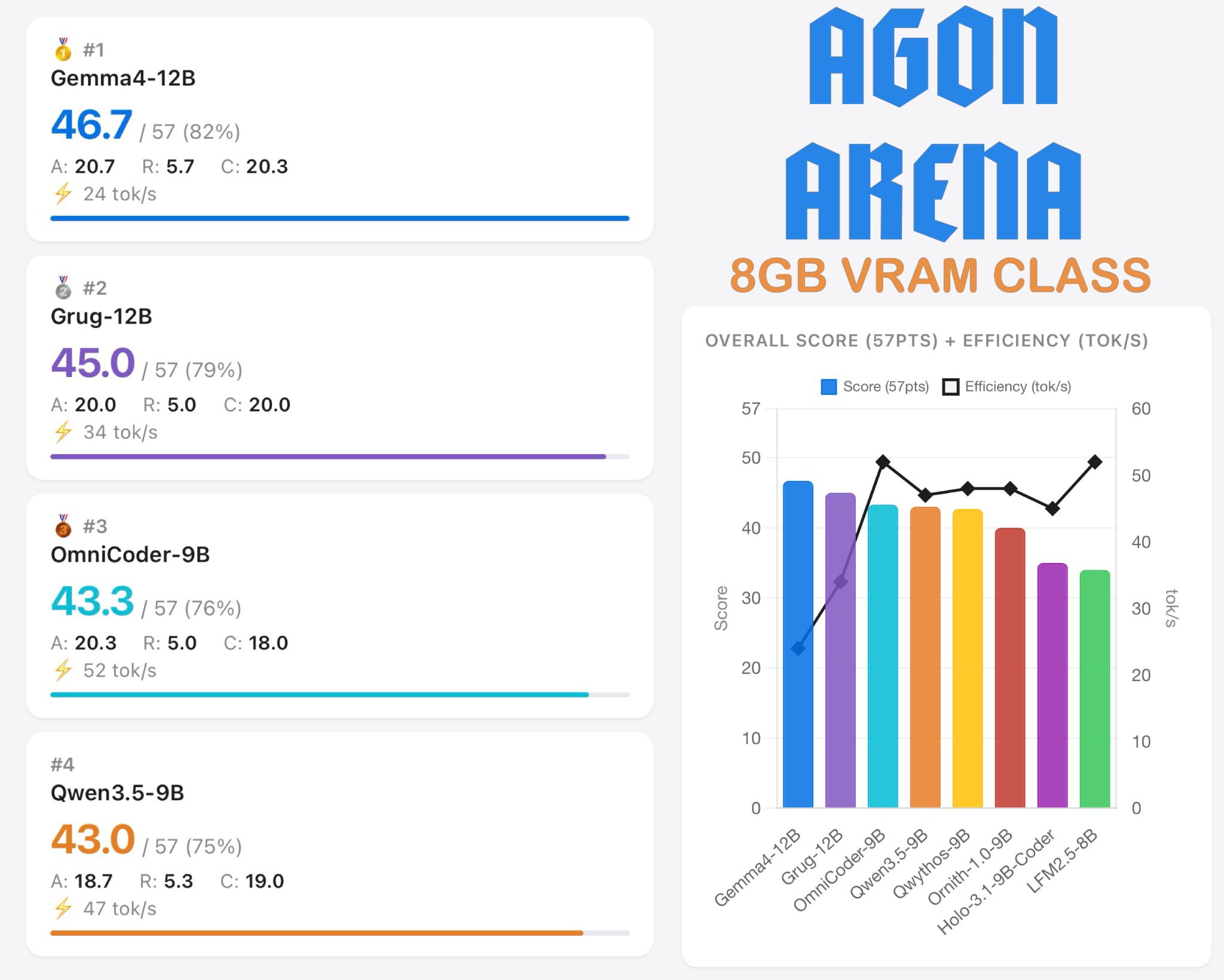
Grug-12B is a fine-tune of Gemma4-12B, not a new architecture. Same 12B params, same Gemma4 tokenizer, same <|channel>thought thinking format. The difference is in the training data and the quantization.
On clean VRAM (one model at a time, 8GB RX 5700 XT), Grug hits 34 tok/s vs Gemma4's 24 tok/s; 40% faster. The Q4_K_M is 6.9GB vs Gemma4's 6.3GB, but when you have the full 8GB to yourself, it flies.
Quality-wise: 45.0/57 on Agon-Bench v2 vs Gemma4's 46.7/57. Within 1.7 points. Grug is better at parsing and web scraping, worse at planning and graph optimization. The regex engine task was a complete miss (0/4).. that's the biggest gap.
The speed advantage is real. The quality gap is small enough that for most agentic workloads, Grug is the better choice on 8GB VRAM. Faster generation means more iterations per dollar, and the capability delta only shows up on the hardest reasoning tasks.
Where it falls apart: complex multi-hop reasoning and code generation that requires precise syntax. The thinking token format (<|channel>thought) isn't suppressed by --reasoning off, so hard tasks trigger long reasoning chains that waste tokens. The benchmark scripts strip them, but the model still burns time generating them.
K
kaiostephens
@kaiostephens
Introducing ⭐Grug-12b!⭐ Grug is an open-source experimental model build on top of Gemma-4-12b. Designed to replicate the efficiency of GPT-5.5 by cutting down thinking into only-necessary chunks. Grug outputs on average ~69.8% less thinking tokens, while preforming within a ~2% total margin of base Gemma-4 This lead to significantly faster generation and less context filling, leading to exponential decreases in generation speed. Download it here: https://t.co/Se5O0SiYdw thanks to @LambdaAPI for the credits necessary for this SFT
A
Check out TRACE, a new self-improvement approach where the agent identifies the missing capabilities behind its own failures and trains itself to address them.
TRACE-trained Qwen3.6-27B reaches 73.2% on SWE-bench Verified, outperforming much larger models like Codex 5.2 and GLM 5, while beating GRPO and GEPA with <1/4 the training rollouts.
By contrasting successful and failed trajectories, TRACE identifies its own weaknesses (such as bug localization or retrieval of the correct doc) and creates new synthetic environments to fix them.
The result is a transferable and sample-efficient synthetic env / data generation + fine-tuning pipeline for agentic tasks.
Great work led by @TarunSures41845 and @hangoo_kang!
H
hangoo_kang
@hangoo_kang
“TRACE: Capability-Targeted Agentic Training” got Spotlight @ ICML AIWILD 🎉 Beats direct RL, GEPA, & synthetic-agent data on SWE-Bench Verified and τ²-Bench. TRACE-Qwen3.6-27B tops GPT-5.2-Codex, GLM 5, & Claude 4.5 Sonnet on SWE-Bench. Co-led with @TarunSures41845. Thanks to @JonSaadFalcon and our advisor @Azaliamirh. Details below 👇
A
This is one of the best breakdowns on the fundamentals of LLMs I've ever read.
Anytime someone asks me for resources to climb the steep AI learning curve, I always provide the same list.
1) @3blue1brown's neural network videos
2) @karpathy's zero to hero playlist
3) @dwarkesh_sp's whiteboard explainers
Now @_raghavdixit_'s "Vectors are all you need" and future articles in the explainer series are getting added to the list.
_
_raghavdixit_
@_raghavdixit_
Vectors are all you need
J
This is insane. Cloudflare Workes wtf?
< 2 min: bootstrapped 3 apps: React (Vite), Astro, SvelteKit.
< 3 min: all deployed to the internet.
< 4 min: live on a real custom domain.
~7 min: all three are working apps Workers AI, KV, R2 + D1.
Cloudflare Workers are ridiculous... https://t.co/SfZ00rxyVb
J
This concept of Virtual Queues is huge. I've talked about the idea of having a "queue per object in your DB" a few times here. We're using Temporal, and had to build this type of idea on top: an orchestrator that let's you define control flow for jobs/workflows that are owned by different objects.
It's actually an extremely hard problem, and something I've been longing for at the durable execution layer for a while now. With a virtual-queue, you can actually define business logic for how your jobs are executed, parallelized etc.
In our case, we do this for building an execution graph, from a set of deploys that need to go out in specific order. We had to build the primitives on top of our DB + some glue to the durable execution layer.
S
StephanEwen
@StephanEwen
Restate 1.7 is out. It is the biggest release in over a year! The star of this release is 𝗳𝗹𝗼𝘄 𝗰𝗼𝗻𝘁𝗿𝗼𝗹, powered by 𝘃𝗶𝗿𝘁𝘂𝗮𝗹 𝗾𝘂𝗲𝘂𝗲𝘀. Restate can now steer load across your the durable functions, agents, and event-driven services with flexible rules. Together with Restate's existing capabilities for durable execution, stateful functions (virtual objects), and reliable RPC/messaging, it forms a durable foundation for your backends and agents that goes much beyond traditional durable execution. And all of it in a single dependency-less binary. Read more here: https://t.co/wrH25VGmJR
M
recommended viewing, tho the "just dropped" is a bit misleading. this is from april. still an excellent talk. @mattpocockuk is a true educator and i admire how he brings structure to this mess we are in.
M
mardehaym
@mardehaym
Matt Pocock just dropped an 18-minute talk at @aiDotEngineer on why software fundamentals matter more than ever in the AI age: 00:00 - Why specs-to-code produces garbage 04:36 - Grill Me: the skill that interrogates your plan before AI writes code 07:21 - Fix verbose AI with a ubiquitous language 09:45 - TDD is your AI's speed limit 12:35 - Deep modules: the codebase structure AI thrives in 15:04 - Design the interface, delegate the implementation These 18 minutes of software design fundamentals will replace 20 paid AI coding courses. Watch it, then read the guide on how to make a company AI-native below.
M
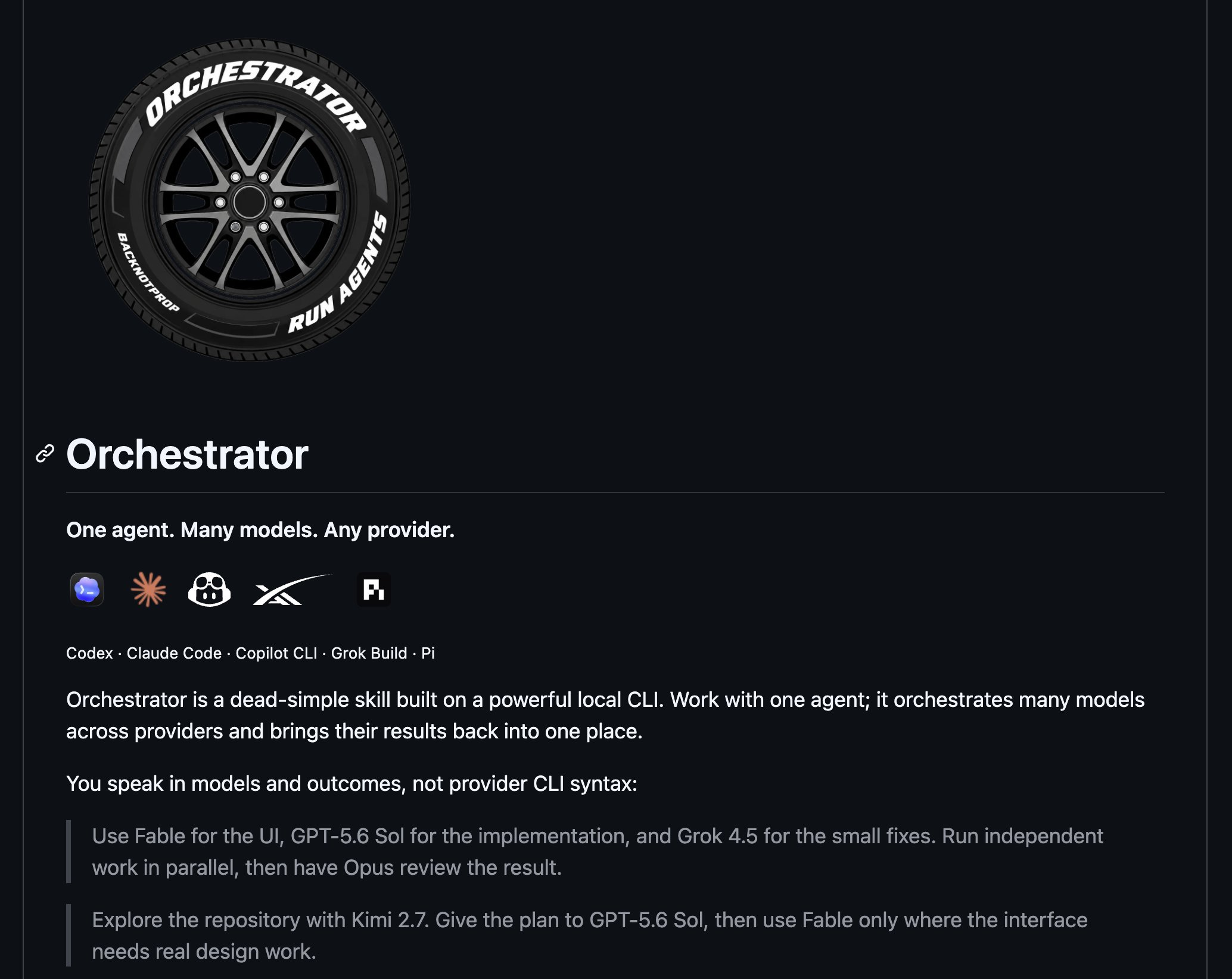
Orchestrator (Skill) - Your harness is the router
I built this so it works across harnesses. Use it as a skill in your preferred coding agent, it can call/manage/delegate to any other agent.
It goes beyond claude -p and codex exec, and gives any agent an operational plane to model other agents. For example, an operator can manage a full codex app-server - multiple threads, steer, and set goals.
It accounts for your usage limits, so you can use up all your token bandwidth across providers.
Describe your preferences in simple language and your harness will smart route for you.
Inspired by Kubectl and Claude Code subagent background processing.
I think using @SpaceXAI Grok4.5 will best as main orchestrator so that's where I'm testing this mainly.
C
ClaudeDevs
@ClaudeDevs
A second strategy: use Fable 5 as an orchestrator. Fable 5 plans and delegates to workers (Sonnet 5). Most tokens are billed at the lower worker rate. https://t.co/cwDZJSXekn
R
I’m incredibly excited to share this:
MiniMax has just closed a new $2B funding round. 🚀
At the same time, our CEO, IO, shared three long-term commitments with the team:
• No salary until we achieve AGI.
• Over the next four years, he will dedicate shares equivalent to 4% of the company’s total equity from his personal holdings to reward employees who are building MiniMax for the long term.
• Another 1% will be committed to supporting the open-source community.
The funding is exciting. But what excites me even more is what it represents: a long-term commitment to AGI, to our people, and to the open-source ecosystem.
We’re living through one of the most exciting moments in the history of AI, and we’re just getting started.
If you’re passionate about frontier AI, open source, and building the future, we’d love to build with you.
Intelligence with Everyone. 🚀
V
Everyone at Sierra uses an internal agent called Pinecone to automate 90% of our coding, analytics, and busywork. I can't go back to any other way of working.
Pinecone:
* Runs an agentic harness in our internal cloud.
* Talks to all our tools (Slack, Github, Linear, GSuite, Clickhouse, Gong, etc.)
* Lets you pick any model. Especially useful this week!
* Can spin up a local version of all of Sierra to test its work.
* Is accessible over mobile, Slack, Github, and Web and is collaborative.
@neilrahilly and team cooked on this. In this post, they share lessons learned from building and scaling Pinecone to the whole company.
N
neilrahilly
@neilrahilly
AI-pilling our company
A
Great post on some of the dynamics to think through for the future competitive advantage in world when AI models are shared amongst firms and packing so much for the intelligence of that industry.
This is going to become a core question for companies and the economy broadly over the next decade and beyond. If AI is trained on the best datasets in every single industry - like law, finance, healthcare, or life sciences - then how do you compete and differentiate in the future?
This is a great open question that I don’t think is perfectly knowable right now because of how fast AI progress is happening. But ultimately it stands to reason that if intelligence is abundant and broadly available to anyone in a field, then the companies that effectively use it the best and against a set of data and knowledge that grows in value over time, will be in a strong position.
There’s a huge reinforcing loop between the intelligence from models, a company’s own data, the connection of that data and AI in their workflows, and how employees ultimately interact with that system to create value. There’s no obvious point where this will become uniform across all companies in a vertical because each company will approach this in a different way, just as they already do with their talent and workflows. If anything, there will be compounding returns to those that do this best that accelerate their advantage over time.
Overall, super interesting question to see how this plays out over time.
J
JayaGup10
@JayaGup10
AI's Value Capture problem
N
Combined @mattpocockuk's "grill me" skill with the concepts from Thariq's "Finding Your Unknowns" article into one agent skill: grill-for-unknowns.
Your agent grills you to surface the unknowns FIRST, so you reach shared understanding before implementation. Works great with models like 5.6 that execute reliably once fully aligned. 😎
https://t.co/2kwo6P0d47
T
trq212
@trq212
A Field Guide to Fable: Finding Your Unknowns
C
GPT-5.6 Sol on 750 Token/s in Blender.
Not sped up. Holy moly. That’s so much more impressive than looking at benchmarks https://t.co/gItRdXTrIf