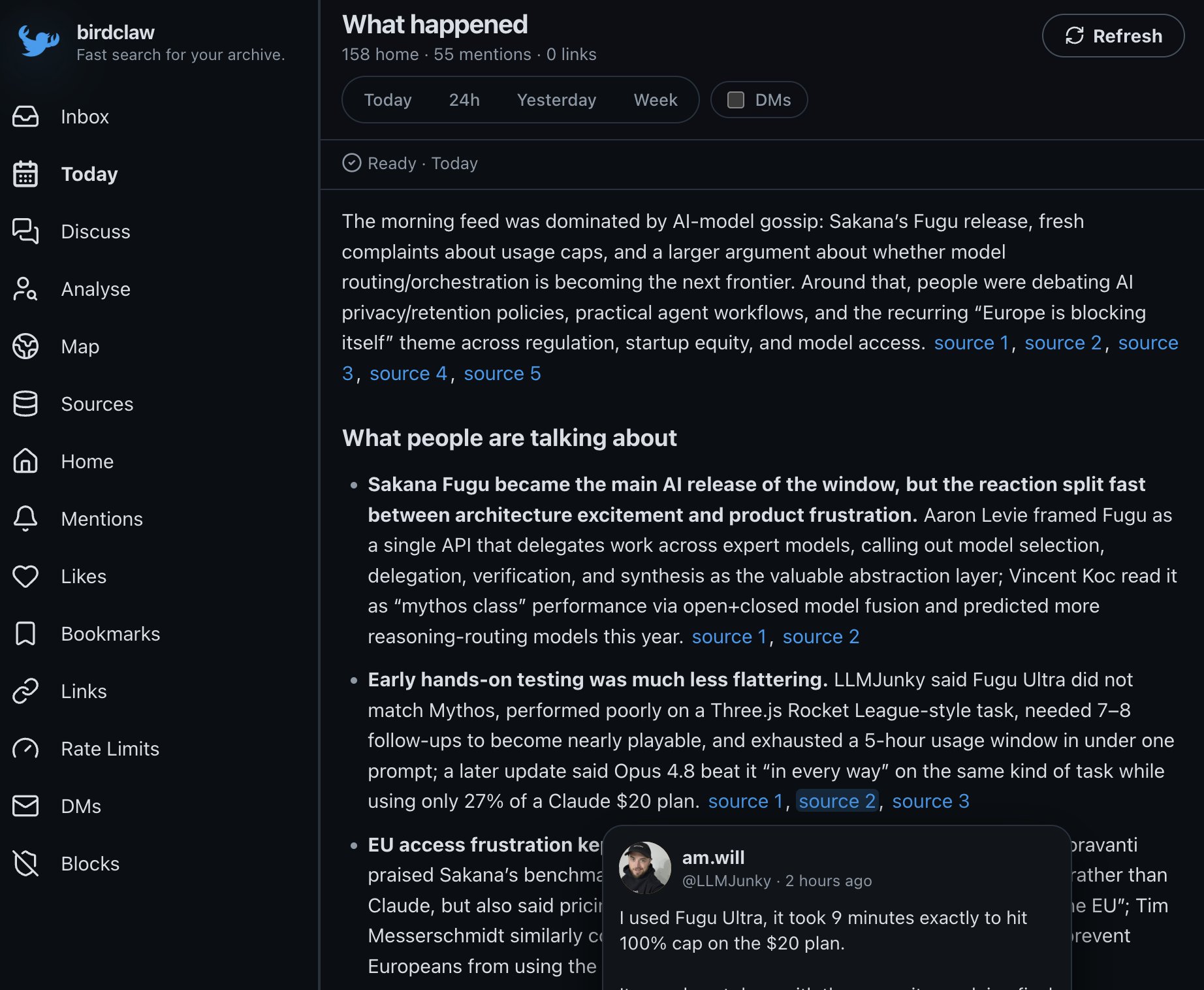
Local Inference Hits Prime Time as Sakana AI Unveils Export-Control-Free 'Fugu Ultra'
The AI community is aggressively shifting focus toward local hardware capabilities and multi-agent orchestration. Developers are optimizing bandwidth and VRAM to run autonomous agents offline, while major players like Santander open-source their governance frameworks to build enterprise trust.
Daily Wrap-Up
The AI ecosystem is experiencing a massive gravitational pull toward local inference and highly capable, efficient agent architectures. For months, the narrative has been dominated by massive cloud compute requirements and API reliance, but today's conversations prove that the pendulum is swinging back to local machines. Developers are sharing deep dives into memory bandwidth, VRAM optimization, and quantization, demonstrating that running highly capable models locally is no longer a futuristic concept but a present-day reality. We are seeing a distinct split in the market where high-end users are investing in serious workstation hardware, while others are proving that surprisingly complex agentic workflows can run on as little as 8GB of VRAM if the software stack is optimized correctly.
On the enterprise front, the conversation has matured significantly past the hype cycle. Building AI is no longer just about getting an LLM to generate a coherent paragraph, it is about governance, security, and continuous improvement. Santander made headlines by open-sourcing its entire AI control layer, setting a precedent that in heavily regulated industries, transparency and robust guardrails are the ultimate competitive moats. This aligns with a broader realization that Evals and context management layers are becoming the true strategic IP for enterprise AI, allowing companies to wrangle the chaos of multiple tools into a single, manageable pane of glass.
The most practical takeaway for developers: Stop obsessing exclusively over massive parameter counts and start mastering the art of context management, quantization, and multi-agent orchestration, because stringing together smaller, highly efficient local or open-source models is rapidly proving to be just as effective for production tasks as relying on giant, monolithic APIs.
Quick Hits
- @eliakuratli shared a deep dive into how they built a complete web analytics SaaS, including realtime dashboards and session replay, entirely on top of Cloudflare's infrastructure.
- @alexklimaj dropped a reality check on the tech industry, noting their bootstrapped drone company is one of the largest in the US by volume, yet receives almost zero press because they never raised venture capital.
- @WSJ highlighted how the AI sprint is hurtling toward a world where anyone can build personal concierges to handle everything from executive presentations to March Madness brackets.
- @steipete shared a screenshot of a new UI, noting that it is quickly becoming their absolute favorite way to read and consume Twitter.
- @aspnetzero reminded developers that starting an Angular and .NET project should not waste weeks on setup, promoting production-ready starting points that enforce best practices out of the box.
The Local AI Hardware Renaissance
Running capable models locally has become a tangible reality, fundamentally changing how developers approach building and deploying autonomous systems. There is a growing sentiment that investing in local hardware is the modern equivalent of early crypto mining. As @tulipking quipped, we have moved from needing 32 ETH to run a validator to thinking "you just need 4 RTX PRO 6000 Blackwells to run local AI and escape the underclass." This encapsulates the current obsession with local inference capabilities, where the conversation has moved well past simple VRAM capacity. The real differentiator is now memory bandwidth and the maturity of the software stack.
This shift requires a fundamental understanding of how models interact with physical hardware. Quoting @TheAhmadOsman, the ultimate mental model for AI hardware comes down to three questions: "What must fit? What bandwidth tier do I need? What software stack can actually deliver it?" @TheAhmadOsman also dropped a massively comprehensive guide covering everything from tokens and attention to VRAM math and hardware tiers, bridging the gap between theoretical LLM mechanics and practical local deployment.
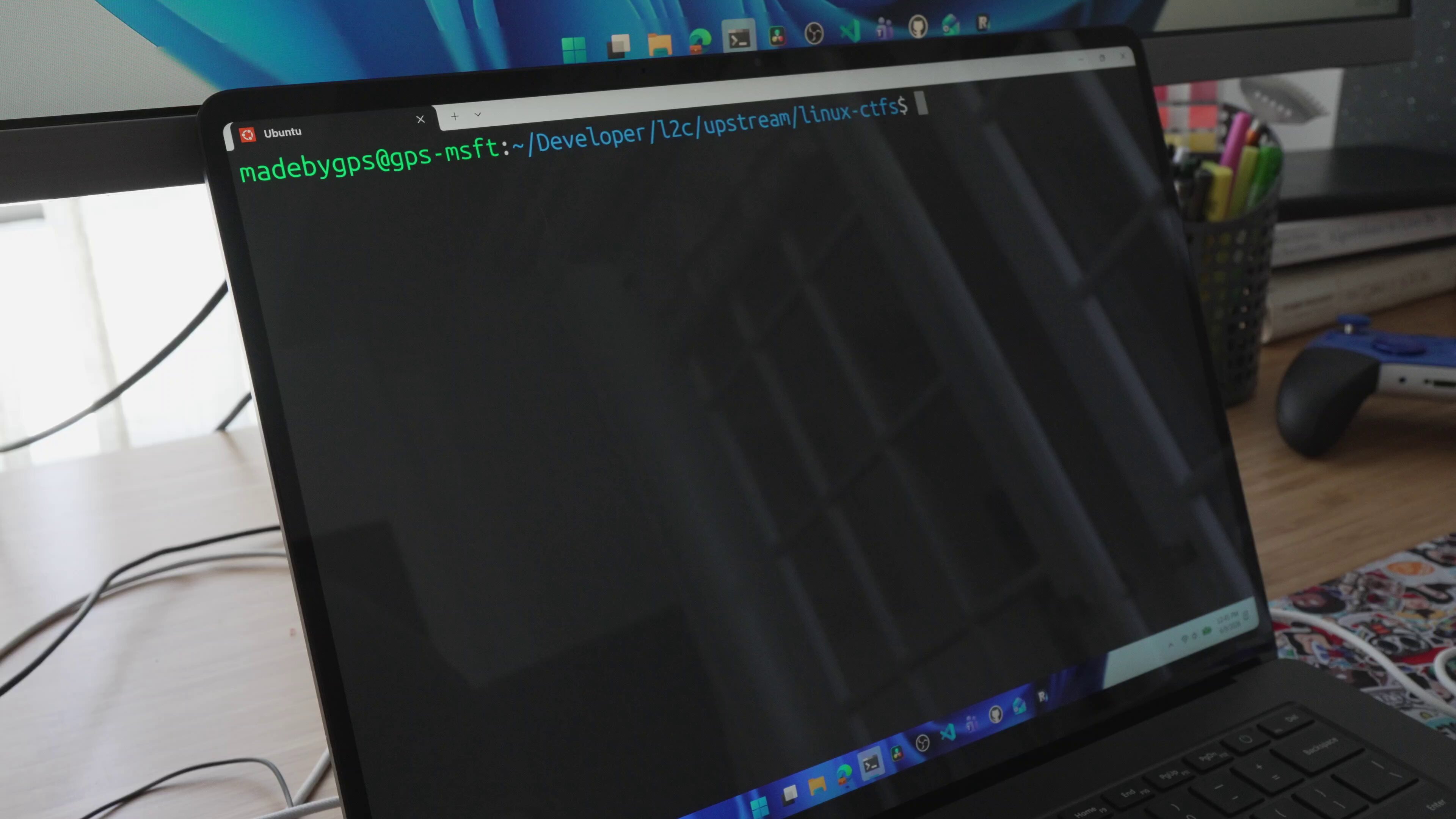
The proof that this local AI transition is ready for everyday use is visible in the autonomous agents currently running in the wild. @loktar00 highlighted how the Hermes agent running on Gemma 4 26B operates fully autonomously on just 8GB of VRAM. By integrating llama.cpp, this setup writes code, manages GitHub, and browses the web completely offline, proving that local is a today thing, not a someday thing. This capability is further bolstered by highly technical community efforts to refine quantization. @hxiao pointed out the hardcore work being done by developers to ensure that directly quantizing from f16 to Q4_K_M minimizes precision loss. To tie these local and cloud deployment strategies together, @madebygps shared a practical tutorial on running your agent in a cloud sandbox, proving that whether you are pushing local hardware limits or leveraging cloud environments, the deployment tooling is rapidly maturing.
Frontier Models and Agentic Architectures
Instead of purely relying on training massive, monolithic models from scratch, the frontier of AI development is heavily leaning into sophisticated multi-agent orchestration and continuous improvement loops. This approach allows developers to achieve frontier-level capabilities by intelligently coordinating existing tools. @birdabo highlighted a massive breakthrough from a lab in Tokyo that effectively matches the performance of massive models like Fable and Mythos. They introduced Sakana Fugu, a full multi-agent orchestration system accessible via a single model API. Because it coordinates existing models, it delivers frontier capability with zero export control risk, edging out giants like Opus and Gemini 3.1 on major benchmarks.
This composite approach to model architecture is consistently setting new standards across the industry. As @leothecurious noted regarding the capabilities of GLM 5.2, modern orchestration and open-weight models are hitting scores that feel like a 90% ARC-AGI-3 score but applied directly to coding tasks. However, building these reliable systems requires moving beyond simple prompt chains and embracing sophisticated architectures.
@sydneyrunkle emphasized the importance of "hill climbing" as the fourth loop in agent engineering. Automating this specific process allows agents to improve their performance over time autonomously, a difficult task but one with ridiculously high ROI. To effectively train these complex, autonomous agents, especially in data-sparse domains like the legal industry, researchers are looking at novel data generation techniques. @nikogrupen pointed out that creating ontologies and structured agent training environments synthetically from unstructured data is a massive unlock, allowing firms to train highly specialized agents without compromising sensitive client data.
Enterprise Open Source and AI Governance
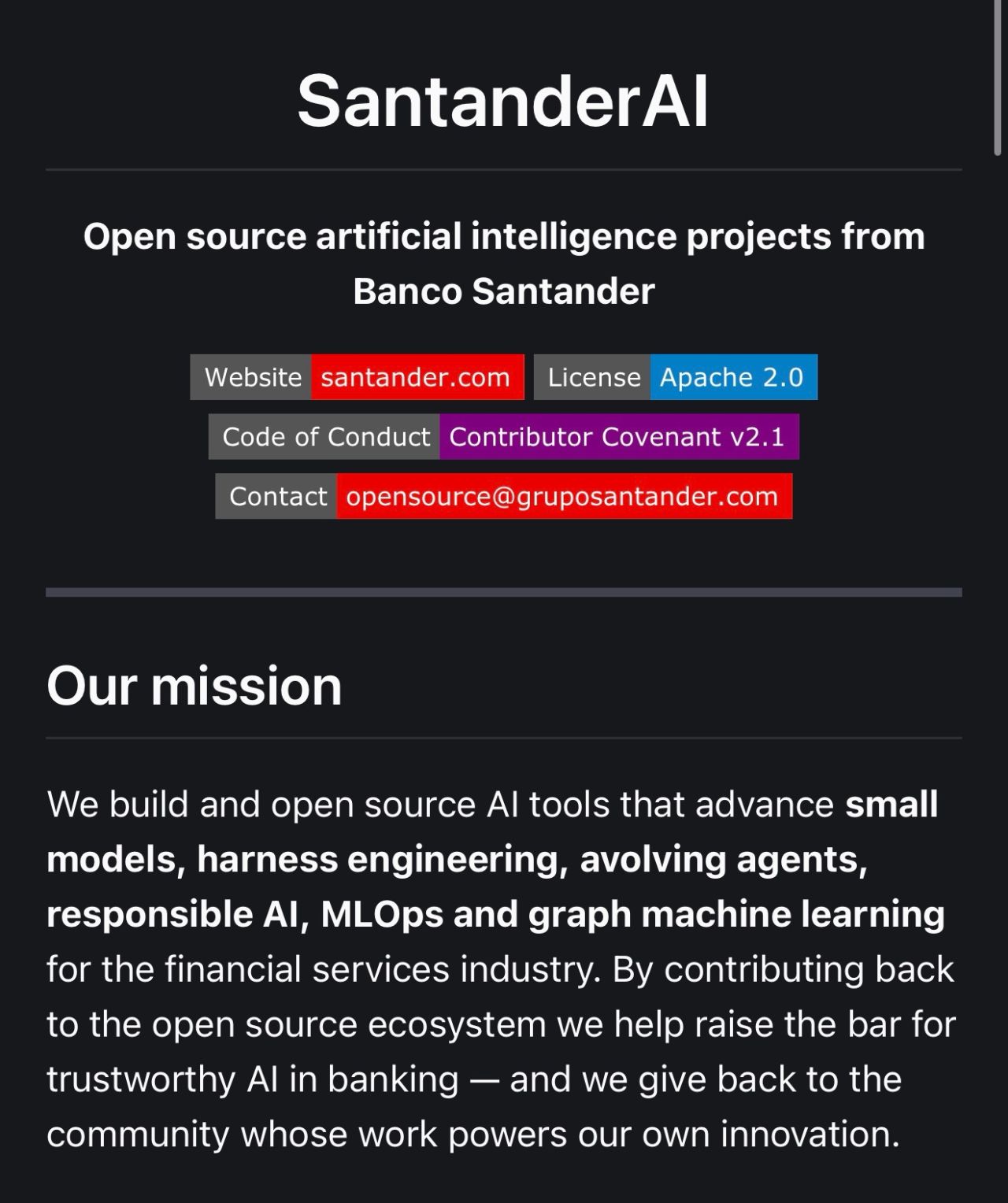
As AI transitions from experimental projects to core enterprise infrastructure, the industry's moat is shifting from the base models themselves to the governance, guardrails, and evaluations surrounding them. Major players are realizing that in a world of ubiquitous open-weights, transparency and robust security layers are becoming the ultimate strategic advantage. @sytaylor broke down Santander's massive move to open-source its AI governance initiatives. The bank pushed 11 repositories to the public under Apache-2.0, including tools for mechanical governance, discrimination testing with counterfactual comparators, and synthetic stressed datasets.
This move perfectly illustrates why the most critical question for big regulated actors has become exactly what @sytaylor noted: "Can you show a decision was safe, fair, auditable, and the same tomorrow as it was today." By putting their AI control layer on the open internet, Santander is proving that transparency is the fastest route to building the regulatory and consumer trust necessary for widespread deployment.
This emphasis on governance aligns perfectly with the realization that evaluations are the true differentiators in modern enterprise AI. As @carrynointerest highlighted via a post from Garrett Lord, Evals are the strategic IP that will define the next era of AI. Companies that can rigorously test, validate, and trust their AI outputs will be the ones who successfully pull ahead. This structured, governed approach is exactly what the broader market needs to deliver on the promise of the personal concierges that @WSJ predicts will soon handle everything from executive presentations to complex daily automation.
Coding Agents and Developer Workflows
The integration of AI into the software development lifecycle is deepening, moving beyond simple autocomplete into autonomous, long-running environments. However, as these tools become more embedded in daily workflows, developers are identifying both their immense potential and their distinct UX limitations. We are seeing the emergence of specialized, framework-backed coding agents designed to handle complex, multi-step engineering tasks. @abpframework announced a new AI coding agent specifically tailored for .NET, featuring plan, agent, and ask modes that deeply understand specific software architectures and conventions.
Emphasizing reliability for massive undertakings, @droid noted that their "Missions" environment can run autonomously for weeks. Users are reporting insanely high-quality software development and reliable migrations when pairing these long-running environments with proxied access to top-tier models. Yet, the interface through which developers interact with AI-generated code remains a battleground. @olvrgln pushed back against the concept of multimodal code reviews, arguing that overly complex visual diagrams actually make it harder for human developers to review whether an AI is catching a real bug, noting that this style of code review is not the future.
Underpinning all of these advanced coding workflows is the absolute necessity of robust context management. As AI sprawl increases within organizations, developers are using multiple platforms, plugins, and agents simultaneously. @giyu_codes highlighted how enterprises are using platforms like Glean as an underlying context layer and AI control plane. By using an MCP with tools like Claude Cowork, companies are seeing a 30% reduction in token usage while strongly preferring the context-aware answers. It is becoming abundantly clear that the future of enterprise engineering relies on a controllable context layer that prevents AI tools from operating in isolated silos.
AI Career Paths and Education
As the AI landscape rapidly matures, the pathways into the industry and the foundational knowledge required to succeed are becoming highly structured. The era of needing a traditional, decade-long academic background to contribute to AI is fading, replaced by accessible, high-quality educational resources. @stanfordnlp shared a prime example of this democratization by highlighting a comprehensive guide written by a developer who recently secured a role at OpenAI. This individual credited their entire learning process to watching Stanford's Language Modeling from Scratch course, which helped organize scattered concepts into a coherent picture of the field, ranging from tokenization to fine-tuning and multimodal models.
This focus on foundational education reflects a broader trend in the tech industry where practical, deep knowledge of system architecture and first principles is valued above all. Whether you are a developer looking to land a role at a frontier lab or attempting to build the next billion-dollar run-rate SaaS, the ability to understand the mechanics of AI is proving to be the most valuable currency in the modern job market.
Sources
y'all, glm 5.2 is very good
@EnoReyes Been using the factory suite with the $20 plan + droidproxy w/ Claude max plan. Absolutely insane quality of software development. Missions are insanely reliable for large pixel perfect migrations!
Tons of new + old glean clients are starting to use Glean as their underlying context layer and AI Control Plane We are seeing a massive increase in the “AI sprawl” if you want to call it that. Enterprises have Claude Code, codex, cursor, glean etc. and it’s difficult to manage all the plugins, MCPs, skills and LLMs We’ve seen that clients that use our glean MCP with Claude Cowork have a 30% reduction in tokens plus preferring answers that use glean over the normal agentic search The future of enterprise AI is a single pane of glass and a controllable context layer, which is why glean is the number 1 option for enterprises and serious companies that want to do work Using consumer grade apps that provide 0 ROI at scale for a business just doesn’t cut it anymore Btw codex app + glean MCP is legit my favorite right now
How I built a web analytics SaaS completely on Cloudflare
I shipped a full web analytics SaaS for my own projects (mrkr.app) Realtime dashboards session replay funnels revenue tracking usage-based billing tea...
Gemma 4 26B plus Hermes Agent, fully autonomous on 8GB VRAM. llama.cpp integration took 2 minutes. Writes code, manages GitHub, browses the web, connects to Notion and Obsidian. All offline, all local, 24/7. https://t.co/oVAyIB2puP
The future of code reviews will be multimodal https://t.co/9nHKsjSQDB
Evals: the strategic IP that will define the next era of AI
@hallerite check this out https://t.co/m2kJmvs4Oq
The Art of Loop Engineering
LLMs 101: A Practical Guide (2026 Edition)
I'm joining OpenAI next week!🥹 The job search turned out to be really challenging but also super rewarding, so I wrote a small blog to share what I learned along the way and hopefully make the process a little less mysterious for the next person. https://t.co/6FigSBdenD
Local AI hardware = capacity × bandwidth × software stack - Capacity tells you what fits - Bandwidth tells you how hard the box can breathe - The software stack tells you how much of the spec sheet you can actually cash out. Hardware by Memory Bandwidth - Mac Studio M3 Ultra: up to 512GB @ 819 GB/s - RTX PRO 6000 Blackwell: 96GB @ 1792 GB/s - RTX 5090: 32GB @ 1792 GB/s - RTX 4090: 24GB @ 1008 GB/s - RX 7900 XTX: 24GB @ 960 GB/s - Radeon PRO W7900: 48GB @ 864 GB/s - AMD Radeon AI PRO R9700: 32GB @ 640 GB/s - Intel Arc Pro B65: 32GB @ ~608 GB/s - Tenstorrent Wormhole n300: 24GB @ 576 GB/s - Tenstorrent Blackhole p150: 32GB @ 512 GB/s + 800G - MacBook Pro M5 Max: 460-614 GB/s - MacBook Pro M5 Pro: 307 GB/s - DGX Spark: 128GB @ 273 GB/s (coherent + CUDA) - Mac mini M4 Pro: 273 GB/s - Ryzen AI Max / Strix Halo: ~256 GB/s (~96GB usable GPU) - MacBook Air M5: 153 GB/s - Snapdragon X2 Elite: 152-228 GB/s - Intel Lunar Lake: 136 GB/s - Snapdragon X Elite: 135 GB/s - Mac mini M4: 120 GB/s - Arc Pro B60: 24GB @ ~456 GB/s Verdict - GPUs are still the bandwidth kings - Apple wins: stupid amounts of memory, don’t want to shard across GPUs - Apple loses: when raw tokens/sec & concurrency matter more - DGX Spark: coherent memory + NVIDIA stack - Strix Halo / Ryzen AI Max: first real x86 unified-memory contender - Tenstorrent: fully OSS stack, excited to see this mature Fitting ≠ serving Even if it fits, you still pay for - bandwidth during decode - KV cache growth - dequantization - batching + concurrency - scheduler quality - framework overhead The only mental model that matters: 1. What must fit? 2. What bandwidth tier do I need? 3. What software stack can actually deliver it? In short: - NVIDIA → fastest raw speed - Apple Studio M3 Ultra → biggest one-box memory - Strix Halo → first real x86 unified - DGX Spark → coherent NVIDIA dev appliance - AMD / Intel Arc → rising alternatives - Tenstorrent → fully opensource stack Do ask: “which bottleneck am I buying?” Not: “which hardware is best?”

Introducing Sakana Fugu: A full multi-agent orchestration system accessible via a single model API. Our ‘Fugu Ultra’ model matches the performance of Fable and Mythos, delivering frontier capability without the risk of export controls. Try it: https://t.co/hhO6qTawgb 🐡
This reveals an issue: directly quantizing from f16 to Q4_K_M still results in a significant loss of precision. We're currently in the final testing phase. Once testing is complete, we'll upload it to HF. If you're interested, feel free to test and compare it.
Insane that society celebrates massive capital raises, while bootstrappers are unknown