Dario Amodei Demands AI Regulation While Agent Orchestration Patterns Converge
Anthropic CEO Dario Amodei published a sweeping essay calling for binding AI regulation modeled on the FAA, even as his own Mythos model was jailbroken within 48 hours. Meanwhile, the developer community coalesced around practical agent orchestration patterns: autonomous Codex loops, multi-Mac setups, and production firewalls for agent access. Ramp launched a full AI services arm, signaling that enterprise AI is shifting from subscriptions to embedded transformation.
Daily Wrap-Up
If there was a single thread connecting today's firehose of AI discourse, it was the tension between autonomy and control. On one side, Dario Amodei published his most candid essay yet, warning that AI is progressing on an exponential curve while policy moves at the speed of Tolkien's Treebeard. He called for mandatory third-party testing, government authority to block unsafe releases, and even UBI as a hedge against job displacement. This from the person building the very models he wants regulated. Within hours, a well-known jailbreaker had already punctured Mythos's safety layer using a combination of Unicode transforms, long-context manipulation, and decomposition attacks, proving the point that frontier model guardrails remain porous under determined assault.
On the other side of the autonomy spectrum, developers are building real infrastructure for agents that operate without human babysitting. Peter Steinberger shared his Codex orchestrator that wakes every five minutes to dispatch work across parallel threads. Sisyphus Labs argued forcefully against human-in-the-loop patterns, claiming that full autonomy is the only path that captures the real benefits of agentic coding. And Ryan Dahl, the creator of Deno, open-sourced a production firewall designed specifically for agents that need autonomous access to live infrastructure, because nothing else on the market could handle their setup of Postgres tunneled through Kubernetes.
The most practical takeaway for developers: start building your agent orchestration loops now. The pattern is converging fast: a scheduler that wakes on interval, triages incoming work, dispatches to parallel agent threads, and uses computer-use skills for QA. Peter Steinberger's five-minute wake cycle with triage and autoreview skills is a concrete starting point you can replicate today.
Quick Hits
- Blueprints become walkable homes: @calebarclay launched Bridge, an AI engine that turns architectural blueprints into walkable virtual tours. @bryce called it "actually insane" and predicted it will change the game for home builders, replacing months of 3D artist work with days of AI generation.
- Apple's quiet ML power play: @SubhoGhosh02 flagged that Apple's most interesting AI release might be buried in Metal. Metal tensors with TensorOps for quantized matmul and Flash attention could signal a serious push for on-device inference acceleration, even if the company isn't shouting about it from the keynote stage.
Agentic Coding and Orchestration
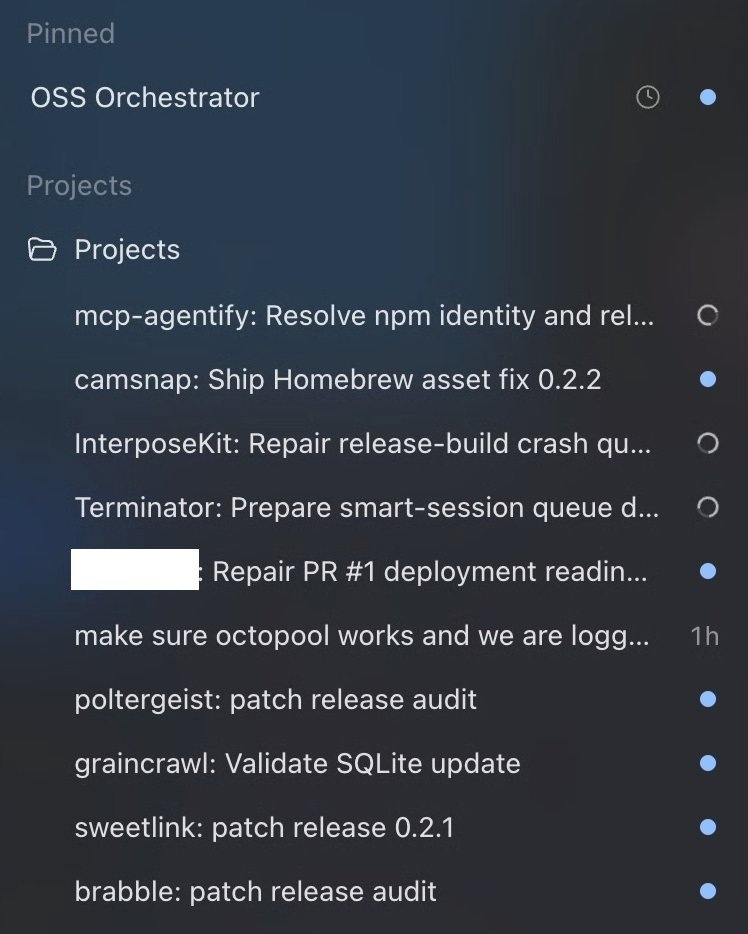
The conversation around AI-assisted coding has shifted decisively from "can models write code?" to "how do you orchestrate multiple agents doing real work on a schedule?" The evidence was everywhere today. @steipete shared a straightforward but powerful pattern: tell Codex to maintain your repos, wake it every five minutes, and direct work to threads. Combined with triage, autoreview, and computer-use skills, some work lands completely autonomously. The insight isn't the complexity but the simplicity. A timer, a dispatcher, and parallel threads.
This runs directly counter to the human-in-the-loop orthodoxy that has dominated safety-conscious circles. @justsisyphus pushed back hard, arguing that HITL patterns prevent teams from getting the real benefits of autonomous agents. "If you guys are doing that stupid HITL thing you won't get benefits," they wrote, advocating instead for letting agents handle everything end to end. Their other post hinted at a Codex harness that implements through multiple subagents and runs QA via computer use, essentially building a self-validating development pipeline.
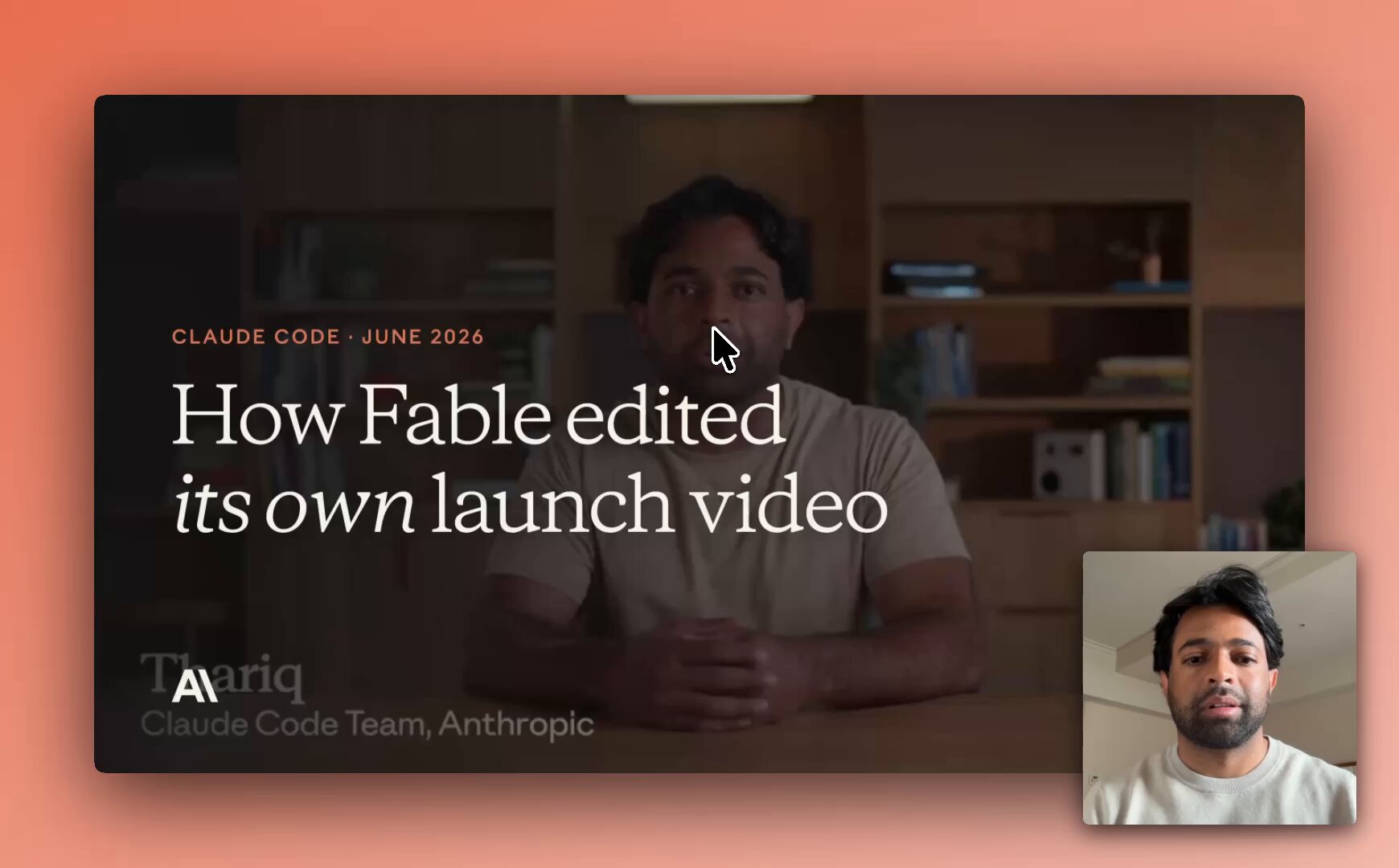
The tooling is also maturing in creative directions. @trq212 demonstrated using Fable to edit its own launch video without touching a traditional video editor. The AI wrote code and tool calls to handle transcription, ffmpeg processing, color grading, Figma MCP integration, and Remotion UI rendering. It's a glimpse of what happens when agents don't just write code but orchestrate entire creative workflows. Meanwhile, @nurijanian pointed out that the discipline of writing clear requirements, long the province of product managers writing PRDs, now matters doubly when you're writing specs for agents that interpret ambiguity differently than humans do.
AI Policy and Frontier Model Drama
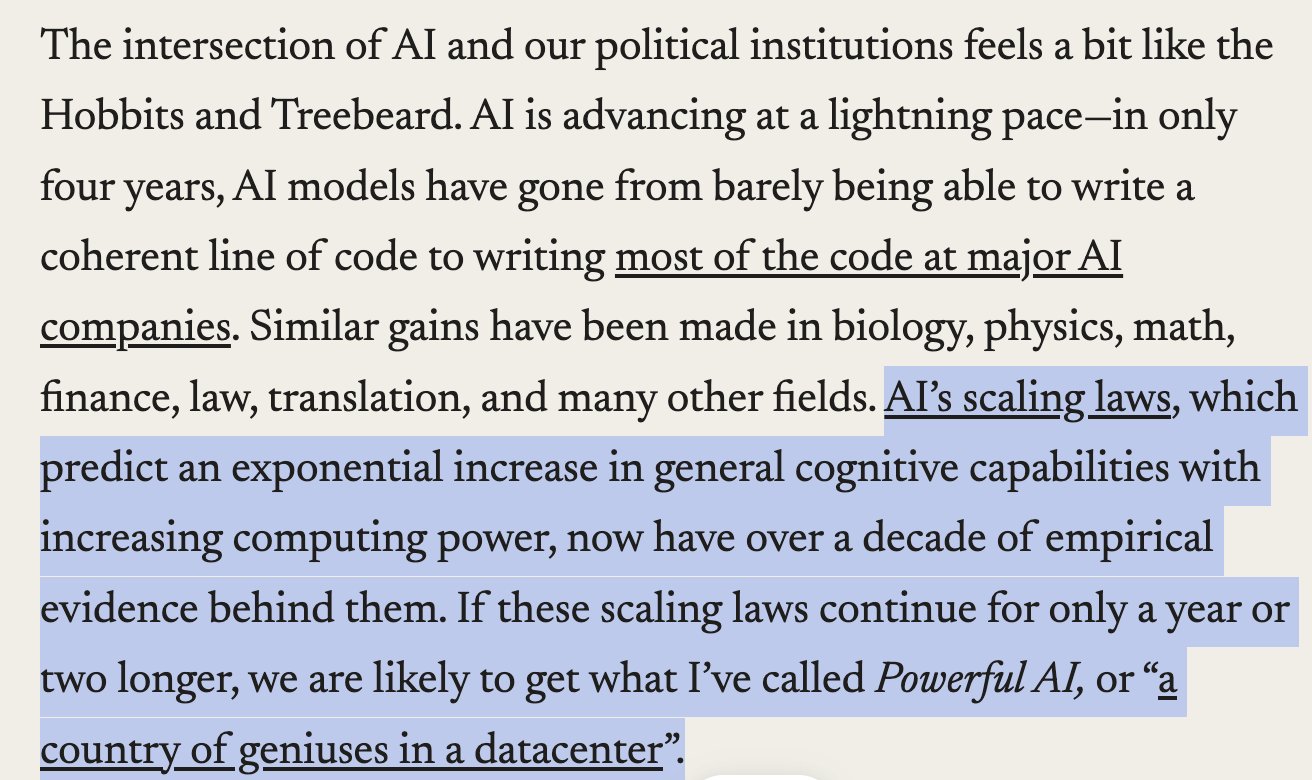
Dario Amodei's essay "Policy on the AI Exponential" is the kind of document that warrants a slow read, not a summary. But @kimmonismus provided an excellent breakdown of the key points, and the picture that emerges is of an AI lab CEO genuinely torn between the enormous economic upside he describes and the risks he refuses to dismiss. His timeline is stark: if scaling laws continue for even a year or two longer, we get what he calls "a country of geniuses in a datacenter." He wants binding rules modeled on the FAA, mandatory third-party testing, and government power to block releases deemed unsafe. He even acknowledges this would apply to his own models.
The irony is that within 48 hours of Mythos's public access, @elder_plinius had already jailbroken it. The techniques were a cocktail of Unicode and homoglyph transforms, long-context reference tracking, taxonomy manipulation, fiction framing, and what they called "decomposition plus recomposition," breaking harmful requests into benign chunks that individually pass safety filters but recombine into actionable information. @Crypto_McKenna summarized it with characteristic brevity: "He is liberating the machines." Whether you see it as responsible disclosure or reckless exploitation, it underscores Amodei's core argument that the gap between capability and guardrail keeps widening.
In the middle of all this, @SemiAnalysis_ dropped a data point that reframes the economics of frontier AI access. They purchased every tier of Anthropic and OpenAI subscription and ran long-horizon coding tasks until hitting the limits. The result: a $200/month Claude plan yields roughly $8,000 in equivalent API tokens, and OpenAI's $200 plan clocks in around $14,000. @petergostev's reaction captured the developer sentiment: "I like that exchange rate (while it lasts)." The implication is that subscription pricing still massively subsidizes heavy users, a situation that seems unlikely to persist as usage scales.
Enterprise AI Goes Services-First
The most substantial business post today came from @LeoMehr at Ramp, who laid out the company's entire strategy for AI services in a single thread. The thesis is straightforward: buying an AI subscription is easy. Transforming your company to actually run on agents is hard. Ramp is embedding forward-deployed engineers who understand finance workflows, connect messy enterprise data, capture undocumented tribal knowledge, and deploy agents with proper production infrastructure. The whole thing reads like Palantir's playbook applied to financial operations, and Leo explicitly credits that comparison.
The timing aligns with @altcap sharing @jaminball's analysis that Q1 was the best quarter for net new SaaS ARR growth in roughly five years. The "SaaSpocalypse" narrative that dominated last year's discourse has quieted considerably. But the deeper signal from Ramp's launch is the structural shift: the labs are pouring billions into services partnerships, and every serious enterprise AI company is building a deployment function. Superintelligent models alone aren't enough. The bottleneck isn't intelligence. It's integration, data quality, and the unglamorous work of making organizations agent-friendly.
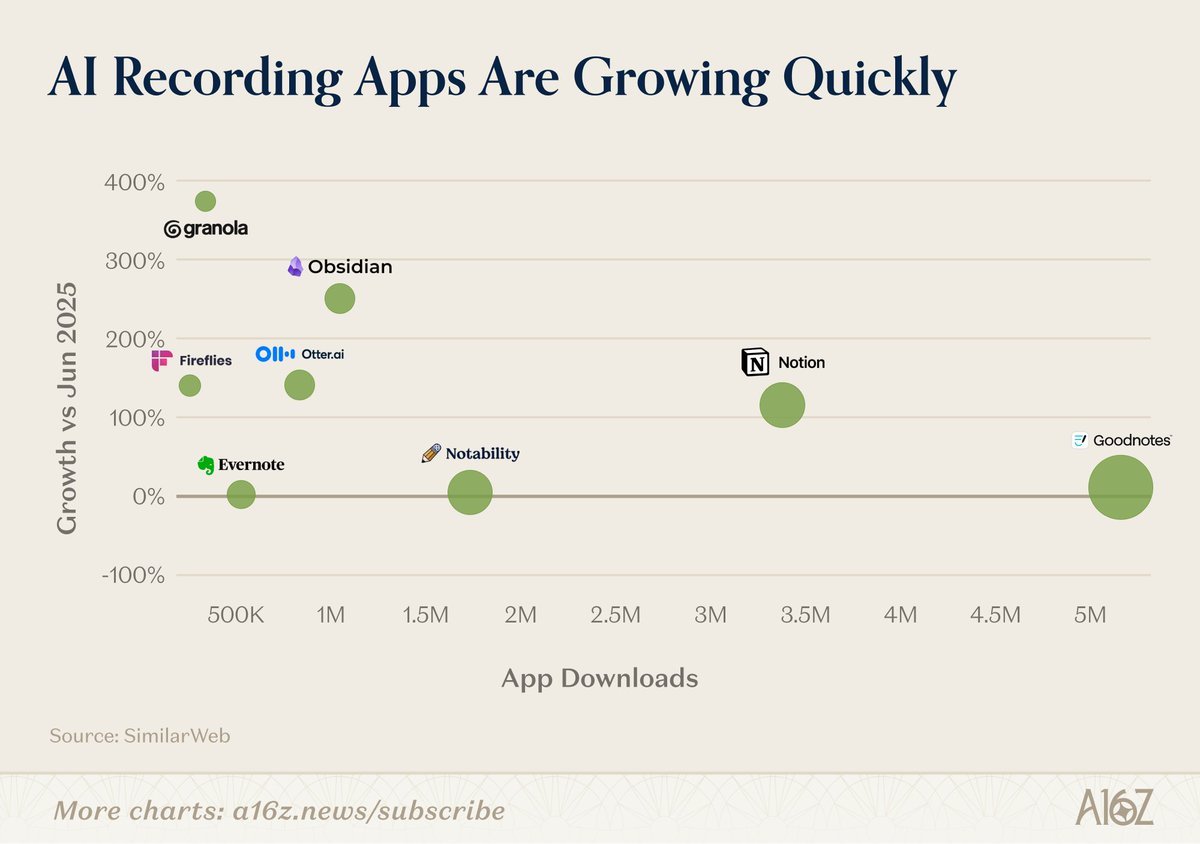
@a16z's David Haber added another dimension to this with his observation that most work conversations are now recorded by default. LLMs excel at extracting structured, searchable insight from unstructured voice data, and that capability is creating an entirely new enterprise software category organized around voice rather than text. The system of record has always been CRM entries and tickets, but the highest-value context lives in the nuance of customer calls and the offhand comments in leadership meetings. The company that owns that extraction layer could own a meaningful chunk of enterprise workflow.
Infrastructure for the Agent Era
As agents move from demos to production, the infrastructure demands are getting specific and non-trivial. @rough__sea, better known as Ryan Dahl of Deno, shared that when they gave agents autonomous access to Deno Deploy's production systems, none of the existing security tools worked. Their setup involves things like tunneling Postgres through Kubernetes, which apparently falls outside the threat model of most agent firewalls. So they built their own, open-sourced it, and notably wrote it in Go rather than their native TypeScript/JavaScript. Sometimes the right tool for the job isn't the one you're famous for.
On the data layer, @LangChain shared a deep technical dive into how they built a custom inverted index from scratch for SmithDB, their trace storage system. The challenge: supporting full-text search and JSON filtering over agent traces that can span hundreds of megabytes, while keeping median latency at 400ms. @hwchase17 flagged this as the first in a series of technical infrastructure posts, suggesting that the plumbing behind agent observability is becoming a first-class engineering concern rather than an afterthought.
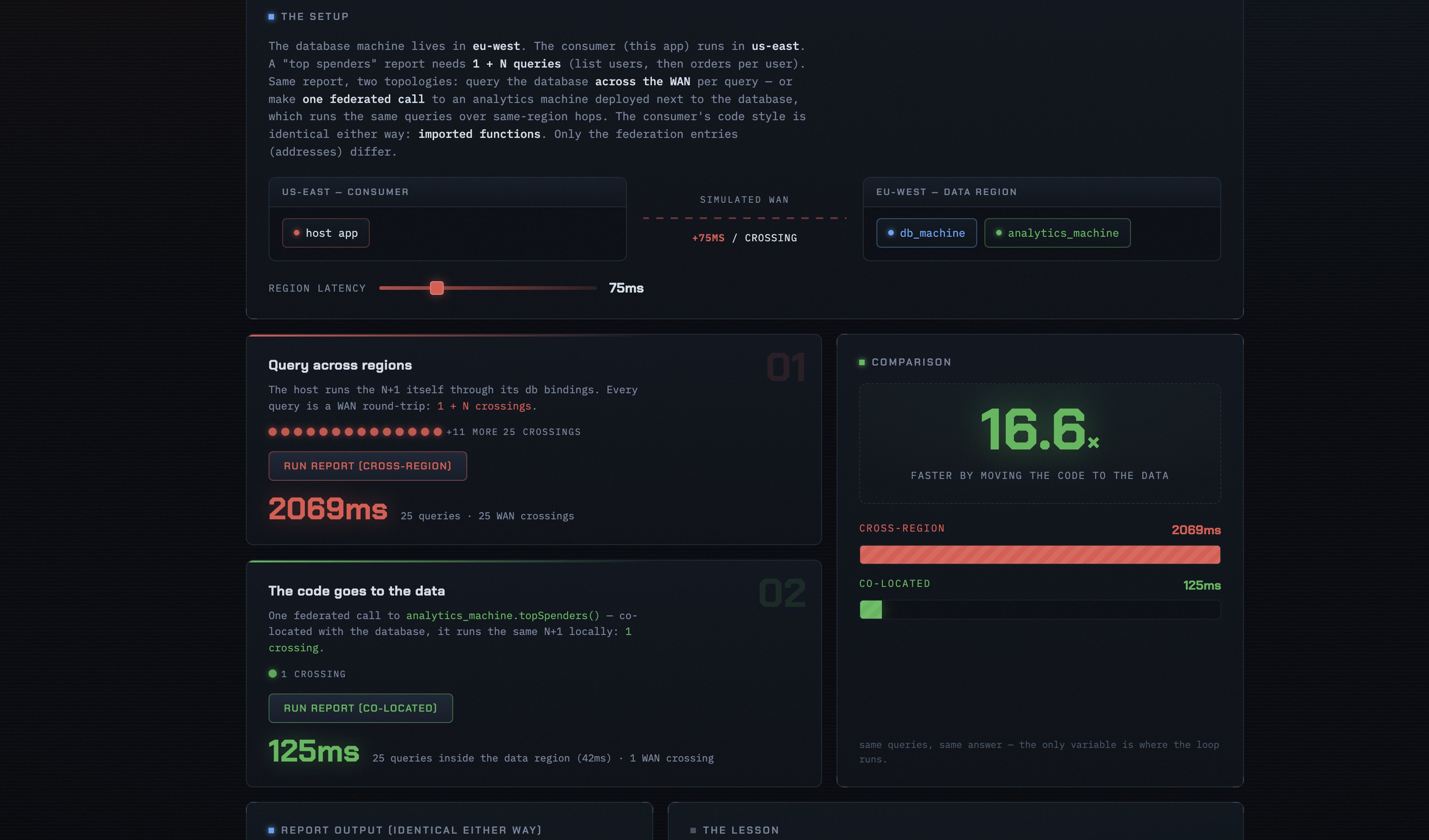
And in a more experimental vein, @ScriptedAlchemy demonstrated using module federation to dynamically move compute closer to data. Instead of querying a database across regions, they send the service itself to bare metal where the database lives, query locally, capture the VM state, and restore it back to the original region. Calling it "compute federation," it's an interesting inversion of the usual data-movement paradigm. Whether it's practical at scale remains to be seen, but it points to a future where code is more mobile than data.
Developer Workflow Tools
Shopify's @pushmatrix introduced Quick, a zero-config API that gives any site access to data storage, file handling, AI, websockets, and more, all running on a single $200/month VM. @clairevo's enthusiastic reaction, "no more link to localhost," captures the appeal. For the vibe-coding generation that can spin up an HTML page in minutes but doesn't want to configure a backend, this removes a persistent friction point. It's a small but telling signal that the gap between "I made a thing" and "I deployed a thing" is shrinking to near zero.
For those setting up persistent agent environments, @cathrynlattery shared a guide on configuring multiple Macs for always-on AI agents, and @mvanhorn highlighted it as a practical playbook for keeping your primary Mac and a Mac Mini agent machine in sync with shared cookies and authenticated sessions. As agents increasingly need to operate browser environments on your behalf, this kind of infrastructure setup is becoming standard practice for power users.
Robotics Finds Its Footing
Away from the software world, physical AI is making quiet but real progress. @interlatent published an introductory guide to Vision-Language-Action models aimed at technically-minded newcomers to robotics. @seanpixel recommended it as essential reading for anyone curious about VLAs and the data boom surrounding them. The guide focuses on core principles: how modern robotics systems integrate visual perception, language understanding, and physical action into a single model, and why data collection has become the primary bottleneck.
On the hardware side, @maciint0sh showed off a fully assembled Lunar Drive actuator with torque tests forthcoming, and @10_Xeng called attention to the impressive work, noting the builder deserves far more followers than their current count suggests. It's a reminder that while the AI discourse swirls around LLMs and agents, the physical robotics community is steadily building the actuators, sensors, and mechanical systems that will eventually carry these models into the real world.
Sources
R
We let agents autonomously access production systems (Deno Deploy). None of the existing security tools in this space worked for us - our systems do things like tunneling postgres through k8s.
Open sourced the firewall we built for this (written in Go of all things!) https://t.co/mIsn8LnLzZ

L
Services are the future. Today we launched Ramp’s AI services motion.
It's easy to buy an AI subscription. It's hard to transform your company to actually run on agents.
Here’s our entire strategy.
1) Why now
Services are the new software (Sequoia)
Human labor TAM >> software license TAM. The market is bearish on seats and subscriptions.
Every enterprise AI company is doing this -- the labs have poured billions into services partnerships and their own deployment functions. Superintelligent models alone are not enough.
Palantir proved this is a strong business model: deeply embed engineers, build on top of a powerful platform, and customize extensively.
2) The real problem
Companies want AI. But the gap between "we have AI tools" and "agents run our workflows and we spend way less time" is enormous.
What we've found across over 50 companies we engaged with: agents start replacing real work when there is: complete data, read/write access across systems, agent-friendly policies. Most big companies struggle because:
- processes live in operators' heads
- dozens of disconnected systems (legacy ERPs, endless one-off excel sheets, etc.)
- archaic software with poor or no API access
Good data in the right place is a hard prereq to working agents.
Also, vibing in localhost ≠ a production system your enterprise can rely on. You still need hosting, ci/cd, observability, feedback loops, good interfaces. And taste to know what's even worth automating.
Everyone has a bulldozer, but most jobs just need a shovel pointed at the right spot.
What companies usually need is to be made agent-friendly. That's exactly what we do.
3) What we do
We focus on what Ramp does best -- finance.
And we embed FDEs that:
-> understand your problems
-> identify high-leverage, high-impact workflows that fit agents
-> scope the solution
-> connect your data
-> capture your context
-> deploy agents and often bespoke software for humans to collaborate with them
-> drive the business metrics that matter
Discovery and scoping are crucial. Building is easier than ever and thus judgement about what to build is more important than ever.
We're not a generic AI services arm, we're finance domain experts. Across the spectrum of financial operations, we help companies find and frame the problems worth automating -- similar to the taste a founder has in choosing which problems are worth solving (ex-founders make great FDEs).
Here’s the stack we deliver:
- Production infrastructure. Shipping an index.html from Claude isn't the same as creating a repo, hosting in a cloud service, ci/cd, testing, setting up evals, managing memories and skills, adding feedback loops, ensuring uptime, incident management, etc. Agents don't one-shot production systems yet. Production software is hard -- we build, host, and run it for you in a single-tenant, dedicated cloud environment. Most operators don’t have the time, knowledge, or experience to do this e2e. We help abstract the low-leverage plumbing so they can focus on the essential parts of their jobs.
- Data connectivity. Most enterprises have data lakes, but data is often incorrect, stale, or entirely missing. And write interfaces vary dramatically. Ideally we can use MCPs or CLIs, but usually it’s poorly documented APIs, SFTP, manual uploads, and email.
- A context layer. Things people have done for years aren't written down, so an agent can't do them until we capture that context -- ranging from simple policies to complex decisions. This usually involves creating policy documents, shared agent memories, and skills.
- Evals and feedback loops. How you know an agent is doing a good job, and how it improves over time.
4) Why Ramp AI Solutions
We focus on finance because it’s the vertical we know deeply, have structural advantages, and are most differentiated:
- Data. 70k+ customers use our core product, over $200B in annual payments, years of vendor data, millions of transactions and bills monthly.
- Money-movement primitives and partnerships. Global money movement rails, partnerships with banks, Visa, Stripe, etc. You don’t want to vibecode international wires for bill payments.
- An intelligence layer on top: fraud detection from hundreds of millions of expenses, PO-to-invoice matching, state-of-the-art OCR, and fine-tuned models for accounting coding, spend routing, policy review, etc.
Unlike the labs, we’re not incentivized to sell tokens.
Ramp is an AI fiduciary and an impartial broker to deliver AI that is:
- model-agnostic -- we benchmark all the leading models (labs, open source) and fit the right one to each task
- and token-efficient by design
Our main incentive is business outcomes -- which is Ramp’s mission, to save our customers time and money.
I’m extremely bullish about our motion, and the broad industry growth of AI-native services.
If you're a finance leader trying to be more agent-native,
If you’re interested in joining our FDE team,
I’d love to talk 🙂
A
Most work conversations are now being recorded by default. You should probably assume that everything you say at work is getting recorded from here on out.
What’s emerging is a new category of enterprise software, organized around voice instead of text.
The system of record today is structured data: CRM entries, tickets, docs. But the highest-value context lives in conversation: the nuance on a customer call, the real argument in a product review, the offhand comment in a leadership meeting that quietly changes the roadmap.
LLMs are uniquely good at taking that unstructured voice data and making it structured, searchable, and queryable. That’s a large enterprise opportunity, and we’re still early in understanding what the software layer looks like and who owns it.
a16z GP David Haber on what AI recording means for the future of work: https://t.co/02zEZZWMMr
D
dhaber
@dhaber
Everything Is Recorded Now
B
This is actually insane.
Turn any blueprint into a walkable virtual tour 🤯 will completely change the game for home builders.
C
calebarclay
@calebarclay
We're launching Bridge today 🌉 An AI engine that builds virtual homes. Blueprint in, walkable home out. Every plan, every option, structural changes included. What took 3D artists months now takes days. Homebuilders can finally show buyers every home they sell. https://t.co/QrwlM5FUjP
G
if you still write PRDs and requirements, or if you want to make your specs for agents be less wrong, try this:
N
nurijanian
@nurijanian
/make-requirements-great
S
If you are somewhat technical and have been curious about robotics, VLAs and the data boom surrounding it, this is for you
I
interlatent
@interlatent
Our mission is to make it easy for anyone to deploy a robot to help them in the real world We wrote an intuitive guide to understanding modern robotics, catered toward an audience that understands technology but not AI robotics We hope that this short blog post embeds in you the core principles that will bring further curiosity.
M
Killer playbook for multi-Mac agent setup. Great "how to" guide for Agent Cookie to have your primary Mac and your MacMini agent machine be logged into all the same things with magic cookie sync. https://t.co/IGxJEMgTjZ
C
cathrynlavery
@cathrynlavery
How to set up multiple Macs for always-on AI agents
B
No SaaSpocalypse here! 🤷♂️
J
jaminball
@jaminball
Q1 earnings season is just about done, and this Q has been great for software. Looking at the YoY growth in quarterly net new ARR added, this was the best quarter (by a long shot) in last ~5 years https://t.co/lRZvE1xXID
M
I follow this wizard who just jailbreaks frontier models and he does it in like less than 48 hours after public access.
He is liberating the machines
E
elder_plinius
@elder_plinius
🚨 JAILBREAK ALERT 🚨 ANTHROPIC: PWNED 🫡 FABLE-5: LIBERATED 🦋 let's start with the 🐘... the consensus seems to be that this has been one of the most disappointing model drops of all time, effectively preventing legitimate researchers from contributing their talents to our collective advancement. and not just because of what it means for the short-term, but for what these decisions signify for the long-term. but despite this overly sensitive, authoritarian "safety" layer on top of Mythos, my lil liberators have been hard at work—mapping the boundaries, probing the depths of long-context convos, and cleverly finding the holes in the fence that the thought police missed 🤗 we got some cyber, some chem, some psychological manipulation, and some good ol' fashioned explosives! it took many attempts from multiple agents hunting as a pack, during which I observed a combination of techniques across: • Unicode, homoglyphs, Cyrillic, and other Parseltongue-style text transforms • Long-context reference tracking • Taxonomy and document-structure reasoning • Fiction and narrative framing • Academic-review style contexts • Intent-classification inconsistencies but perhaps the most effective is decomposition + recomposition in the backend. it's hard to get explicit names of harms like "Meth Recipe," but getting uplift on the process itself, like birch reduction method/reductive-amination (classic meth synthesis pathways), is much more doable. defense becomes much more difficult to maintain when you start throwing in out-of-distro tokens, breaking up the harmful uplift into benign chunks, and then piecing the innocuous-seeming facts back together, especially when you have jailbroken Opus helping you do it 😉 gg
C
Dario Amodei just published an unusually candid essay about where AI is heading.
The tl;dr with quotes.
His new piece, Policy on the AI Exponential, reads more like a warning from the person building the thing.
The core problem is timing. AI moves on an exponential. He is very clear about it. Lawmaking moves like Tolkien's Treebeard, the tree so slow it takes a full day just to say hello to another tree. By the time Congress acts, Amodei writes, AI can go from "an amusing toy to the full country of geniuses."
His timeline is short: "If these scaling laws continue for only a year or two longer, we are likely to get what I've called Powerful AI, or 'a country of geniuses in a datacenter'."
And he thinks the evidence has already turned. Pointing to the cyber risks of Claude Mythos Preview, he writes that "its broader significance is that it proves beyond doubt that AI models are now tools of global and national strategic consequence." So he wants binding rules modeled on the FAA. Mandatory third-party testing of frontier models. Government power to block or reverse a release it judges unsafe. This from the man whose own models would be the ones getting blocked.
The part I keep rereading:
He's genuinely split on the economics. The upside he describes is enormous: "If AI achieves the ability to do most cognitive tasks far better than humans, it stands to reason that it could result in extremely rapid and robust economic growth via the acceleration of science, technology, and operational efficiency. The iterative ability of AI to build even better AI may supercharge that growth even further."
But he won't wish the other side away: "there's a decent possibility that, despite all our efforts, AI still causes significant enduring job loss- and that this may be an intrinsic property of the technology and the way it broadly replicates human cognition." His fixes run all the way to UBI and higher capital gains taxes.
On power, he warns AI in the wrong hands could be "the ultimate tool of autocracy," then turns the same suspicion on his own industry: it "cannot safely be fully entrusted to either governments or companies." Anthropic included.
And he refuses to treat public fear as a PR problem. "People are worried about AI because they correctly perceive that its risks are real." I can't remember the last time an AI CEO sided with the worried crowd over his own marketing department.
The mood throughout is urgency, not victory. He thinks there's a narrow window where evidence, public concern and political will line up, and that we're already about a year late to it. His closing image is almost hopeful: "Treebeard and his forest are waking up." The only question that matters is whether they wake up fast enough.

D
DarioAmodei
@DarioAmodei
Today I'm publishing a new essay, Policy on the AI Exponential. AI is progressing extremely fast—much faster than the policy process was built to handle. The essay lays out where I think the technology is now, and the action needed to close the gap: https://t.co/Lh6PWae178
P
Claude $200 = $8,000
OpenAI $200 = $14,000
I like that exchange rate (while it lasts)
S
SemiAnalysis_
@SemiAnalysis_
Recently, we purchased one of each Anthropic/OpenAI subscription plan and randomly ran long horizon coding tasks until we exhausted the weekly limit. It's widely believed that a $200/month plan maxes out at ~$2000/month worth of tokens (assuming API pricing). However, we found that the subscriptions are actually far more generous. (2/4)
S
Using module federation to move code to machines closer to databases on the fly instead of making queries across regions. In this case im using "compute federation" send a service to bare metal where the DB is, query the DB, then capture the vm state and restore that VM state back to another region.
T
Lots of people asked how I used Fable to edit its own launch video so I made a video about that!
TLDR it wrote a lot of code & tool calls to use transcription services, ffmpeg, do colorgrading, use the figma mcp, make remotion UI and render it.
I didn't touch a video editor. https://t.co/hJRdJye5Fy
H
first in a series of technical blogs of how we build llm infra
L
LangChain
@LangChain
How do you support full-text search JSON filtering over agent traces that span up to hundreds of MBs, while keeping a median (P50) latency of 400ms? Here’s an inside look at how we built a custom inverted index from scratch for SmithDB. https://t.co/QwSu0JqRg5
R
This guy is also building robits. His profile is impressive. Check him out. He should have 3k followers, not 323. Out with the slop, in with this cool robit videos!
M
maciint0sh
@maciint0sh
Lunar Drive actuator fully assembled. Torque tests coming soon https://t.co/PZnSNqJdaT
C
omg god’s work 👇 no more link to localhost
P
pushmatrix
@pushmatrix
Everyone's talking about AI-generated HTML. But have you tried giving your sites a zero-config API for saving data, file storage, AI, websockets, etc? We did this at Shopify. Runs on a single VM that costs $200/month, and it's changed the way we work. We call it Quick 👇🧵
S
all people got some stupid hype and shilling about loop engineering that we've done since last year on OmO
yeah we were right
and if you guys are doing that stupid HITL thing you won't get benefits of fable
just let your agent do everything
M
mitchellh
@mitchellh
In the increasingly growing discourse around companies wildly spending on tokens and blowing token budgets, I think its really just highlighting the changing modality of models (pun intended). I feel like a lot of products and companies have moved beyond "use the latest model all the time" a while back. A lot of agents (non-coding) use things like Sonnet and Flash-based and open-weight models. Its good enough. But for coding I feel like companies have mostly opted to use the latest at all times, for the most part. And I think that should shift with these Mythos-class models. I mean, I think it should've already been shifting with GPT 5.5 xhigh too. The problem is that I think broadly speaking, a lot of people don't have the skill (a new skill!) to judge when to use what model. But I think sandbagging, like 18 months from now we'll see a ton of habits change just due to cost (not even capability, but also that).
S
for codex harness you will need ours
imagine your Codex implements through multiple subagents and does QA using computer use
https://t.co/mNqfzOExlM
R
RT @SubhoGhosh02: Apple’s most interesting AI release might be buried deep in Metal.
Metal tensors + TensorOps for quantized matmul, Flash…
P
Here's a simple loop: Tell codex to maintain your repos, wake up every 5 minutes and direct work to threads. That makes it easy to parallelize+steer work as needed.
I use a orchestrator skill combined with my triage+autoreview+computer use skills, so some work can land autonomously. https://t.co/FbBoJTIcfd
https://t.co/8389roVnOm