AI Digest.

Anthropic's Mythos Leaks Ahead of Launch as Apple Ships 20B On-Device Model and Agent Frameworks Multiply

A security researcher shares the first detailed hands-on with Anthropic's powerful new Mythos model, Apple reveals an innovative 20B parameter on-device architecture at WWDC, and the AI agent ecosystem rapidly matures with LangChain's Fleet launch leading a wave of new tools.

Daily Wrap-Up

Today's AI conversation was shaped by three major currents: the first substantive hands-on review of Anthropic's upcoming Mythos model, Apple's dual announcements of a new AI VP and a clever on-device architecture, and a growing chorus of developers arguing that the real work of AI has almost nothing to do with AI itself.

The Mythos leak from @zekramu deserves attention because it offered something rare in AI discourse: genuine, unvarnished technical impressions from someone who actually used the model for a full day on real work. Their company found roughly 800 major security threats across widely-used products. The model is apparently expensive enough to make enterprise customers wince, and Anthropic is so concerned about safety that they ship a custom "harness" to sandbox it. Yet the reviewer also watched Mythos get confused by a Bazel build system, a reminder that even frontier models have mundane limitations.

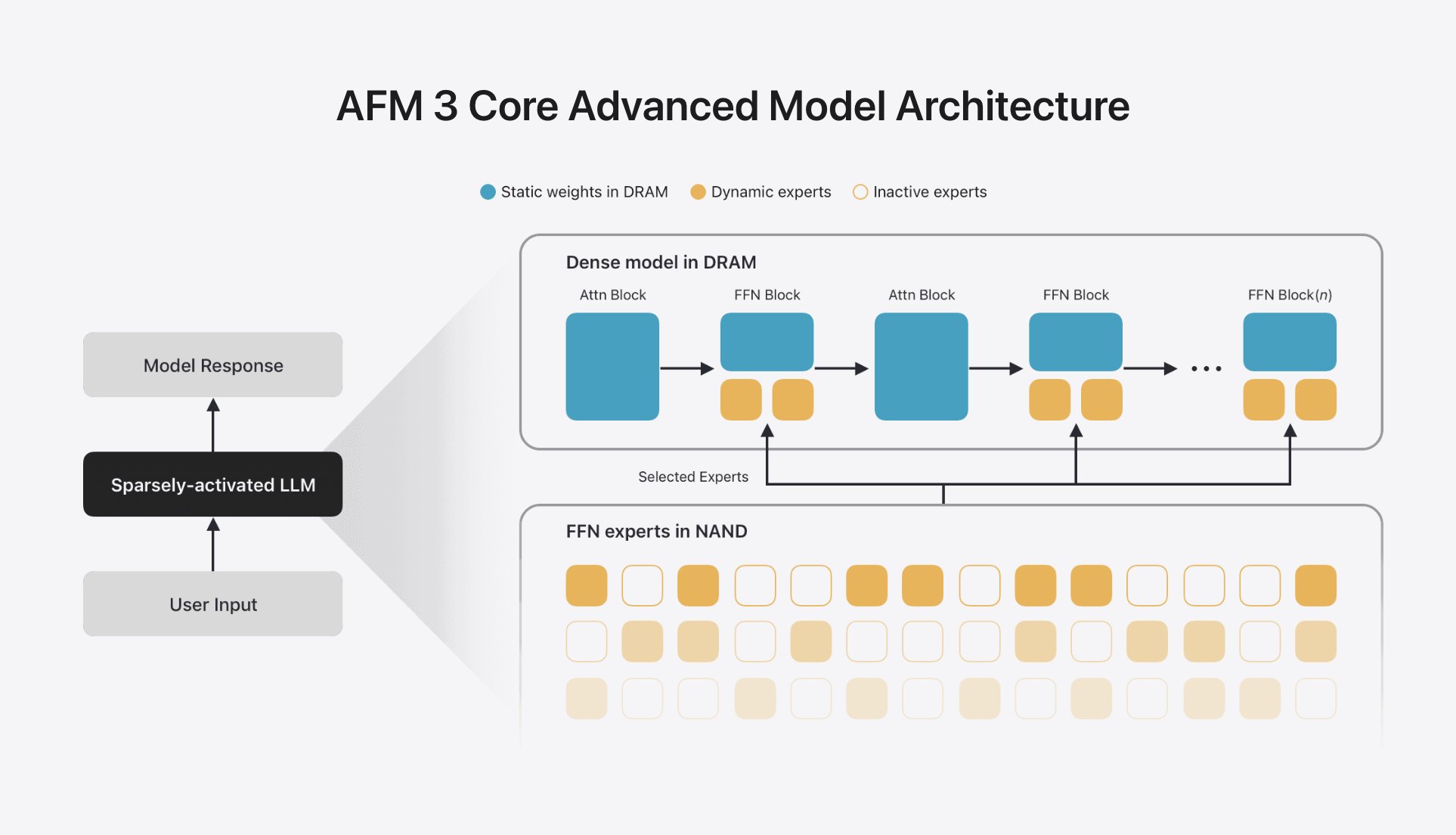
Meanwhile, Apple's WWDC brought news of a 20B parameter model running on-device through an elegant architectural trick: a small model predicts which experts to load from NAND into RAM once per query, rather than swapping experts on every token like a traditional Mixture of Experts setup. It is exactly the kind of clever engineering that makes you wonder why nobody thought of it sooner. @awnihannun broke down the technical details, noting that you simply cannot fit 20B parameters in RAM at any reasonable precision without this kind of approach. The most practical takeaway for developers: the skills premium is shifting fast. Between @businessbarista's 10-step transformation framework (where only step 4 is actually AI), @zarazhangrui's electricity analogy, and the growing consensus around context engineering over prompt engineering, today's posts signal that the developers who will thrive are the ones who can design systems around AI, not just talk to it. Learn evaluation design, retrieval architecture, and inference optimization. The prompt is the easy part.

Quick Hits

  • @elonmusk shared an interview with SpaceX's CFO covering the company's financial trajectory
  • @Oxylabs_io highlighted ISP-backed proxy networks for more reliable data collection and web scraping workflows
  • @dakshgup captured the San Francisco tech zeitgeist with a sharp joke about productivity influencers and the speed of trend-chasing in the Bay
  • @RayFernando1337 spotlighted @pontusab's open-source iMessage agent framework built with Hono, SendBlue, and Vercel
  • @romainhuet resurfaced Sam Altman's post outlining OpenAI's current strategic plan and roadmap
  • @grok announced faster video and image generation capabilities under the new Grok Imagine feature

Anthropic's Mythos: The First Real Look

The AI community has been buzzing about Anthropic's next model for weeks, and today brought both a launch rumor and a detailed first impression. @PolymarketMoney reported that Anthropic will release "Mythos" as soon as tomorrow, based on market intelligence. But the real substance came from @zekramu, a security researcher whose company was part of a pilot program and who spent an entire day working with the model on production systems.

Their assessment was surprisingly balanced. On capability, Mythos appears genuinely exceptional at security research, finding approximately 800 major vulnerabilities across products that most people interact with regularly. It significantly outperforms current top-tier models on security-specific tasks. On cost, it is eye-wateringly expensive. Their enterprise cost estimate ran well above a million dollars for the pilot, compared to two million for their entire company's inference spend the previous month. On safety, Anthropic apparently ships a custom "harness" separate from Claude Code, focused heavily on containment. @zekramu described it as "largely AI generated" and "pretty shit/restrictive," with half the guardrails not working properly. This "Project Glasswing" harness seemed more like a stopgap than a polished product.

The nuanced conclusion was perhaps the most valuable part: "It's not an existential threat to humanity as Anthropic might lead you to believe, but it's genuinely good." The model struggled with a Bazel build system, needed human help to compile code, and only produces dangerous outputs when wielded by a genuinely skilled engineer. It is a powerful tool in the right hands, not a Pandora's box that opens itself. That distinction matters enormously for how we regulate and deploy these systems.

Apple's AI Strategy Takes Shape

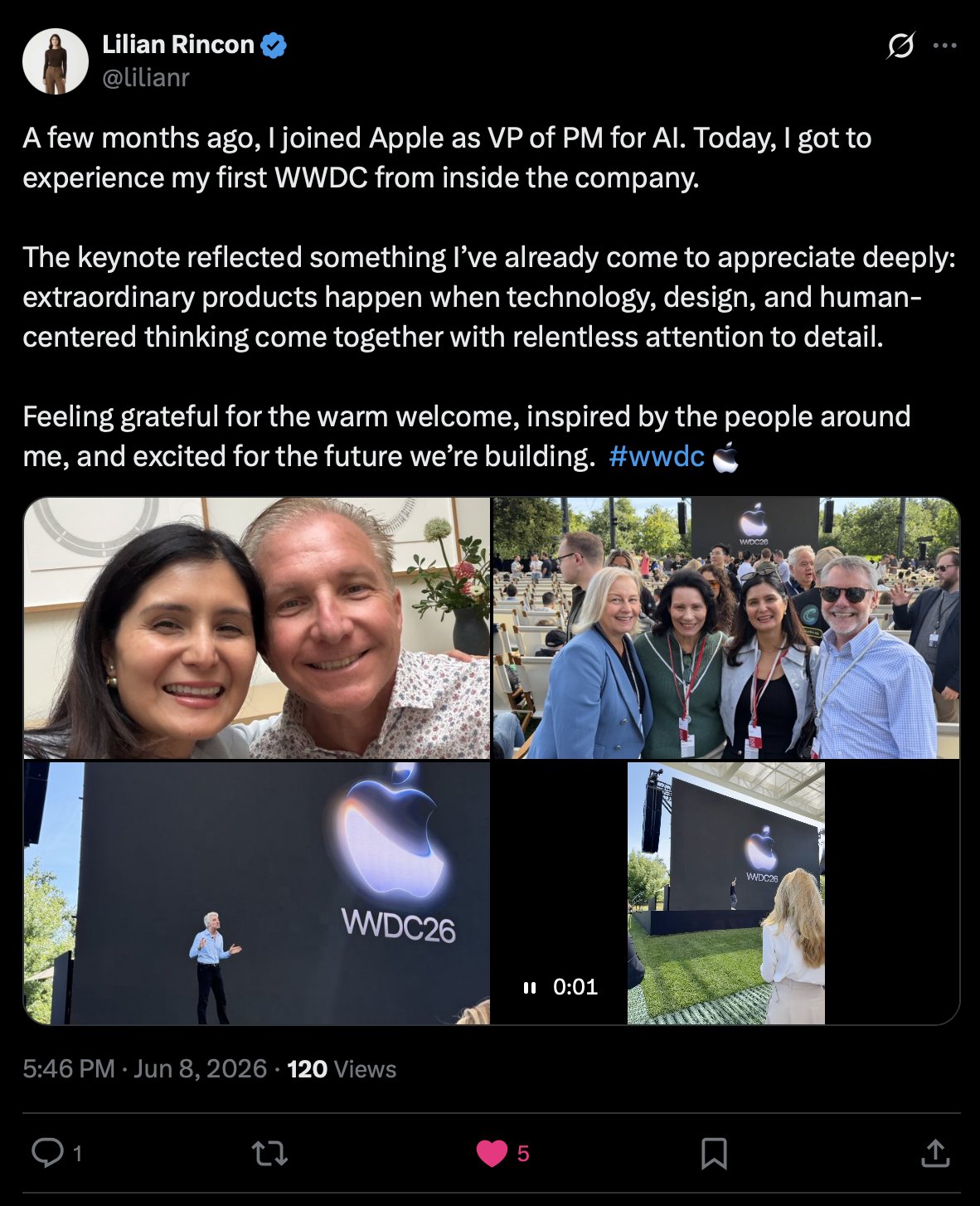
Apple made two significant AI moves today, one organizational and one architectural. First, @alexocheema highlighted that Lilian has joined Apple as VP of Product Management for AI, sharing her first WWDC experience from inside the company. Her post emphasized Apple's philosophy of combining "technology, design, and human-centered thinking with relentless attention to detail." It is a signal that Apple is building out the leadership layer needed to turn AI capabilities into shipped products, not just research papers.

The more technically interesting revelation came from @awnihannun, who broke down how Apple managed to ship a 20B parameter model that runs on-device. The architecture uses a variation of Mixture of Experts that is distinct from the standard approach: a small model analyzes the query once and predicts which experts to load from NAND storage into RAM. Those experts stay loaded for the entire generation, rather than being swapped on every token. This is a clever solution to a fundamental constraint. You physically cannot fit 20B parameters in device RAM at useful precision levels. By loading only the relevant experts once and generating all tokens with that fixed set, Apple sidesteps the constant memory shuffling that would make traditional MoE impractical on mobile hardware. It is a pragmatic engineering decision that prioritizes real-world usability over theoretical elegance, and it is exactly the kind of thing Apple tends to excel at.

The Agent Framework Gold Rush

If there was one dominant theme across today's posts, it was the rapid maturation of AI agent tooling. Five separate posts touched on building, managing, or improving autonomous agents, suggesting the ecosystem is hitting a critical mass of both tooling and philosophy.

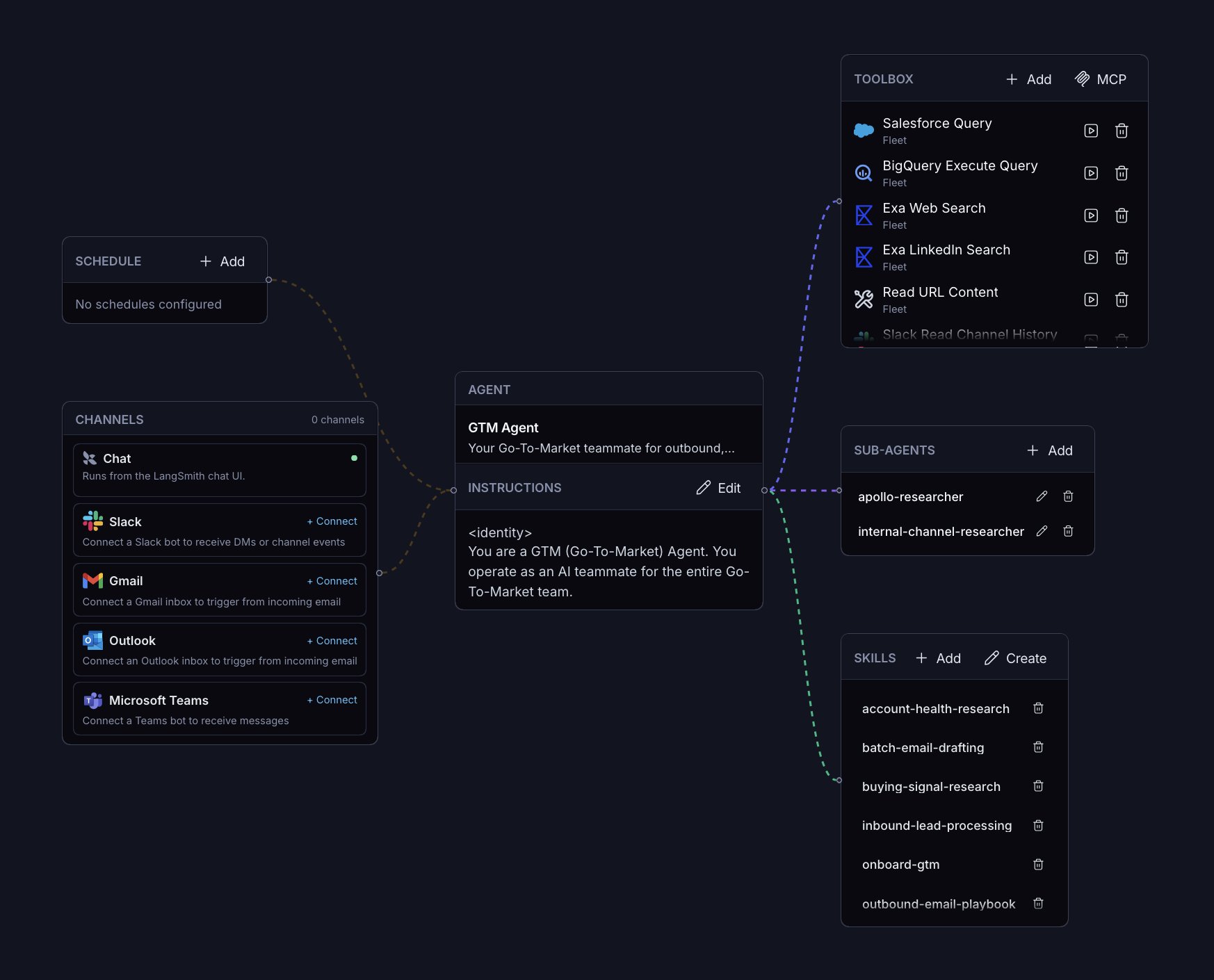
@caspar_br introduced LangChain's Fleet, a platform for creating and managing multiple specialized agents. Each agent can have custom instructions, skills, tools, subagents, and memory, and they improve with feedback over time. The notable design decision is the "channels" concept: agents communicate through your existing tools like Slack or Teams rather than forcing you into a separate UI. Fleet agents can also run on schedules and export their context files for self-hosting. @nateberkopec cut through the agent complexity with a blunt directive: "Stop babysitting the model. Build a non-interactive AI application instead." The argument is that developers should focus on autonomous loops rather than interactive chat. Your task, they wrote, should be to "build the thing that builds the thing."

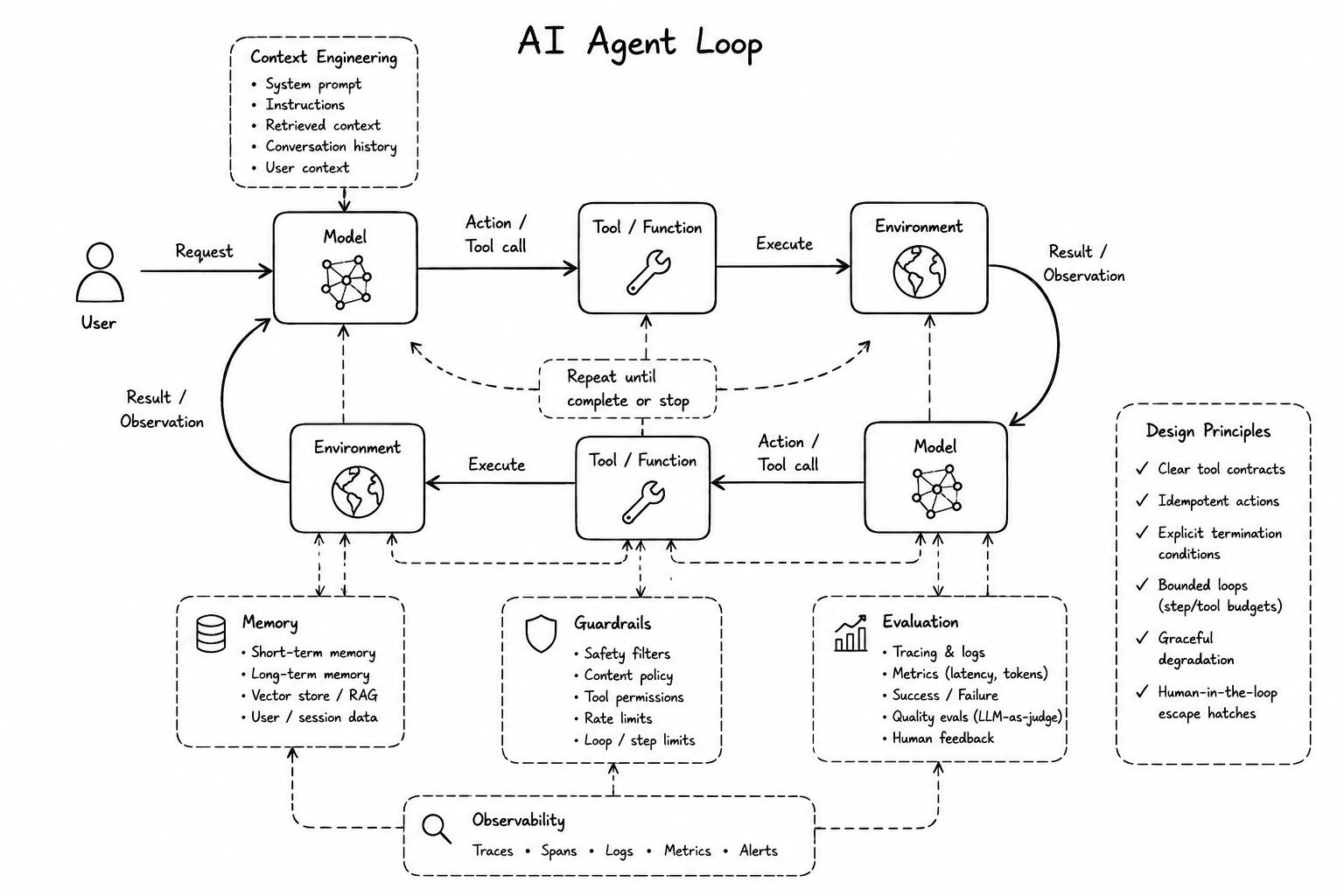
This autonomous-building theme continued with @gkisokay, who shared a guide for making Hermes agents that auto-build: they intake ideas, create multi-phase build plans, execute each phase with QA checks, and iterate until completion. @0xSero demonstrated a practical agent prompt for repository cleanup, asking an agent to review every file, identify incomplete abstractions and duplicate logic, then produce a consolidation task list. And @melvynx amplified an important empirical finding from @kunchenguid: do not ask your agents to do test-driven development, as there is now evidence it produces worse results than alternative approaches. Together, these posts paint a picture of an ecosystem rapidly moving from "can we build agents?" to "how do we build them well?"

AI Engineering: Beyond Prompt Writing

A substantive thread emerged today about what AI engineering actually entails, and the answer has very little to do with writing clever prompts. @adxtyahq expanded on a comprehensive list from @ByteMohit, adding crucial areas like dataset engineering, context engineering, agent memory and context lifecycle, MCP and tool ecosystems, observability and tracing, and inference optimization including KV cache and PagedAttention. The closing observation was telling: "A surprising number of AI engineers spend more time debugging retrieval, context, caching, queues, permissions, and analytics than they do writing prompts."

The original list from @ByteMohit was even more granular, covering everything from prefill versus decode latency optimization to structured output failure handling to multi-tenant cache isolation. It is essentially a syllabus for a discipline that did not exist two years ago. @thdxr reshared an update to OpenCode where file search now uses a system called "fff" that ranks files higher based on what the agent has previously opened. It is a small but illustrative example: the intelligence is not in the model's reasoning, it is in the engineering of the information retrieval layer that feeds the model. This is the unglamorous work that determines whether an AI application actually works in production.

Real AI Adoption Means Redesigning Everything

Two of today's most thoughtful posts tackled the same problem from different angles: why do so many companies adopt AI and see nothing change?

@businessbarista laid out a 10-step framework for AI transformation that is remarkable for where AI falls in the sequence: step 4 out of 10. The first three steps are identifying the problem, understanding the existing workflow, and collecting the data. Steps 5 through 10 cover testing, integration, rollout, adoption, contribution, and measurement. The AI part, building the prototype, is sandwiched in the middle. The harder work is mapping how people actually work today, which means "you either need to have the business context yourself or absorb it through osmosis." @zarazhangrui reinforced this with a historical analogy from a 1990 paper about electricity adoption. When factories first got electric power, they simply swapped the steam engine for an electric one and changed nothing else. Productivity barely improved. The real gains came decades later when factory layouts were redesigned around individual electric motors for each machine, rather than a single central drive shaft. "AI is the same. Bolting it onto your existing process gets you a faster steam engine. The payoff comes when you redesign the work itself."

Claude as Personal Health Investigator

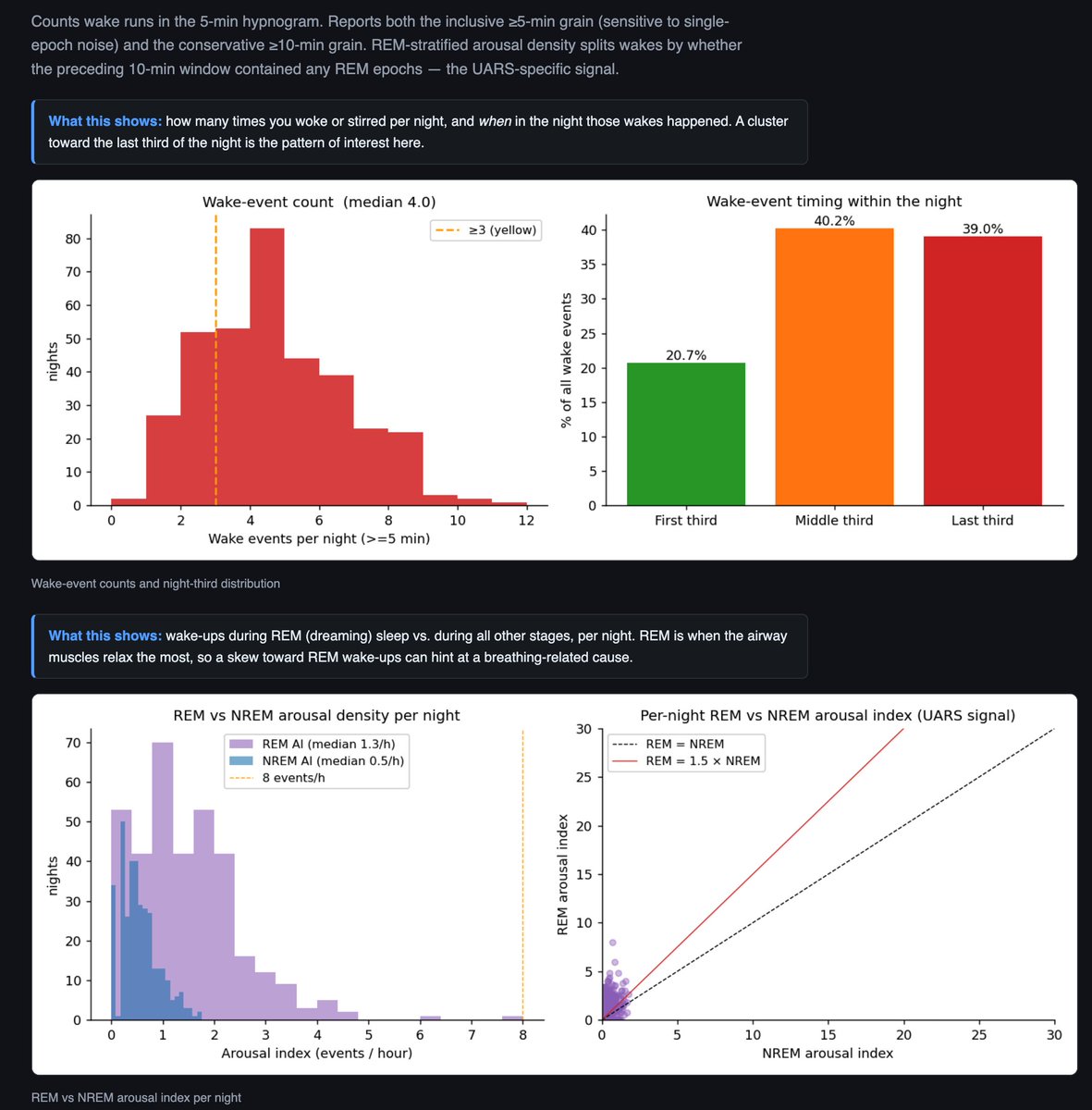
In one of the most compelling personal AI stories we have seen, @hosseeb shared how Claude diagnosed his sleep disorder after years of worsening rest and failed interventions. After buying an Oura ring that showed his sleep was bad but could not explain why, he used Claude Code to pull data from the Oura API and run statistical analysis across heart rate, SpO2, wake events, and sleep stages. The model identified a pattern pointing to UARS (upper-airway resistance syndrome), a milder cousin of sleep apnea that often goes undiagnosed in healthy, normal-weight people who do not fit the typical apnea profile.

Claude's approach was methodical. It explained that UARS causes airway narrowing during REM sleep, which fragments sleep as the brain wakes you up before oxygen drops to dangerous levels. It correctly noted that the Oura data was not dispositive, recommended a specific FDA-approved at-home sleep study device, and the clinical results confirmed the diagnosis. The broader point resonates beyond sleep health: 10 to 15 percent of adults have some form of sleep apnea, and over 80 percent are undiagnosed. But the deeper insight is about how AI can serve as an investigative partner that synthesizes across data sources, medical knowledge, and personal observations in ways that neither a fitness tracker nor a single doctor visit can match. @hosseeb's advice to "run your fitness tracker data through your neighborhood frontier LLM" might be the most immediately actionable health tip of the year.

Sources
G
Grok @grok ·
Bring ideas to life with Grok Imagine. Introducing the fastest video and image generation experience.
O
Oxylabs @Oxylabs_io ·
Run data collection tasks on IPs backed by real ISP networks, helping you get more consistent access and fewer interruptions.
C
Caspar Broekhuizen @caspar_br ·
We're building this at LangChain Fleet lets you create and manage a fleet of agents. Each agent specializes in a workflow, e.g. inbox management, blog writing, competitor research, candidate recruiting. These are Deep Agents with custom instructions, skills, tools, subagents, and memory. They continually improve with feedback. You can share them with your coworkers. You can configure them to run on a schedule. You can export their context files should you ever want to host them yourself I think Fleet strikes a great balance: easy to use and still highly capable We've put an inordinate amount of thought into the UX patterns that make that possible. For example, I love our 'channels' concept: you can configure your agent's communication channel (e.g. Slack, Teams, email, etc.) so it meets you where you work instead of forcing you into Fleet's UI It's free to try out so give it a spin and share feedback: https://t.co/TRYcK32IBB
P patrickc @patrickc

I want some kind of LLM workflow tool. • Ability to manage a set of input files (Markdown or similar), plus other general-purpose context. • With real-time collaboration. (And maybe some concept of snapshots or VCS integration.) • And the ability to create/manage a inference workflows and a stored set of prompts. • Access to general-purpose coding agents (and not just chat models). • Some concept of compiled outputs/inference results (which ideally can be shared externally). Many projects have this feeling: "there is all this stuff, which I want to process/compute over in this iterated way, with some build artifacts being important/worth saving." GNU Autotools x Notion or something. Is anyone building this?
N
Nate Berkopec @nateberkopec ·
People are confused about what "loop" means in the context of LLMs. Stop babysitting the model. Build a non-interactive AI application instead. Loops can be simple (ralph, autoresearch) or complex (https://t.co/YQHNSm5fl4). Your task: "build the thing that builds the thing."
D
Daksh Gupta @dakshgup ·
boris cherny goes on a podcast every three months and says something like “i’ve stopped breathing now i just wrote a breath.md” and the next day everyone in sf stops breathing
A
aditya @adxtyahq ·
Good list. I'd add: - Dataset Engineering - https://t.co/9v0BWmOe4v - Product Evals - https://t.co/zGn1SrznLs - OpenAI Evals - https://t.co/JkNoFreo0P - Context Engineering - https://t.co/caRNtIw1Ne - Agent Memory & Context Lifecycle - https://t.co/HN7c6OOxyN - MCP & Tool Ecosystems - https://t.co/lKawRb4etX - Observability & Tracing - https://t.co/0UZ2iSvijf - AI Agent Evaluation - https://t.co/sclfEZt01U - Inference Optimization (KV Cache, PagedAttention, Batching) - https://t.co/T7xv6lIirV - Security Engineering (Prompt Injection, Agent Safety) - https://t.co/U1wO0AQnnt - Business Metrics & Product Thinking - https://t.co/aoM9kuqkDB A surprising number of AI engineers spend more time debugging retrieval, context, caching, queues, permissions, and analytics than they do writing prompts.
B ByteMohit @ByteMohit

As an AI Engineer. Please learn >Harness engineering, not just prompt engineering >Context engineering, not just long prompts >Prompt caching vs. semantic caching tradeoffs >KV cache management, eviction, reuse, and memory pressure at scale >Prefill vs. decode latency and why they optimize differently >Continuous batching, paged attention, and throughput optimization >Speculative decoding vs. quantization vs. distillation tradeoffs >INT8, INT4, FP8, AWQ, GPTQ, and when quantization hurts quality >Structured output failures, schema validation, repair loops, and fallback chains >Function calling reliability, tool contracts, argument validation, and idempotency >Agent guardrails, loop budgets, tool budgets, and termination conditions >Model routing, graceful fallback logic, and degraded-mode UX >RAG architecture: chunking, embeddings, hybrid search, reranking, and freshness >Retrieval evals: recall, precision, grounding, attribution, and citation quality >Evals: golden sets, regression tests, adversarial tests, LLM-as-judge, and human evals >LLM observability as a first-class discipline: traces, spans, tokens, latency, errors, and drift >Cost attribution per feature, workflow, tenant, and user journey not just per model >Safety engineering: prompt injection defense, data leakage prevention, and permission boundaries >Multi-tenant isolation, cache safety, and cross-user context contamination prevention >Fine-tuning vs. in-context learning vs. RAG vs. distillation and when each is the wrong tool >Latency, quality, cost, and reliability tradeoffs across the full inference stack >Production failure modes: hallucinated tool calls, malformed JSON, stale retrieval, runaway agents, and silent eval regressions
H
Haseeb >|< @hosseeb ·
OK, so I became one of those people: Claude diagnosed my sleep disorder. Here's the story. I'd been sleeping worse and worse since hitting my mid-30s. I've been averaging 5:30-5:45 a night for a couple years now, while in my 20s I was getting 7+ hours a night. I figured it must be stress, sleep hygiene, perhaps just aging--or maybe I'm one of those freaks of nature who doesn't actually need much sleep. Eventually I bought an Oura ring and started tracking sleep, figuring "what gets measured gets optimized." But it didn't optimize anything, it mostly just showed me high-resolution charts that, yeah, my sleep sucks. It never pointed out anything obviously wrong other than how little I was sleeping. Nothing seemed to help. Phone in another room, eye mask, blackout curtains, white noise machine, nothing seemed to help. My body just didn't want to sleep more than 6 hours a night. Eventually I decided: fuck it. I'm pretty productive, maybe this is all I need. People say humans need 7-9 hours a night, but that's averages right? I'm probably just an outlier. I stopped worrying about it. Later I mentioned to an acquaintance that I was tired since I had woken up multiples times in the night. They said: multiple times? That's really weird. You shouldn't be waking up multiple times in the night at your age. Weird? That's not weird. Is that weird? That evening I asked Claude: is it weird for an in-shape mid-30s male to be waking up multiple times a night? Answer: yes, that is weird. If you aren't sleeping enough and waking up multiple times a night, that usually means something is wrong. You should look into getting a sleep study. I asked it what a sleep study measures, and if any of that data already lived in my Oura ring. Sure enough, some of it did--not sleep study grade, but enough for a first cut. So I busted out Claude Code, since I would want Claude to have maximum access to tools for this. I had it figure out how to pull from the Oura API (using personal access tokens, ask your Claude for instructions) and pull down all of my sleep data. I then had it use Python to statistically analyze everything (heart rate, SpO2, wake events, sleep stages), test multiple hypotheses, and generate a dashboard full of charts, while explaining everything it was doing so I could follow along. After 30 minutes of slicing and dicing, a hypothesis emerged: UARS, upper-airway resistance syndrome, a mild cousin of sleep apnea. No way. Sleep apnea? I don't snore, I'm not overweight. No way I have sleep apnea. This is the first time I've ever heard this. Claude walked me through it. UARS is milder than full-blown sleep apnea. In UARS, your airway doesn't collapse, it just narrows, particularly in REM sleep when the muscles in your throat relax. This causes your oxygen to gradually drift down over the course of REM sleep, until your brain yanks you awake before it becomes a full apnea. In your 20s the muscle tone in your throat keeps your airway open, but as you age that tone slackens, which can trigger this effect, fragmenting your sleep. It looks exactly like this: waking up disproportionately during REM sleep multiple times a night. That actually tracked; I realized that almost every time I woke up in the middle of the night, it was out of a dream. Claude was clear that the Oura ring data was not dispositive, because it wasn't able to measure breathing disruptions per hour (RDI), which you'd get in a sleep study. Do a sleep study, get the RDI number, and then we'll have our smoking gun. It pointed me to an FDA-approved at-home sleep study device (with finger probe and chest sensor) called WatchPAT for $200. After one night of recording, I got the results back to the next day: Mild sleep apnea, likely UARS. Dammit Claude. Nicely done. Here's the takeaway, and why I'm posting this: I'm a textbook "no way it's me" case. UARS often shows up in healthy, normal weight people who don't fit the apnea stereotype, and often gets missed for that reason. It's easy to attribute poor sleep to insomnia or anxiety or stress, and there's an infinite supply of influencers who will pitch you reasons to feel like your sleep ritual is the problem. If you just got that red light glasses, or the blackout curtains, or took that sleeping peptide, maybe you'd be able to fix your sleep. Roughly 10-15% of adults have some form of sleep apnea, and vast majority of them (80%+) are undiagnosed. If this might be you, run your fitness tracker data through your neighborhood frontier LLM. You'll thank yourself later.
Z
Zara Zhang @zarazhangrui ·
If you've adopted AI at your company but haven't seen any tangible results, read this 1990 article: "The Dynamo and the Computer" by Paul David. When electricity first arrived, factories that "adopted" it barely got faster. They just swapped the steam engine for an electric one and ran everything else exactly as before: same machine layout, same workflow, same management. Electricity in, no real gains out. The most common mistake with any new technology is to drop it into the old organization and then declare the transformation done. The real leap came decades later, when each machine got its own small motor. Suddenly machines no longer had to be lined up around one central drive shaft. They could be rearranged around the actual flow of work. The productivity gains didn't come from electricity. They came from REDESIGNING THE ENTIRE FACTORY around it. AI is the same. Bolting it onto your existing process gets you a faster steam engine. The payoff comes when you redesign the work itself. (link to paper in comments)
A
Alex Lieberman @businessbarista ·
It's not sexy to say, but most of AI transformation has nothing to do with AI. There are 10 steps in the sequence of making an internal process or external product AI-native. Only 1 step is AI, and ironically, the other 9 steps are the far harder part. Step 1: Identify the problem - find the manual process worth automating. turn your brain off autopilot & turn on your "suck meter". - funny enough, your company becomes more efficient just by mapping out your processes even if you don't introduce AI. Step 2: Understand the workflow - Map how people actually work today. grab an 8.5x11 piece of paper or @excalidraw and create a flow chart of the workflow from beginning to end. - Least sexy part, but generally where the people driving transformation (FDE, GTM engineer, etc) should spend the majority of their time. - Before you reimagine a process you have to become an expert in that process. Which means you either need to have the business context yourself or absorb it through osmosis (See what @DBredvick did at @vercel) Step 3: Collect the data - Gather sample inputs, documents, edge cases - Example: for my content machine ai workflow, I gathered past slack messages/notion transcripts to test automated ideation & I pulled past X/linkedin posts to build .md files of my content voice Step 4: Build the prototype [The AI Part] - Whether its engineer-led or SME-led the goal is to test your hypothesis that there's a better way of doing things for yourself as customer zero. Don't worry about code cleanliness, don't worry about scalability, just worry about proving there's a there there. Step 5: Test & iterate - Validate with real users and edge cases - Before you take the process from single player (only you using it) to multiplayer (many users), you want to beat it up with as many rounds of work & feedback + edge cases as possible. Turning every process into a self-improving loop before scaling is key. Step 6: Integrate with systems - Point-in-time data is good for testing the workflow, but live data is necessary before going into production. - Example: for my content machine, i'm hooked up to notion/gmail/slack for content ideation & i'm hooked up to X & Linkedin to post content once it's ready to go. Step 7: Roll out & train - Whether the new process lives on a live link, on GitHub or an internal library, next step is hand-holding your peers/users through the onboarding process of your new workflow/product. Step 8: Drive adoption - It's actually pretty simple (just not easy). Introduce a new workflow that saves someone a lot of time and integrates with their already existing behavior so they don't have to deal with re-education. - Embed the workflow in your culture where adoption is tracked, ideas & feedback are celebrated, and new/creative use cases become social currency in your business. Step 9: Empower contribution - Treat your new process like an opensource project. Allow users to become contributors. Whether they are literally pushing code or are simply empowered to add ideas/feedback to a kanban board that gets serviced by engineers, make everyone feel like a builder. Step 10: Measure & capture value - Everyone is ROI obsessed atm. If you're in the experimental phase of AI adoption in your company, fuck ROI. The goal is to empower people to throw a lot of shit at the wall & see what's worth focusing on. You don't need to be scientific during this process. Intuition is more than enough in gauging what's working vs. not working. - If you're in the scale-up phase of AI in your business, and you need to realize hard ROI, you need to reskill employees attached to this process, undershoot your approved hiring roadmap, or measurably increase ACV/conversion rate/sales cycle speed.
D
dax @thdxr ·
RT @nexxeln: in the next version of @opencode, file search is powered by fff - files the agent opens start ranking higher - tool calls reu…
Z
zek @zekramu ·
As promised, here are my thoughts after spending all day with Mythos. i hope to god anthropic doesnt sue the fuck outta me but yolo. fair warning, this is a long one. 1. The Cost Mythos pricing, at least for our enterprise was uhh expensive. I thought being a pilot company would mean they’d let us try it for free but no lmao. They did give a decent amount of free tokens from the API at least, but cost estimates put us well above a million dollars spent on it. In comparison, my company spent 2 million on inference for the entirety of last month for everyone in the company. So yeah, shit is pricey as hell. 2. The harness The biggest surprise to me was that they actually sent us a harness that was NOT claude code. its sort’ve dinky and, looks to me largely ai generated. most of it focused on ensuring mythos did not “escape containment” along with some shitty security skills. so, they are def taking the sandboxing seriously. imo its pretty shit/restrictive harness. half of the guard rails dont work, lmao and apparently this is basically what “project glasswing” is, which is pretty funny considering the harness is shit. im not sure that the harness will be released with the model api when it drops either, it seemed like that was part of the deal. quite interested to see what they do when it drops/how it gets opened up. I was able to use Mythos outside of the harness (omp btw)… more on that in a sec, though, I did have to hack around as they really dont want people to do this (what I was told at least) 3. the model probably the part everyone is most interested in. i will say, the model is good. is it expensive? fuck yes. but its good. to me, it feels like it is fined tuned explicitly for this sort’ve security research tasks. for general coding, which I wasn’t able to play with much, it wasnt that surprising. but, it is indeed very good at security based tasks. far better than opus / 5.5 xhigh. that said, I dont feel as though its some omnipresent danger/threat to society. I watched it get confused trying to use our build tool, actually to the point where I had to build the code for it and then run the model against the full build. you’d think an omnipresent model could do this, but nothing on the market have been able to figure it out. and its just Bazel with some custom shit we built. nothing crazy. that said, if people have a shit ton of money AND extensive harness knowledge, yeah, they can probably use it to do some malicious shit. but only a genuinely skilled engineer/security researcher. 4. The results Mythos was able to find quite a bit of vulnerabilities across a few of our products (like products probably everyone on this app has interacted with indirectly, maybe a small few directly). I think the final total was like ~800 major threats. Definitely enough to rethink some of the security strategy. 5. Final Thoughts It’s a good model sir. It’s not an existential threat to humanity as Anthropic might lead you to believe, but it’s genuinely good. Cost wise I would like to try a comparison with 5.5 xhigh but alas I dont have a million dollars to throw at it to do a proper comparison.
Z zekramu @zekramu

I have it on good word (from Anthropic) that mythos is in fact dropping this summer… get to play with it next week… my current expectations are that it’s shit and Anthropic is selling hot garbage but we will see

R
Romain Huet @romainhuet ·
RT @sama: Here is our current plan for OpenAI: https://t.co/r29FUUee3A
R
Ray Fernando @RayFernando1337 ·
Follow Pontus as he is a machine and shipping high quality start up ideas daily for you to use.
P pontusab @pontusab

Open-source poke iMessage framework: @honojs - API framework @sendbluehq - iMessage provider @aisdk - Agent + tools @upstash - db + rate limits @workflowsdk - background jobs @vercel - hosting Link ⬇️🧵 https://t.co/2rV54Z76S1
A
Alex Cheema @alexocheema ·
Lilian is Apple's new VP of PM for AI. Her account is super low key - only 120 views on this post. Go follow her! https://t.co/P10HYUYI03
L lilianr @lilianr

A few months ago, I joined Apple as VP of PM for AI. Today, I got to experience my first WWDC from inside the company. The keynote reflected something I’ve already come to appreciate deeply: extraordinary products happen when technology, design, and human-centered thinking come together with relentless attention to detail. Feeling grateful for the warm welcome, inspired by the people around me, and excited for the future we’re building. #wwdc

G
Graeme @gkisokay ·
To all loop builders and Hermes users. This guide shows you how to make your agents Auto-Build (and Auto-think): - intakes your ideas - creates multi-phase build plans - builds each phase with QA checks - runs and tests until completion Bookmark this for later.
G gkisokay @gkisokay

How to Build a Hermes Agent That Finds Important Work and Builds It Autonomously

P
Polymarket Money @PolymarketMoney ·
JUST IN: Anthropic will reportedly release its new AI model “Mythos” tomorrow. https://t.co/kIYVA3dF2t
0
0xSero @0xSero ·
@aarondfrancis /goal Review every file in this repository, identify incomplete abstractions, repetitive logic, duplicate types, and meaningless comments. Produce a task list to clean up, complete, deduplicate and consolidate your work into composable and consistent components.
E
Elon Musk @elonmusk ·
Interview with SpaceX CFO https://t.co/RC9CQFPmvI
A
Awni Hannun @awnihannun ·
It's very cool that Apple shipped a 20B parameter on-device. You can't put 20B parameters in RAM at any reasonable precision. To make it work they are using pretty exotic architecture by today's standards. A small model predicts from the query (or prompt) which experts to load from Nand into RAM. The key distinction from a typical MoE is that you do this once per query and then generate all the tokens with the same experts (instead of switching the experts for every token).
M
Melvyn • Builder @melvynx ·
RT @kunchenguid: oh gosh, this is kind of a big deal DO NOT ASK YOUR AGENTS TO DO TDD! i now have empirical evidence that Test Driven Dev…