Uber Burns Through Annual AI Budget in One Quarter as DeepSeek v4 Undercuts Anthropic on Price
Enterprise AI hit a cost reckoning with Uber's CEO admitting they blew through their 2026 AI budget in a single quarter, while Lindy switched 100% of traffic from Anthropic to DeepSeek v4 and actually saw performance gains. Meanwhile, Meta launched Business Agent for small businesses, Thrive Capital put $1 billion into AI-powered accounting roll-ups, and Google released Gemma 4 12B as an open-source multimodal model that runs on a single consumer GPU.
Daily Wrap-Up
The enterprise AI cost narrative reached an inflection point today, and it wasn't the kind the big model providers wanted to see. Uber CEO Dara Khosrowshahi went on record saying the company burned through its entire 2026 AI budget in one quarter, forcing a rethink on headcount and a pivot toward cheaper models for production workloads. This is a $150 billion company with world-class engineering discovering that AI adoption costs scale far faster than anyone modeled. Then Flo Crivello at Lindy dropped the news that they've switched all traffic from Anthropic to DeepSeek v4, saving millions while seeing performance improvements. When your customers can switch to a competitor and get better results for less money, the pricing power narrative starts looking wobbly.
The product launches were equally telling about where AI is actually landing. Meta introduced Business Agent to bring conversational AI to small businesses out of the box. Thrive Capital announced a $1 billion bet on buying accounting firms and rebuilding them around AI. Eric Glyman launched Stack, an AI operating system for accounting firms. Three independent signals pointing at the same conclusion: the real money in AI isn't in selling to developers who read benchmark papers. It's in replacing the back-office drudgery that keeps small businesses small.
The most practical takeaway for developers: start building for cost efficiency now, not later. Uber's approach of using expensive models for exploration and cheaper ones for production is becoming the standard pattern. If your architecture assumes a single premium provider, you're building on sand. Design your pipelines to be model-agnostic from day one, because your finance team will force you to switch anyway.
Quick Hits
- @badlogicgames is eyeing Plannotator 0.19.27 for a major refactoring project, which now supports Kiro and integrates with Glimpse for a semi-standalone coding experience
- @T_Zahil raises the question many developers are quietly asking: why use Hermes when you already have Codex and Claude in your workflow?
- @CostHawkAI piggybacks on Uber's budget overshoot to pitch their AI cost tracking tool, proving every bubble spawns a compliance startup
- @DarioCpx backs @edzitron's takedown of OpenAI's cost commentary, calling it brave given the industry's groupthink problem
- @elonmusk responds to Fei-Fei Li's world models thesis with a note about Hadamard transforms and image-space thinking, a rare semi-technical comment from the X owner
- @demian_ai publishes a deep analysis on AI's photonics bottleneck, arguing that data centers should be understood as communication systems first and compute systems second
Enterprise AI Hits the Cost Wall
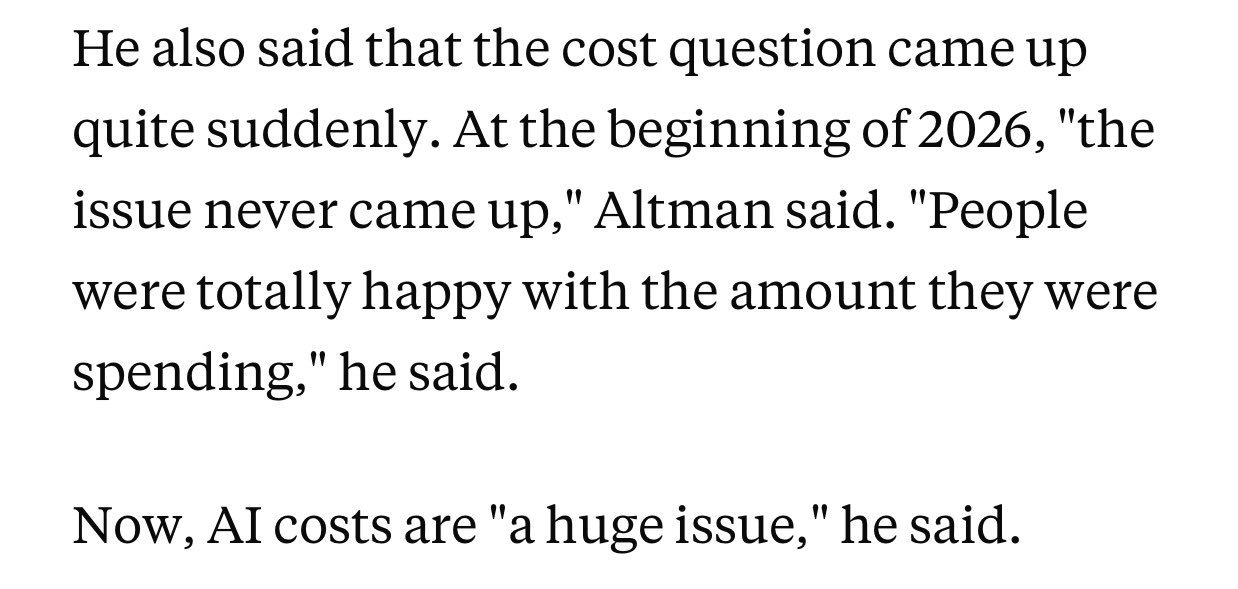
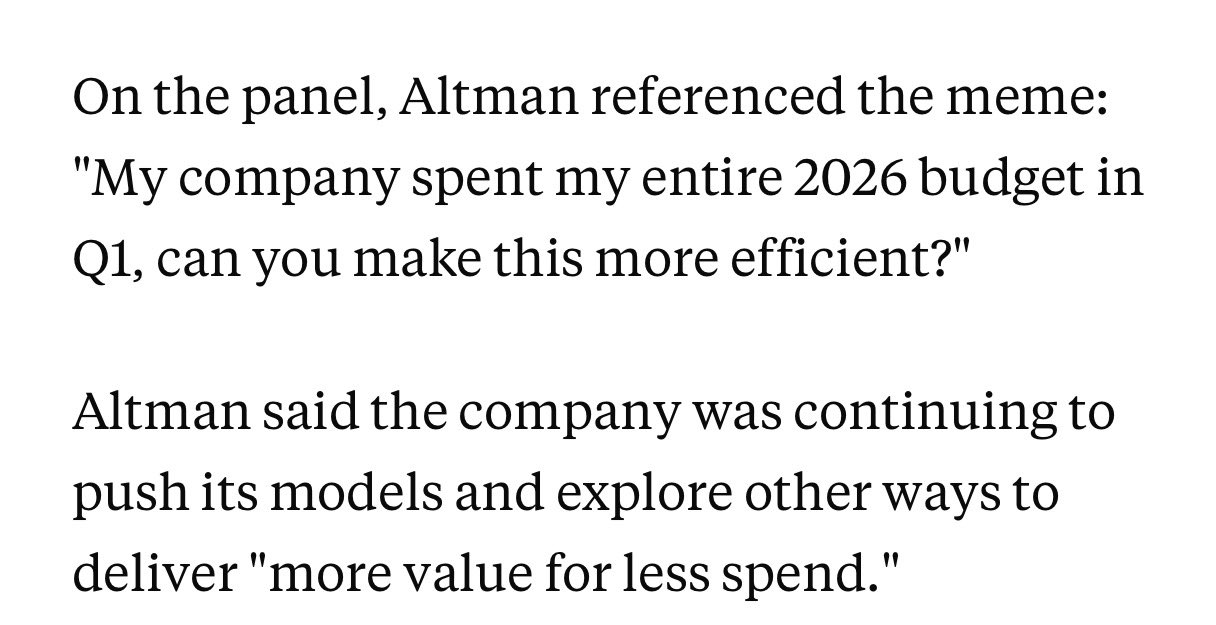
Dara Khosrowshahi's candid remarks about Uber's AI spending should be required reading for anyone building or buying AI products. "We blew through our AI budget in a quarter, for the whole year. It is forcing us to adjust," he told @patrick_oshag. The adjustment involves metering headcount increases because engineers are getting more efficient, but that efficiency carries a significant cost. Khosrowshahi also revealed a clear two-phase strategy: use expensive frontier models for exploration, then switch to cheaper or open source models once experiences scale.
Brandon Carl provided the enterprise reality check that explains why costs spiral even when the AI technically works. He laid out the "Seven Gates of Software Hell" that every enterprise AI deployment must pass through: data controls, data quality, security and controls, SLAs, vendor risk, legal and procurement, and model governance. Each gate adds months to deployment timelines. His sharpest observation was about the human tension underneath it all: "While you've been working through the 7 Gates of Hell you've had to manage a team of workers you know you're going to fire to justify the AI spend." Ed Zitron was characteristically blunt about what this means for the providers, calling OpenAI "absolutely cooked" for acknowledging customer cost concerns four years and $122 billion into the bubble.
AI Agents Get Serious About Context and Control
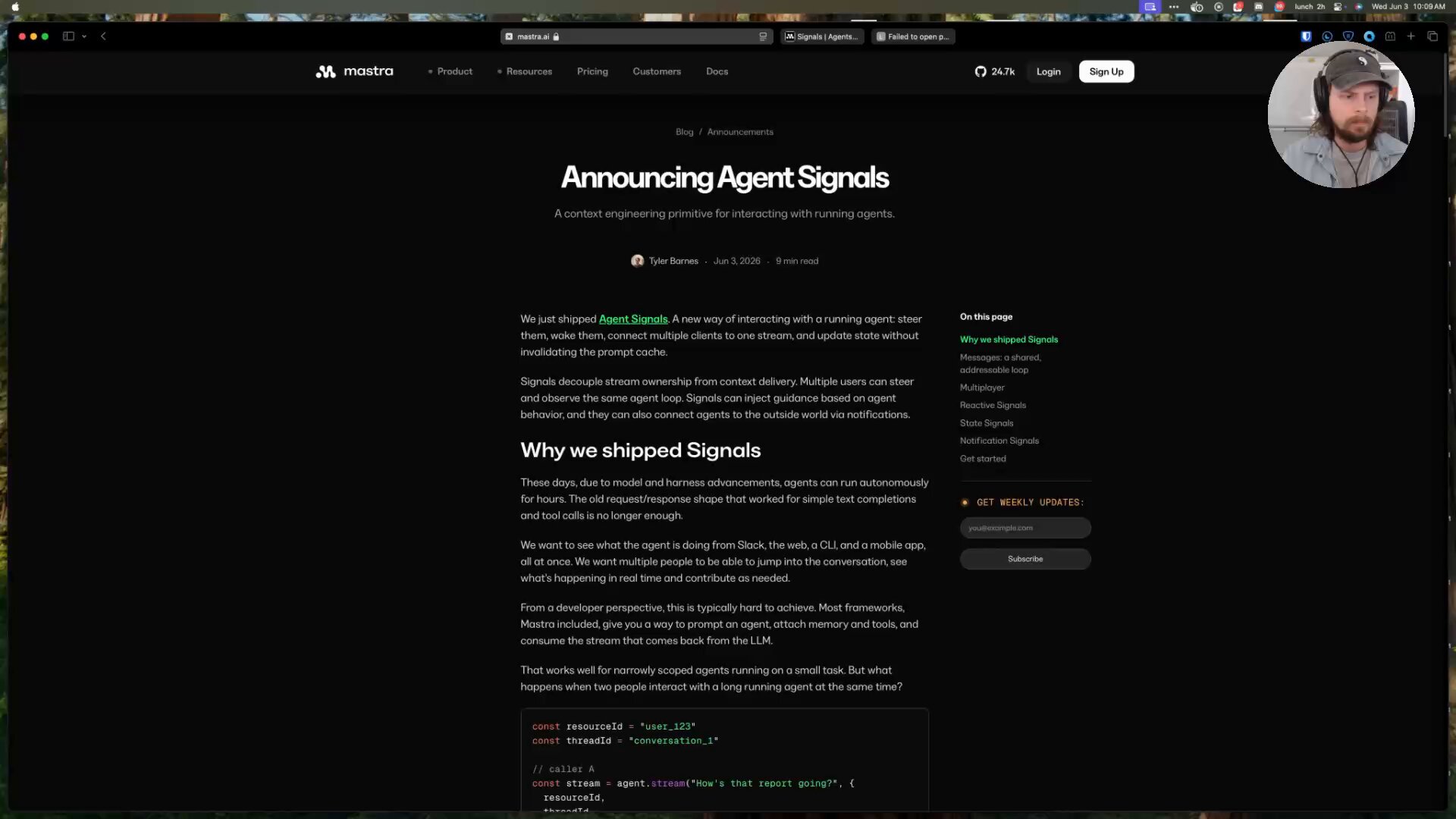
The agent ecosystem matured noticeably this week, with multiple teams shipping infrastructure that goes beyond chat-and-response patterns. @tylbar and the Mastra team released Agent Signals, a new context engineering primitive that enables multiplayer steering, dynamic cacheable system prompts, and automatic behavior guidance. Cacheable system prompts alone address one of the biggest cost and latency pain points teams face when running agents at scale.
@thorstenball observed the trend with characteristic brevity: "Agents, everywhere." He was commenting on Amp's rebuilt UI that lets users watch and drive agents across web, mobile, and CLI simultaneously. The emphasis on observability and control is telling. Building agents is no longer the hard part. Knowing what they're doing, correcting them mid-task, and managing multiple agents in parallel is where the engineering challenge has moved.
@alexhillman shared an open-source learning skill that discovers its own context from session files, with progress indicators and visual recaps in solo or co-learner modes. "It rules so hard," he wrote. @HuggingModels highlighted Mercury Agent, which keeps all memory local in SQLite, runs as a daemon, and asks permission before write operations. The community is converging on agents that are stateful, observable, and safe by default.
The Model Price War Heats Up
Flo Crivello's announcement that Lindy switched entirely to DeepSeek v4 from Anthropic models is the kind of customer testimonial that should keep premium providers up at night. "Saves us millions of $ and we're actually seeing an increase in performance on many core use cases," @Altimor wrote. This isn't a side experiment. It's 100% of production traffic for a significant AI product. If DeepSeek delivers comparable results at a fraction of the cost, the premium model market has a serious structural problem.
The open source ecosystem keeps strengthening the price pressure from below. Google released Gemma 4 12B, a unified multimodal model that processes text, image, video, and audio natively under an Apache 2.0 license with 256k context. @sudoingX noted it runs on a single 3090 at bf16, roughly 24GB, and is benchmarking it against Qwen 3.6 27B dense for the consumer GPU crown. On the Nvidia side, @fujikanaeda revealed that his acquired team contributed to Nemotron models and released tools including NeMo Data Designer, NeMo Anonymizer, and OpenShell. Every new open release narrows the gap between premium APIs and self-hosted alternatives.
AI Roll-Ups Target Professional Services
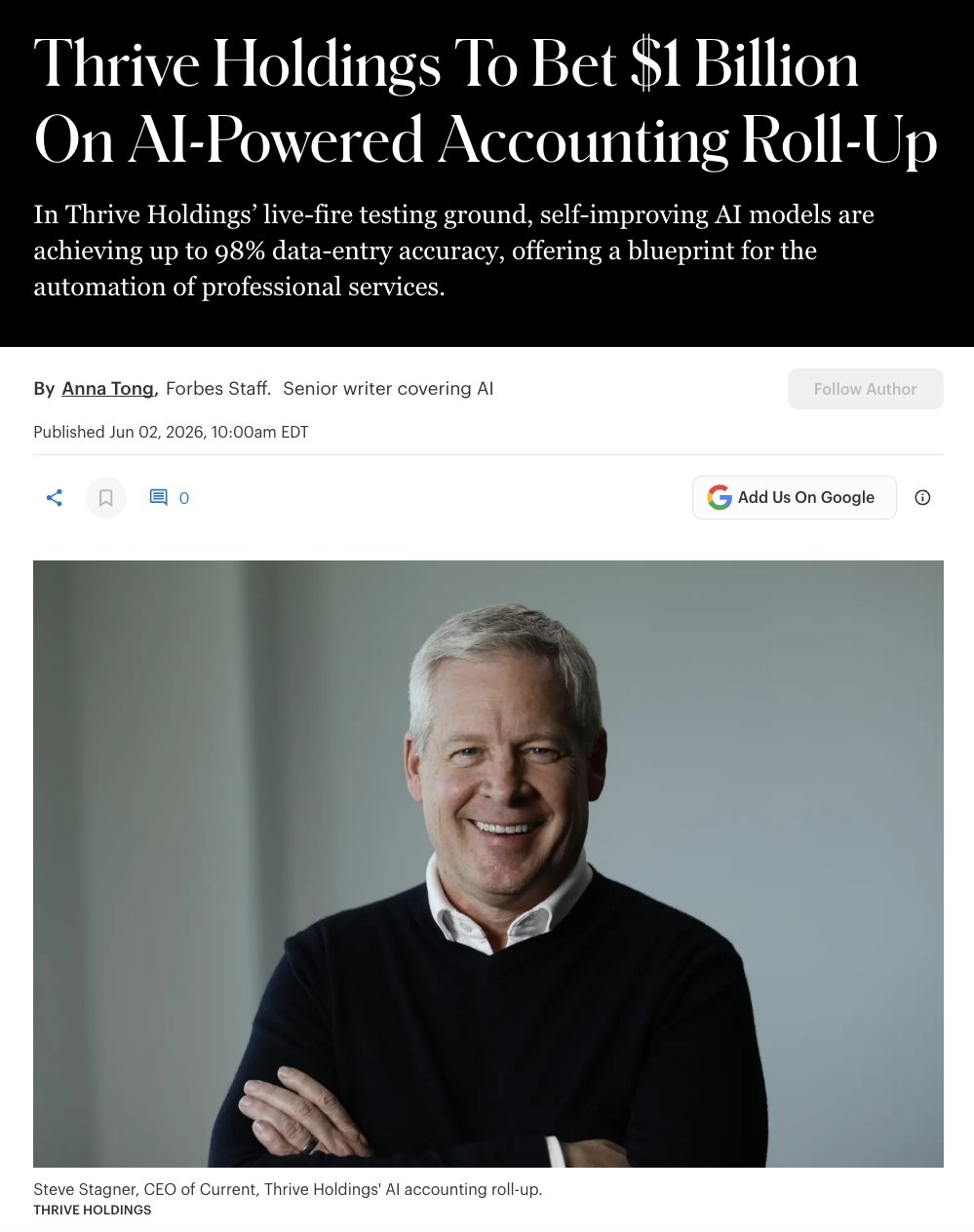
Joshua Kushner's Thrive Capital is placing a $1 billion bet that AI plus permanent capital can run professional services firms better than the people who built them. The vehicle is a company called Current, which acquires majority stakes in established CPA firms and re-engineers their back offices with AI. @NikMilanovic reported that in-house models are hitting 98% accuracy on data entry at the first test firm, Larson Gross, a regional practice Current acquired in 2025. He notes the important caveat: data entry is the high-volume floor of accounting, not the judgment work clients actually pay for. The hold strategy is modeled after Berkshire Hathaway: buy, hold, and let local partners keep meaningful equity.
Eric Glyman's Stack launch maps directly onto the same thesis. Stack is an AI operating system for accounting firms that learns a firm's process, runs the close, and posts journals, all fully auditable. @eglyman called it "the biggest shift in accounting since the spreadsheet." Between Thrive's acquisition engine and products like Stack, accounting is becoming the first real test case for whether AI can transform an entire professional services vertical end to end. If the template works, law firms, insurance agencies, and consulting shops are next in line.
The Engineering Workflow is Evolving Fast
Hiten Shah captured a shift that many developers are feeling but few have articulated this cleanly. The tools are useful, but the workflow is the part worth studying. "Ideas become plans. Plans become durable context. Agents run in parallel. Voice replaces typing. Notes become memory. Skills turn repeated work into leverage," @hnshah wrote. The key insight is about where the human role is migrating: closer to judgment. You steer, react, redirect, and decide what is good enough to keep. Peter Steinberger's MS Build talk, titled "Build the thing that builds the thing," pushes this further up the chain. When your tools can build other tools, the job becomes less about implementation and more about specification.
Claude's Internal Analytics and Anthropic's Security Research
Anthropic's data team published details on how they automated 95% of business analytics queries using Claude. @_catwu shared that the blog post covers their approach to evals, ablations, and online validation when building agents for data analysis. It's a notable signal because it's Anthropic eating its own cooking at scale. If nearly all of your analytics queries can be automated, the implications for business intelligence teams are hard to ignore. In a separate thread, @AnthropicAI shared research examining 832 malicious accounts and mapping their activity onto established security frameworks, testing how well traditional cyberdefense techniques hold up against AI-enabled attacks.
Meta Brings AI to Main Street
@fivepointscap made a bold call that Meta Business Agent is the company's ChatGPT moment. The product gives small businesses an always-on AI that handles customer questions, product recommendations, booking, and sales. What makes this different from the thousands of AI chatbot products already flooding the market is distribution and simplicity. Mark Zuckerberg framed it: "A clothing shop in Birmingham or a bakery in Sao Paulo can offer the same always-on, highly personalized experience as a major brand." A restaurant owner doesn't want to learn prompt engineering or hire a consultant. Meta Business Agents just work. If the execution matches the promise, having billions of users on WhatsApp, Instagram, and Messenger makes Meta the default AI interface for small business globally.
Sources
https://t.co/95lFnAyw0e

Introducing Meta Business Agent: AI that lets businesses show up for their customers as if they had an infinite team behind them answering questions, making product recommendations, booking appointments, closing sales, and more. https://t.co/wCFU7OWXQv
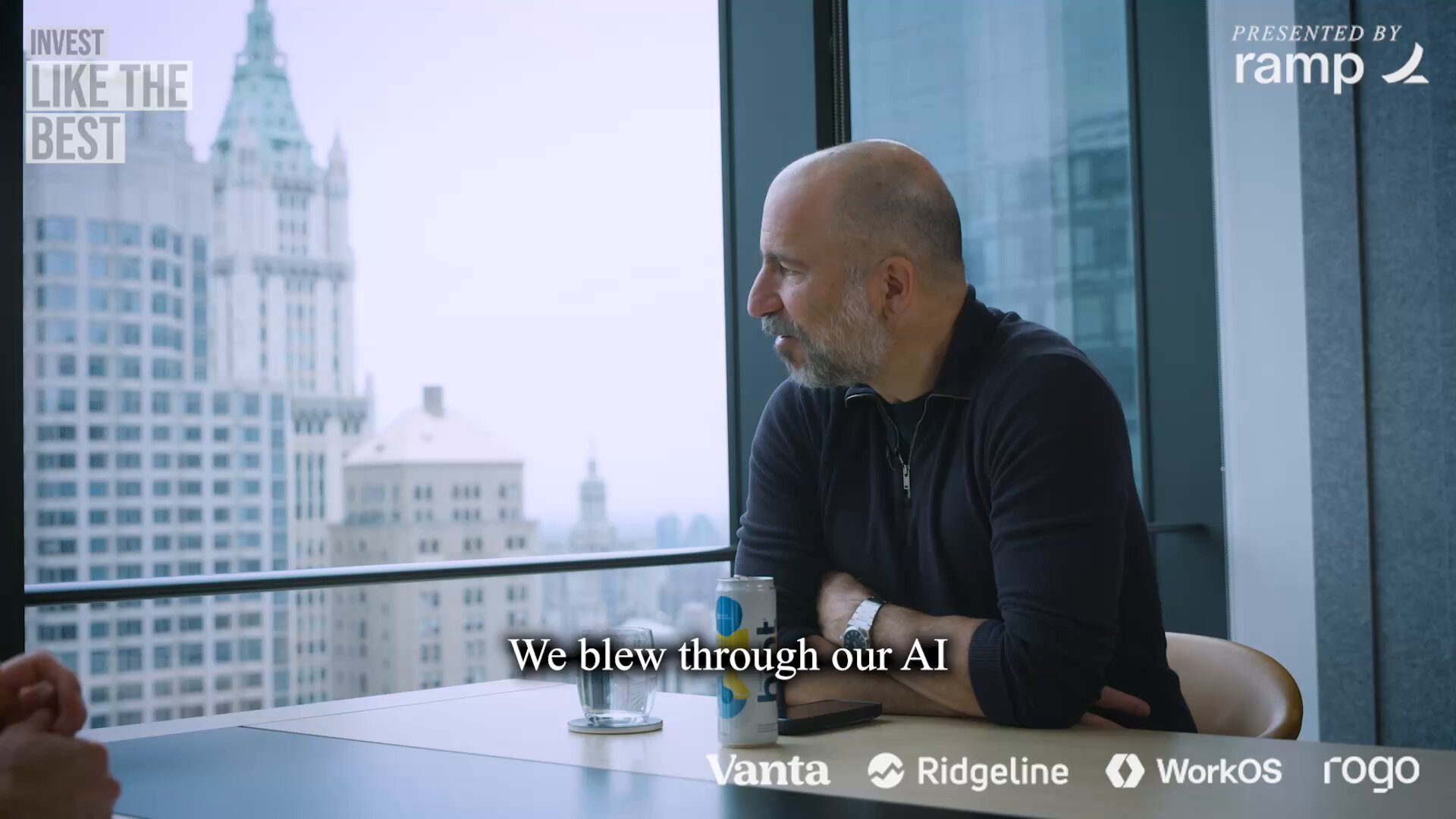
My conversation with @dkhos, CEO of Uber. Dara took over in 2017, when Uber was losing roughly $4.5B a year. Today the company generates $10B in free cash flow and is worth about $150B. We discuss: - How Daniel Ek convinced him to take the job - How Uber spent a full year of its AI budget in a single quarter - Uber's approach to autonomous vehicles - Drones, hotels, and building a superapp - Lessons from Allen & Co, Barry Diller, and Reed Hastings Enjoy! Timestamps 0:00 Intro 3:44 Bringing Order to Uber’s Chaos 7:22 Managing Stress and Going All In 14:28 Why Uber Is at the Center of AI and Physical 22:39 How to Win in Autonomous Vehicles 32:25 The Trillion-Dollar AV Opportunity 37:05 Drones, Robotaxis, and Global Adoption 38:20 Uber Eats, Uber One, and Aggregating Supply 47:00 The Future of the Uber App 55:55 Lessons from Barry Diller
Meet Gemma 4 12B! A unified, encoder-free multimodal model designed to bring high-performance intelligence directly to your laptop, and released under an Apache 2.0 license. Bridging the gap between edge efficiency and advanced reasoning. Here is what’s new with Gemma 4 12B: 👇 https://t.co/gf4FZv0WZb

Running an AI agent that forgets everything between sessions and phones home to the cloud? Mercury Agent keeps all memory local in SQLite, runs 24/7 as a daemon, and asks permission before any write or shell command. 2,500+ GitHub stars and counting. Full specs next. #DevTools https://t.co/6MnNXqGJUz
Plannotator 0.19.27 is out Plannotator will use @DanielGri's Glimpse instead of a browser if you have that installed. This creates a semi standalone experience. (See glimpse in the video along with annotating all agent messages) @kirodotdev is now supported Plan/Annotate: - You can now annotate multiple messages. - Mermaid rendering optimizations - Pi approval flow optimizations (plan mode) App wide: - A bit more of an obvious update notification that doesn't stick around.
What happened to all the synthetic data startups?
been asking others at Anthropic how they stay in the loop with Claude and fully understand the work being done this is one of my favorites from Suzanne: https://t.co/nqIMcGXiKI
We rebuilt Amp's UI so you can watch and drive all your Amp agents on web, mobile, and CLI. https://t.co/nlNhe1hAA3 https://t.co/R2MwXsgDcb
How do we automate business analytics with Claude? New blog post covering our best practices for skills, data foundations, and evaluations when building agents to perform data analysis: https://t.co/mfEJMAQFBU
World Labs CEO Dr. Fei-Fei Li: "The world is not made of words." "Language models have given machines an extraordinary command of concepts, vocabulary, and reasoning, but the physical world, virtual or real, runs on a different substrate." "Where language models learn the statistical structure of text, world models learn the statistical structure of space and time: how light falls on a surface, how a garden looks from an angle no camera has captured, how objects respond to force and follow the laws of physics." "Language gave machines a way to talk about that world. World models are how machines will finally come to understand, imagine, reason and interact with it." Full piece: https://t.co/C9qOJg5wuc