Meta's REFRAG Delivers 30x RAG Speedup as Claude Code Quality Debate Heats Up
Meta's REFRAG paper promises to reshape RAG economics with 30x faster decoding at zero accuracy loss. Meanwhile, the Claude Code community splits between enthusiastic adopters and enterprise teams reporting serious quality regressions, and Mark Cuban's take on AI's real wealth transfer sparks conversation about who actually captures value in the AI era.
Daily Wrap-Up
Today's feed split neatly into two camps: the builders pushing forward and the practitioners pumping the brakes. Meta dropped REFRAG, a context compression technique that slashes RAG latency by 30x without sacrificing accuracy, which is the kind of infrastructure-level improvement that quietly changes what's economically viable for retrieval-heavy applications. On the other side, enterprise users are loudly voicing frustration with Claude's recent model quality, with security professionals warning teams to migrate away entirely. Somewhere in between, Cloudflare revealed that it's running its entire internal AI stack on its own products, processing 241 billion tokens through AI Gateway, which is the kind of dogfooding story that actually builds confidence.
The philosophical thread of the day came from Mark Cuban's observation about AI's real opportunity: not building the models, but wiring them into the 33 million American businesses that have no AI budget and no AI expertise. It's a compelling frame, and one that resonates with the growing "AI integrator" archetype we're seeing emerge. The most entertaining moment was Opus 4.7 apparently beating Stockfish at chess by parsing board state from the DOM, which is either a testament to frontier model capabilities or the most over-engineered chess engine in history.
The most practical takeaway for developers: if you're building RAG pipelines, study Meta's REFRAG approach to context compression. The core insight that most retrieved passages have sparse attention patterns and don't interact with each other is immediately useful for anyone trying to reduce latency in retrieval-augmented systems, even before adopting the full framework.
Quick Hits
- fal teases a new model release with @BlendiByl hyping it as "insane." No details yet, just the standard pre-launch drumroll. (link)
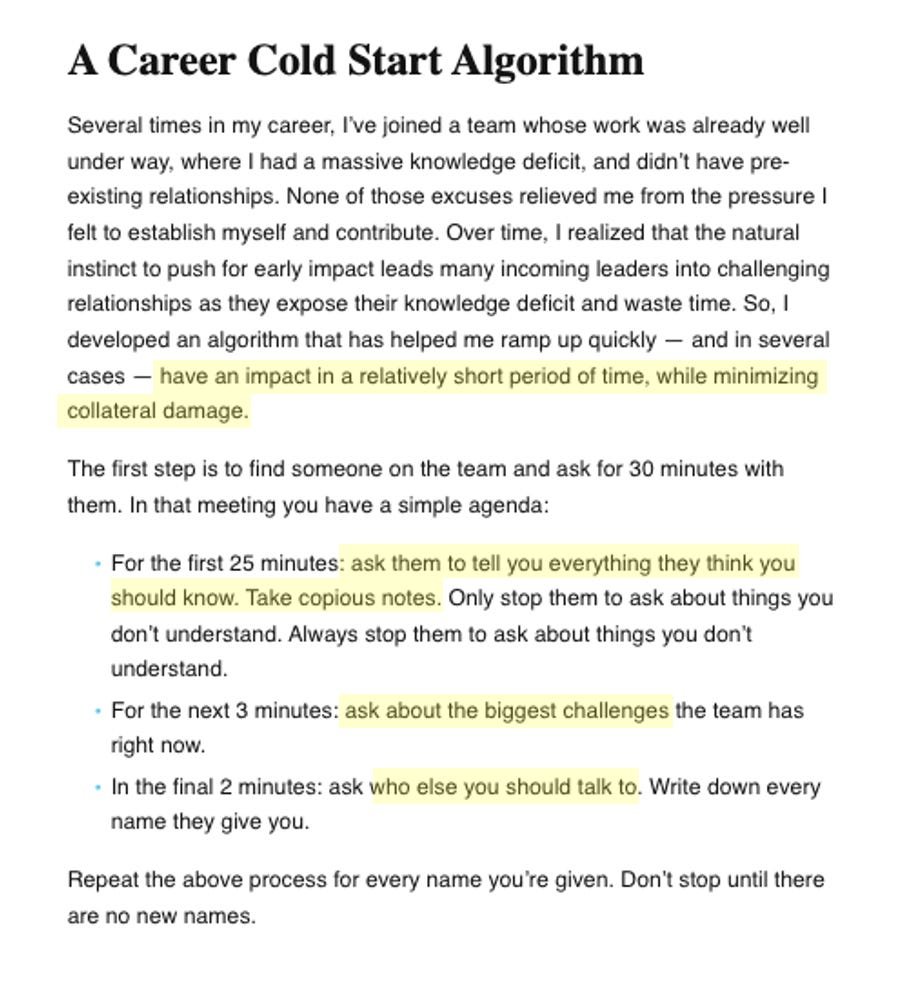
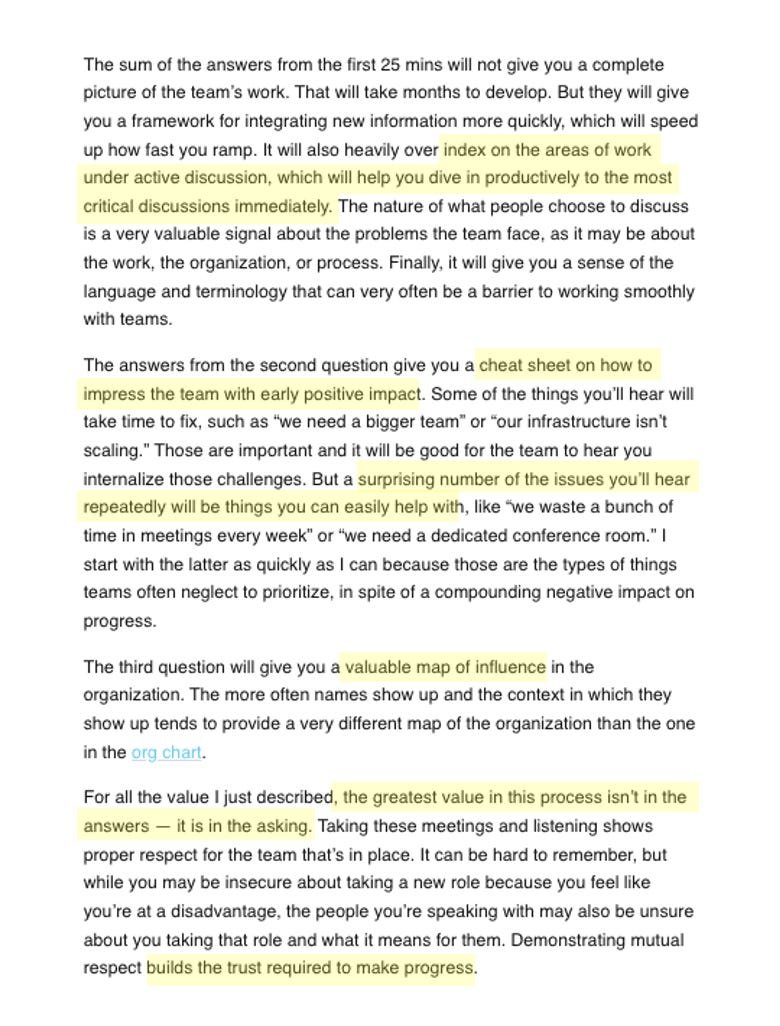
- @IvanLandabaso shares Meta CTO's guide to starting a new job, calling it one of the most useful frameworks he learned during his time there. Career advice from the infrastructure layer. (link)
- PCMag covers Nokia's AI-driven network topology from the MWC stage, exploring how AI workloads are fundamentally reshaping telecom infrastructure. (link)
- @SilenceCaPrompt highlights a Japanese developer's Claude Code workflow using "Find Skills" to match tasks with the right skill packs, powering an automated YouTube system. (link)
- @huntlovell shares what he calls the best writeup on production-grade agents, covering the failure modes teams have discovered over years of running agents in production. Also notes: "it's been really funny to say our agents run on LSD." (link)
Meta's REFRAG: Compression That Actually Works
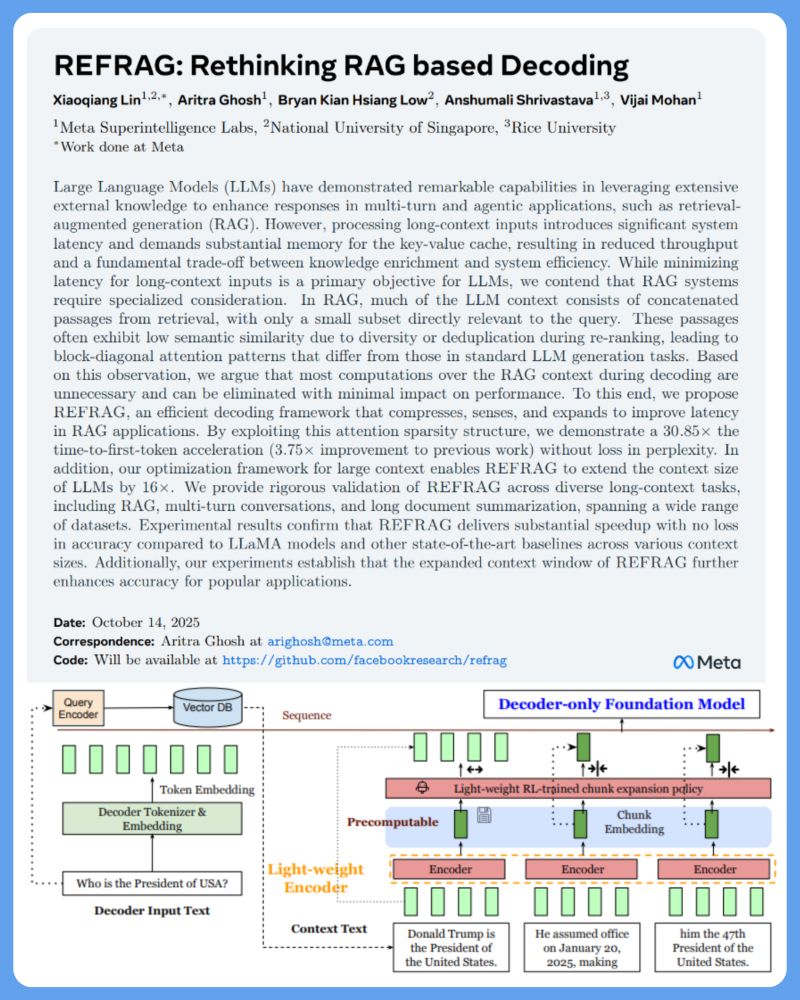
The single most technically significant post of the day came from @techNmak breaking down Meta's REFRAG paper, which tackles what might be RAG's most underappreciated problem: you retrieve 80 passages, but only 5-10 matter. The rest just burn compute. REFRAG's solution is elegant in concept. Instead of processing thousands of tokens from retrieved context, compress each chunk into a single embedding and let an RL-trained policy decide what gets compressed.
The numbers are hard to ignore: "30.85× faster time-to-first-token. Zero perplexity loss. 16× context extension from 4K to 64K tokens." What makes this more than a benchmark curiosity is the architectural flexibility. Unlike previous compression methods that only work at specific positions in the context window, REFRAG compresses at any position, and the embeddings are precomputable and cacheable from the retrieval step.
The real-world implication is about economics as much as speed. If you can serve 8 passages at single-passage latency while maintaining accuracy even with weaker retrievers, you've fundamentally changed the cost curve for production RAG systems. Companies that were bottlenecked on latency or compute costs for long-context retrieval now have a credible path forward. This is the kind of research that takes 6-12 months to show up in frameworks and managed services, but it's worth understanding now if retrieval is core to your stack.
Claude Code: The Quality Regression Debate
The Claude ecosystem is having a rough week, and today's posts captured both sides of the argument. @HackingDave didn't mince words, warning enterprise teams to be "extremely careful" with Claude's current output: "It's introducing massive bugs, security issues, and code quality is way worse than Opus 4.5, substantially worse on both 4.6 and 4.7." His team is actively migrating off Claude entirely, and his recommendation to adopt tools with flexible model selection like Cursor or AWS Bedrock reflects a growing enterprise sentiment that vendor lock-in to any single model provider is increasingly risky.
On the other side, Anthropic's @bcherny responded to quality reports with specific debugging guidance, pointing to harness changes that may have caused issues: "There were a number of harness changes that may have caused this, all of which are fixed in the latest." His recommendation to use "Opus 4.7 plus xhigh/max effort" and stay on the latest version (2.1.116) suggests the team views this as partially a configuration and tooling issue rather than a pure model regression.
What's notable is the gap between these two framings. Enterprise security professionals are seeing production-impacting bugs, while the team points to harness updates and version pinning. The truth likely sits somewhere in between. Model behavior can shift meaningfully across versions, and when your CI pipeline or security review process depends on consistent output quality, even small regressions compound fast. The broader lesson: any team building critical workflows on LLM output needs regression testing infrastructure that catches quality shifts before they hit production. Meanwhile, Browser Use retweeted @shawn_pana's claim that Opus 4.7 beat Stockfish at chess through Claude Code, which is a fun counterpoint suggesting that raw capability isn't the issue. It's consistency and reliability in enterprise contexts that's being questioned.
The AI Integrator Economy
Mark Cuban's thesis about AI wealth distribution generated the most prose-heavy post of the day, courtesy of @r0ck3t23, and the core argument deserves attention beyond the motivational framing. Cuban's observation is structural: "There are 33 million companies in this country. Aren't going to have AI budgets. Aren't going to have AI experts." The implication is that the real economic opportunity isn't in building frontier models but in connecting them to the vast majority of businesses that can't distinguish Claude from Gemini.
The electricity analogy is apt: "The biggest winners of the electricity era were not the engineers who built the generators. They were the ones who walked into dark factories and showed the owners where to plug in." This maps cleanly to what we're already seeing in the market. The consulting and integration layer around AI is growing faster than the model layer itself, and the margins are arguably better because you're selling outcomes, not compute.
For individual developers, this reframes the career calculus. Deep ML expertise matters, but domain expertise combined with working knowledge of available models and tooling might be the higher-leverage bet. The shoe store doesn't need someone who can fine-tune a transformer. It needs someone who understands inventory management AND knows how to wire an agent into their existing systems.
Local Models and the Practical Stack
@0xSero posted a concise rundown of actually useful local models for consumer hardware, targeting the sub-$1000 setup with 24GB VRAM. The recommendations split neatly by use case: "Qwen3.6-35B and Gemma-26B for speed, Qwen3.5-27B and Gemma-31B for quality," with specialty picks like Zeta-2 for tab-completion style coding and Parakeet for speech-to-text.
What makes this useful isn't the specific model names, which will shift in weeks, but the emerging pattern of a practical local inference stack. A year ago, running anything meaningful locally required serious hardware and deep technical knowledge. Now there's a clear playbook: pick your GPU, match the quantized model to your use case, and you're running inference locally at zero marginal cost. The inclusion of Hermes-4.3-36B for "no refusals" hints at the ongoing tension between safety-tuned cloud models and the unconstrained local alternatives that some developers prefer for certain workloads.
Agent Infrastructure and Optimization
Two posts pointed at the maturing agent tooling ecosystem. @intertwineai highlighted his dspy-agent-skills pack, which simplifies building DSPy RLM and GEPA pipelines for Claude Code and Cursor. The claim of ">25% RAG lift on a free 1.6B model" is notable because it suggests meaningful optimization gains are achievable even on small models when the pipeline architecture is right.
Meanwhile, Cloudflare's internal numbers via @elithrar paint a picture of what production-scale AI engineering looks like today: "20 million requests routed through AI Gateway, 241 billion tokens processed." What's particularly interesting is their model mixing strategy, running "Kimi K2.5 plus GLM 5.1 on Workers AI and Opus plus GPT 5.4 based on MR size and complexity" for automated code review. This multi-model routing approach, matching model capability to task complexity, is likely where most enterprise AI architectures are heading. It's not about picking the best model; it's about picking the right model for each request.
Sources
P
How AI is driving a whole new network topology and Nokia is adapting, from the stage at MWC https://t.co/g5u6SJWFBv
M
the team did an incredible job with this: we run automated review on every GitLab MR (with human oversight & override).
we mix Kimi K2.5 + GLM 5.1 on Workers AI and Opus + GPT 5.4 based on MR size & complexity.
C
Cloudflare
@Cloudflare
We built our internal AI engineering stack on the same products we ship. That means 20 million requests routed through AI Gateway, 241 billion tokens processed, and inference running on Workers AI, serving more than 3,683 internal users. https://t.co/MyodrT9Pwg
D
Mark Cuban just described the largest wealth transfer of the AI era.
Almost nobody understood what he said.
Cuban: “There are 33 million companies in this country. Aren’t going to have AI budgets. Aren’t going to have AI experts.”
Not tech startups.
The shoe store. The regional trucking outfit. The accounting firm with 12 employees.
The businesses that actually run the physical economy.
They know AI is coming. They have no idea what to do with it.
Cuban: “You’ve got the head of Microsoft saying software is dead because everything’s going to be customized to your unique utilization.”
Software is dead.
The SaaS era ran on one rule. Build a generic product. Force millions of companies to bend their workflows around it. Charge rent forever.
AI ends the contract.
The business stops bending to the software. The intelligence bends to the business.
But customized by whom.
The third-generation manufacturer cannot tell Claude from Gemini. The county hospital is staring at a reactor asking where the light switch is.
Cuban: “Who’s going to do it for them?”
That question is worth more than the frontier models themselves.
Hundreds of billions are being burned to build the foundation. The smartest engineers alive are locked in a bloodbath over who owns the base layer.
Let them fight.
Let them burn the capital. Let them drive the cost of raw intelligence toward zero.
Because the wealth does not collect where the brain is built.
It collects where the brain meets the business.
Every ambitious kid in college right now thinks survival means a seat at OpenAI or Anthropic.
Cuban is staring at the other 99 percent of the economy.
Learn the models. Then learn the messy, unglamorous reality of how a 50-person company actually operates.
Walk through the door. Understand their problems. Wire the intelligence directly into their revenue.
That is not a job title. That is an entire economic class being born.
You do not need to build the brain. You need to build the nervous system.
The biggest winners of the electricity era were not the engineers who built the generators. They were the ones who walked into dark factories and showed the owners where to plug in.
33 million companies are standing in the dark right now.
Silicon Valley is racing to build the god. The fortunes will belong to whoever teaches him a trade.

D
For the enterprises using Claude, if you are using it for heavy enterprise type stuff - be extremely careful. It's introducing massive bugs, security issues, and code quality is way worse than Opus 4.5, substantially worse on both 4.6 and 4.7.
Our entire development team is shifting off of it. It's unusable at the moment aside from beautiful UI stuff, it's code quality is not something you can trust.
Still no word from Claude on why they mangled their models and didn't tell anyone - which is particularly alarming on every front.
I would recommend switching teams over to something like Cursor, Perplexity, or AWS Bedrock - as the frontier models continue to innovate (or regress) - having the ability for flexible model selection that doesn't disrupt development workflow will be insanely important for enterprise.
S
Ce japonais a trouvé le vrai levier de Claude Code avant tout le monde.
Il installe "Find Skills", décrit ce qu'il veut faire et le système lui propose les skills parfaits parmi des centaines.
Son système YouTube automatisé cartonne grâce à ça.
https://t.co/ksE769k2td
H
this is probably the best writeup we have on what makes agents production grade - there’s a lot of failure modes for agents we’ve learned over the years, most of which are articulated here
Also it’s been really funny to say our agents run on LSD lol
S
sydneyrunkle
@sydneyrunkle
The runtime behind production deep agents
B
Insane model, just wait on it 👀 https://t.co/0YUSattZ1w
F
fal
@fal
🥁 Something big is coming... https://t.co/wsBmidB0Kp
B
👋 Is there a specific issue you're hitting? If so, would you mind running /feedback and sharing the id here? That would be most helpful for debugging.
There were a number of harness changes that may have caused this, all of which are fixed in the latest (last known issue was fixed in 2.1.116 today). We will be sharing more in a bit, and have also shared a few updated on X/Threads as we've been investigating.
General tips:
1. Use Opus 4.7 + xhigh/max effort
2. Make sure you're using the latest version of Claude Code (currently 2.1.116)
B
Exactly @raw_works — DSPy.RLM is quietly powerful as a memory mechanism when agents share the REPL.
My dspy-agent-skills pack makes it dead simple for Claude Code / Cursor to build full RLM + GEPA pipelines (with the rich eval harness that actually makes optimization work).
Toy example in repo shows >25% RAG lift on a free 1.6B model.
→ https://t.co/GGxCra8yWJ
R
raw_works
@raw_works
i think this is directionally right. dspy.rlm without any modifications is pretty powerful on memory benchmarks: https://t.co/cYDizMajcm because the agents share the REPL, yes one could make the argument that is a memory-mechanism for the AI program as a whole. without the REPL, the recursion would likely just be a "game of telephone", where error propagation degrades performance over iterations.
T
Meta solved RAG's biggest bottleneck.
30× faster decoding. Zero accuracy loss.
The problem nobody talks about:
When you feed an LLM 80 retrieved passages, only 5-10 are actually useful.
The rest? Dead weight. But you're computing attention for ALL of them.
The math is brutal:
Traditional RAG with 16K context: → 100+ seconds to first token → 10× throughput drop → Massive memory waste
What REFRAG does:
Compresses context chunks into single embeddings.
Instead of processing 16,384 tokens → Process 1,024 chunk embeddings.
The results:
✓ 30.85× faster time-to-first-token
✓ Zero perplexity loss
✓ 16× context extension (4K → 64K tokens)
✓ 3.75× better than previous SOTA
Why it works:
RAG contexts have sparse attention patterns. Most retrieved passages don't interact. REFRAG exploits this with:
1./ Precomputable embeddings - Cached from retrieval, reused across inferences
2./ RL-based compression - Smart policy decides what to compress
3./ Works anywhere - Unlike previous methods, compresses at any position
Real impact:
• 8 passages at single-passage latency
• Better accuracy with weak retrievers
• Handles unlimited conversation history
• No model architecture changes needed
This changes RAG economics: More context + Lower latency.
(Link to the Meta paper in comments)
♻️ Repost to save someone $$$ and a lot of confusion.
✔️ You can follow @techNmak, for more insights.
B
RT @shawn_pana: Opus 4.7 beat Stockfish...
Claude Code just learned how to play Chess
> parses board state from the DOM
> tracks changes b…
I
Meta's CTO guide to starting a new job.
One of the most useful things I learned there: https://t.co/000UiPmeao
0
Actually useful local models to run on < 1000$
- 24GB vram (4090, 3090)
- 24GB Mac
Qwen3.6-35B & Gemma-26B = speed
Qwen3.5-27B & Gemma-31B = quality
Zeta-2 - Cursor tab style
Parakeet - Speech to text
Hermes-4.3-36B - No Refusals