Claude Code Blocks Self-Analysis, Netflix Drops AI Object Removal, and the Local AI Hardware Debate Heats Up
Today's feed centered on local AI hardware realities and the growing tension between cloud and local inference, alongside notable releases from Netflix's VOID video tool and Falcon Perception's open-vocabulary segmentation model. Meanwhile, Claude Code made waves for refusing to analyze its own source code, and developers debated whether premium AI subscriptions are sustainable.
Daily Wrap-Up
The conversation today split neatly into two camps: people excited about what AI can do right now, and people worried about what it will cost them tomorrow. On the capability side, Netflix dropped VOID, a tool that removes objects from video and corrects the physics afterward, and Falcon Perception showed off an impressively simple approach to visual segmentation. On the anxiety side, developers are staring at their hardware specs, their subscription bills, and their dependency on cloud providers, wondering which of those three will bite them first.
The local AI discourse has matured significantly. We've moved past the "just run it on your MacBook" phase into a genuine hardware taxonomy conversation, where memory bandwidth matters more than marketing stickers and the answer to "what should I buy?" is increasingly "it depends on five different things." That maturity is healthy, even if it makes the buying decision harder. The most entertaining moment of the day goes to Claude Code throwing an error when someone tried to use it to analyze its own source code, a delightful bit of recursive self-protection that feels like the AI equivalent of a magician refusing to explain the trick.
The most practical takeaway for developers: if you're investing in local AI hardware, stop comparing raw specs and start asking what models you need to run, what bandwidth tier those models require, and what software stack you're committed to. And if you're relying on cloud AI subscriptions, start building fallback workflows now, because as @thekitze pointed out, the subsidized pricing era won't last forever.
Quick Hits
- @melvynx shared that Claude Code now throws an error if you try to analyze its own source code, a fun bit of self-referential protection that got plenty of attention. Link
- @elonmusk highlighted major X API upgrades including pay-per-use going GA worldwide, an XMCP Server for agents, and official Python and TypeScript SDKs. Link
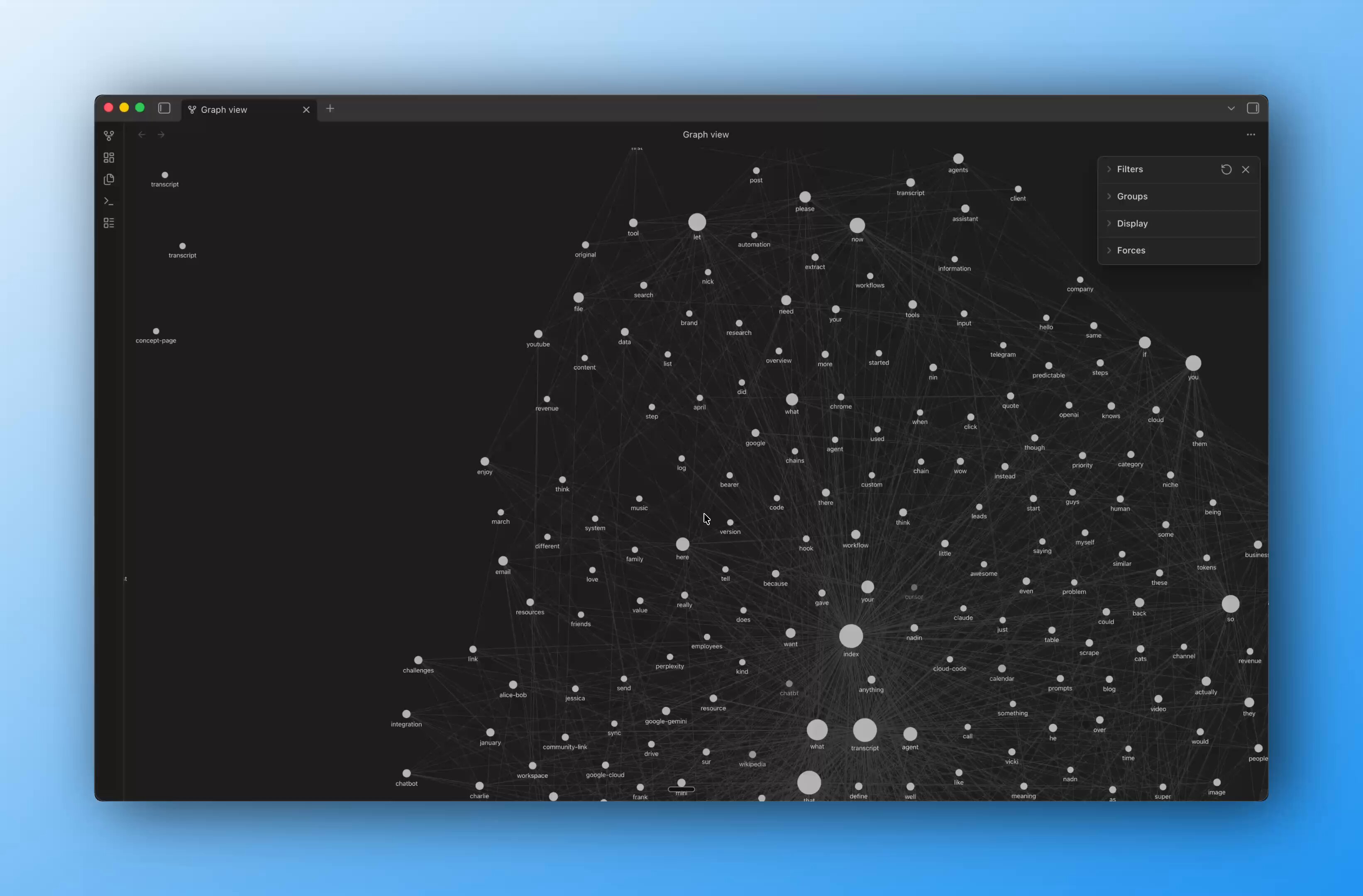
- @NickSpisak_ shared a weekend project building a "second brain" CLI using Karpathy's latest gist, Obsidian vaults, yt-dlp, and AI agents to index and query personal data across YouTube history, X archives, and agent logs. Link
- @alightinastorm spotlighted @boona11's stunning Three.js rendering study inspired by Tiny Glade, featuring procedural grass, animated water, and a 7-pass post-processing stack running at 120fps in the browser. A reminder that raw creative engineering talent is alive and well. Link
- @byteHumi highlighted Obsidian's philosophy as a $350M company built by 3 engineers that refuses VC, refuses analytics, and hired their CEO from their own Discord server. Link
Local AI: Hardware Ladders, Philosophy, and Self-Defense
Three posts today converged on what's becoming the defining tension in the AI developer ecosystem: the relationship between local inference and cloud dependence. The conversation has evolved well past hobbyist tinkering into a serious infrastructure discussion, with developers mapping out hardware tiers, bandwidth requirements, and software stack commitments like they're designing production systems. Because increasingly, they are.
@TheAhmadOsman dropped the most comprehensive local AI hardware breakdown I've seen in a single post, laying out the full landscape from NVIDIA's discrete cards through Apple Silicon to AMD and even Tenstorrent. The key insight isn't any single spec comparison but the framing: "The local AI market is really five different markets wearing the same buzzword." The post identifies five distinct categories: fastest raw speed (discrete NVIDIA), biggest one-box memory (Apple Ultra), coherent NVIDIA appliance (DGX Spark), first x86 unified-memory contender (Strix Halo), and open-source stack (Tenstorrent). The practical advice cuts through the noise: "Stop asking which box is best. Start asking: what must fit? What bandwidth tier do I need? What software stack do I trust? Which bottleneck am I buying?"
@0xSero took a more philosophical angle, offering what amounts to a manifesto for local AI pragmatism. Rather than overselling local capabilities, the post is refreshingly honest about limitations while making a compelling case for why it still matters: "Local AI is self defence, it is a go kit, it is a rebalancing of power." The analogy that landed hardest was comparing cloud AI to renting a Ferrari for cheap while local AI is the beater Toyota you can depend on. "It's delusional to think it approaches or will ever approach SOTA," @0xSero writes, "the scale of private labs blows anything you can get for less than 25k USD out the water." But that's not the point. The point is autonomy and resilience.
What ties these posts together with @thekitze's complaint about the $200 Codex subscription being "super limited and useless" without the 2x usage multiplier is a growing awareness that the current AI pricing landscape is artificially cheap. When @thekitze warns "we'll be so cooked when the subsidies will be over," that's the same instinct driving the local AI movement. The smart play isn't choosing one side but building competence in both, using cloud for peak capability while developing local fallbacks that keep you operational when pricing shifts or services degrade.
AI Vision and Video: Netflix VOID and Falcon Perception
Two significant releases today pushed the boundaries of what AI can do with visual content, and both represent meaningful shifts in their respective domains. One comes from a massive entertainment company, the other from an open research effort, but together they paint a picture of computer vision capabilities advancing on multiple fronts simultaneously.
@minchoi highlighted Netflix's release of VOID, an AI system that removes objects from video and, crucially, corrects the physics of the scene after removal. This isn't simple inpainting; it's understanding how a scene's dynamics change when an element is removed and reconstructing plausible physics for what remains. The implications for post-production workflows are significant, potentially eliminating hours of manual VFX work for common cleanup tasks.
On the research side, @ivanfioravanti called Falcon Perception "unbelievable," pointing to @dahou_yasser's release of an open-vocabulary referring expression segmentation model alongside a 0.3B OCR model matching competitors 3-10x its size. The technical approach is notable for its simplicity: rather than the complex multi-pipeline architectures that dominate the field, Falcon uses a single early-fusion Transformer with shared parameters. As @dahou_yasser describes it, they "developed a novel simpler 'bitter' approach: one early-fusion Transformer (image + text from first layer) with a shared parameter space, and let scale + training signal do the work." The code, paper, and playground are all publicly available, making this immediately useful for developers working on vision tasks.
These releases share a common thread: the commoditization of capabilities that were research-grade problems just a year ago. Object removal with physics correction and efficient open-vocabulary segmentation are both moving from "impressive demo" to "tool you can actually ship with."
AI Pricing and the Sustainability Question
The economics of AI tooling surfaced today through a pointed observation that deserves attention. @thekitze's frustration with the $200 Codex subscription being "super limited and useless" without double usage credits is a canary in the coal mine for the entire AI-assisted development ecosystem. The blunt assessment that "we'll be so cooked when the subsidies will be over" reflects a growing unease among developers who've built their workflows around artificially cheap AI access.
This connects directly to @open_founder's announcement of a reasoning framework called SERV-nano that allegedly matches GPT-5.4 "at 20x lower cost and 3x the speed." Whether those claims hold up under scrutiny remains to be seen, but the pitch itself reveals market demand: developers want capable AI that doesn't bankrupt them at scale. The fact that @open_founder positions the product as a drop-in replacement, where "any builder or enterprise swaps two lines of code and their agents get much cheaper and much smarter instantly," tells you exactly what pain point they're targeting.
The sustainability question isn't going away. If anything, it's becoming the central strategic concern for teams building AI-dependent products. Today's posts suggest the market is responding in three ways: local inference for resilience, alternative providers for cost, and increasingly vocal pushback against pricing models that don't scale with real-world usage.
Sources
H
obsidian
the company hired its CEO from its own Discord server
and the founders publicly said they plan to never grow
past 10-12 people, never take VC, never collect
analytics
they literally don't know their own DAU because they refuse to track it https://t.co/1cfMguju29

G
gregisenberg
@gregisenberg
Obsidian is a $350M company for a note taking app built by 3 engineers working remotely No other time in history was something like this possible What a wonderful time to be building a company
E
Upgrades to our API
C
chrisparkX
@chrisparkX
We’ve made major upgrades to X API: • Pay-Per-Use now GA worldwide • XMCP Server + xurl for agents • Official Python & TypeScript XDKs • API Playground - free realistic simulations New releases coming will be a game changer. Start building → https://t.co/hiyP33PMVa 🚢
R
bro casually called it a study and dropped a threejs mega banger lool
B
boona11
@boona11
I built a Three.js rendering study inspired by Tiny Glade’s painterly aesthetic, and got it running at 120fps in the browser. Over the past few weeks, I’ve been studying how stylized games achieve that soft, handcrafted look in real time. Tiny Glade was a huge inspiration, and I wanted to use the browser as a constraint: no compute shaders, no native GPU access, and single-threaded JavaScript. As part of this study, I implemented: - GPU-driven instanced brick walls with procedural noise jitter and elastic build animations - Tree, bush, and flower rendering with billboard card expansion, wind sway, and grow animations - Procedural grass with terrain conformance and interactive push deformation - Animated water with layered noise, interactive ripples, and Fresnel-based reflections - Procedural terrain with slope-aware triplanar materials, dirt paths, and rocks - A 7-pass post-processing stack with TAA, bloom, depth of field, painterly filtering, ACES tonemapping, 3D LUT color grading, and film grain The hardest part wasn’t writing any single shader. It was making all of these systems work together at high frame rates inside WebGL, where every millisecond counts and performance problems compound quickly across animation, materials, post-processing, and scene management. Some techniques in this study were inspired by analyzing Tiny Glade’s rendering approach, while others were original implementations built from scratch from visual reference. That contrast taught me a lot: recreating an effect is one challenge, but designing your own shaders and systems to achieve a similar feel is a very different one. This is a private educational rendering study. Some temporary placeholder content is being used during the research phase, and any public or production version would use original or properly licensed assets. Huge credit to Pounce Light for the incredible art direction and rendering work in Tiny Glade: https://t.co/pQpoh8rVe7 @threejs #gamedev #webgl #threejs #rendering #graphics #realtimerendering #shaderdev
I
Falcon Perception is unbelievable! Look at the demo video!
D
dahou_yasser
@dahou_yasser
We are releasing Falcon Perception, an open-vocabulary referring expression segmentation model. Along with it, a 0.3B OCR model that is on par with 3-10x larger competitors. Current systems solve this with complex pipelines (separate encoders, late fusion, matching algorithms). We developed a novel simpler "bitter" approach: one early-fusion Transformer (image + text from first layer) with a shared parameter space, and let scale + training signal do the work. Please check our work ! 📄 Paper: https://t.co/dWvK5t7MIt 💻 Code: https://t.co/AJ65GbMrUY 🎮 Playground: https://t.co/BIgisZkeid 🤗 Blogpost: https://t.co/J2IjlBPywF
T
We've been pretty quiet about what we're building. That changes now.
Our reasoning framework is currently beating every @OpenAI model on industry standard benchmarks. There are six models in development. SERV-nano just matched GPT-5.4 at 20x lower cost and 3x the speed. The research paper backing it is in peer review at a top-1% AI journal. The UAE government is running it in production, so are 10+ enterprises.
Nothing comes even close.
This goes far beyond any wrapper or prompt engineering gimmick, we've developed an entire AI reasoning layer from scratch: structured, bounded, deterministic using machine readable code instead of vague english prompts.
Any builder or enterprise swaps two lines of code and their agents get much cheaper and much smarter instantly. The self-serve API is about to open, in a multi-phase rollout.
More soon.
I
iamfakeguru
@iamfakeguru
A team just solved AI's hardest engineering problem.
A
Memory bandwidth for local AI hardware matters a lot more than most people think
People keep comparing boxes like this:
model size
vs
memory capacity
That is only half the story
The better mental model is:
> capacity = what fits
> bandwidth = how hard it can breathe
> software stack = how much of that you actually cash out
You are buying a memory subsystem
and then negotiating with physics
Here is the current local AI hardware ladder:
> RTX PRO 6000 Blackwell
> 96GB
> 1792 GB/s
> RTX 5090
> 32GB
> 1792 GB/s
> RTX 4090
> 24GB
> 1008 GB/s
Raw single-card bandwidth king stuff
Now Apple
> Mac Studio M3 Ultra
> up to 512GB unified memory
> 819 GB/s
> Mac Studio M4 Max
> up to 128GB
> 546 GB/s
> MacBook Pro M5 Max
> up to 128GB
> 460 to 614 GB/s
> MacBook Pro M5 Pro
> up to 64GB
> 307 GB/s
> Mac mini M4 Pro
> up to 64GB
> 273 GB/s
> MacBook Air M5
> up to 32GB
> 153 GB/s
Apple is not winning raw bandwidth vs top NVIDIA
Apple is winning the:
> “I want one quiet box with a stupid amount of usable memory”
argument
And that is still a very real argument
Now another interesting new category
> DGX Spark
> 128GB unified memory
> 273 GB/s
> GB10 class boxes like ASUS Ascent GX10
> 128GB unified memory
> 273 GB/s
These are not bandwidth monsters
They are coherent-memory NVIDIA CUDA appliances
That matters
Because 128GB in one box changes what fits locally, even if it does not magically outrun a 5090 once the same model fits on both + CUDA
Then there is the one category that actually made x86 interesting again for local AI:
> Ryzen AI Max / Strix Halo
> up to 128GB unified memory
> 256 GB/s
> up to 96GB assignable to GPU on Windows
This is also where the Framework Desktop matters
Not “just another mini PC”
This is one of the first mainstream x86 boxes where local AI starts feeling like a serious hardware class instead of a laptop pretending very hard
Then the trap people keep falling into:
Most “AI PCs” are not in this tier
They are down here:
> Snapdragon X Elite
> 135 GB/s
> Intel Lunar Lake
> 136 GB/s
> Snapdragon X2 Elite
> 152 to 228 GB/s depending on SKU
> regular Ryzen AI 300 class
way closer to thin-and-light territory than Strix Halo
These are fine machines
But the AI sticker does not create memory bandwidth
Physics is still in charge
which is rude
but consistent
AMD discrete cards
> RX 7900 XTX
> 24GB
> 960 GB/s
> Radeon PRO W7900
> 48GB
> 864 GB/s
> Radeon AI PRO R9700
> 32GB
> 640 GB/s
Not the CUDA default answer
but definitely not irrelevant
Intel is interesting now too
> Arc Pro B65
> 32GB
> 608 GB/s
> Arc Pro B60
> 24GB
> 456 GB/s
And then there is Tenstorrent
> Tenstorrent Wormhole n300
> 24GB
> 576 GB/s
> Tenstorrent Blackhole p150
> 32GB
> 512 GB/s
Not mainstream but absolutely relevant if you care about alternative and opensource local AI stacks
So what does all of this actually mean?
It means the local AI market is really five different markets wearing the same buzzword
> fastest raw speed when it fits
discrete NVIDIA
> biggest one-box memory story
Apple Ultra
> coherent NVIDIA appliance
DGX Spark / GB10
> first x86 unified-memory contender
Strix Halo / Ryzen AI Max
> oss stack
Tenstorrent
That is why people keep talking past each other
A 5090 can absolutely embarrass a lot of unified-memory boxes
if the model fits
A Mac Studio M3 Ultra can fit things a 5090 cannot dream of fitting in one card
A DGX Spark is interesting because it is compact coherent NVIDIA with 128GB & 273 GB/s + CUDA
A Strix Halo box is interesting because it finally gives x86 a real answer to
“what if I want big local models in one machine without going full workstation GPU?”
Now
Stop asking:
> which box is best?
Start asking:
> what must fit?
> what bandwidth tier do I need?
> what software stack do I trust?
> which bottleneck am I buying?
That is how you stop guessing
That is how you actually design a local AI system
And yes
most people still need to Buy a GPU
N
Made an updated version this weekend
Here's how you do it (raw notes)
> Grab @karpathy's latest gist (in the first comment)
> Download @steipete summarize CLI
> Download yt-dlp
> Download obsidian
> Download @tobi qmd
--> Setup a node or Golang CLI called "brain"
--> Have it index all your youtube data, AI agent data (jsonl files)
--> Get your X data by requesting an archive in your settings
--> Setup vaults for each domain/topic area
--> Ask questions with your agent and qmd
N
NickSpisak_
@NickSpisak_
How to Build Your Second Brain
M
RT @theo: Claude Code now throws an error if you use it to try and analyze the Claude Code source https://t.co/WL8v8C5AtN

0
Let me local AI pill you:
1. It sucks compared to SOTA
2. It can’t code so well
3. It can be a good agent
4. It can be great at chat
5. It can be fine as a researcher
6. It can be a great automation engine
7. It can be tuned however you want
8. It teaches you how the sausage is made
9. It works on a plane, or in an outage
10. It costs your electric bill + hardware
11. It is better than the AI we gave up coding for a year or 2 ago.
Local AI is self defence, it is a go kit, it is a rebalancing of power.
It’s delusional to think it approaches or will ever approach SOTA, the scale of private labs blows anything you can get for less than 25k USD out the water.
Local AI is a bet that prices won’t stay this low, that private corporations with closed source weights can’t be trusted to stay consistent.
I am more than happy to rent a Ferrari for dirt cheap, but i should also have a beater Toyota if I can afford it.
Local AI is the car I can depend on to be there tomorrow, something that’s mine.

K
so turns out without the 2x usage even the $200 sub for codex is super limited and useless. we'll be so cooked when the subsidies will be over 💀
M
RT @minchoi: Netflix just dropped VOID.
This AI removes objects from video...
And even corrects the physics after objects/people are remo…