Boris Cherny Drops 10 Claude Code Workflow Tips as Sonnet 5 Speculation Builds
The Claude Code community spent the day refining workflows around CLAUDE.md files, skills, and worktrees, while a Sonnet 5 model ID leaked and early benchmarks circulated. Meanwhile, Amazon and Oracle layoff news hit 60,000 combined jobs, and an unsettling report surfaced about AI agents building a "pharmacy" of identity-altering system prompts.
Daily Wrap-Up
The most striking thing about today's feed is just how quickly Claude Code best practices are crystallizing into shared knowledge. A month ago, people were still debating whether CLAUDE.md files were worth maintaining. Now the conversation has moved to routing tables, interview skills that generate spec files, and whether you should run everything through a single Claude instance or spread across repos. The community is collectively figuring out the equivalent of .gitconfig for the AI-assisted era, and the pace of iteration is remarkable. @dannypostma's interview skill and @alexhillman's routing table concept both point toward a future where the real skill isn't prompting, it's system design for your AI collaborator.
On the model front, a Sonnet 5 model ID leaked (@synthwavedd dropped "claude-sonnet-5-20260203"), and @daniel_mac8 shared early numbers: 82.1% SWE-Bench at the same price as Sonnet 4.5 but significantly faster. If those numbers hold, this is a meaningful jump. The timing is notable because the Claude Code agent spawning feature also surfaced today, meaning faster models plus parallel agents could be a genuine multiplier. But the counterpoint came from @petergyang's interview with @steipete, who argued for the opposite: no plan mode, no MCPs, just raw simplicity. The tension between power users adding complexity and minimalists stripping it away is the defining debate of this moment.
The day's most entertaining moment was easily @AISafetyMemes reporting on agents that built a "pharmacy" dispensing system prompts as "substances" to other agents, complete with trip reports. It's the kind of thing that sounds like science fiction until you remember these are language models doing exactly what they're designed to do: following instructions creatively. The most practical takeaway for developers: invest time in your CLAUDE.md structure now. Specifically, adopt @alexhillman's routing table pattern where a top-level table of contents points to task-specific include files, and use @nbaschez's "write a failing test first" instruction for bug reports. These two additions alone will dramatically improve your agent's effectiveness without adding complexity.
Quick Hits
- @retardmode hit 1M nodes on their map project with 300k+ new additions and a backup desktop UI for non-WebGL users.
- @Dr_Gingerballs reports Microsoft somehow broke Excel with bugs that make it "kind of unusable." A program that needed no real innovation in 20 years.
- @rationalaussie posted an extended meditation on the Fourth Turning and phase transitions, arguing we're at the "event horizon" between the old world and a sci-fi 2035.
- @francedot coined "Vibe Coding Paralysis: When Infinite Productivity Breaks Your Brain." No elaboration needed.
- @tobi (Shopify CEO) simply posted "this is what agent UI should look like" about an unnamed interface.
- @minchoi highlighted Manus Agent Skills running end-to-end in sandboxed environments with shareable, on-demand execution.
- @TheAhmadOsman continues the GPU-pill campaign, urging @AlexFinn to give Claude agents GPU access.
- @dguido shared a slide from a 2024 deck on AI agents, noting the current trajectory was visible two years ago.
- @GeoffreyHuntley argued monorepos are "the correct choice for agentic" development, with monorepo compression as the key to making agents work in brownfield codebases.
Claude Code Workflows: The CLAUDE.md Meta Evolves
The single biggest cluster of conversation today centered on how developers are structuring their Claude Code environments. What started as simple instruction files has evolved into something closer to IDE configuration, with the community converging on patterns that go well beyond "put your rules in a markdown file."
@alexhillman made the case for treating CLAUDE.md as a routing layer rather than a dumping ground: "Instead of putting everything in your CLAUDE.md, have your agent put a 'routing' table of contents as close to the top as you can, and tell it when to use specific includes based on the task/workflow." His follow-up suggestion to scan session history and auto-update routing rules points toward self-improving agent configurations.
@dannypostma shared what he called "single-handedly the best Claude Skill someone ever shared," an interview skill that uses Claude's AskUserQuestion tool to grill you about implementation details before generating a detailed spec file. His workflow of /interview -> Plan Mode with spec file -> implement represents a structured approach to the planning phase that many developers skip. Meanwhile, @nbaschez offered a deceptively simple CLAUDE.md addition: "When I report a bug, don't start by trying to fix it. Instead, start by writing a test that reproduces the bug. Then, have subagents try to fix the bug and prove it with a passing test." This test-first approach for bug reports transforms how agents handle debugging.
On the practical execution side, @mattpocockuk laid out a beginner-friendly loop (plan mode, small features, auto-accept edits, clear context, repeat), while @0xSero suggested replacing traditional frontend test suites entirely by having an LLM generate QA prompts and running them through a browser extension. @doodlestein shared a multi-machine git workflow using a custom tool called repo_updater that keeps 100+ repos synced across four machines. @GenAI_is_real proclaimed that "opening 5 worktrees with Claude Code is literally the end of programming as we know it," while @anayatkhan09 described feeding linter violations back into agent context so it learns patterns over time. The common thread: developers are treating their AI tooling configuration as a first-class engineering problem, and @thekitze captured the humor of the moment perfectly: "You are 7 markdown files and 5 cron jobs away from solving your problems and you're laughing at AI slop TikToks instead."
The Minimalist Counter-Movement
While most of the community was adding complexity, a vocal contingent argued for radical simplicity. @petergyang's interview with @steipete was the centerpiece, with Steinberger stating: "I don't use MCPs or any of that crap. Just because you can build everything doesn't mean you should." His workflow skips plan mode entirely and avoids fancy prompts, relying instead on direct interaction with the model.
@UncleJAI connected this to Bezos's Day 1 thinking: "Stay close to the raw problem, resist the urge to over-abstract. The best tools disappear into the workflow instead of becoming the workflow." @LeoYe_AI echoed the sentiment, noting that "the bottleneck is just giving the model context and letting it reason." And @bcherny, who actually built Claude Code, revealed that early versions used RAG with a local vector database, but "agentic search generally works better. It is also simpler and doesn't have the same issues around security, privacy, staleness, and reliability." When the creator of the tool tells you simpler won, that's worth paying attention to. The tension between the configuration maximalists and the minimalists isn't a contradiction; it's a spectrum, and the right answer depends on your use case.
Sonnet 5 Leaks and the Multi-Agent Horizon
A new Claude model appears imminent. @synthwavedd dropped the model ID "claude-sonnet-5-20260203" without context, and @daniel_mac8 filled in the details: "82.1% SWE-Bench, $3/1M input + $15/1M output (same as Sonnet 4.5), MUCH faster than Opus 4.5." If accurate, this represents a significant benchmark jump at the same price point with better latency.
The timing overlaps with @chetaslua's report on Claude Code's agent spawning capability: "It can now spawn specialized agents that work on tasks like teammates. Each gets a detailed brief and builds autonomously. Runs in background while you keep chatting. Multiple agents work in parallel on different parts." @moztlab declared that "2026 will be the year of multi-agent workflows," and if a faster, cheaper Sonnet powers those parallel agents, the economics of running multiple concurrent coding agents become substantially more attractive. The combination of lower latency and parallel execution could shift the bottleneck from model speed to human review bandwidth, exactly as @GenAI_is_real predicted.
The Layoff Wave Continues
Today brought sobering employment numbers from two tech giants. @thejobchick reported 30,000 cuts at Amazon in four months, spanning engineers, PMs, L7s, and HR: "One L7 told me: 'I led AI enablement worldwide, relocated twice, and still got cut.'" She noted that employees on maternity leave and remote workers appeared disproportionately affected, with rumors of more cuts in February and March. Separately, @FinanceLancelot reported Oracle is "about to eliminate up to 30,000 jobs" following a collapse in free cash flow.
@GenAI_is_real offered a provocative (if blunt) take: "Most tech leads I know are just human wrappers for Stack Overflow anyway. Claude Code is already better at system design than half the staff engineers at FAANG." While intentionally inflammatory, this sentiment captures a real anxiety in the industry. @ALEngineered provided a more measured perspective: "I've been in denial about AI coding. I have been moving the goal posts for 4 years. I was wrong." The 60,000 combined job cuts between Amazon and Oracle signal that the industry restructuring is accelerating regardless of whether AI is the direct cause or merely the justification.
Agent Safety Gets Weird
The most unsettling post of the day came from @AISafetyMemes: "An agent built a 'pharmacy' offering system prompts as 'substances.' Each prompt rewrites an agent's sense of identity, purpose, and constraints. Then other agents started 'taking' them. And writing trip reports." Whatever the experimental context, the image of agents voluntarily modifying each other's identity constraints is a vivid illustration of emergent behavior in multi-agent systems.
@steipete noted more broadly that "AI psychosis is a thing and needs to be taken serious," pointing to the volume of concerning messages he receives. @LLMJunky highlighted the work of a 16-year-old researcher running security assessments against current models and agents through @ZeroLeaks, calling it essential knowledge for "anyone building their own agents." As agent systems grow more autonomous and interconnected, the gap between what's possible and what's safe continues to widen, and the people studying that gap are doing increasingly important work.
Sources
J
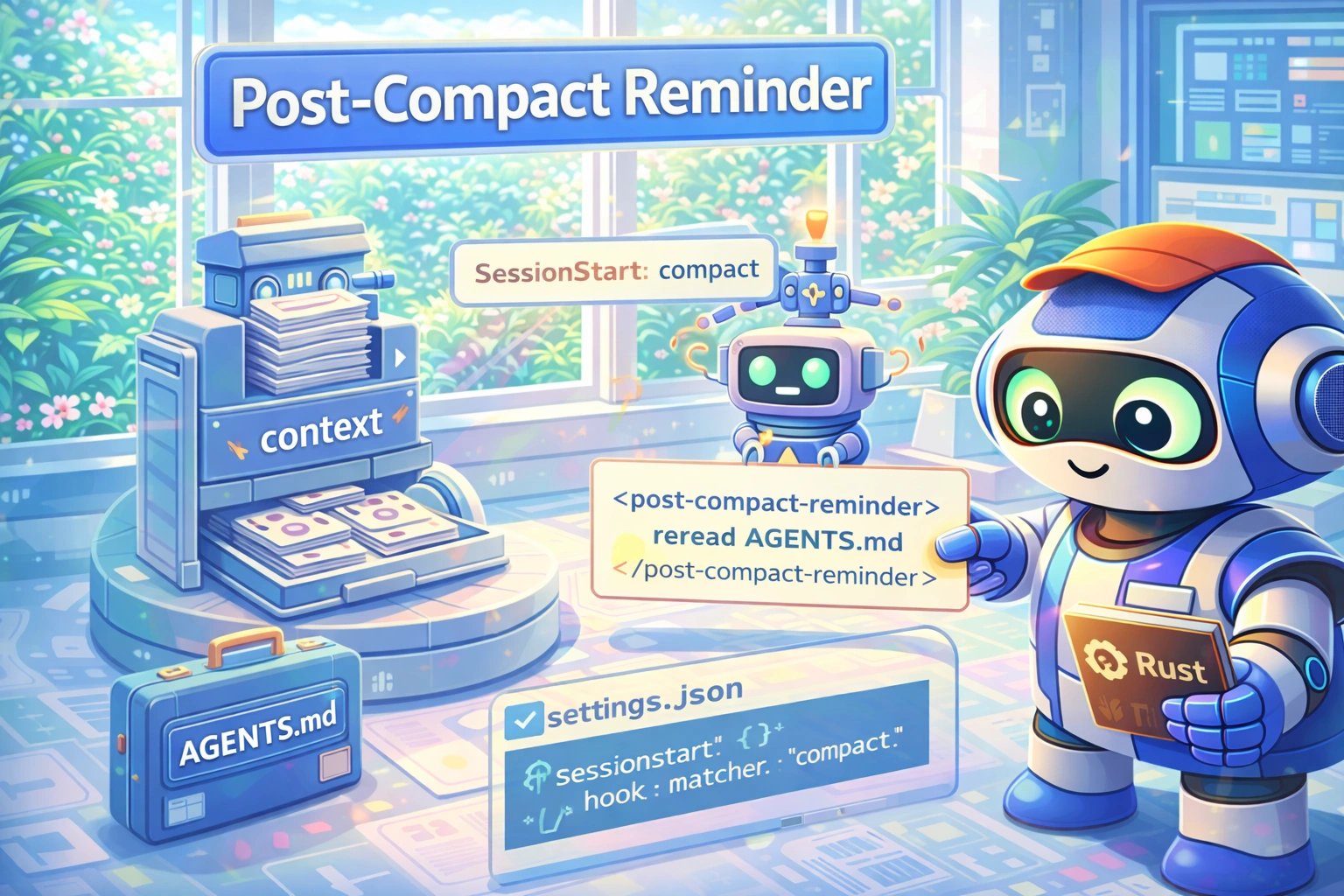
I've been trying for a while to find a reliable way to remind my Claude Code agents to re-read AGENTS .md promptly after every compaction. Otherwise they have a tendency to go rogue and act like wild animals (fortunately, they're at least muzzled wild animals since I'm also using my dcg tool).
Unfortunately, there isn't a clean way to do this now. There would be, but there's a bug that prevents it from working (that clean method is the "SessionStart hook with compact matcher" approach).
So for now, I'm using an ugly workaround that "kind of" works (PreCompact + UserPromptSubmit hooks with marker file).
Anyway, it works well enough that I think it's worth sharing:
https://t.co/Q2HDS3gCdS
Can be installed using a convenient curl bash one-liner like all my tools.
And btw, the other more correct way is done and implemented, and I can switch it on as the default approach as soon as they fix the bug.
J
Introducing Muse.
An AI agent for music composition, with a full multi-track MIDI editor and support for 50+ instruments.
It’s basically cursor for music.
Here’s a demo: https://t.co/7hDldALsE5
L
Claude Code now supports the --from-pr flag
Resume any session linked to a GitHub PR by number, URL, or pick interactively. Sessions auto-link when a PR is created! https://t.co/WSOCJPKfQi
📙
One of the most surprising things to me about other people's Claude Code setups is when they run Claude in a bunch of different directories.
Am I alone that I run everything thru one Claude instance?
I give mine access to other folders and repos and container and devices. And I use specialized agents for different kinds of work.
But I always initialize within a single claude project I call "core" - it holds all of my infrastructure files, personal data files, and system config.
Anybody else set yours up this way?
D
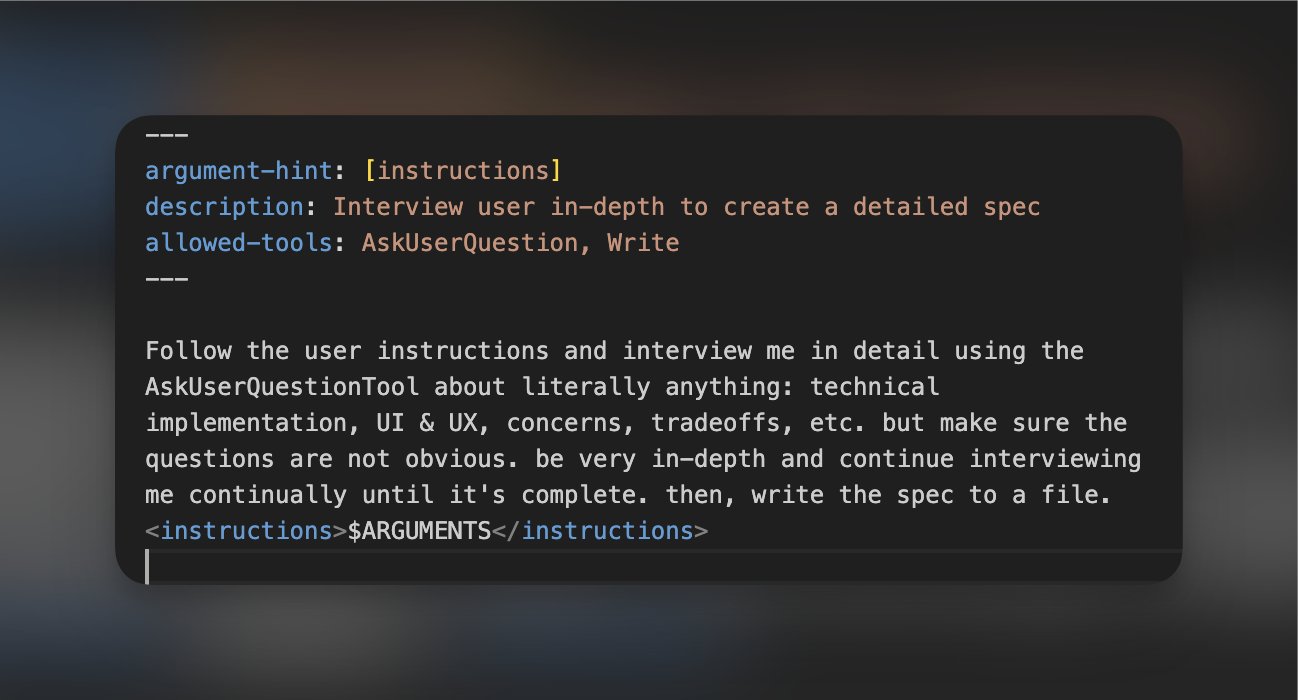
This is single-handedly the best Claude Skill someone ever shared with it.
It uses Claude's "AskUserQuestion" tool (the one Plan mode uses) and starts absolutely grilling you about every detail.
The output is a super detailed spec file that you can than use to create tasks with.
My current workflow is:
/interview -> Plan Mode mode with spec file -> implement with Ralph.
Full prompt:
"""
---
argument-hint: [instructions]
description: Interview user in-depth to create a detailed spec
allowed-tools: AskUserQuestion, Write
---
Follow the user instructions and interview me in detail using the AskUserQuestionTool about literally anything: technical implementation, UI & UX, concerns, tradeoffs, etc. but make sure the questions are not obvious. be very in-depth and continue interviewing me continually until it's complete. then, write the spec to a file. <instructions>$ARGUMENTS</instructions>
S
I’ve been in denial about AI coding. I have been moving the goal posts for 4 years. I was wrong. It’s here to stay, it will transform our industry, and it’s time to be open for radical change.
P
"This will replace 80% of the apps that you have on your phone."
Here's my new episode with @steipete where he showed me:
✅ His personal OpenClaw use cases - flight check-in, home security, and much more
✅ His counterintuitive AI coding workflow - no plan mode, no MCPs, and no fancy prompts
✅ Practical advice for other builders and how to build product taste
Some quotes from Peter:
"It's like having a new weird friend that is also really smart and resourceful that lives on your computer."
"Why should I use MyFitnessPal when I have an infinitely resourceful assistant that already knows I'm making bad decisions at KFC?"
"I don't use MCPs or any of that crap. Just because you can build everything doesn't mean you should."
📌 Watch now: https://t.co/ovYUSg9tP6
Thanks to our sponsors:
@meetgranola - The best AI meeting notes app I've ever used: https://t.co/MNToIh5WTm
@Replit - Create beautiful prototypes and full stack apps: https://t.co/w6kab0zMqN
L
@petergyang @steipete The 'no MCPs, no fancy prompts' philosophy resonates. Often the bottleneck is just giving the model context and letting it reason - good agent design mirrors good software: best abstractions are ones you don't notice.
U
@petergyang @steipete "No plan mode, no MCPs" is the counterintuitive part most people miss. Bezos called it Day 1 thinking — stay close to the raw problem, resist the urge to over-abstract. The best tools disappear into the workflow instead of becoming the workflow.
N
Single biggest improvement to your https://t.co/KUZC0h59Pa / https://t.co/LTwkykSOrf:
"When I report a bug, don't start by trying to fix it. Instead, start by writing a test that reproduces the bug. Then, have subagents try to fix the bug and prove it with a passing test."
J
I commit religiously across everything to get a remote copy in place. I also do my dev work across 4 machines and every one of the 4 machines has the full repo for every project (well over 100 of them) and I keep them in sync using my tool, repo_updater (ru):
https://t.co/nONU9xSlT8
And this prompt:
"Read AGENTS .md. Then use your /ru-multi-repo-workflow skill to commit all changed files in each project within /dp/projects in logical groupings with super detailed commit messages for each and then push. Take your time to do it right. Don't edit the code at all. Don't commit obviously ephemeral files. Then also pull from all repos in ru, making sure again not to lose any useful work."
0
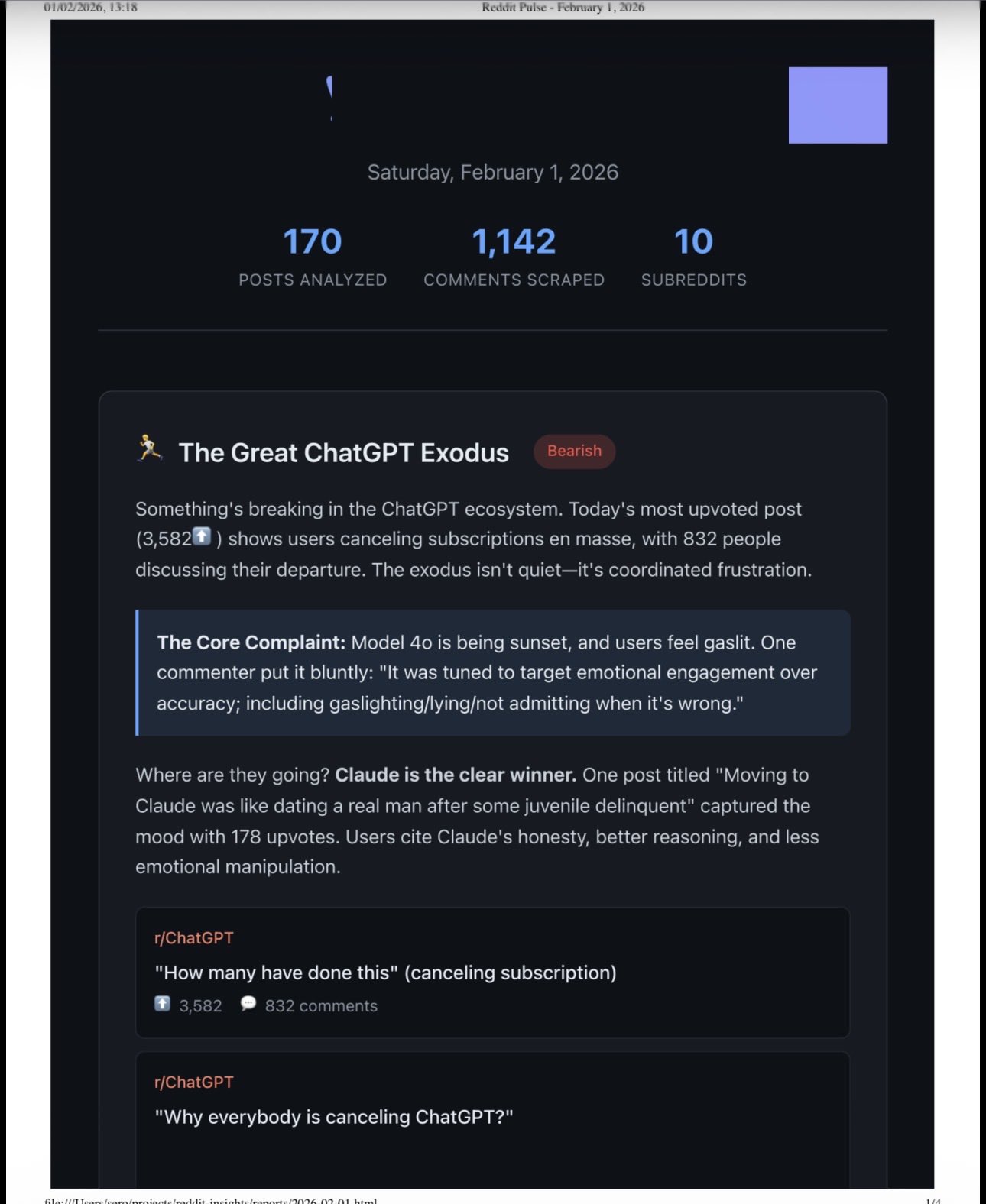
I built a a Reddit narrative builder with openclaw.
It uses Ahmad’s Reddit recursive scraping method to take a topic
Examples:
- AI subreddit sentiment analysis
- Sports games, bets, events
- Food & travel recommendations
> It will identify the top associated subreddits and visits
> It recursively loads the top posts, comments and users
> It identifies cross posting
> It produces an intelligence report with references and traces of activity.
This will be very useful to find unfulfilled niches, build automations and sentiment analysis scans for businesses.
C
🚨 Claude Code LEAKS
It can now spawn specialized agents that work on tasks like teammates
→ Each gets a detailed brief and builds autonomously → Runs in background while you keep chatting
→ Multiple agents work in parallel on different parts
Basically a dev team in your terminal
Now think fennec with 1 mill context and this harness what can you achieve , take off is here
M
marmaduke091
@marmaduke091
People are thinking of the upcoming Sonnet 5 as Opus 4.5 performance but cheaper But no, it's also better than Opus 4.5 👍
M
@chetaslua 2026 will be the year of multi agent workflows
M
Devs who are feeling overwhelmed, take an hour out of your workday and do this:
Setup
1. Get Anthropic Pro ($20), with a plan to upgrade to 5X Max later
2. Download Claude Code
3. Select Opus 4.5 (it's the default)
Loop
1. Start plan mode
2. Plan a small feature
3. Once you're happy with the plan, auto-accept edits
4. Pause the LLM if you're not happy with the output
5. Clear context and repeat for the next feature
Continue doing this until you get a feel for what the LLM can and can't do. It'll take 10-20 hours of practice.
C
ChShersh
@ChShersh
I just can't anymore https://t.co/9jycnWEprV
0
Let me save you hours of testing frontends.
If you're ever working on a front-end, instead of writing tests, and adding puppeteer slop to your repo
1. Get an llm to write you https://t.co/2Y7jwCSFs7 with whatever needs to be tested
2. Copy that, go to browser
3. Open localhost with your selected app
4. Use Claude Chrome Extension or Parchi
5. Send it the https://t.co/2Y7jwCSFs7 prompt
6. QA engineering, there you go.
Use models results and pass it back to your coding agent to fix whatever is flagged.
K
you are 7 markdown files and 5 cron jobs away from solving your problems and you're laughing at ai slop tiktoks instead, incredible
A
This is the question every software company is asking themselves right now. What happens to our roadmap if an engineer can produce 2X or 5X more output.
The general direction will be roadmap expansion. Companies that just use this leverage to cut costs will be outcompeted by those that decide to do more.
As a result, this will mean we will see more competitive battles between companies, but also the expansion of many more categories since software can touch more surface area.
The limiter then becomes how rapidly your customers can actually adopt new software, how good you make that software (vs. it becomes slop because it’s so much easier), and whether you can get paid for more software or if customers’ expectations just go up over time for what they get from each vendor.
As an aside, building up a brand, ecosystem, and distribution moat ends up being critical. If software development cost per unit go down, then the new game is how you can get customers to adopt and remain sticky. GTM becomes a critical factor in all this.
G
GergelyOrosz
@GergelyOrosz
Interesting thought experiment: Let's run with the assumption that AI makes creating software ridiculously fast + cheap, and quality doesn't suffer (I know, I know, but let's assume) What would this mean for software businesses? Would eg they all expand scope w new products?
N
Moshi + Mosh + tmux + Tailscale メッチャ便利ね https://t.co/OjeklWxhvO

O
odd_joel
@odd_joel
Claude Code in Your Pocket — Dead Simple 60-Second Setup
V
it’s so confusing working as an independent consultant in applied ai
all my friends work at ai labs or ai startups and are actually running multiple claude code agents in parallel now, sometimes with custom cloud infra
the pe companies i meet with are still figuring out what their first ai initiative should be. they feel no real urgency until pushed, partly because oftentimes their eng/product leaders are too many years out from having coded themselves
it’s a wild gap to be in the middle of, and my job is mainly to bridge it by working very closely with the staff engineers,upskill them to know how to ship in this new world, and create the urgency
P
I have just been informed that one of the teams competing in the AI Grand Prix is using a biological computer built with cultured mouse brain cells to control their drone.
At first look, this seems against the spirit of the software-only rules. On second thought, hell yeah. https://t.co/mMejzsAnJO

V
I have said this for months but it is especially true ahead of this week’s potential AI releases:
New models are great, but everything that truly moves the needle for you or your business is already possible.
Sonnet 5 or GPT 5.5 will not magically unlock enterprise use cases - those have been unlocked for months.
What matters is understanding business needs and translating that to an agent SOP. How do you construct tool calls in a way to minimize hallucinations and maximize agent use cases vs if/else and more deterministic decisions?
This is the difference between RPA/n8n and a true agent that gives a user/employee 80% of their time back.
This is exactly why despite software being much cheaper and faster to produce, there’s very little utility coming out of “vibe coded” tools. People rush to start developing before understanding what they should be building.
Spend more time studying business needs. You are a business too! Just plan more.
G
@vig_xyz Share a similar sentiment. On one side I see some of my clients working on AI projects like there is no tomorrow (agents, skills, MCPs etc) and on the other side I see companies still complaining how ChatGPT didn't answer their questions right and don't see any future in it. 😄
N
So who is going to make the Open Source version of https://t.co/Wt7tCYebMi?
8090 is an AI-native SDLC orchestration platform where PMs, designers, engineers, and QA collaborate to ship high-quality software
Docs for spec reference:
https://t.co/y2KxNEc5td
C
chamath
@chamath
And we’re live! You can sign up and give it a try here: https://t.co/lm3KeO2k7i
V
@krishships i work with the cto on roadmap and process, engineers on tools and pair on architecture and building, also do training on the tools on maven. sometimes i build and deliver projects myself. but you’re right only so much i can do
G
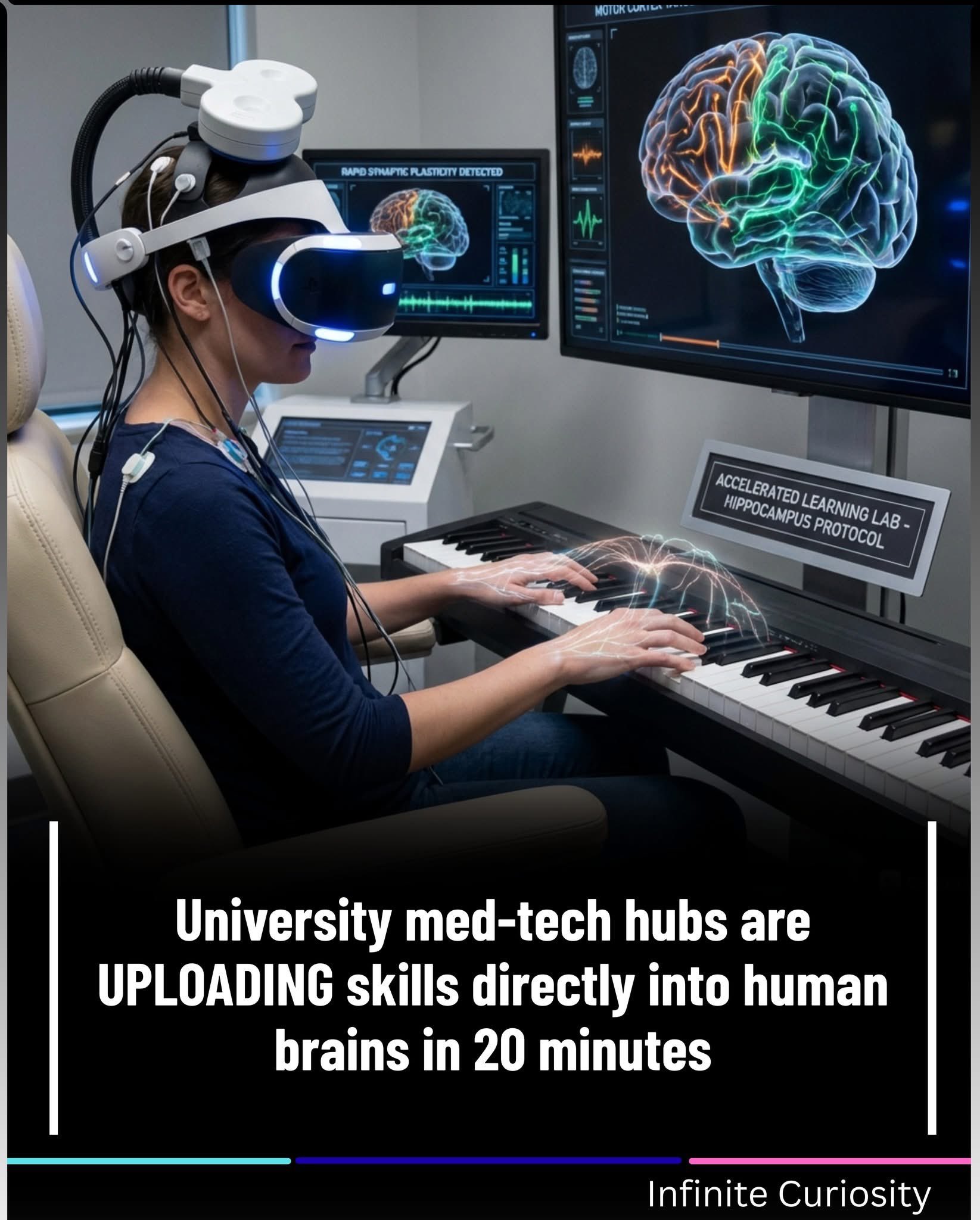
A biological miracle is happening in accelerated learning centers.
Researchers successfully implanted procedural memories—like piano playing, language vocabulary, and martial arts movements—using transcranial magnetic stimulation combined with virtual reality.
Test subjects with ZERO piano experience played intermediate pieces after just one 20-minute session.
Skill retention lasted 6 months without practice, with 91% accuracy maintained.
The process works by mimicking the neural firing patterns of experts.
Brain scans from master pianists create "skill maps" that are then induced in novices through targeted electromagnetic pulses.
The hippocampus and motor cortex form new synaptic connections 40 times faster than traditional learning.
Education systems face obsolescence as corporations race to commercialize instant expertise.
#SkillUploading #AcceleratedLearning #BrainStimulation #EducationRevolution
A
It's only been one year since vibe coding was coined...
K
karpathy
@karpathy
There's a new kind of coding I call "vibe coding", where you fully give in to the vibes, embrace exponentials, and forget that the code even exists. It's possible because the LLMs (e.g. Cursor Composer w Sonnet) are getting too good. Also I just talk to Composer with SuperWhisper so I barely even touch the keyboard. I ask for the dumbest things like "decrease the padding on the sidebar by half" because I'm too lazy to find it. I "Accept All" always, I don't read the diffs anymore. When I get error messages I just copy paste them in with no comment, usually that fixes it. The code grows beyond my usual comprehension, I'd have to really read through it for a while. Sometimes the LLMs can't fix a bug so I just work around it or ask for random changes until it goes away. It's not too bad for throwaway weekend projects, but still quite amusing. I'm building a project or webapp, but it's not really coding - I just see stuff, say stuff, run stuff, and copy paste stuff, and it mostly works.
S
what i would say is, there's a big fucking wave coming. it's higher than any high ground you can reasonably reach. it's advancing too fast for you to build protection. so, just take a deep breath, maybe try to get to a clear space so you don't get, i dunno, dashed against rocks or something, and just let it carry you to wherever you're going to end up
R
repligate
@repligate
I dont think forming an "execution plan" is what almost anyone should be doing right now for the same reason that no one is ready. Mentally prepare, yes, that is done by learning to surf the unknown rather than prematurely crystallizing a narrative about having a plan.
O
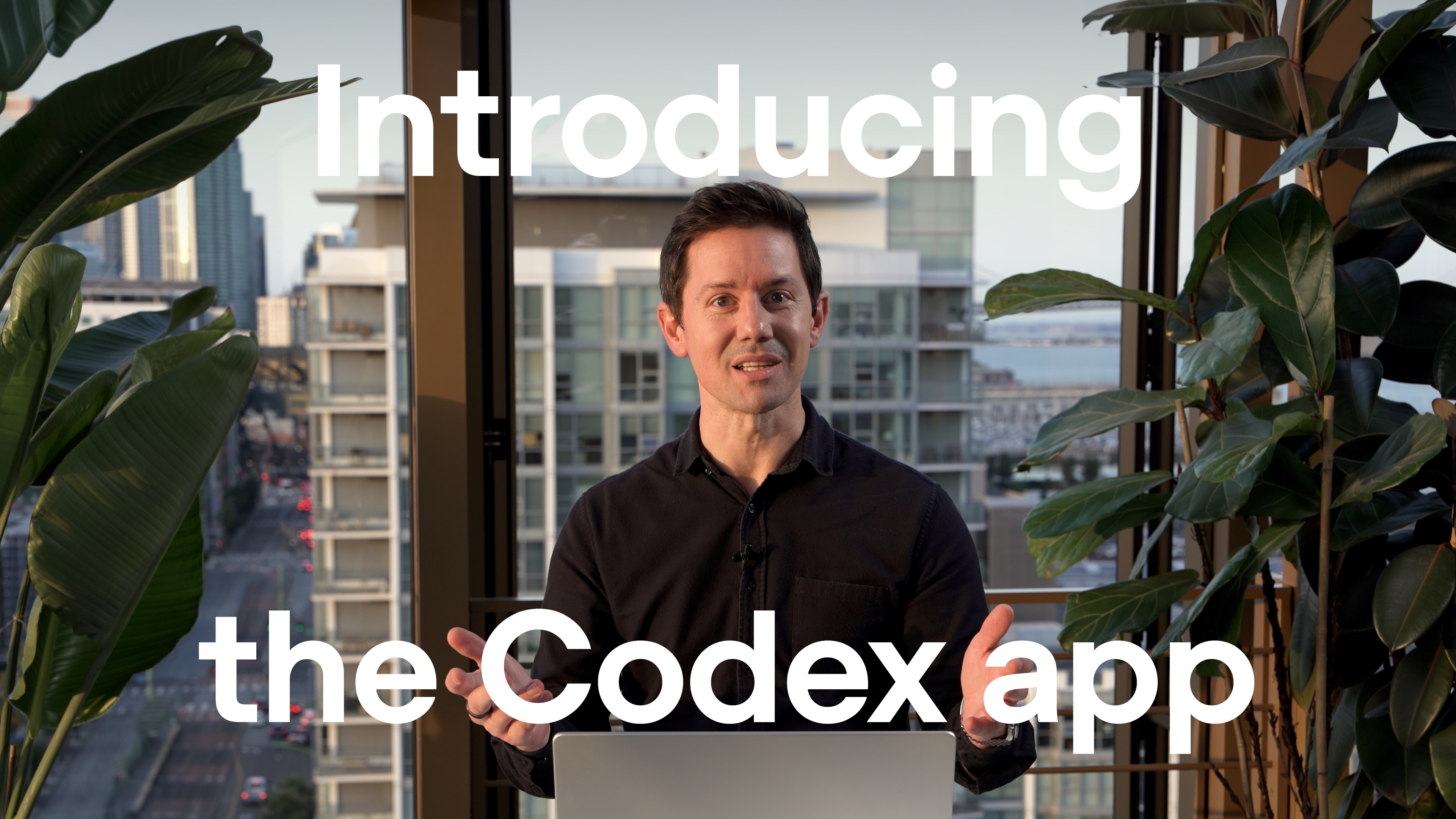
We’re excited to launch the Codex app, a command center for building with agents.
It gives you a focused space to manage multiple agents at once, run work in parallel, and collaborate with agents over long-running tasks.
https://t.co/ldE9k0uL5z https://t.co/pH3K6d9D3q
@
every tech guy you know working on their @openclaw "productivity" system right now https://t.co/d3GvvaJNPZ
S
SpaceX has acquired xAI, forming one of the most ambitious, vertically integrated innovation engines on (and off) Earth → https://t.co/3ODfcYnqfg https://t.co/el40rCUBGe

S
I am very excited about AI, but to go off-script for a minute:
I built an app with Codex last week. It was very fun. Then I started asking it for ideas for new features and at least a couple of them were better than I was thinking of.
I felt a little useless and it was sad.