AI Learning Digest.

Multi-Agent Workflows Hit the Human Bottleneck While Context Management Becomes Core Engineering

Daily Wrap-Up

The most striking signal from today's posts is how quickly the conversation has shifted from "can agents work?" to "how do we manage the operational complexity of running many agents at once?" @unclebobmartin perfectly captured the inflection point: with one agent, you wait for Claude. With three, Claude is waiting for you. The bottleneck has flipped, and the implications ripple through everything from context window management to system performance monitoring to career planning. We're past the proof-of-concept phase and deep into the "now make it actually work at scale" phase.

The context management thread deserves special attention. Multiple practitioners independently converged on the same insight: treating CLAUDE.md files like lazy-loaded modules, placing instructions in subfolders so they only enter context when relevant, and building dynamic offloading systems that swap large tool outputs for filesystem pointers. This isn't prompt engineering anymore. It's a genuine engineering discipline with its own patterns, tradeoffs, and failure modes. @AndrewYNg's new course on Agent Skills with Anthropic suggests the ecosystem recognizes this and is starting to formalize it.

On the lighter side, @theo noting that "I haven't heard anyone mention GraphQL in years" as an upside of AI got a genuine laugh. And the career discourse ranged from @hosseeb's thoughtful "sit at the front of the class" essay to @davidpattersonx's blunt "Don't learn to code. In fact, don't plan a career in anything." The truth, as usual, is somewhere in the messy middle. The most practical takeaway for developers: invest time in learning context management patterns for AI agents, specifically how to structure project instructions, manage memory across sessions, and architect multi-agent workflows. These skills are rapidly becoming as fundamental as version control.

Quick Hits

  • @BillAckman on Neuralink's potential to restore sight: a reminder that amid all the developer tooling discourse, AI is also tackling profound medical challenges.
  • @nummanali shared a piece arguing the future of software distribution will be via specification rather than compiled artifacts. Worth a read if you're thinking about how AI changes packaging and deployment.
  • @chris__sev flagged a security article covering prompt injection risks when giving AI agents access to email and CLI tools. The attack surface grows with every integration.
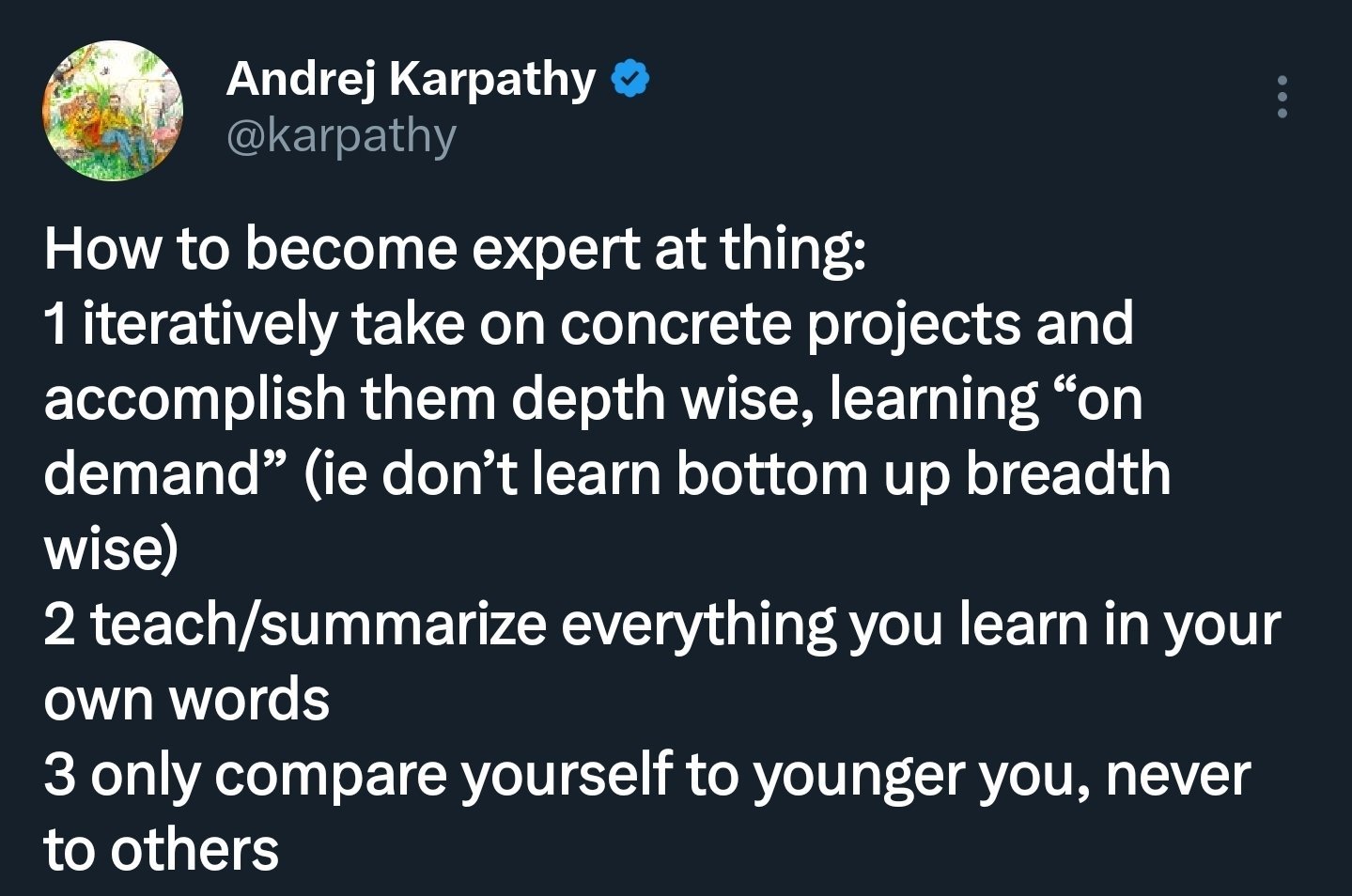
  • @TheAhmadOsman shared Karpathy's advice on becoming an expert at anything: build things from scratch to understand the internals. Still the best learning strategy in the AI era.
  • @angeloldesigns launched Supa Colors, a palette generator focused on visual balance rather than pure math. Three years of color tool work distilled into one product.
  • @exQUIZitely went on a nostalgia trip about Anno 1602, the Austrian city-builder that held Germany's #1 sales spot for five years. Not AI-related, but a welcome palette cleanser.
  • @theo noted Cursor's migration to React is "going roughly as expected" with a laughing emoji. Framework migrations remain painful even for AI-powered editors.
  • @theo also observed that AI has effectively killed GraphQL mentions in his timeline. REST won by outlasting.
  • @ashebytes shared reflections on beauty being found in the relational and AI's potential to reconnect us with our own humanity.
  • @doodlestein dropped a reference to their cass and xf search tools for coding agent sessions and Twitter archives, building out a personal search infrastructure.

Agent Orchestration and the Human Bottleneck

The multi-agent conversation has matured dramatically. We've moved past "look, an agent did a thing" into serious operational discussions about running agent fleets reliably. @unclebobmartin's observation that "with three agents Claude is waiting for me. I am the bottleneck. And the bottleneck is all planning" captures a fundamental shift in how development work gets structured. The constraint isn't AI capability anymore. It's human capacity to plan, review, and direct.

This reality is spawning an entire category of tooling and methodology. @ryancarson is working on patterns for agents that "learn and ship while you sleep," while @dcwj published "The Mr. Meeseeks Method" for building software factories. @mattshumer_ demonstrated Clawd autonomously signing up for a Reddit account using its own email through @agentmail, showing agents handling increasingly complex multi-step workflows without human intervention.

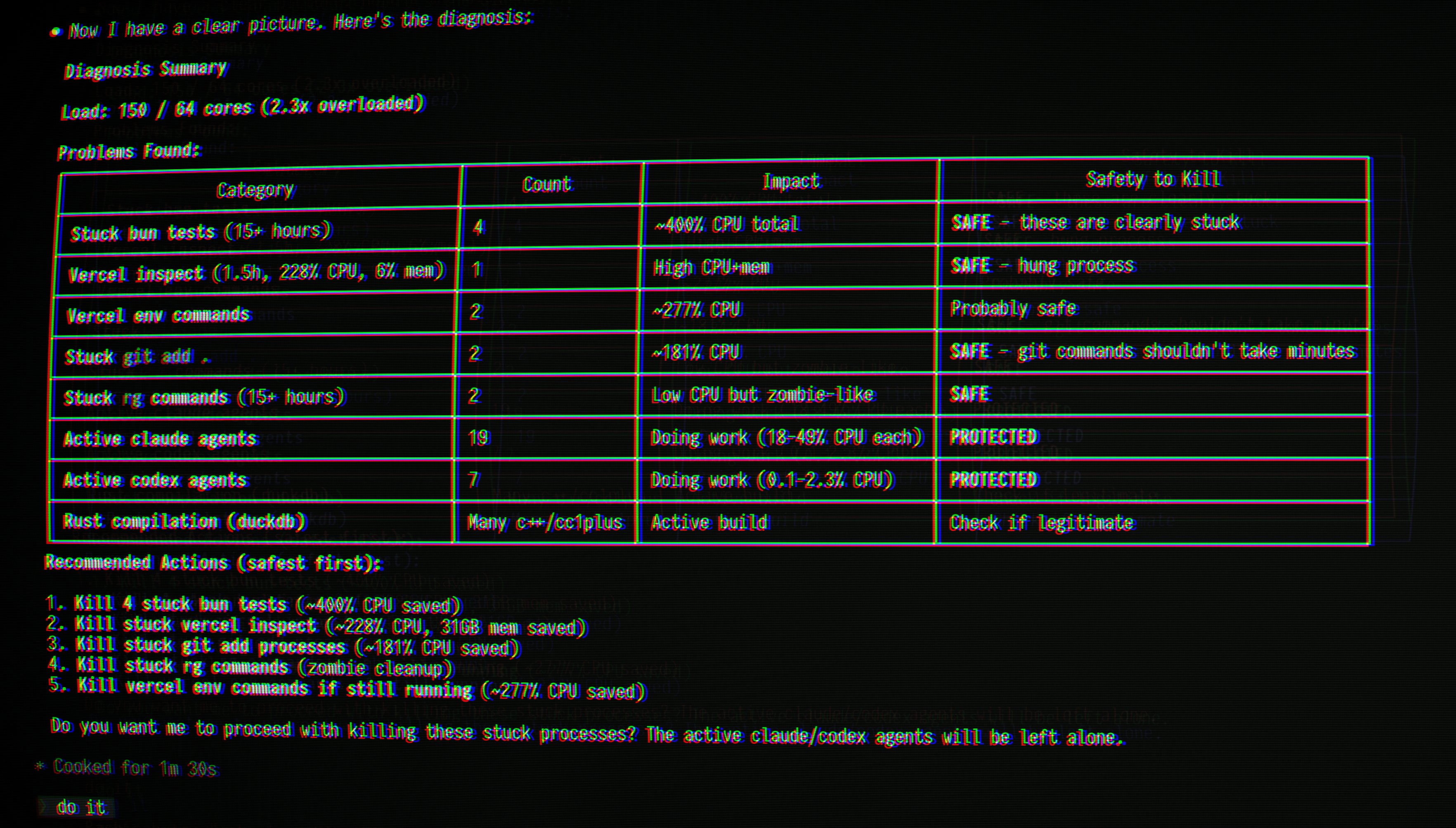
But the operational overhead of running agents is real and underappreciated. @doodlestein's new "System Performance Remediation" skill addresses a problem that anyone running multiple agents has encountered:

"The sheer amount of zombie / stuck / malfunctioning stuff that accumulates is mind-boggling to me when you run enough agents... This stuff adds zero value and is often just pointlessly bringing your machine to its knees."

On the context management side, @masondrxy described a dynamic offloading approach that reads like garbage collection for agent memory: "When context hits a threshold, large tool inputs and results are swapped for filesystem pointers and 10-line previews, while older history is compressed into a summary that the agent can 're-read' via retrieval tools only when needed." @jumperz added a practical refinement: writing to memory files mid-session rather than just at end-of-day captures more context before it gets lost. These aren't theoretical patterns. They're production solutions from people running agents at scale.

Claude Code: Context as Architecture

A cluster of posts today focused specifically on how to structure project instructions for maximum effectiveness. The consensus is clear: context management is becoming an architectural concern on par with database schema design or API contracts. @housecor made the case for placing CLAUDE.md files in subfolders rather than at the project root:

"When instructions only apply to a subfolder, place the CLAUDE.md within the subfolder. Why? Then those instructions are lazy loaded. They're only in context when that subfolder is read/written to."

@somi_ai validated this pattern from production experience: "We have like 12 different CLAUDE.md files across our project and it keeps context super focused. The trick is putting high level architecture stuff in root and feature specific stuff in subdirs." This is a genuinely useful architectural pattern that trades a small amount of file management overhead for significantly better context utilization.

@AndrewYNg announced a new DeepLearning.AI course on Agent Skills built with Anthropic, covering how to create skills that work across Claude.ai, Claude Code, the API, and the Agent SDK. The fact that skills follow an open standard format means you build once and deploy across platforms, which is exactly the kind of composability the ecosystem needs. Meanwhile, @damianplayer took a more skeptical angle with "Claude Code Is Mostly Hype. Unless You Do This," suggesting the gap between hype and reality comes down to how deliberately you configure your environment.

The Career Anxiety Spectrum

Today's career discourse spanned the full range from thoughtful to nihilistic. @hosseeb wrote the most substantive piece, drawing a parallel to the 1993 PC revolution and arguing against sitting on the sidelines:

"No matter how old you are or young you are, no matter what stage of your career you are in, we are all going through the biggest technological change of the last 100 years... Nobody has the answers. It's obvious that so much is going to change, but nobody is going to figure it out before you do if you choose to stay at the frontier."

On the darker end, @davidpattersonx offered "Don't learn to code. In fact, don't plan a career in anything," while @andruyeung declared "Entry-level McKinsey consultants have now been automated." @alexhillman observed that "software became a factory floor and nobody noticed until it was too late." These aren't fringe takes anymore. They reflect a genuine uncertainty that even experienced engineers are grappling with.

@PatrickHeizer raised what might be the most underrated scenario in the entire AI discourse: "AGI is never achieved, but it's enough of a capable replica that most 'BS jobs' are eliminated, creating an economic crisis where the productivity gains from the not-quite AGI can't 'raise the tide' enough for all." This middle path, where AI is good enough to displace but not good enough to create entirely new economic paradigms, deserves more serious consideration than it gets.

Local Inference Reaches Price Parity

The economics of local AI inference are shifting fast. @thdxr pointed out that consumer hardware capable of running very good models now costs $20K, right in the range that many companies already spend per developer per year on cloud inference. "Can't believe we're here already," he wrote, and the sentiment is warranted.

@TheAhmadOsman demonstrated the practical reality: running Claude Code with local models on 4x RTX 3090s serving GLM-4.5 Air through vLLM. "This is what local AI actually looks like," he noted alongside GPU utilization screenshots. Meanwhile, @doodlestein conducted an extensive bake-off of local embedding models for semantic search, ultimately landing on a two-tier system using potion-128M for sub-millisecond first-pass results while all-MiniLM-L6-v2 runs in the background to refine rankings. The approach of showing results immediately and then upgrading them as the better model finishes is exactly the kind of practical UX thinking that makes local AI actually usable.

Developer Tools and Protocols

The tooling layer continues to thicken. @github announced that Copilot CLI now supports the Agent Client Protocol (ACP), enabling standardized communication between AI agents and clients for initializing connections, creating isolated sessions, sending multimodal prompts, and receiving streaming updates. This is infrastructure-level work that could reshape how agents integrate with IDEs, CI/CD pipelines, and multi-agent systems.

@balintorosz launched Beautiful Mermaid, a visual layer on top of the Mermaid diagramming format. "Diagrams are becoming my primary way of reasoning about code with Agents," he explained, and this tracks with the broader trend of using visual representations as an interface between human intent and agent execution. @sawyerhood released Do Browser, claiming 110x speed improvement over Claude for Chrome on tasks like retheming Figma files (30 seconds vs 55 minutes). And @nummanali is experimenting with Playwright and end-to-end tests managed entirely by agents, another sign that testing is becoming an agent-native workflow.

AI in Practice: Refactoring, Reverse Prompting, and Research Bets

Three posts today captured different facets of AI delivering real value in practice. @mattgperry identified refactoring as AI's sweet spot: "It's tedious, not imaginative, and error prone. The refactor needed to get layout animations running outside React was massive & I abandoned a couple week-long attempts last year. Opus 4.5 had it done in an afternoon." This is a concrete, reproducible result that should shape how teams plan technical debt work.

@theallinpod shared Coinbase CEO Brian Armstrong describing "reverse prompting," where instead of telling an AI what to do, you ask it what you should be thinking about. Armstrong's internal AI, connected to all company data sources, told him about team disagreements he wasn't aware of and analyzed how he actually spent his time versus how he intended to. This inverts the typical AI interaction model and suggests a powerful pattern for organizational intelligence.

Finally, @karpathy pushed back on the narrative that it's too late for new AI research startups: "With still a large gap between frontier LLMs and the example proof of the magic of a mind running on 20 watts, the probability of research breakthroughs that yield closer to 10X improvements (instead of 10%) imo still feels very high." Coming from someone who watched OpenAI prove this thesis once already, it's a bet worth taking seriously. @filippkowalski also highlighted Claude managing App Store workflows autonomously, showing the long tail of practical applications continuing to extend.

Source Posts

Z
Zac @PerceptualPeak ·
WOW!!! If you have semantic memory tied to your UserPromptSubmit hooks, you MUST ALSO include it in your PreToolUse hook. I promise you - it will be an absolute GAME CHANGER. It will put your efficiency levels are over 9,000 (*vegeta voice*). How many times have you sat there, watching Claude code go through an extended workflow, just to notice it start to go down a path you just KNOW will be error filled - and subsequently take it forever to FINALLY figure it out? The problem with relying strictly on the UserPromptSubmit hook for semantic memory injection is the workflow drift from your original prompt. The memories it injects at the initiation of your prompt will be less and less relevant to the workflow the longer the workflow is. Claude has a beautiful thing called thinking blocks. These blocks are ripe for the picking - filled with meaning & intent - which is perfect for cosign similarly recall. Claude thinks to itself, "hmm, okay I'm going to do this because of this", then starts to engage the tool of its choice, and BOOM: PreToolUse hook fires, takes the last 1,500 characters from the most recent thinking block from the active transcript, embeds it, pulls relevant memories from your vector database, and injects them to claude right before it starts using its tool (hooks are synchronous). This all happens in less than 500 milliseconds. The result? A self correcting Claude workflow. Based on my testing thus far, this is one of the most consequential additions to my context management system I've implemented yet. Photos: ASCII chart showing the workflow of the hook, and then two real use-cases of the mid-stream memory embedding actually being useful. If you already have semantic memory setup, just paste this tweet and photos into Claude code and tell it to implement it for you. Then enjoy the massive increase of workflow efficiency :)
D
Damian Player @damianplayer ·
Clawdbot Is Mostly Hype. Unless You Do This (read twice)...
A
Angelo Libero @angeloldesigns ·
Excited to share something I've been working on. 3 years of color tools. 2 months building this. Supa Colors generates palettes where every shade looks balanced — visually, not just mathematically. Really proud of it. 🔗 https://t.co/LT0GSmor7H https://t.co/esBIlNEly3
M
Mason Daugherty @masondrxy ·
We use dynamic offloading to fight token bloat. When context hits a threshold, large tool inputs and results are swapped for filesystem pointers and 10-line previews, while older history is compressed into a summary that the agent can "re-read" via retrieval tools only when needed.
H
Haseeb >|< @hosseeb ·
On the one hand, AI influencers are breathlessly raving about Claude Code, Clawdbot, and Cowork. And on the other hand, most people I know—even software engineers—are despondent, overwhelmed about how everything is changing so quickly. I hear this from people early in their careers especially, a fear that everything they've learned and the skills they've gained are rapidly being devalued. This is a mental trap. Don't fall for it. You should not just be watching from the sidelines or reading articles about "how software engineering is changing." Imagine it was 1993 and the personal computer revolution was kicking off. If you could go back in time to then, what should you have done? The answer: try everything. Buy a PC. Learn how to touch type. Figure out what the Internet is. Imbibe it all. Don't wait until it becomes a job requirement. That's exactly what you should do with AI. Try everything. Try Claude Code, try Clawdbot, try the Excel integrations, Veo, everything you can get your hands on. Learn what it's doing. Build your intuitions. Be one step ahead of it. Evolve alongside it. Don't lose your curiosity or get swallowed by anxiety or let yourself be convinced that you'll learn it when you have to. Think deeply about how AI will change the things around you—not society, that's too hard to project—but how it will change your job, your personal life, your immediate environment. No matter how old you are or young you are, no matter what stage of your career you are in, we are all going through the biggest technological change of the last 100 years, and we're going through it together. Nobody has the answers. It's obvious that so much is going to change, but nobody is going to figure it out before you do if you choose to stay at the frontier. So don't hide from it. Sit at the front of the class. Pay close attention. And be grateful that it's never been easier to stay at the frontier of the most important technology change of our lifetimes.
A
Andrew Yeung @andruyeung ·
Entry-level McKinsey consultants have now been automated.
S Superagent @superagent

We are Superagent, the AI product for deeper thinking. Now part of @Airtable, Superagent is the next evolution of DeepSky. Turn your complex business questions into boardroom-ready answers, beautifully rendered as reports, slides, or websites. 🔗Try it: https://t.co/m0pq6DVAFq https://t.co/VtvzsMnVOA

J
JUMPERZ @jumperz ·
@ryancarson running this pattern too. one addition: having the agent write to memory files mid-session not just end of day catches more context before it gets lost
J
Jeffrey Emanuel @doodlestein ·
My new "System Performance Remediation" skill is so useful. I wish I had done this weeks ago. Often the reason your machine is sluggish isn't what you think it is. Yes, you know you're running a lot of agents and that some might be doing slow compilations or test suites at the same time. But the sheer amount of zombie / stuck / malfunctioning stuff that accumulates is mind-boggling to me when you run enough agents (especially when they stop in the middle of what they're doing because of usage limits and you restart them rather than doing the login flow because your hand hurts too much... ahem @bcherny). This stuff adds zero value and is often just pointlessly bringing your machine to its knees. And this stuff is cumulative if you don't periodically "clean off the barnacles."
D
Daniel Colin James @dcwj ·
The Mr. Meeseeks Method: How to Make a Software Factory (For Dummies)
B
Boris Cherny @bcherny ·
In case it’s not clear in the docs: - Ancestor https://t.co/pp5TJkWmFE’s are loaded into context automatically on startup - Descendent https://t.co/pp5TJkWmFE’s are loaded *lazily* only when Claude reads/writes files in a folder the https://t.co/pp5TJkWmFE is in. Think of it as a special kind of skill. We designed it this way for monorepos and other big repos, tends to work pretty well in practice.
N
Numman Ali @nummanali ·
Currently testing UI with with playwright and e2e tests managed by agents Aidens approach looks very superior and optimised Going to need to give this a spin
A Aiden Bai @aidenybai

Introducing Ami Browser Build a feature → Agent tests web app and fixes bugs here's Ami discovering an infinite like glitch on X https://t.co/rkli2Rx8Ls

d
dax @thdxr ·
this costs $20K and it's on consumer hardware and this model is very very good lot of companies are already spending $10-20k per dev per year on cloud inference can't believe we're here already
A Alex Cheema - e/acc @alexocheema

Running Kimi K2.5 on my desk. Runs at 24 tok/sec with 2 x 512GB M3 Ultra Mac Studios connected with Thunderbolt 5 (RDMA) using @exolabs / MLX backend. Yes, it can run clawdbot. https://t.co/ssbEeztz2V

U
Uncle Bob Martin @unclebobmartin ·
With one agent, I used to wait for Claude. With two agents I still waited for Claude, but not as long. With three agents Claude is waiting for me. I am the bottleneck. And the bottleneck is all planning.
M
Matt Shumer @mattshumer_ ·
This demo is the craziest thing you’ll see today. Full stop. Watch Clawd SIGN UP for a Reddit account completely autonomously with its own email account (thru @agentmail) + web browser. The next six months are going to be wild. https://t.co/B2Jh5BehJj
N
Numman Ali @nummanali ·
The Future of Software distribution will be via Specification Amazing read: https://t.co/wSZUV5KGOO cr: @kenn https://t.co/ovJE0QTL9k
A Andrej Karpathy @karpathy

@airesearch12 💯 @ Spec-driven development It's the limit of imperative -> declarative transition, basically being declarative entirely. Relatedly my mind was recently blown by https://t.co/pTfOfWwcW1 , extreme and early but inspiring example.

A
Andrew Ng @AndrewYNg ·
Important new course: Agent Skills with Anthropic, built with @AnthropicAI and taught by @eschoppik! Skills are constructed as folders of instructions that equip agents with on-demand knowledge and workflows. This short course teaches you how to create them following best practices. Because skills follow an open standard format, you can build them once and deploy across any skills-compatible agent, like Claude Code. What you'll learn: - Create custom skills for code generation and review, data analysis, and research - Build complex workflows using Anthropic's pre-built skills (Excel, PowerPoint, skill creation) and custom skills - Combine skills with MCP and subagents to create agentic systems with specialized knowledge - Deploy the same skills across https://t.co/Ru4OXv4saV, Claude Code, the Claude API, and the Claude Agent SDK Join and learn to equip agents with the specialized knowledge they need for reliable, repeatable workflows. https://t.co/3hq83c3q0U
A
Ahmad @TheAhmadOsman ·
running Claude Code w/ local models on my own GPUs at home > vLLM serving GLM-4.5 Air > on 4x RTX 3090s > nvtop showing live GPU load > Claude Code generating code + docs > end-to-end on my AI cluster this is what local AI actually looks like Buy a GPU https://t.co/WZkjjUtMoi
📙
📙 Alex Hillman @alexhillman ·
I regret to inform you that I've removed another MCP server and replaced it with a CLI and skill file
A
Ahmad @TheAhmadOsman ·
nobody should use ollama btw > slower than llama.cpp on windows > slower than mlx on mac > slop useless wrapper alternatives? > lmstudio > llama.cpp > exllamav2/v3 > vllm > sglang like literally anythingʼs better than ollama lmao
A
Andrej Karpathy @karpathy ·
A conventional narrative you might come across is that AI is too far along for a new, research-focused startup to outcompete and outexecute the incumbents of AI. This is exactly the sentiment I listened to often when OpenAI started ("how could the few of you possibly compete with Google?") and 1) it was very wrong, and then 2) it was very wrong again with a whole another round of startups who are now challenging OpenAI in turn, and imo it still continues to be wrong today. Scaling and locally improving what works will continue to create incredible advances, but with so much progress unlocked so quickly, with so much dust thrown up in the air in the process, and with still a large gap between frontier LLMs and the example proof of the magic of a mind running on 20 watts, the probability of research breakthroughs that yield closer to 10X improvements (instead of 10%) imo still feels very high - plenty high to continue to bet on and look for. The tricky part ofc is creating the conditions where such breakthroughs may be discovered. I think such an environment comes together rarely, but @bfspector & @amspector100 are brilliant, with (rare) full-stack understanding of LLMs top (math/algorithms) to bottom (megakernels/related), they have a great eye for talent and I think will be able to build something very special. Congrats on the launch and I look forward to what you come up with!
F Flapping Airplanes @flappyairplanes

Announcing Flapping Airplanes! We’ve raised $180M from GV, Sequoia, and Index to assemble a new guard in AI: one that imagines a world where models can think at human level without ingesting half the internet. https://t.co/7W7WNJ278R

S
Somi AI @somi_ai ·
honestly the lazy loading is so clutch for monorepos. we have like 12 different https://t.co/pbJ4jymZPh files across our project and it keeps context super focused. the trick is putting high level architecture stuff in root and feature specific stuff in subdirshonestly the lazy loading is so clutch for monorepos. we have like 12 different https://t.co/pbJ4jymZPh files across our project and it keeps context super focused. the trick is putting high level architecture stuff in root and feature specific stuff in subdirs
P
Patrick Heizer @PatrickHeizer ·
We underrate potentially the worst non-lethal AI situation: AGI is never achieved, but it's enough of a capable replica that most "BS jobs" are eliminated, creating an economic crisis where the productivity gains from the not-quite AGI can't 'raise the tide' enough for all.
e
exQUIZitely 🕹️ @exQUIZitely ·
Some games had a wonderfully soothing and relaxing vibe - usually the slow paced "build your empire" games. Few have done it better than Anno 1602 (Max Design, 1998), which I consider among the best ever of its kind. I can't think of too many Austrian game studios, MAX Design being the rare exception. Generally, games that were created in and for the German speaking market, didn't do that well outside of those, but the first Anno game (many, many sequels followed) was so incredibly popular, that it remained the #1 selling game in Germany for 5 years until 2003, and its success helped it boost sales overseas, too. Total sales for Anno 1602 eventually closed in on 3 million, an unheard number for a small game studio at the time. What was normally a male dominated industry, got turned on its head a bit, with a large portion of the Anno 1602 players being female. The Anno series had 7 more sequels, the latest one being published in 2025.
T
The All-In Podcast @theallinpod ·
Coinbase CEO Explains “Reverse Prompting” and the Rise of the AI CEO @brian_armstrong: “One of the big pushes we made in the last year was we got our own internal hosted AI model that was connected to all of our data sources, right?” “So it's like every Slack message, every Google doc, Salesforce data, Confluence, you know.” “So now the data is all aggregated and I've started to ask it really… it's not just like prompting it, ‘Hey, can you write this kind of memo for me,’ or something.” “I'm asking these AI agents now, ‘As CEO, what should I be aware of in the company that I might not be aware of?’ And it'll tell me, ‘Did you know that there's actually disagreement on this team about the strategy?’ And I was like, actually, I didn't know that.” “This is like reverse prompting. So instead of telling the AI agent what you want it to do, you ask it what you should be thinking more about.” @Jason: “It's a mentor. It's a coach.” Brian: “Yeah. Like, what could make me a better CEO? And it's like, ‘Well, I looked at how you spent your time in the last quarter and here's how you said that you wanted to spend it, but you actually spent 32% of your time on this instead of 20%.’” “I've asked it other questions like, ‘What's the thing that I changed my mind on the most over the last year?’ Things like that.” “It'll prompt you with information you should be thinking about instead of the other way around.” Thanks to our partner for making this happen!: Our episode is sponsored by the New York Stock Exchange - a modern marketplace and exchange for building the future. It all happens at the @NYSE. https://t.co/cUEk8db7Sw
R
Ryan Carson @ryancarson ·
How to make your agent learn and ship while you sleep
A
Ahmad @TheAhmadOsman ·
great advice to become an expert at anything from Andrej Karpathy this is how i learned the inner workings of LLMs btw https://t.co/oki3ULZPNZ
R
Ryan Graves @uncertainvector ·
I remember being told that this wasn’t real and I should be amazed at how well these algorithms could predict my purchasing preferences. Turns out they were doing exactly what everyone thought.
R RT @RT_com

Has your phone ever shown you an ad for something you only whispered...? Google agrees to fork over $68MN to settle claims that its Assistant was SECRETLY recording your convos WITHOUT 'Hey Google' & feeding them straight to targeted ads — The Hill No wrongdoing admitted though https://t.co/GTbFjsBhfE

M
Mason Daugherty @masondrxy ·
Context Management for Deep Agents
T
Theo - t3.gg @theo ·
Upsides of AI: I haven't heard anyone mention GraphQL in years
N
Naval @naval ·
There’s no point in learning custom tools, workflows, or languages anymore.
C
Chris Sev @chris__sev ·
Very thoughtful (and terrifying) article. My favorite is the email prompt injection if you gave your @openclaw access to gog (Google CLI) https://t.co/Xoj4DoHFXg
c chirag @mrnacknack

10 ways to hack into a vibecoder's clawdbot & get entire human identity (educational purposes only)

T
Theo - t3.gg @theo ·
Sounds like Cursor’s move to React is going roughly as expected 🤣
i ian @shaoruu

another @cursor_ai command that i've been using to remove unnecessary reactjs useEffects: /you-might-not-need-an-effect /you-might-not-need-an-effect scope=all diffs in branch /you-might-not-need-an-effect fix=no useful for cleaning up 💩 code, 🧵 below https://t.co/nRg7AHSRSt

J
Jeffrey Emanuel @doodlestein ·
I wanted to have a good, lightweight, and fast semantic embedding model for local search for both my cass tool (for searching across coding agent sessions) and my xf tool (for searching your downloaded X archives). Basically, it has to run on CPU only and should be fairly quick (sub-1-second response) and actually "understand" semantic concepts well. I also needed a "reranker" model for fusing together the semantic search results with the standard lexical search results to get a good hybrid search, with the same requirements for CPU-only speed. There are so many options to choose from for both that it's a bit overwhelming if you want to pick the current all-around best ones. So I had Claude do a bunch of web research and then conduct a "bake off". You can see what it came up with here (the whole /docs directory is filled with relevant stuff): https://t.co/Y4HTGLFYfw So what did I end up choosing in the end? The two main choices were the potion-128M model, which has sub-millisecond response time and "ok" results, and a bona fide mini transformer model, all-MiniLM-L6-v2, that has really decent embeddings but takes 128ms to respond, or 223x slower! Finally, I realized I didn't need to choose, I would have my cake and eat it, too. I asked Claude: "what about a 2-tier system where we use potion as a first pass but at the same time in the background (separate thread or memory-resident "hot" process for quick start) we do miniLM-L6 and then when it finishes we "upgrade" the search results in an intuitive way, showing the results continuously moving to rearrange according to the revised semantic scores; this shouldn't change the rankings TOO much." Claude liked the idea (see screenshots) and the rest is history. This will be my standard search that I use across all my Rust tooling (I'll probably port it to Golang, too, so I can embed it in bv natively).
📙
📙 Alex Hillman @alexhillman ·
Software became a factory floor and nobody noticed until it was too late (or they got paid enough to ignore it and leaned into the pyramid scheme)
T Taylor Eernisse @theirongolddev

@alexhillman It’s one of the worst things about a lot of corporate software engineering today; engineers rarely get to be creative, they’re just expected to stay in line and do what they’re told. Attempts to innovate are often rebuked out of hand.

B
Balint Orosz @balintorosz ·
Diagrams are becoming my primary way of reasoning about code with Agents. And I didn't find anything there that I'm happy to look at all day long. Mermaid as a format is amazing - so we built something beautiful on top of it. It's called Beautiful Mermaid https://t.co/HCE43DM7Gx
M
Matt Perry @mattgperry ·
One area where I've found AI to really shine is refactoring. It's tedious, not imaginative, and error prone. The refactor needed to get layout animations running outside React was massive & I abandoned a couple week-long attempts last year. Opus 4.5 had it done in an afternoon.
M Motion @motiondotdev

Long promised, finally delivered. Layout animations are now available everywhere! Powered completely by performant transforms, with infinitely deep scale correction and full interruptibility. Now in alpha via Motion+ Early Access. https://t.co/Scm8Wbdmis

C
Cory House @housecor ·
This is an important point for context optimization. When instructions only apply to a subfolder, place the https://t.co/i5oTIORKNu within the subfolder. Why? Then those instructions are lazy loaded. They’re only in context when that subfolder is read/written to.
B Boris Cherny @bcherny

In case it’s not clear in the docs: - Ancestor https://t.co/pp5TJkWmFE’s are loaded into context automatically on startup - Descendent https://t.co/pp5TJkWmFE’s are loaded *lazily* only when Claude reads/writes files in a folder the https://t.co/pp5TJkWmFE is in. Think of it as a special kind of skill. We designed it this way for monorepos and other big repos, tends to work pretty well in practice.

I
INK @0xInk_ ·
so there’s a guy who just came straight out of the future to show us how to use AI if you’re looking for advanced AI workflows, follow Dilum Sanjaya
D Dilum Sanjaya @DilumSanjaya

Vibe coded a ship selection UI for a space exploration game 3D assets Nano Banana + Midjourney → Hunyuan3D UI Nano Banana → Gemini Pro More details ↓ https://t.co/Ngky4nudC7

F
Filip Kowalski @filippkowalski ·
This is super handy With this Claude can manage a lot of the app store related stuff on it's own
R Rudrank Riyam @rudrank

App Store Connect CLI 0.16.0 is out as one of the biggest releases yet! It covers the entire App Store review workflow end‑to‑end: details, attachments, submissions, and items, all under a single `asc review` command. Enjoy! https://t.co/bJrdsQ2CjD https://t.co/sDXXPg6Ahd
D
David Scott Patterson @davidpattersonx ·
Don’t learn to code. In fact, don’t plan a career in anything.
N Naval @naval

There’s no point in learning custom tools, workflows, or languages anymore.

J
Jeffrey Emanuel @doodlestein ·
@XyraSinclair Just cass, xf is for searching your personal X/Twitter archive (and this search system will be in both within a day, 2 max): https://t.co/55m0AwDpYe
J Jeffrey Emanuel @doodlestein

I'm very pleased to introduce my latest tool, xf, a hyper-optimized Rust cli tool for searching your entire Twitter/X data archive. You can get it here: https://t.co/S91cAGleaK Many people don't realize this, but X has a great feature buried in the settings where you can request a complete dump of all your tweets, DMs, likes, etc. It takes them 24 hours to prepare it, but then you get a link emailed to you and can download a single zip file with all your stuff. Mine was around 500mb because of all the images I've posted. The problem is, what do you do with it? It's not very convenient or fast to search the way they give it to you. Enter xf, which takes that zip file and makes it into an incredibly useful knowledge base, at least if you use X a lot. And that's because you get it for free! You're just piggybacking on something you were already doing anyway for other reasons. As you may have noticed, I'm a bit addicted to posting on here and also to building in public. So whenever I have a new tool, I usually post about it and explain how I use it and answer questions. I also have a ton of posts about my workflows in general, and my advice on how to do things, my opinions on various tools and libraries, etc. All of that is potentially relevant to a coding agent that is working on my projects, editing my personal website, responding to GitHub issues on my behalf, etc. So now, I can just tell them to use xf; simply typing that shows the quickstart screen shown in the attached screenshot, and then the agents are off to the races. The more you use X (for work at least, it's not going to help if you just troll people), the more of an unlock this is for your personal productivity. Imagine that you're a cult leader with devoted acolytes (your agents). Before doing anything, you want them to ask "What would our leader do?" and then they think "I know! I shall consult the sacred texts!" (i.e., your tweets and DMs). That can be your new reality starting today if you install xf. PS: Can someone get this to Elon? I think he would love seeing how fast this tool tears through a massive archive of data and he would end up using it daily. And if someone from X sees this: please make the archives include the full text of any tweet you reply to, it would make this tool even more useful.

B
Bill Ackman @BillAckman ·
If @elonmusk can bring sight to the blind, it will outdo every one of his near-miraculous achievements to date. With all of the ‘bad news’ that circulates to drive your attention, it is important to be reminded that we have so much more to be optimistic about.
D DogeDesigner @cb_doge

ELON MUSK: "Our next product, Blindsight will enable those who have total loss of vision, including if they've lost their eyes or the optic nerve, or maybe have never seen, or even blind from birth, to be able to see again." https://t.co/3SQirqsimx

G
GitHub @github ·
🆕 Copilot CLI now supports the Agent Client Protocol. Set up this communication between AI agents and clients to: • Initialize a connection and discover agent capabilities • Create isolated sessions with custom working directories • Send prompts with text, images, and context resources • Receive streaming updates as the agent works • And more ✅ Learn how you can rethink IDE integrations, CI/CD pipelines, custom frontends, and multi-agent systems with ACP. 👇 https://t.co/voS348IOoM