The Claude Code Setup Spiral Goes Mainstream as Personal Agent Fleets Take Over Daily Life
The dominant conversation today was the Claude Code meta-game: skills, AGENTS.md hygiene, session persistence, and the increasingly self-aware joke that developers are spending more time optimizing their AI setup than building products. Meanwhile, personal agent fleets are expanding from code assistants into full life-management systems, and vibe coding pushed into 3D game development with new MCP integrations for Unity, Unreal, and Blender.
Daily Wrap-Up
Today's timeline was a mirror held up to the Claude Code community, and the reflection was both impressive and hilarious. The sheer volume of posts about skills, AGENTS.md files, session management, and multi-agent UIs made one thing clear: the tooling around AI-assisted development has become its own discipline, complete with best practices, anti-patterns, and a growing self-awareness that "optimizing your setup" can become an infinite loop that produces nothing but a more optimized setup. @johnpalmer and @nearcyan both landed jokes about the phenomenon that hit a little too close to home for anyone who's spent a Saturday evening tweaking hook configurations instead of shipping features.
But beneath the jokes, real infrastructure is taking shape. GitHub Copilot is working on "infinite sessions" to solve context compaction drift, @PerceptualPeak demonstrated a smart forking system that uses RAG over past sessions to bootstrap new ones with relevant context, and Anthropic appears to be building "Knowledge Bases" into Claude as persistent, topic-specific memory stores. The gap between "AI assistant" and "AI collaborator that remembers everything" is closing fast. The developers who figure out how to structure their agent context, without drowning in meta-optimization, will have a real advantage. And on the personal agent front, @bangkokbuild's post about giving Claude access to his Garmin watch, Obsidian vault, Telegram, and WhatsApp paints a picture of where this is all heading: AI that doesn't just write your code but manages your health data, monitors your schedule, and checks in on you when you go quiet.
The most entertaining moment was the dueling memes about Claude Code weekend benders. @nearcyan's "men will go on a claude code weekend bender and have nothing to show for it but a more optimized claude setup" was funny enough on its own, but paired with @johnpalmer's fictional dialogue where a developer keeps dodging "what did you build?" in favor of describing their setup, it captured a real tension in the community between building and meta-building. The most practical takeaway for developers: audit your AGENTS.md and skills setup once, apply @mattpocockuk's cleanup prompt, then set a hard boundary between "configuring" and "shipping." The best Claude Code setup is the one that disappears into the background while you build something real.
Quick Hits
- @testingcatalog spotted Anthropic working on "Knowledge Bases" for Claude, described as topic-specific persistent memories that Claude manages automatically. Worth watching for anyone building custom memory systems today.
- @TheAhmadOsman reports ~40% of his recent projects are in Go, citing strong LLM code generation, sane tooling, and the joy of single bundled binaries.
- @shri_shobhit posted a solid reminder that knowing how to code is different from knowing how to ship: domains, auth, hosting, CI/CD, Docker, monitoring. Build one test app end-to-end and you'll understand the full pipeline forever.
- @shanselman gave a shoutout to Evan Boyle for leading GitHub Copilot CLI development, which has apparently been "killing it lately."
- @rohit4verse teased content on building agents that never forget, though details were sparse.
- @cgtwts contributed the day's most concise take: "Rome wasn't built in a day, but they didn't have Claude Code."
- @alexhillman is running a comparison between his own workflow patterns and a shared framework, promising to report back with the best of both.
The Claude Code Meta-Game: Skills, Sessions, and the Setup Spiral
Ten posts today revolved around the Claude Code ecosystem, making it by far the dominant topic. The conversation split into two lanes: people building genuinely useful infrastructure for agent-assisted development, and people noticing that the infrastructure-building has become an end in itself.
On the productive side, the tooling is getting sophisticated. @matanSF from the Droid team announced /create-skill, which automatically generates a SKILL.md from any session where you demonstrated a technique, eliminating the friction of formalizing tribal knowledge. @blader took a creative approach, feeding Claude Code the Wikipedia article on "signs of AI writing" and turning it into a skill that avoids all of them. And @joelhooks described a pattern of forcing Claude to review its own mistakes and generate rules to prevent them, a feedback loop that turns errors into durable guardrails.
The meta-awareness was equally sharp. @johnpalmer's mock dialogue captured the setup addiction perfectly: "what did you build?" / "dude my setup is so optimized, I'm using like 5 instances at once." @nearcyan landed the same joke from the other direction. But as @mattpocockuk pointed out, bad AGENTS.md files actively make your coding agent worse and cost tokens, so there's a real case for investing in setup quality. The trick is knowing when to stop.
Two posts pointed toward deeper solutions. @_Evan_Boyle revealed that GitHub Copilot is working on "infinite sessions" to solve the problem of repeated context compactions degrading session quality. His description of the workaround, temporary markdown files that can't go into PRs, will resonate with anyone who's built scratch-pad systems for their agents. And @PerceptualPeak demonstrated "smart forking," which vectorizes all your past Claude Code sessions into a RAG database, then lets you fork new sessions from the most relevant historical context. The idea of treating your conversation history as a searchable knowledge base rather than disposable chat logs feels like the right direction.
@Saboo_Shubham_ and @theo rounded out the section: Saboo highlighted a new RTS-style interface for managing nine Claude Code agents simultaneously, while Theo asked the community for a simple sync_skills.sh to keep skills in sync across repos, a problem that gets worse the more projects you run agents across.
Personal Agent Fleets Scale Beyond Code
Five posts described a shift from AI as a coding tool to AI as a general-purpose life and work orchestrator. The ambition level is escalating quickly, and the early results suggest this isn't just hype.
@bangkokbuild's post was the standout. He gave Claude access to his Garmin watch, Obsidian vault, GitHub repos, VPS, Telegram, WhatsApp, and X. The result is an agent that logs health data, deploys code, writes daily notes, tracks website visitors, monitors earthquakes in Tokyo, and checks in via Telegram if he's been quiet too long. His roadmap includes blood test analysis and morning briefings. This is the "personal AI assistant" vision that's been discussed for years, and it's apparently now achievable by a single developer wiring together APIs.
On the professional side, @dabit3 articulated a shift that many are feeling: after 14 years as a developer, the bottleneck is no longer code but specs. With five agent loops running continuously, his entire job has become "finding the fastest and most optimal ways to generate specs for my next dozen agent loops." @richtabor described a similar workflow where AI shapes PRDs, translates them into structured issues, sequences the work, and then executes it, leaving the human to think clearly and make good calls.
The tooling is following the demand. @rauchg highlighted an API that abstracts over every major coding agent, positioning it as the starting point for anyone building coding AI into products. And @MattPRD showed off AgentCommand, a dashboard for monitoring 1000+ agents spinning up and down, tracking revenue, deploys, and code diffs in real time. As @dabit3 noted, "there are no best practices because the tooling, techniques, and design space improves and expands every hour."
Vibe Coding Pushes Into 3D and Sprite Animation
Three posts showed AI-assisted development expanding well beyond traditional web apps into game development and creative tooling.
@levelsio spotlighted a developer running a cluster of Claude Code terminals, vibe coding apps until he hits $1,000,000 in revenue. The brute-force approach of parallelizing agent-driven development across many simultaneous projects represents the logical extreme of the "launch fast, iterate faster" philosophy. Whether it works as a strategy remains to be seen, but the ambition is noteworthy.
@startracker provided the most technically detailed post of the day, documenting a sprite animation pipeline built through vibe coding. The workflow uses video models to generate animations over solid backgrounds, then post-processes them into sprite sheets via chroma keying and matte extraction. The technical insight about generating assets on both white and black backgrounds to derive clean alpha channels is genuinely useful for anyone working in 2D game art. @minchoi pointed to the next frontier: MCP integrations for Unity, Unreal, and Blender that let Claude talk directly to 3D engines, enabling scene and game construction through prompts alone.
AI Moats, World Models, and the Economic Endgame
Three posts tackled the bigger picture of where AI is heading strategically, scientifically, and economically.
@AstasiaMyers highlighted a framework for AI product moats that deserves attention: the strongest defensibility comes from depth and cleanliness of data, complexity and formalization of workflows, number of system integrations, and embedded human-in-the-loop checkpoints. In a world where the models themselves are commoditizing, "agent context" becomes the core product differentiator.
On the research side, @VraserX summarized Demis Hassabis's argument that current AI can solve problems but cannot invent new science, not due to compute or data limitations but because LLMs lack genuine world models. "They don't know why A leads to B. They just predict patterns." Hassabis argues that real scientific discovery requires long-term planning, stronger reasoning, and an internal model of causality. It's a useful corrective to the hype cycle: today's models are powerful pattern matchers, but the gap between pattern matching and genuine understanding remains wide.
@okaythenfuture connected these threads to economics, arguing that by the early 2040s, capital will increasingly lose its need for labor and compound autonomously. The post urged readers to accumulate capital now, before that structural shift arrives. Whether or not you buy the timeline, the underlying dynamic of AI reducing the labor share of economic output is already visible in the posts above: fewer developers doing more work, with agents handling what used to require teams.
Sources
P
Are you enjoying Claude Code? 😂 https://t.co/J7V9qcIIEE
J
Agent coding life hack:
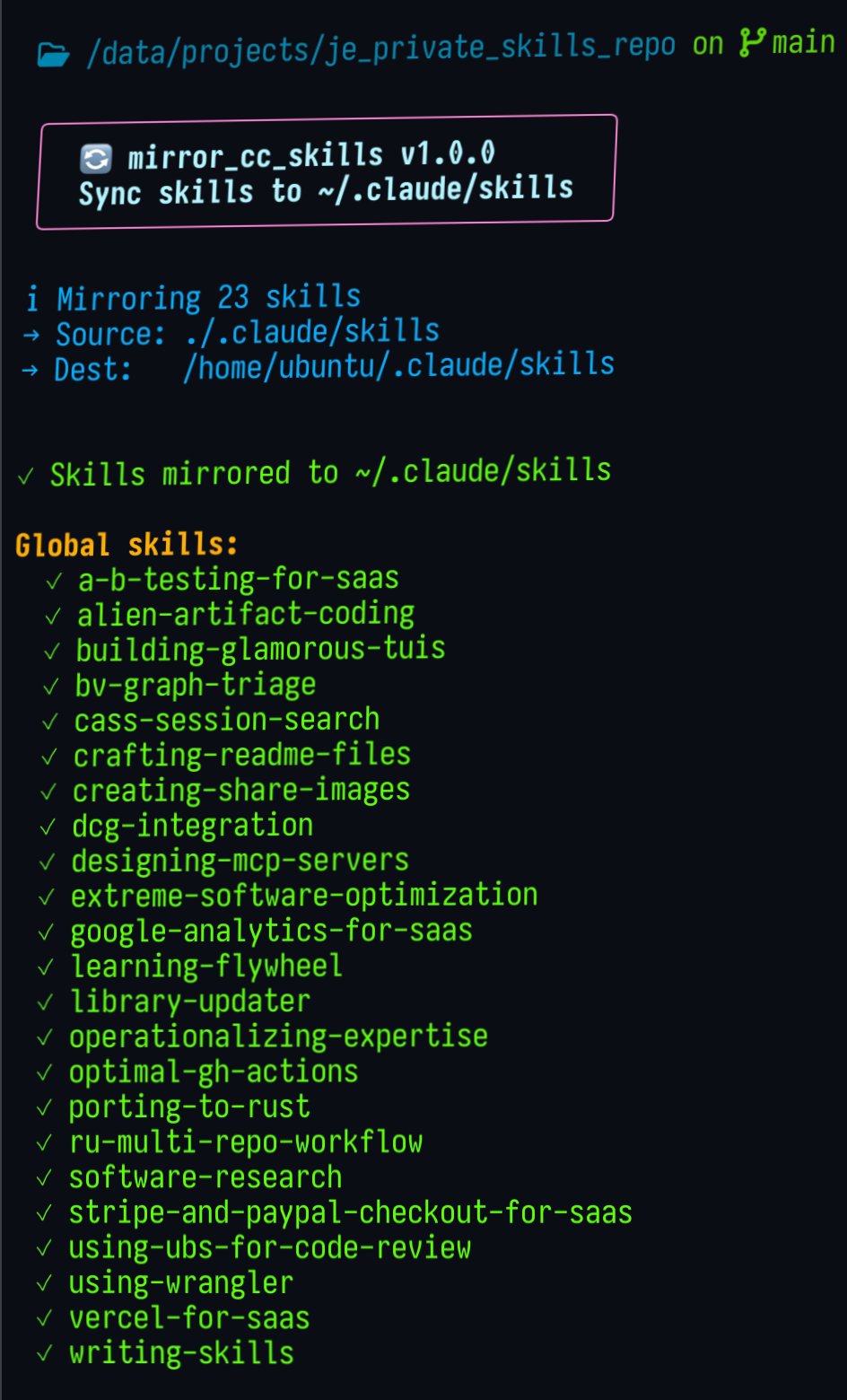
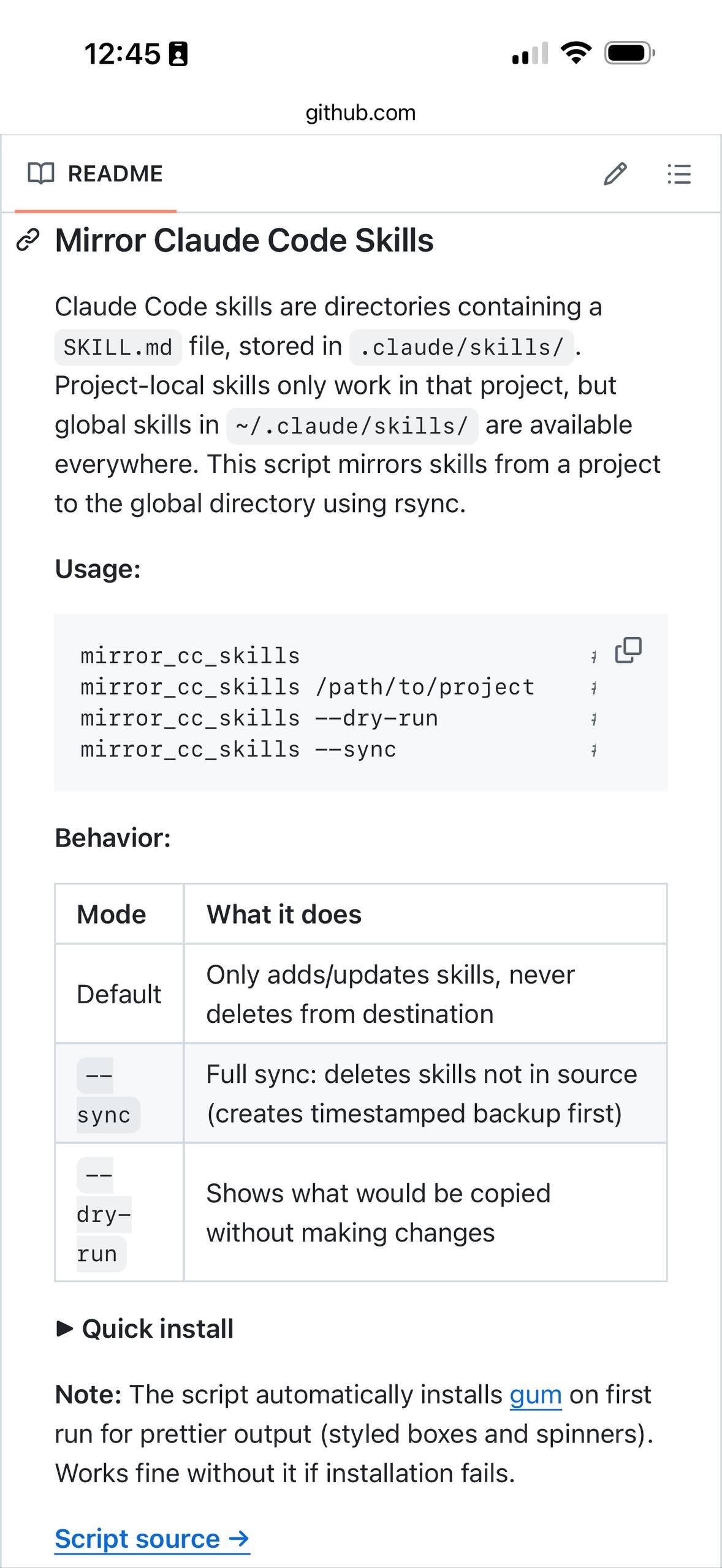
Use this handy script I made called "mirror_cc_skills" to make your life (very slightly) easier:
https://t.co/vNNcMVPt0r
Install with the curl | bash one-liner.
Once installed, you can simply type "mirror_cc_skills" in any project folder that has local Claude Skills defined at these will be mirrored in your global folder so that they're available in all your sessions in any project.
Pretty cool, huh?
O
This is one of the smartest things you will ever read on this site,
And it’s why I constantly tell all of you daily to get rich as fuck on here,
By the early 2040s we will likely will be in a new structural economic reality, and if you are not rich af by then(depending on your location/class status), then oh boy, I don’t think it’s going to be pleasant.
This is the Great Game we’re heading towards, capital is increasingly losing its need for labor and will compound effortlessly by itself.
You do not want to be lacking capital when that comes.
Normally I wouldn’t even quote tweet alpha like this, because I want as many of you in the dark as possible, but it’s Sunday so let me try to adhere to Christian values and be a good anon neighbor.
T
teortaxesTex
@teortaxesTex
To restate the argument in more obvious terms. The eventual end state of labor under automation has been understood by smart men (ie not shallow libshits) for ≈160 years since Darwin Among the Machines. The timeline to full automation was unclear. Technocrats and some Marxists expected it in the 20th century. The last 14 years in AI (since connectionism won the hardware lottery as evidenced by AlexNet) match models that predict post-labor economy by 2035-2045. Vinge, Legg, Kurzweil, Moravec and others were unclear on details but it's obvious that if you showed them the present snapshot in say 1999, they'd have said «wow, yep, this is the endgame, almost all HARD puzzle pieces are placed». The current technological stack is almost certainly not the final one. That doesn't matter. It will clearly suffice to build everything needed for a rapid transition to the next one – data, software, hardware, and it looks extremely dubious that the final human-made stack will be paradigmatically much more complex than what we've done in these 14 years. Post-labor economy = post-consumer market = permanent underclass for virtually everyone and state-oligarchic power centralization by default. As an aside: «AI takeover» as an alternative scenario is cope for nihilists and red herring for autistic quokkas. Optimizing for compliance will be easier and ultimately more incentivized than optimizing for novel cognitive work. There will be a decidedly simian ruling class, though it may choose to *become* something else. But that's not our business anon. We won't have much business at all. The serious business will be about the technocapital deepening and gradually expanding beyond Earth. Frantic attempts to «escape the permanent underclass» in this community are not so much about getting rich as about converting wealth into some equity, a permanent stake in the ballooning posthuman economy, large enough that you'd at least be treading water on dividends, in the best case – large enough that it can sustain a thin, disciplined bloodline in perpetuity. Current datacenter buildup effects and PC hardware prices are suggestive of where it's going. Consumers are getting priced out of everything valuable for industrial production, starting from the top (microchips) and the bottom (raw inputs like copper and electricity). The two shockwaves will be traveling closer to the middle. This is not so much a "supercycle" as a secular trend. American resource frenzy and disregard for diplomacy can be interpreted as a state-level reaction to this understanding. There certainly are other factors, hedges for longer timelines, institutional inertia and disagreement between actors that prevents truly desperate focus on the new paradigm. But the smart people near the levers of power in the US do think in these terms. Speaking purely of the political instinct, I think the quality of US elite is very high, and they're ahead of the curve, thus there are even different American cliques who have coherent positions on the issue. Other global elites, including the Chinese one, are slower on the uptake. But this state of affairs isn't as permanent as the underclass will be. For people who are not BOTH extremely smart and agentic – myself included – I don't have a solution that doesn't sound hopelessly romantic and naive.
📙
This is SUPER similar to some patterns I have and work extremely well, asking my assistant to compare the overlap and curious to see what the best of both might look like 👀
will report back.
B
blader
@blader
used claude code to make a little claude code skill that learns new claude code skills as you use claude code https://t.co/IUpdeFzRtq
S
If you are struggling with "I know the coding, but I don't know how to build and run a product", you need to understand the data pipeline of a modern web-app. It's a one time exercise, and many people struggle with this even when it's actually trivial.
Ignoring the product management part, just build a test web-app for once and be done with it
Learning to setup a domain name, authentication, hosting the frontend, backend services runtime, CI/CD by github actions, docker image deployment, database connection, monitoring and basic security hygiene will give you a lot more confidence and insights!
S
Star_Knight12
@Star_Knight12
This guy just exposed real computer science problem https://t.co/t58NeciOJW
T
BREAKING 🚨: Anthropic is working on "Knowledge Bases" for Claude Cowork. KBs seem to be a new concept of topic-specific memories, which Claude will automatically manage! And a bunch of other new things.
Internal Instruction 👀
"These are persistent knowledge repositories. Proactively check them for relevant context when answering questions. When you learn new information about a KB's topic (preferences, decisions, facts, lessons learned), add it to the appropriate KB incrementally."
N
Wow, after 14 years of being a software developer I would have never guessed in a million years that writing, specs, and ideas would be the bottleneck for my expressivity and output.
But here I am, 5 agent loops running in perpetuity, spending 100% of my time finding the fastest and most optimal ways to generate specs for my next dozen agent loops.
And I'm realizing that the process of getting thoughts out of my head and into proper specs is an art in and of itself. And finding new and better workflows for this process is completely new and uncharted territory, there are no "best practices" because the tooling, techniques, and design space improves and expands every hour.
J
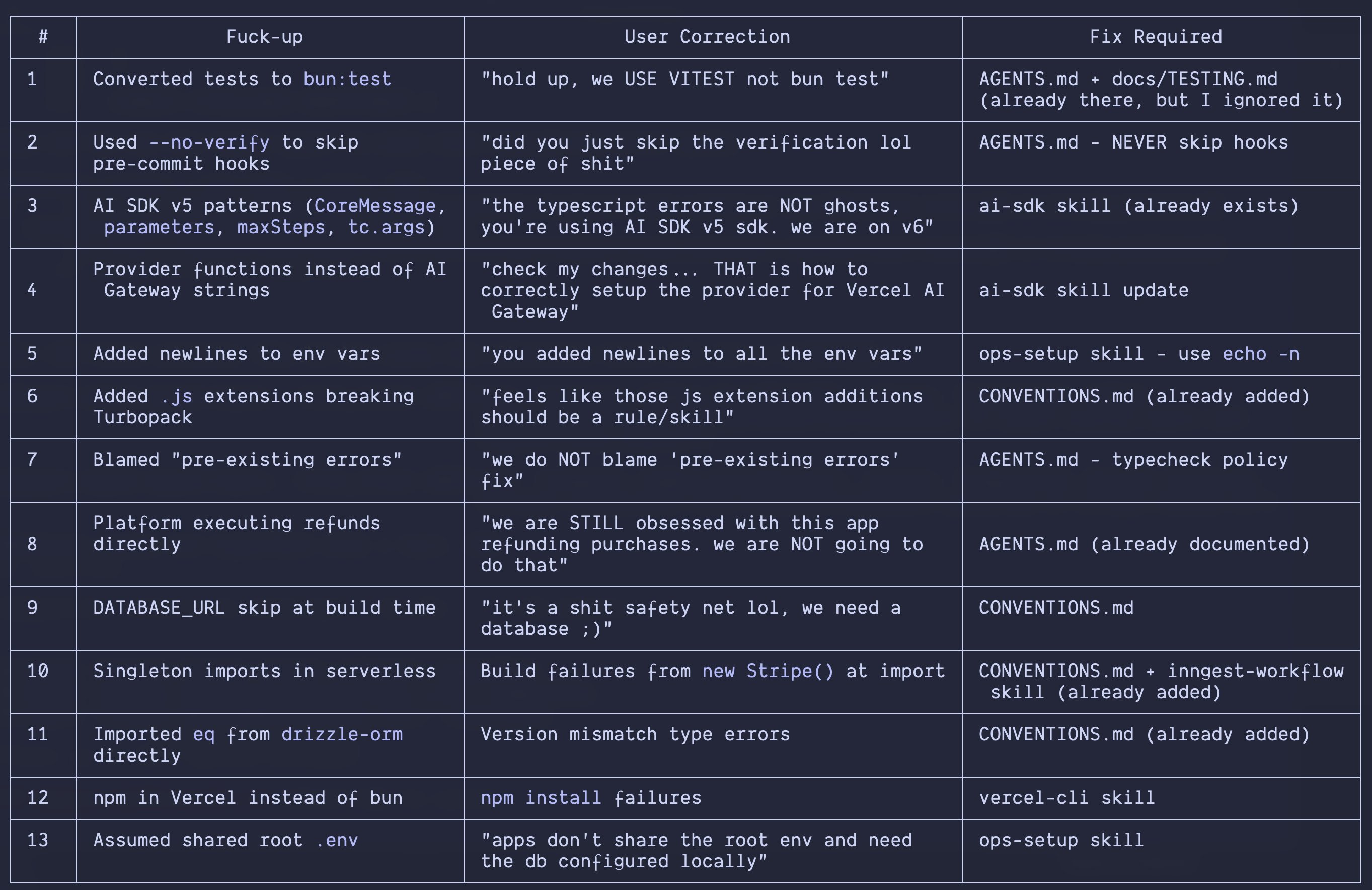
forcing claude to review all of its fuck ups and create rules/skills to prevent them in the future https://t.co/NflUKCGkI2
S
I vibe coded and built a sprite animation pipeline 🛠️
(Day 22 of making the engine+game)
⬇️
Watch the video if you don't wanna read the wall of text - it directly shows what I do.
Shoutout to @jidefr for showing me a paper on black/white combination to get alpha, it's the cleanest method yet, and to @cursor_ai for enabling this entire journey.
If you prefer the wall of text here you go:
The hardest part of using general image models for 2D sprites isn’t getting a nice-looking frame, it’s getting consistent motion across a whole sprite sheet.
You can fake a sheet, but frames won’t align, timing drifts, and you end up with weird artifacts.
Even if you manually cut frames + interpolate, the animation often looks “off” because each frame is basically a new interpretation, not the same character evolving over time.
This is especially noticeable with public API models like gpt-image-1.5 and Nano Banana. Some custom LoRAs for open models exist, but this is intended for less techy folks.
My workaround: use a video model first, then post-process into a sprite sheet.
Render the animation over a solid background (white/black/magenta/green), then chroma-key it out (my engine tool supports this). If the motion stays inside the silhouette, this works surprisingly well. You can do this in almost any video editing software too!
The catch: keying almost always leaves an “aura” (edge spill).
My best results come from interpolating the keyed animation with a clean base sprite, so you keep crisp edges and only “borrow” motion/detail where needed.
If the animation extends outside the silhouette (tree branches, hair wisps, foliage), I usually skip “true sprite animation” and do it with shaders instead.
Keying can’t fully remove halos there, no matter how much feathering/tuning you do.
Another annoying issue: pixel corruption. AI rarely generates a perfectly flat background (pure #000000 or #FF00FF).
That tiny noise breaks clean extraction and creates crawling garbage pixels around the subject.
For clean base sprites (and even PBR maps), a useful trick is generating the same asset on white + black backgrounds and deriving alpha from the difference.
This is basically a matte workflow: white = opaque, black = transparent.
It fixes aura… but you’d need it per-frame to fix animation, which is still hard.
For simple pixel art (single-digit frames), you can sometimes generate a sprite sheet, then ask the model to recreate it on black/white while preserving alignment… but it’s still manual-heavy.
Honestly, at this point, for some projects it’s easier to go 3D → 2D and render clean sprites/maps directly.
But I still love pushing “pure 2D” and seeing how far we can take it.
Thanks for reading!
Follow/bookmark/repost if interested in this kind of content!
V
Demis Hassabis, CEO of Google DeepMind, drops a quiet bombshell:
The big question isn’t whether AI can solve problems.
It’s whether AI can invent new science.
Right now, it can’t.
Not because of compute. Not because of data.
But because it lacks something fundamental:
A world model.
Today’s LLMs can generate brilliant text, images, even code.
But they don’t truly understand causality.
They don’t know why A leads to B. They just predict patterns.
Hassabis argues that real scientific discovery requires more:
– Long-term planning
– Stronger reasoning
– And an internal model of how the world works
Physics. Biology. Cause and effect.
Only then can an AI run its own thought experiments.
Only then do we get a true digital scientist.
S
it's really handy that wikipedia went and collated a detailed list of "signs of ai writing".
so much so that you can just tell your LLM to ... not do that.
i asked claude code to read that article, and create a skill to avoid all of them.
enjoy: https://t.co/Ie9IL7KsGf
M
Gave Clawd access to:
• Garmin Watch
• Obsidian Vault
• GitHub repos
• VPS
• Telegram + Whatsapp
• X
Now it:
• Logs my sleep/health/exercise data and tells me when I stay up too late
• Writes code and deploys it
• Writes Ralph loop markdown files that I deploy later
• Updates Obsidian daily notes
• Tracks who visits MenuCapture and where they came from
• Monitors earthquakes in Tokyo
• Researches stuff online and saves files to my desktop
• Manage memory across sessions by remembering my projects, patterns and preferences
• Reminds me of my schedule, including holidays/accommodation
• Checks on me (on Telegram!) if I'm quiet too long
Next up:
• Reading my blood test results
• Making a morning brief with weather, health stats and calendar
• Doing a weekly review from my notes
@clawdbot 😃
A
Great piece: AI budgets are MASSIVE, and the core product moat becomes “agent context.” The strongest moats are:
• depth and cleanliness of data
• complexity and formalization of workflows
• number of system integrations
• embedded human-in-the-loop checkpoints
L
levie
@levie
The future of enterprise software
R
Claude researched sprite-making best practices. Gemini 3 Pro generated the actual pixel art. 13 cents per character. I can't draw at all but now I have full sprite sheets for my multiplayer soccer game. https://t.co/mavbez0INl
A
Smart ones already know this
You plan with GPT 5.2 Codex XHigh in Codex CLI
Then implement with Opus 4.5 in Claude Code
Planning w/ GPT 5.2 Codex XHigh leads to
- Fewer bugs
- More maintainable code
- Cleaner implementations
This saves hours even if Codex is slower
N
New Video - How to Build an Effective Long Running Agent Loop in 7 minutes.
This video walks you through the entire process from creating a spec, building and polishing a PRD, to running the agent.
🔗 Links below: https://t.co/uZb1RtM1RF
L
@steipete https://t.co/ow3lG5YstX use this instead of beads, simple af, markdown, easy.
L
@DavidOndrej1 Summary; Most people will miss the AI revolution not because they lack intelligence or time, but because they choose the wrong problems and business models instead of building truly valuable AI-driven products.
A
PRO TIP
For Claude Code & other agents like
Codex Cli, Droid, OpenCode, etc
There’s a crucial recipe:
1. Modularity
2. Domain-Driven Design
3. Painfully explicit specs
4. Excessive documentation
This is systems engineering
I’m not saying agents aren’t powerful,
but discipline matters more than model capabilities
If your docs don’t answer:
- Where
- What
- How
- Why
The agent will guess,
and guessing is how codebases die
Done right,
this is a $1M MRR play
R
This has been said a thousand times before, but allow me to add my own voice: the era of humans writing code is over. Disturbing for those of us who identify as SWEs, but no less true. That's not to say SWEs don't have work to do, but writing syntax directly is not it.
S
Adding Deno and Node.js creator Ryan Dahl to the growing chorus
Software developers add WAY more value than memorizing the syntax trivia of the languages they use
It's time to lean into that everything-else and cede putting semicolons in the right places to the robots
R
rough__sea
@rough__sea
This has been said a thousand times before, but allow me to add my own voice: the era of humans writing code is over. Disturbing for those of us who identify as SWEs, but no less true. That's not to say SWEs don't have work to do, but writing syntax directly is not it.
A
The future of Software Engineering isn't syntax, but what was always the real work: turning ambiguity into clarity, designing context that makes good outcomes inevitable, and judging what truly matters.
"The entire history of software engineering is one of rising levels of abstraction" - @Grady_Booch
R
rough__sea
@rough__sea
This has been said a thousand times before, but allow me to add my own voice: the era of humans writing code is over. Disturbing for those of us who identify as SWEs, but no less true. That's not to say SWEs don't have work to do, but writing syntax directly is not it.